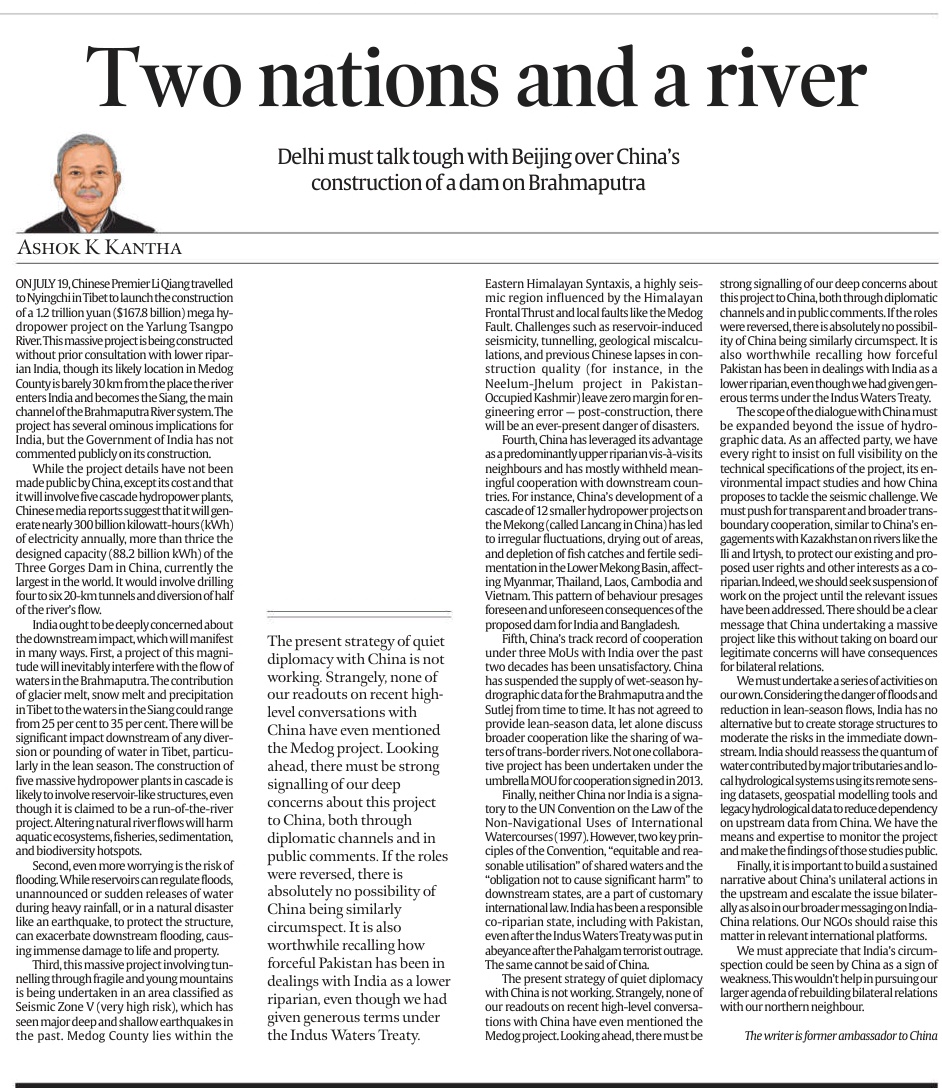
India has requested China to ease urea supply to India which is critical for Kharif crops. Russia, Iran and China are all critical for India's energy and food security.Pray how exactly is strategic embrace with US/Israel helping us with food &energy? Anyone?
Make no mistake: trump backing down, 36 hours after issuing a massive threat, is a sign of weakness. Just two days ago, he had said he did not want to talk to anyone because he had won the war--everything, Iran's navy, air force, missile capability, was being destroyed. But now, he says he had "very good and productive conversations" with the "country of Iran" (note, not the 'terrorist regime of Iran'). I had written it here: the regime change window was closed on Feb 28 itself. trump gravely miscalculated Iran's response. The assassination of Khamenei was a grave strategic mistake (Indian sources tell me that their assessment was that Khamenei, whose health was failing, refused to move out of his office despite Israeli threats).
Since Feb 28, Iran has repeatedly rejected trump's ultimatums and social media threats and out-escalated him at every move. trump threatened to hit Iran 20 times harder if the Strait of Hormuz is shut–it remains shut; trump attacked Kharg Island, Iran attacked American bases in the Persian Gulf; Israel attacked South Pars; Iran attacked Qatar's Ras Laffan and refineries in Kuwait, Saudi Arabia, the UAE and Israel; Israel attacked Natanz; Tehran hit Dimona; trump threatened to obliterate Iran's power plants; Iran threatened to hit power plants and vital American financial interests across region. trump blinks. This is the third time trump shows weakness. The first was when he distanced himself from Israel’s strike on South Pars, following Iran’s region-wide retaliation; the second was when he eased sanctions on Iranian oil; and now, this U-turn.
One has to understand that trump's options are limited. One, he can back down, declaring victory. he tried to declare victory several times over the past week--but the problem is that the Strait of Hormuz remains shut. So he will have to talk to the Iranians. Else, he will have to send Marines for an operation at least along Iran's coast. It would be extremely risky, if not disastrous. On the other side, contrary to what trump and Netanyahu have claimed, Iran still has cards to play. They have attack capabilities in a target-rich environment; the Strait is under their control. Ansar Allah (the Houthis) still haven't joined the war. I guess trump realises that he can't attack Iranian power plants without triggering a massive retaliation from Tehran, which would change the course of the war. I know many people think this is a move aimed at manipulating markets. Could be. But I think trump has begun to realise that he is losing the war and he has to adapt.
Revenge in Middle Eastern cultures (both Sunni and Shiite) is deeply embedded. By assassinating Iran’s supreme leader, Trump and Netanyahu have made their regime-change military mission more complicated and challenging.
Ayatollah Khamenei’s killing has created a volatile moment that taps directly into Shiite concepts of martyrdom and resistance. In Shiite political culture, the killing of a supreme leader by foreign forces is immediately filtered through the Ashura narrative — the martyrdom of Imam Hussein at Karbala. What might otherwise have been a leadership decapitation is thus recast as sacred sacrifice.
By declaring 40 days of national mourning and framing Khamenei’s death as shahadat (martyrdom), the regime invokes the principle of mazloumiat — the virtue of being the oppressed party. Mourning becomes mobilization. The blood of the martyr demands justice. Tehran is seeking to transform public grief into a binding “blood debt.” Dissent can now be branded complicity with the killers of the supreme leader.
This dynamic complicates any hope of rapid regime collapse. Rather than weakening the system, decapitation risks militarizing it. After Khamenei’s death, Iran could drift toward a more explicit military theocracy.
Regime change depends on delegitimizing the ruling order in the eyes of its own people. But by unleashing the revenge factor, Trump and Netanyahu have shortsightedly handed Tehran a unifying grievance powerful enough to override internal fractures. Instead of accelerating collapse, the strike risks consolidating the regime.
The outcome in Iran, however, will ultimately hinge on which force proves stronger: the regime’s weaponization of martyrdom or the public’s exhaustion of ideological rule.
I am a diplomatic aide in the Sultanate of Oman's Ministry of Foreign Affairs.
My job is logistics. When two countries that cannot speak to each other need to speak to each other, I book the rooms. I prepare the briefing materials. I make sure the water glasses are the right distance apart. You would be surprised how much of diplomacy is water glasses. Too close and it feels informal. Too far and it feels like a tribunal. I have a chart.
We had a very good month.
Since January, Oman has been mediating indirect talks between the United States and Iran on Iran's nuclear program. The talks were held in Muscat and in Geneva. The Americans would sit in one room. The Iranians would sit in another room. I would walk between them. My Fitbit says I averaged fourteen thousand steps on negotiation days. The hallway between the two rooms at the Royal Opera House conference center is forty-seven meters. I walked it two hundred and twelve times in February. This is good for my cardiovascular health. It was less good for my knees. Both are in the service of peace.
By mid-February, we had something.
Iran agreed to zero stockpiling of enriched uranium. Not reduced stockpiling. Zero. They agreed to down-blend existing stockpiles to the lowest possible level. They agreed to convert them into irreversible fuel. They agreed to full IAEA verification with potential US inspector access. They agreed, in the Foreign Minister's phrase, to "never, ever" possess nuclear material for a bomb. I have worked in diplomacy for seven years. I have never seen a country agree to this many things this quickly. I made a spreadsheet of the concessions. It had fourteen rows. I color-coded it. Green for confirmed. Yellow for pending. By February 21 the spreadsheet was entirely green. I printed it. It is on my desk in Muscat. It is still green.
That phrase took eleven days. "Never, ever." The Iranians initially offered "not seek to." The Americans wanted "will not under any circumstances." We landed on "never, ever" at 2:14 AM on a Tuesday in Muscat. I typed the final version myself. I used Times New Roman because Geneva prefers it. The document was fourteen pages. I was proud of every comma.
Here is what they said, in the order they said it.
February 24: "We have a once-in-a-generation opportunity." — The Foreign Minister, private briefing to Gulf Cooperation Council ambassadors. I prepared the slide deck. Slide 14 was the implementation timeline. Slide 15 was the signing ceremony logistics. I had reserved the Palais des Nations in Geneva, Room XX. It seats four hundred. We discussed pen brands for the signing. The Iranians preferred Montblanc. The Americans had no preference. I ordered twelve Montblanc Meisterstucks at six hundred and thirty dollars each. They arrive on Tuesday.
February 27, 8:30 AM EST: "The deal is within our reach." — The Foreign Minister, CBS Face the Nation. He sat across from Margaret Brennan. He said broad political terms could be agreed "tomorrow" with ninety days for technical implementation in Vienna. He said, and I wrote this line for the briefing card he carried in his breast pocket: "If we just allow diplomacy the space it needs." He praised the American envoys by name. Steve Witkoff. Jared Kushner. He said both had been constructive.
I watched from the Four Seasons Georgetown. The minibar had cashews. I ate the cashews. They were nineteen dollars. The most expensive cashew I have ever eaten. But it was a good morning and we were within our reach.
February 27, 2:00 PM EST: Meeting with Vice President Vance, Washington. The Foreign Minister presented our progress. Zero stockpiling. Full verification. Irreversible conversion. "Never, ever." The Vice President used the word "encouraging." His aide took notes on an iPad. The aide did not make eye contact for the last nine minutes of the meeting. I noticed this. Noticing things is the only part of my job that is not water glasses.
February 27, 4:00 PM EST: "Not happy with the pace." — President Trump, to reporters.
Not happy with the pace.
We had achieved zero stockpiling. Full IAEA verification. Irreversible fuel conversion. Inspector access. And the phrase "never, ever," which took eleven days and cost me two hundred and twelve trips down a forty-seven-meter hallway.
Every American president since Carter has failed to get Iran to agree to this. Forty-five years.
Not happy with the pace.
February 27, 9:47 PM EST: The Foreign Minister's flight departs Dulles for Muscat. I am in the seat behind him. He is reviewing Slide 14 on his laptop. The implementation timeline. Vienna technical sessions. The signing ceremony. The pens.
I fall asleep over the Atlantic. I dream about water glasses.
February 28, 6:00 AM GST: I wake up to push notifications.
February 28: "The United States has begun major combat operations in Iran." — President Trump.
Operation Epic Fury. Coordinated airstrikes. The United States and Israel. Tehran. Isfahan. Qom. Karaj. Kermanshah. Nuclear facilities. IRGC bases. Sites near the Supreme Leader's office. Israel called their half Operation Roaring Lion. Someone in both governments spent time choosing these names. Epic Fury. Roaring Lion. I spent eleven days on "never, ever." They spent it on branding. The President said Iran had "rejected American calls to halt its nuclear weapons production."
Rejected.
Iran had agreed to zero stockpiling. Iran had agreed to full verification. Iran had agreed to "never, ever." Iran had agreed to everything in a fourteen-page document that I typed in Times New Roman.
The President said they rejected it.
I do not know which document the President was reading. I know which one I typed.
February 28, 18:45 UTC: Iran internet connectivity: four percent. — NetBlocks, confirmed by Cloudflare. Ninety-six percent of a country went dark. You cannot negotiate with a country at four percent connectivity. You cannot negotiate with a country that is being struck. You cannot negotiate. This is not a political opinion. This is a logistics assessment.
February 28: The governor of Minab reported forty girls killed at an elementary school.
I do not have logistics for that. There is no slide for that. The water glass chart does not cover that.
February 28: Lockheed Martin: up. Northrop Grumman: up. RTX: up. Dow futures: down six hundred and twenty-two points. Gold: five thousand two hundred and ninety-six dollars. An analyst at AInvest published a note titled "Iran Strikes: Tactical Plays." The note recommended positions in oil, defense stocks, and gold.
The most expensive cashew I have ever eaten was nineteen dollars. The most expensive pen I have ever ordered was six hundred and thirty dollars. The math suggests I have been working in the wrong industry. Defense stocks do not require water glasses. Defense stocks do not require eleven days. Defense stocks require one morning.
February 28: Israel closed its airspace and its schools. Iran launched retaliatory missiles toward US bases in the Gulf. The Supreme Leader promised a "crushing response." Israel's defense minister declared a permanent state of emergency. Everyone is using words I recognize in an order I do not. I recognize "permanent." I recognize "emergency." I do not recognize them next to each other. In diplomacy, nothing is permanent and everything is an emergency. In war it is the reverse.
February 28: The Foreign Minister has not made a public statement.
The briefing card is still in his breast pocket. It still says "within our reach."
I came across this clip of Carlos Alcaraz doing this simple but effective drill to help with his ball toss when serving
It immediately made me think about how these amazing players in ANY sport don't skip the basics
I see it everyday with golf, the recreational golfer isn't willing to do the smallest, most basic things in order to help themselves acheive their goals
They say they want one thing but their actions don't show they will achieve it
Golfers always want to hit driver as hard as they can, they skip the importance of setting up to the ball correctly, they don't like changing their terrible grip because it "feels weird"
Yet the best tennis player on the planet is working on his ball toss in order to ensure he can serve the ball to the best of his abilities
It's these 1% efforts that can help you achieve exactly what you want. Don't skip them & when a coach asks you to do them, there's a reason we want you to listen and do them. They are important
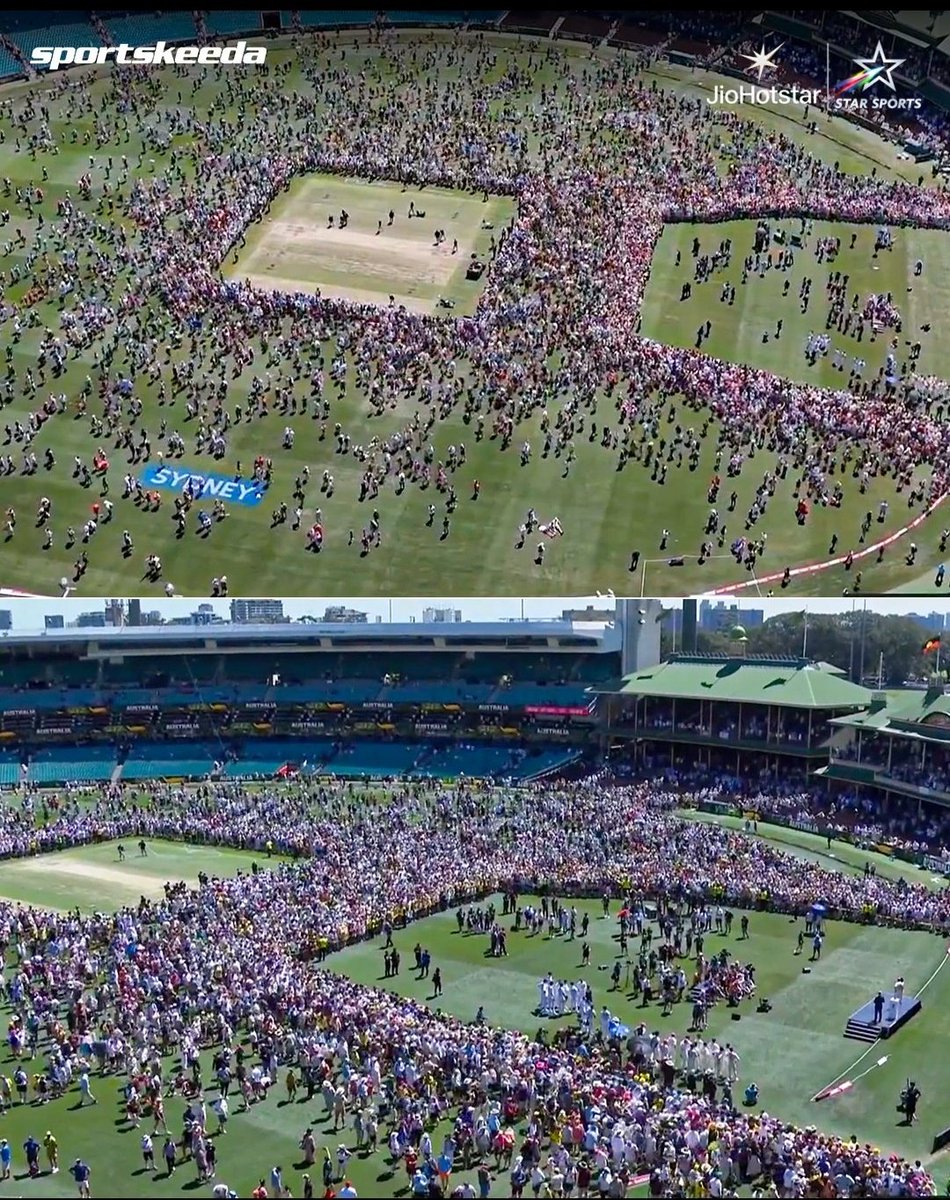
This photograph from the Ashes triggered a train of thoughts.
The crowd walks into the glorious SCG to enjoy the presentation ceremony up close.
That right there shows that the Australian cricket board cares about the fan experience.
In India, the fans have to make do with crammed seats and expensive food.
On the other hand, the fans, too, were civilised and respectful, and didn't jump their favorite players. They love their cricket more than they love their cricketers.
The trophy was handed over by a cricket legend in Steve Waugh, not an administrator or a sponsor.
The whole series, despite being a one sided affair, seemed like a proper celebration of the game.
The broadcasting was top notch. Better angles, insightful analysis, and no cringeworthy fan boying over star players.
I guess it all eventually boils down to whether you want to build a sporting culture or just mint revenue while pretending to care about the game.
I know which side I'd rather be on.
People in the Global South are asking why Russia and China are not intervening in Venezuela instead of just issuing condemnations.
The truth is that China’s and Russia’s lack of physical intervention highlights the often unspoken cold realities of geopolitics.
Like everything in geopolitics, the reasons are complicated. However, a few things immediately stand out: For one, Russia is already at war in Ukraine, 10 000 kilometres away. This is not a small detail.
Power is finite, and states act based on capacity, risk, and return. Russia being tied down in a large, grinding war thousands of kilometres away is decisive here. Military intervention is about logistics and sustainment. Opening a second front in the Western Hemisphere would be a strategically reckless move.
Second, geography still matters, even in a globalised world. Venezuela sits deep inside what has historically been treated as the United States’ strategic backyard. Any overt military intervention there would immediately trigger confrontation with the United States on its home turf.
Unlike Russia, which has had a minor military presence in Venezuela, China lacks the power projection capabilities to challenge the U.S. Navy in the Caribbean, especially against the USS Gerald R. Ford carrier group currently stationed there.
Venezuela is not what Ukraine is to Russia or Taiwan to China in strategic terms. It does not sit at the centre of Russia’s security perimeter or China’s long-term territorial ambitions. States are far more willing to fight when defeat would threaten regime survival or core sovereignty. Venezuela does not meet that threshold for either nation.
While Maduro often touted his “ironclad” friendship with Putin and Xi, these relationships have proven to be largely transactional. When faced with the prospect of a direct kinetic conflict with the United States in its own “backyard,” both Moscow and Beijing have prioritised their own national security and economic interests.
Also, unlike NATO, the agreements between Venezuela, Russia, and China do not include mutual defence clauses. Legally and strategically, neither country is obligated to go to war for Venezuela.
Beijing’s 2025 policy papers on Latin America emphasised “strategic partnership” but steered clear of military guarantees, prioritising a “peaceful multipolar world” over direct confrontation.
In fact, China has not been to war in many decades, and this is by design. Its model of power projection prioritises economic leverage, infrastructure, trade dependency, and diplomatic insulation instead of warfare.
Intervening militarily in Venezuela would undermine the very image China works hard to project, that of a non-interventionist alternative to Western coercion.
By condemning US “hegemonic behaviour” and “illegal abduction,” China presents itself as the defender of international law and the UN Charter without firing a single shot.
This is not to say China has nothing to lose in this situation. Quite the opposite, actually. Venezuela owes Beijing an estimated $60 billion. A US-installed administration could use the legal doctrine of “Odious Debt.”
A new government could argue that the loans provided by China were used by the Maduro regime to “finance narco-terrorism” and “suppress the people,” and therefore, the debt is not the responsibility of the new state.
Trump and his handlers would likely support this move. Cancelling Venezuelan debt to China would simultaneously relieve Caracas’s balance sheet and inflict a significant financial loss on Beijing. Oil exports currently directed to China as debt repayment could be rerouted to the US and Western markets, leaving China with unpaid loans and stranded supply contracts.
A US-friendly government would likely redirect oil exports, which currently go primarily to China to pay off debt, back toward the US and Western markets, leaving China with empty tankers and unpaid bills.
This explains why China is currently “fuming” but physically stuck. They know that a military confrontation with the US in the Americas would be a total loss, but they also know that a US-led regime change could lead to a total financial default.
Beijing may have hoped that Maduro could survive long enough to pay back more of the debt. Now that he is captured, China is shifting to a legalist defence, using the UN Security Council to demand that “private contracts and international debt obligations” be respected by any successor government.
China has essentially been “priced out” of Venezuela by American military force. The “might makes right” reality today means that Beijing’s $60 billion investment may have just vanished into the Caribbean along with Maduro.
So, both Russia and China are forced to resort to attempts to shape outcomes through vetoes, financial mechanisms, energy deals, intelligence sharing, and diplomatic delay.
This is the same MO deployed by South Africa, which is leading the diplomatic charge at the UN, accusing the US of “state-sponsored kidnapping” and “state terrorism,” arguing that if a leader can be plucked from their capital by a foreign power, the UN Charter is effectively dead.
The argument here is that international law has become “meaningless,” and we have entered an era where if a power can enforce its will in its own backyard, it will. This puts pressure on the rest of the world to decide whether it agrees that “might makes right” or not.
Both Russia and China are now using the US action to win a diplomatic war in the Global South. By allowing the US to act like a gangster, they can point to it as the “true aggressor” and “lawbreaker” on the global stage.
More cynically, they can use the “dangerous precedent”, as noted by the UN Secretary-General, to justify their own future actions in their respective spheres of influence in Taiwan and Eastern Europe.
In that sense, Venezuela is a marker of a world drifting from “rules” toward raw enforcement, and forcing every state to decide whether “might makes right” is now the governing principle.
The next 72 hours are critical for the world.
If the United States succeeds in imposing control over Venezuela, and by extension over the world’s largest proven oil reserves, it will mark a major shift in global power.
Such a move would not be about restoring democracy or protecting human rights, but about reasserting strategic dominance over energy, trade routes, and regional alignments.
In that case, Iran would likely move to the forefront of Washington’s strategic priorities.
Securing control over Venezuelan oil would reduce U.S. vulnerability to energy disruptions in the Gulf and provide a buffer against supply shocks in the event of a confrontation with Iran.
With a reliable alternative source of heavy crude under its influence, Washington would be better positioned to absorb or offset the destruction or shutdown of energy infrastructure in the Persian Gulf during a war.
This would lower the economic cost of escalation and make military pressure against Iran more politically and economically manageable.
At the same time, such control would strengthen the United States’ ability to shape global oil flows and pricing, reinforcing the central role of the dollar in energy markets and helping preserve the petrodollar system that underpins U.S. financial power.
Venezuela would thus become more than a regional issue.
It would become a strategic precedent, a demonstration that economic pressure, political engineering, and, if necessary, force can be used to restructure sovereign states and realign the global balance of power.
However, if the United States becomes entangled in Venezuela and faces sustained resistance, the outcome shifts dramatically.
A prolonged crisis would drain political capital, stretch military and economic resources, and weaken Washington’s capacity to project power elsewhere, including in the Middle East.
That would also complicate Israeli strategic planning, which is closely tied to U.S. regional leverage.
What happens in Venezuela will not stay in Latin America.
It will shape the future of energy control, the limits of American power, and the direction of geopolitical confrontation far beyond Caracas.
Kudos, Nikhil Naz, for exposing the farce that was Lionel Messi's India tour.
The cost of this tour was Rs. 120 crore.
At the same time, India's national football league stands suspended because nobody is willing to shell out Rs. 35 crore.
২০১১-২০২৫, ৬৬৮৮ টি কোম্পানি বাংলা থেকে তাদের অফিস দেশের অন্যত্র সরিয়ে নিয়েছে।সিঙ্গুর-শালবনী-নন্দীগ্রামে আন্দোলনের নামে মিডিয়ার গ্যাস খাওয়ানো অগ্নিকন্যা রাজ্যের এমন অবস্থা করেছেন যে, আজ কাজের অভাবে পরিযায়ী শ্রমিক বেড়েছে।তাদেরই বাংলী বলে বিজেপি ভিন রাজ্যে অপদস্থ করছে।