

@Aelthemplaer No I'm going to D for Signal Mountain in Tennessee
English
Psychic Necrosis
445 posts

@PsychicNecrosis
Memetic Biologist / Alles Aus Liebe Zu Ihr / A10

You just won a 2-week, all-expenses-paid vacation. But there’s a catch: you have to stay within one region the whole time. What are you picking?


Peter Thiel has temporarily relocated his family to Argentina, enrolled his children in school there, and bought property, partly due to Thiel’s concerns about the United States’ future, per NYT.

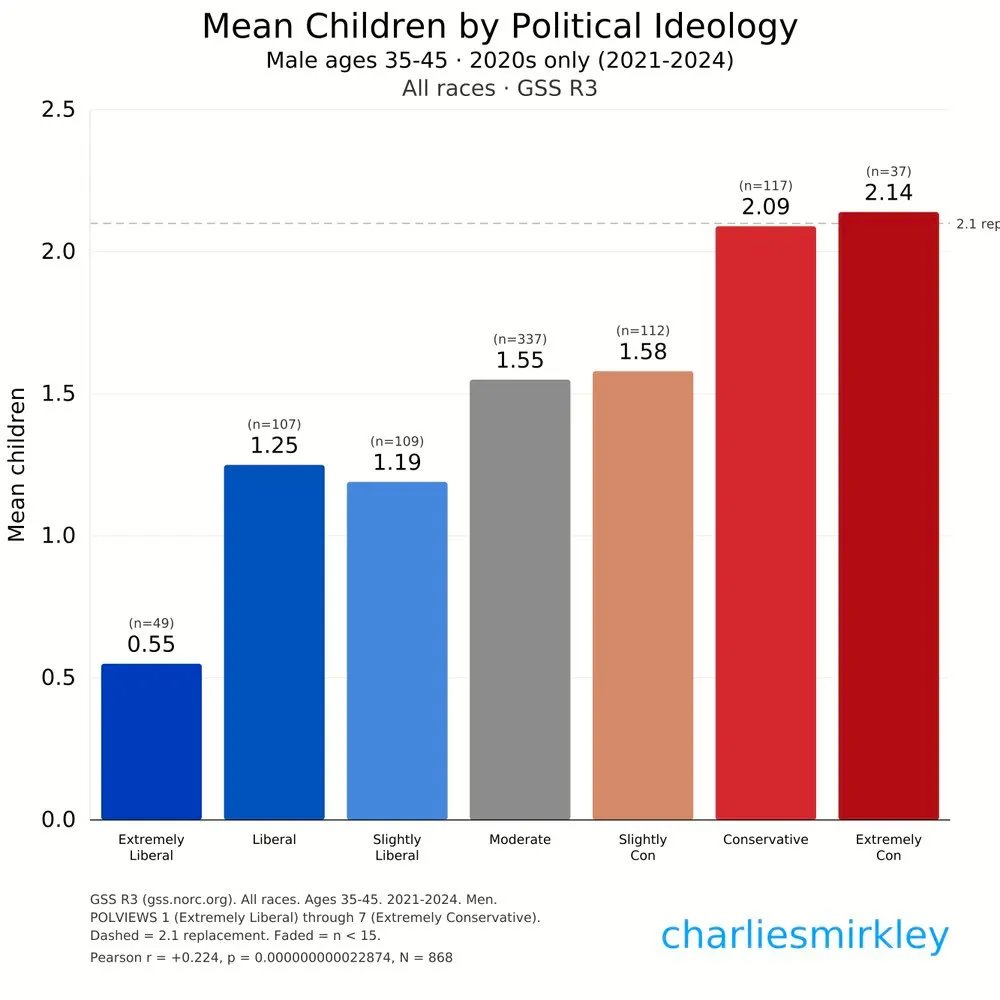
Birth update for the United States (50 states and DC) for April 2026 from CDC Wonder. This also includes updated numbers for March 2026, which resulted in NHW share for that month being revised upward from 50.71% to 50.80%.



Peter Thiel is cooking up a plan B for fleeing the United States and hunkering down in Argentina, which I hope is an indicator of how bad he think it’s going to get for the new right and how dramatically JD Vance has failed as a viable political vehicle for Thiel’s agenda




Throughout Christian civilizational history, as a matter of ordinary civic order, inheritance, household economy, officeholding, tax logic, social respectability, and political representation, the married household was usually treated as the normal civil unit. The basic pattern was this: Christendom did not usually imagine society as an aggregation of autonomous individuals. It imagined society as a hierarchy of households, estates, guilds, parishes, villages, towns, monasteries, and corporations. The stable household, headed by a married man, was therefore not merely private. It was a miniature polity. Marriage made a man more legible to the community because it marked him as a householder: economically invested, reproductively ordered, socially accountable, and capable of bearing civic responsibility. That meant the unmarried adult, especially the unmarried man who was not a cleric, monk, soldier, apprentice, servant, or dependent kin, could appear socially incomplete. He might not be legally enslaved or formally disenfranchised everywhere, but he often lacked the full standing that came from being a paterfamilias, burgess, property holder, guild master, parish officer, or head of household. In that sense, yes: bachelorhood was frequently treated as a lesser civic condition.

