Sabitlenmiş Tweet

Puffer Preconf
70 posts

@puffer_preconf
Puffer Preconf (by @puffer_finance) is a preconfirmation AVS on @eigencloud, enabling the speed and composability needed for rollups! 🚀
📖Glossary: Synchronous Composability Real-time interaction across L1 and L2, and between rollups, inside the same block. Two directions. Two mechanisms: • L1 to L2: Signal Service, same-slot message passing, no bridges • L2 to L2: shared Ethereum sequencing root, with state-aware gateways coordinating in the same slot Both require based sequencing and real-time proving to work. Puffer UniFi is built to make both possible: one execution environment across Ethereum-aligned rollups.
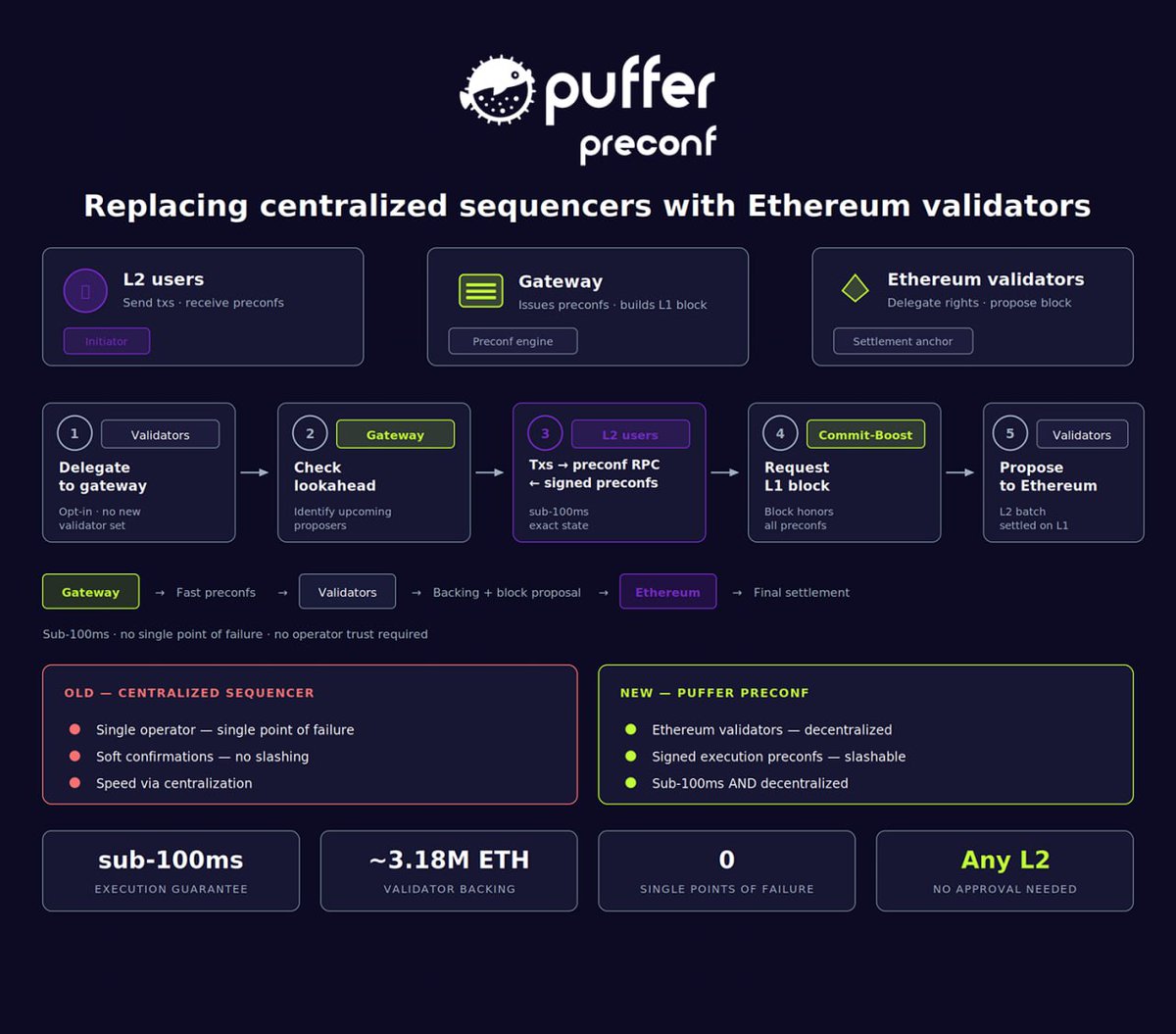
🏗️ Building UniFi #2: UniFi's Mission UniFi is what makes based appchains truly possible on Ethereum. UniFi is the first based rollup built on this stack - Puffer’s own proof of concept. But the stack is open: any project can spin up its own based appchain and inherit the same sequencing, proving, preconfirmation, and composability guarantees from day one. The focus is clear: enable synchronous composability across L1 <> L2 and L2 <> L2, so liquidity, contracts, and applications can coordinate without becoming isolated silos. Based rollups and based appchains should extend Ethereum, not fragment it. To make that possible, UniFi combines @Puffer_Preconf, a decentralized preconfirmation layer built around gateway delegation from upcoming proposers, targeting sub-10 ms transaction speeds while remaining anchored to Ethereum L1 validators. It also uses multi-TEE provers, with Intel TDX and AMD SEV supporting near real-time, trust-minimized block attestations, with ZK proving in the pipeline. The objective is practical: provide developers with a customizable execution environment on Ethereum where speed, composability, and economic alignment are built in from the start. 📖Learn more: docs-unifi.puffer.fi

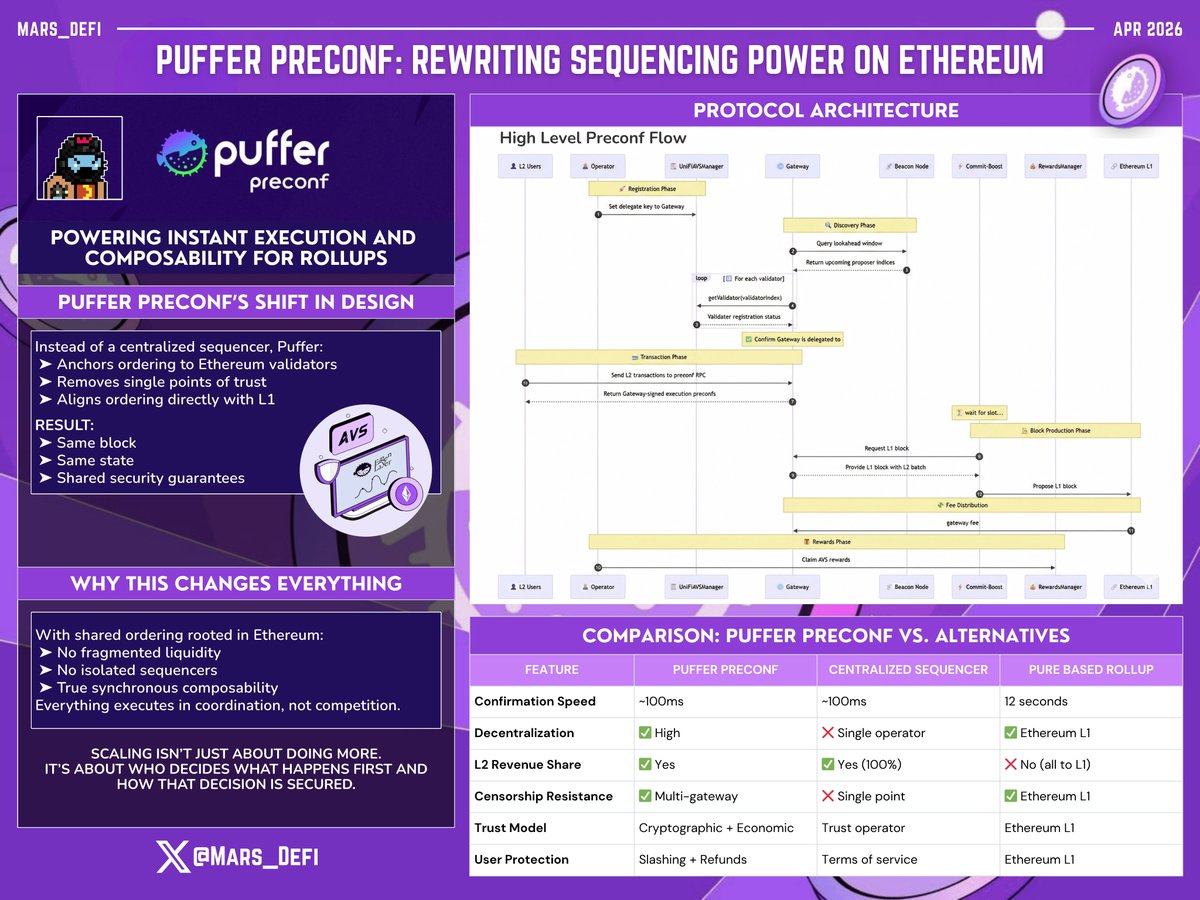
📖 Glossary: Sequencing On Puffer Preconf, sequencing is the authority to order L2 transactions during a specific slot window, held by Ethereum validators and delegated to gateways, determining how transactions execute before they are settled on Ethereum.

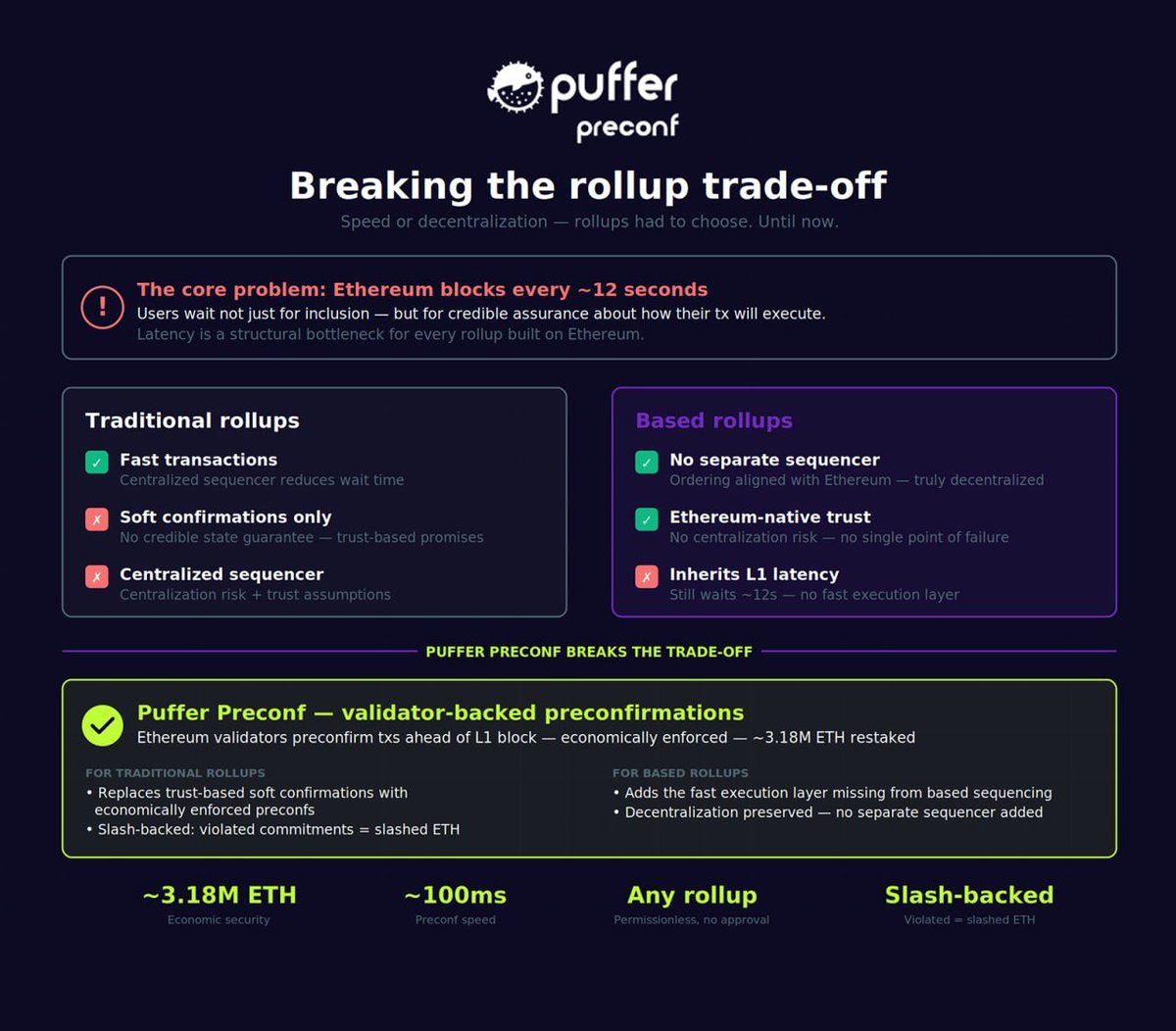
🏗️ Building UniFi #1: Programmable Money Programmable money is only powerful if it’s unified. Ethereum turned money into software. Instead of value just sitting in accounts, ETH and tokens can be used by smart contracts to lend, borrow, swap, collateralize, stream, and settle automatically. Ethereum turned money into software. Instead of value just sitting in accounts, ETH and tokens can be used by smart contracts to lend, borrow, swap, collateralize, stream, and settle automatically. The bottleneck is Ethereum L1 blockspace. As demand grows, L1 can’t run every app’s computation on-chain without gas fees spiking and confirmations slowing down. Rollups solved that by moving execution off-chain while still settling to Ethereum. But rollups also created a new problem: fragmentation. Apps and users spread across many L2s, liquidity gets siloed, and capital doesn’t flow back to L1 as a single shared pool. Bridges become the default UX. Ecosystems turn parallel. UniFi’s answer is based appchains plus native and based rollups that scale execution while staying composable with Ethereum. Appchains pay for L1 data (blobs), share revenue with validators via gateways, and still retain control over order flow. UniFi is for Programmable Money. 🐡