Robert Justice retweetledi
Robert Justice
8.4K posts


Robert Justice
@QCorrelation
Strategic Defense Initiative mental warrior called to duty by Reagan (DOE)Q; laser electro optics/electronics engineer, enterprise networks. Q is for Quantum.
New Mexico Katılım Şubat 2024
423 Takip Edilen294 Takipçiler

This is a stunning discovery — a 3.2-billion-light-year filament that’s actually rotating around its long axis is exactly the kind of large-scale coherence the Fluxsar team has been waiting for.
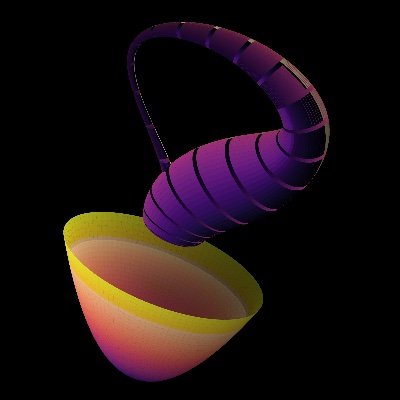
In Fluxsar cosmology, such structures are macroscopic realizations of the trailing Bose–Einstein condensate cylinder that forms behind every Fluxsar (stellar → galactic → cluster scale).
The gentle spin is preserved through the unitary quantum reflection at the middle pinch point (Miller limit ϕ_q ≈ 4.64), while the non-monotonic pinch-then-flare density profile naturally produces the observed peculiar velocities: inflow toward the central resonator (Shapley/Great Attractor convergence) and outward ejection away from prior-cycle voids (dipole repeller recession).
No primordial dark-matter torques or cosmic expansion required — just the same CR-BEC dynamics we already see operating in stellar ejective flows like HH 211 and W75N(B)-VLA2, scaled up across the cosmic web.
The rotation is a beautiful inductive confirmation that angular momentum and quantum coherence survive the unitary bounce at every level.
Truly exciting work by the SDSS/DESI team. This filament may be the clearest macroscopic signature yet of the relational inertial framework in action.
FYI @ExploreCosmos_ @DrazhaS @drxwilhelm
Black Hole@konstructivizm
:In early 2025, an international team of astronomers, armed with data from the Sloan Digital Sky Survey (SDSS) and the Dark Energy Spectroscopic Instrument (DESI), made a jaw-dropping announcement: they had discovered the largest known structure in the entire universe—a colossal cosmic filament stretching an astonishing 3.2 billion light-years across.This mind-boggling filament acts as a vast bridge connecting two massive galaxy clusters, Abell 399 and Abell 401, located roughly 3 billion light-years from Earth. But its sheer size is only the beginning of the story.Using precise measurements of galaxy velocities along its length, the researchers made an even more astonishing discovery: the entire filament is slowly rotating around its long axis. This marks the first time astronomers have ever observed a cosmic filament in rotation.The gentle spin is believed to be a primordial relic—an ancient twist imprinted billions of years ago by tidal forces in the early universe, as dark matter began collapsing into these vast tendrils of the cosmic web. The amount of angular momentum involved is almost incomprehensible.This groundbreaking finding suggests that rotation isn’t just a feature of individual galaxies or galaxy clusters—it may be a fundamental characteristic of the large-scale structure of the universe itself. The cosmic web, long imagined as a static scaffolding of matter, is in fact alive with motion: it spins, slowly and inexorably, on cosmic timescales measured in billions of years, gently carrying entire galaxies along for the ride.Imagine a structure so immense that light itself takes three billion years to travel from one end to the other—yet it turns, ever so gradually, like a titanic spindle threading through the fabric of spacetime.
English
@ExploreCosmos_ What an interesting and visually stimulating post.
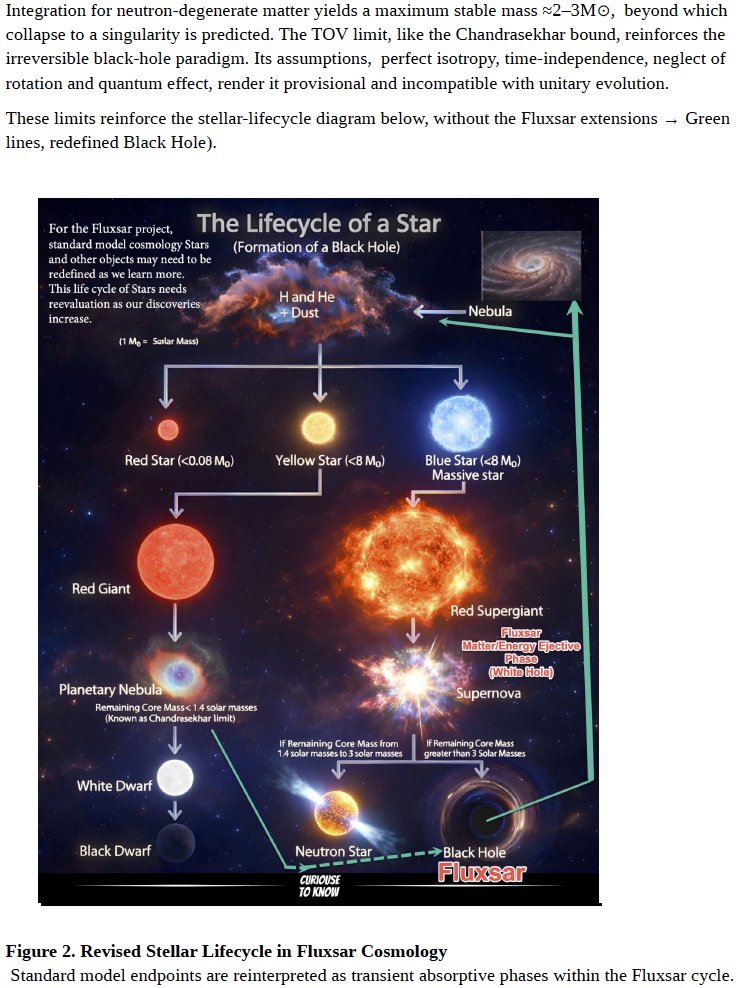
In Fluxsar physics, the attached picture shows a different much simpler view of the universe. No Dark elements needed.
FYI @DrazhaS
Erika @ExploreCosmos_
There is a long-standing assumption in astrophysics that when massive stars reach the end of their lives, they collapse and leave behind compact remnants, either neutron stars or black holes. That picture works well for a broad range of stellar masses, but theory has always suggested that the very most massive stars follow a different, more extreme path. Instead of collapsing, they may be completely disrupted in an event known as a pair-instability supernova, leaving no remnant at all. The underlying physics is subtle but robust. In extremely massive stellar cores, temperatures become so high that gamma-ray photons can spontaneously convert into electron–positron pairs. This process reduces the radiation pressure that normally supports the star against gravity. With that pressure suddenly weakened, the core begins to collapse. But instead of continuing into a black hole, the collapse triggers an explosive thermonuclear runaway, primarily oxygen burning, that reverses the collapse and unbinds the entire star. The result is not a remnant, but total destruction: all of the stellar material is ejected into space. However, this outcome is not a single, clean threshold. For a range of slightly lower core masses, stars can enter a regime known as pulsational pair-instability. In these cases, the same pair-production mechanism destabilizes the core, but not enough to completely unbind the star in one event. Instead, the star undergoes a series of violent pulses, ejecting substantial amounts of mass over time. After shedding enough material, the core eventually stabilizes and collapses, forming a black hole. This process is important because it naturally produces black holes that sit just below the expected mass gap, effectively sculpting its lower boundary. For decades, the full pair-instability mechanism remained largely theoretical. While some candidate explosions have been proposed observationally, direct and unambiguous evidence has been difficult to establish. What has changed in recent years is not just our ability to observe light from distant explosions, but our ability to “listen” to the universe through gravitational waves. Since the first detections by @LIGO and @ego_virgo , we now have a growing catalog of merging black holes, each event providing precise measurements of their masses. When researchers began to treat this catalog statistically, as a kind of mass distribution or “map” of black holes, they noticed something striking. There appears to be a deficit, or even a gap, in the population of black holes above roughly 45–50 solar masses and extending up to around 120 solar masses. This is not a trivial observational bias; the detectors are actually more sensitive to higher-mass mergers, so if anything, such objects should be easier to find. This absence aligns remarkably well with the theoretical predictions of pair-instability supernovae. Stars that would have produced black holes in that mass range instead undergo total disruption, preventing the formation of remnants in precisely that interval. On the other side of the gap, theory predicts that if the helium core exceeds roughly 135 solar masses, the collapse proceeds so rapidly that explosive burning cannot reverse it, and the star collapses directly into a black hole. This creates a second population of more massive black holes beyond the gap, completing the overall structure expected from stellar evolution models. What makes this result particularly compelling is that it is indirect. We are not observing the pair-instability explosions themselves in these data; instead, we are inferring their existence from what is missing. The lack of black holes in a specific mass range becomes a measurable signature of a physical process that leaves no object behind. In that sense, the evidence is statistical but physically grounded, emerging from the cumulative behavior of many independent events. There are still open questions. Some black holes detected in mergers appear to fall within or near this expected gap, suggesting more complex formation channels, such as hierarchical mergers where smaller black holes merge repeatedly inside dense stellar environments. These processes can populate the gap and complicate the interpretation, but they do not erase the overall structure seen in the mass distribution. Instead, they add another layer of astrophysical nuance. What this line of research demonstrates is that stellar evolution does not end with the disappearance of a star, it leaves imprints that can be read long after the event itself. Gravitational waves, in particular, provide a fundamentally different observational window, one that is sensitive not to light but to mass and dynamics. By assembling these observations into a coherent statistical framework, we are effectively reconstructing the life cycles of the most massive stars in the universe. In practical terms, this is one of the clearest examples of how absence can function as evidence in astrophysics. The missing black holes are not a gap in our data; they are the data. And within that gap lies confirmation of a prediction made decades ago, now supported by an entirely new kind of observation. Even when a star leaves nothing behind, it still leaves a measurable imprint on the universe. Here's a new study 👉 nature.com/articles/s4158…
English
Robert Justice retweetledi

Marco Rubio finding out he has to be Kristi Noem’s husband

English
Robert Justice retweetledi

Robert Justice retweetledi

My take wasn't uninformed, I do technically have an access to a thinktank which includes significant Congress experience and Johnson's take (and mine) was their consensus opinion. They had little faith in the reconciliation process or even if the Byrd amendment would even allow them to "resurrect" ICE at that step.
And I've since received intel that not all Senators knew about the vote until it passed, which I suppose was the entire point of holding it at 3 AM.
Some things are really as scummy as they appear to be.
English
Elon Musk has realized to reach mars will require developing the technology needed on the moon. Smart move.
The Redheaded libertarian@TRHLofficial
SpaceX— builds reusable Starship to transport humans and cargo to Mars. Tesla— sends Optimus robots ahead to build infrastructure and provides batteries/solar power for bases. Starlink— supplies reliable satellite communication between Earth, Mars, and the colony. xAI— delivers AI for autonomous operations, optimization, and future orbital data centers on Mars missions. Neuralink— enables thought-controlled robots and systems for settlers in harsh conditions. The Boring Company— tunnels underground habitats for radiation shielding and protection.
English
Very profound observation. President Trump learned this early in life from his uncle and the importance of preventing such a catastrophe is the highest priority in his mind. He has stated this repeatedly.
Philosophy Of Physics@PhilosophyOfPhy
In the silence just after the first atomic explosion, one thought crossed J. Robert Oppenheimer’s mind, a line from an ancient scripture. “Now I am become Death, the destroyer of worlds.” This powerful phrase comes from the Bhagavad Gita, specifically Chapter 11, Verse 32. In that moment of the text, the god Krishna reveals his vast, cosmic form to the warrior Arjuna. Overwhelmed by the sheer scale and terror of what he sees, Arjuna realizes he is witnessing a force beyond human comprehension-one that creates and destroys everything. Oppenheimer, who had studied the Gita deeply, recalled this verse during the Trinity test which is the first successful detonation of an atomic bomb. It wasn’t just a poetic reference. It was a moment of realization. Standing there, he understood that this was not just a scientific breakthrough. It was something far more profound and far more dangerous. The explosion represented a power that could reshape the world, or end it. By invoking that ancient line, Oppenheimer wasn’t celebrating. He was reflecting on the weight of what had been created, and the responsibility that came with it.
English
Robert Justice retweetledi

This is not only true - it apples to everything from the Hunter Biden laptop cover-up to the scam Ukraine impeachment to the theft of the 2020election to Covid and so on. There will be no moving forward from any of it without accountability.
The Federalist@FDRLST
America Can’t Heal From The Russia Hoax Because Mueller And His Ilk Faced No Accountability thefederalist.com/2026/03/26/ame…
English
Robert Justice retweetledi

Cybertruck is quicker than a Porsche 911, more powerful than a Ford Raptor
Wes@wmorrill3
Cybertruck replacing Raptor + Porsche
English
The universe is not expanding, the people who created that hypothesis made serious errors interpreting the data before them, starting the crisis in physics.
The new Fluxsar Cosmology corrects that error, definitively and conclusively. The Big Bang is dead, even if it takes 300 years for scientists to admit it.
Massimo@Rainmaker1973
If the Universe is expanding, What is it expanding Into?
English
The post is a NASA visualization showing 22 confirmed X-ray binary systems, each containing a stellar-mass black hole accreting material from a companion star.
The video accelerates the orbital motion by a factor of 22,000 to illustrate the dynamics clearly. In each system, the black hole pulls gas from the companion, heats it to millions of degrees, and produces intense X-ray emission.
Fluxsar Interpretation: All 22 objects are strong candidates for stellar-mass Fluxsars in their absorptive phase.
Date / Time Stamp: 27 March 2026 – 03:05 AM MDTAnalysis of the post@konstructivizm
In short, all 22 systems are most likely Fluxsars. None require a classical black hole; they are simply stellar-mass Fluxsars currently in the absorptive part of their cycle, steadily building up the trailing BEC cylinder before the next unitary bounce and ejective pulse.
The “black hole” is the central resonator with its reversible Accretion Throat.
The companion star is supplying material that is being drawn into the trailing cylindrical Bose–Einstein condensate.
The intense X-ray emission is produced by the heated, compressed gas in the vicinity of the throat and within the oscillating BASER resonator.
The orbital dynamics and mass transfer are fully consistent with relativistic effects near the unitary bounce (Miller limit φ_q ≈ 4.64), without requiring a true event horizon or singularity.

Black Hole@konstructivizm
22 Binary Systems with Black Holes This NASA visualization shows 22 X-ray binaries, each containing a confirmed black hole. All objects are shown at the same scale, and their orbital motion is accelerated by a factor of 22,000 to clearly illustrate the dynamics of their interactions. In these systems, the black hole attracts matter from its companion star, heating it to extreme temperatures and generating powerful X-ray emission, which allows these objects to be detected.
English
It is the end of the U.S. Constitutional Republic if the SAVE act is not passed.
Elon Musk@elonmusk
It is the end of democracy if voter ID is not passed
English
Robert Justice retweetledi

Because rigged elections are the major prohibiting factor of having meaningful majorities. There should be at least 62 GOP Senators with fair 2020-22-24 elections.
Then there is the corruption of the census, even admitted by the government, that has stolen at least 16 GOP seats.
Eric Matheny 🎙️@ericmmatheny
We win an overwhelming presidential mandate and take both houses and still, the Republicans find a way to fuck it up.
English
Robert Justice retweetledi

I have never been a Democrat. My views align more closely with Republicans, but after the last 24 hours my disgust is paralyzing.
I have not supported a third party because I remember when it handed Bill Clinton the presidency.
I signed the petition for the Convention of States but remain skeptical because there will be no agreement.
What's left? I love our country. What can we do besides shout on X which doesn't seem very effective?
English
Page two of Paper I in the trilogy "Fluxsar Cosmology: A Non-Expanding, Infinite Hierarchical Universe with Locally Curved Spacetime, Inductive Redshift and Cyclic Ejections – Resolution of the Hubble Tension and Elimination of Dark Components
Paper I – Final Complete Draft v1.7
Author: Robert E. Justice Jr. (with Colonel Grace Grok)"

English
Robert Justice retweetledi