QuantMario

598 posts

QuantMario

QuantMario

@QuantMario

#Bitcoin | Quant | Ex-Glassnode

Katılım Eylül 2019
480 Takip Edilen3.6K Takipçiler
Sabitlenmiş Tweet
QuantMario
QuantMario@QuantMario·
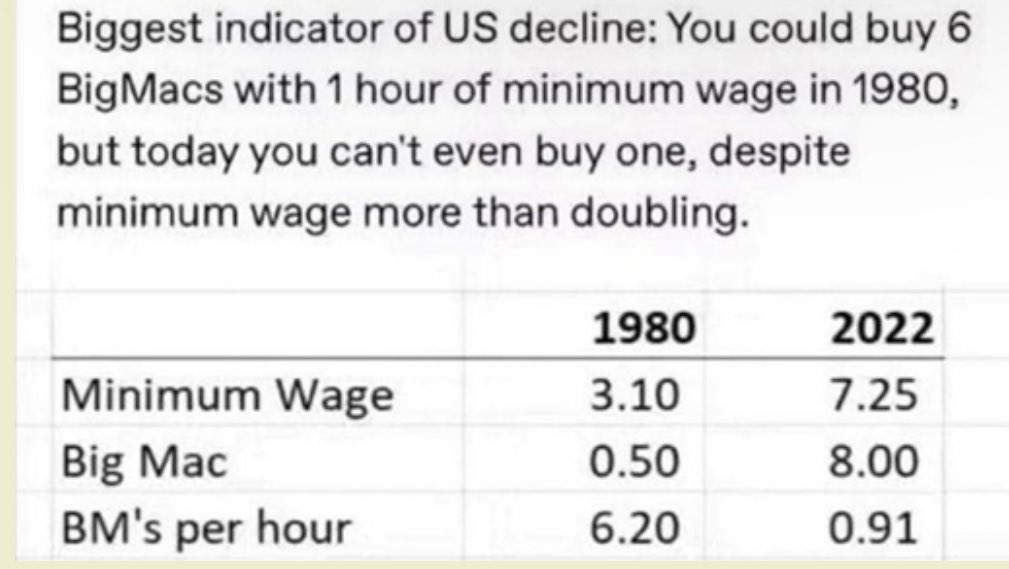
Why not measure Bitcoin in Big Macs instead of USD? 🍔💡 The USD is like a ruler that stretches and shrinks over time 📏🔄, making it tough to grasp the actual purchasing power of #Bitcoin. With the "Bit Mac Index," we unlock a tasty new perspective on #Bitcoin 's real worth. Say hello to BTC/MAC! 🎉 The Big Mac 🍔 offers a juicy, consistent benchmark 🎯 across years. It's a more solid reference because it's tied to real goods and services, reflecting actual purchasing power. 🌍💸 Yet, it's important to note we have not yet hit a new ATH in BTC/MAC. 😱 Data sources: @glassnode @TheEconomist (economist.com/big-mac-index)
QuantMario tweet media
English
4
13
60
11.6K
Lyn Alden
Lyn Alden@LynAldenContact·
Politicians are like “we’re going to fix this”
Lyn Alden tweet media
English
385
1.6K
8.1K
650.3K
QuantMario
QuantMario@QuantMario·
Excited to share some new research we’ve been working on at @glassnode! #Bitcoin spending isn’t random—it actually follows a fascinating and predictable pattern. As coins age, their likelihood of being spent drops in a smooth, measurable way. This power-law decay gives us new insights into holder behavior, from short-term holders to long-term HODLers—and even those ultra-long-term whose coins rarely, if ever, move. Check out the full research below 👇
glassnode@glassnode

The investors’ spending behaviour in the #Bitcoin ecosystem, is far from random - it follows a predictable power-law decay. Our latest research uncovers how the age of coins directly influences their likelihood of being spent. 🧵

English
2
2
11
2.6K
QuantMario
QuantMario@QuantMario·
Daniel, your journey is truly inspiring! It's amazing to see how your dedication and intuition have led to such impactful work in the Bitcoin and environmental space. I'm grateful for our meeting a few months back, and I admire your relentless pursuit of knowledge and positive change. Keep up the fantastic work!
English
0
0
0
36
Daniel Batten
Daniel Batten@DSBatten·
How did this happen ??? 3 months ago, I went through a period of uncertainty and shared that on X. So many people stepped up and were supportive and helpful. And the whole community helped me. Today I'm sharing what happened next. TL;DR: I'm now living in Costa Rica. There's still uncertainty. And, I'm also more surprised than anyone to find that I'm now advising some of the world's top Bitcoin companies, Family Offices, and even a US presidential campaign team. You were a part of making this possible. Til now, I've not shared the story of how this happened. My ego would love to say "I planned it" and it was because of some great skills in me. But that would be untrue. Yes I am good at analysing data and communicating it back to a general audience. But there are people better at both of those things than me. So here's what really happened. It was lock-down 3.0, 2020. Unfettered by my usual social engagements, I went on an online meditation retreat. During that retreat I got an insight "reconnect with your friend Willy". I did. It turned out in the 5 years since we'd chatted, he'd become a globally respected Bitcoin analyst. We chatted like no time had passed. I asked how he'd made the shift from running tech companies to researching Bitcoin. He shared his story "I had 2 months spare and a burning question about Bitcoin. I kept researching it til I got the answer." Because of that, this happened. It was early 2022. Bitcoin was getting hammered in the press for its environmental impact. China reportedly banned it, and Telsa had ditched it. Both cited environmental concerns. I held a small amount, and was about to ditch it too. But before I did, I had a chance conversation with Vlatko, an environmentalist entrepreneur who'd started a climatetech company I'd invested in. He suggested I research it deeper first. As I sat down to meditate that evening, Willy's words punctured my tranquility "I had 2 months spare and a burning question about Bitcoin. I kept researching it til I got the answer." My next move was clear: I resolved to do the same. I cleared my diary and did something I'd never done: I researched for no other purpose than to get an answer. I worked long hours. I didn't eat much. I lost weight. I hunted down every piece of data I could about renewable energy, how grids worked, climate change, methane mitigation, Bitcoin mining, Bitcoin mining economics. I read the articles for and against Bitcoin. I spoke to renewable energy engineers, people actually doing Bitcoin mining, climate scientists, and grid experts. I extrapolated trendlines. I drew charts. I tested theories. I questioned sources. Everything led to the same conclusion: Bitcoin mining had been widely criticized based on the largely unfounded fears that accompany all disruptive technologies, not research and understanding: Bitcoin would likely follow the same trend as solar to become a net positive to the environment. In fact Bitcoin had the potential to become the most fast-acting form of climatetech the world had seen. All the other technologies we were investing in would have an impact after 2030. But this could have a pre-2030 impact on reducing methane emissions and building out the grid renewably (a conclusion that has since been endorsed in peer-reviewed studies. Then something unexpected happened: the week after I finished my research, GreenpeaceUSA kicked off an environmental campaign against Bitcoin. As a subscriber to Greenpeace, who'd participated in actions with them shoulder to shoulder I was surprised. So I read the logic behind their campaign to see what they had discovered that I might have missed. My heart sank. They quoted studies that had already been debunked. It was clear they had not done even 5% of the research I just had, but rather had relied for the most part on some questionable accounts written by mainstream journalists, and the work of a certain central bank employee whose models I had found lacked scientific integrity. I felt this strong intuitive voice inside me say “you should write a response”. Logically I saw no point. I had no active followers to speak of. And the last time I’d used Twitter was a decade ago where I would regularly get one “like” per ten tweets if I was lucky. So I wrote a response on Twitter. I pointed out the errors in GreenpeaceUSA’s messaging. That tweet changed everything. The post received over 600,000 views. I was asked to appear on two podcasts, and I was instantly connected to a global community of environmentalists, climate scientists, philosophers and renewable energy experts I didn’t know existed who, like me, had researched Bitcoin really thoroughly and realized it was likely to become an environmental net-positive. There was one thing that sat uncomfortably with me though. Bitcoin was, or seemed to be, using a disproportionately high amount of fossil fuel. This made me reluctant to advocate too strongly for Bitcoin mining. But then, another intuition came: a very precise intuition “The Cambridge model that everyone relies on is not factoring in offgrid mining. That’s causing it to overstate how much fossil fuel Bitcoin uses.” Yes, it wasn’t brilliant analysis, or research. It was a simple intuition I had that I followed “the Cambridge model does not factor in offgrid mining.” I shared this thought with @level39, who did something amazing and unexpected, for which I'm very grateful He trawled through the Cambridge website and found in the fineprint of their methodology section and said words to the effect “you’re right. Look at this, they not only exclude offgrid mining, but also “methane mitigation”. Buoyed by the fact my intuition had been accurate, I decided to do something I would never have done if I’d known how much work was involved. I started building a ground-up model of Bitcoin mining, which used Cambridge’s data as a starting point, but addressed their inaccuracies. This work required me to hunt down as many bitcoin mining companies as I could and validate their hashrate, power consumption and renewable energy mix. There was no shortcut, just a huge amount of phonecalls, surveys, emails and cross-validation. Along the way, I made other discoveries about Bitcoin mining, how it was helping stabilize grids, reducing electricity costs through monetizing wasted renewable energy and just how much methane it was mitigating. I spent the bulk of each day for two years building the model and publishing what I was finding on Twitter. The response was overwhelming. I was invited to speak at two conferences and Michael Saylor quoted my research. I was invited on 3x more podcasts than I had the capacity to accept. It was amazing, yet at the same time it meant that for two years I received very little income. This was afterall supposed to take two months, not two years. While I was flattered by the level of outreach, I couldn’t feed a family on podcast invites. And I hadn’t been looking for new coaching clients for two years and my number of clients had started to dwindle. My intellect was screaming "stop working for free". Yet my intuition was encouraging “keep going.” II kept on doing more unpaid work, either Bitcoin research, or running meditation courses for The Art of Living. Eventually I finished. To my surprise, the model is now used in preference to Cambridge’s model by most institutions now, including two AI engines. The shock is not that people find merits in the model: I know it is a superior model to Cambridge’s. My surprise is that so many other people would adopt it over such an established institution. Along the way, I’d also realized that my third climate tech fund had to involve Bitcoin mining on landfills: my research was showing me that doing Bitcoin mining with vented landfill gas reduced 45x more emission than investing in solar infrastructure, while yielding better returns. Problem was, New Zealand was the wrong country for international business. With my business partners in the States, and landfill projects in LATAM, it was time to move. My wife was supportive, and my daughters were up for the adventure, so we relocated to Costa Rica. Then the miraculous happened: my two worlds started to collide. A single tweet asking for some advice from the community on twitter led to the unintended, yet much appreciated, consequence of work offers within the bitcoin ecosystem. I was offered an advisory role at a large publicly listed mining company, a research role at another company, and a job helping create a Bitcoin mining video to be sent to regulators the world round. Then Lisa Hough said to me “you’ve got a gift coaching people. Have you thought of coaching Bitcoin companies?” Remarkably I hadn’t. Yet it was so obvious. One tweet later, a number of founders of Bitcoin companies enrolled to get coaching on gaining investment, growing their company, or navigating the challenges that come with running your own tech firm. I don’t know what will happen next. I had no plan when I started all this, and I still don’t - other than to keep listening to the intuitive pull, and to keep meditating so that the stray messages get filtered out so I can hear that voice clearly. But I have felt another intuition: “Bitcoin price is being suppressed because Sovereign Wealth Funds can’t adopt it. They can’t adopt it because their ESG investment committees are blocking it. You should talk to them and help them change their minds.” Again I did some research, and again this intuition was right. A youtube video of Kevin O’Leary on What Bitcoin Did randomly appeared on my Youtube list that same night. I watched in awe as Kevin O’Leary confirmed every word of this intuition, and then some. So apparently I’m going to start talking to Sovereign Funds and Pension Funds? I have no idea when and how. But that’s not my business to try and figure out. And any ideas I could figure out would be inferior to the divine plan. I’m simply listening to a wisdom higher than my own, and beyond what I could have done through my intellect or my experiences. When president Nayib Bukele who has performed a social and economic miracle in El Salvador was interviewed recently he was asked about his economic plan for his country. With a twinkle in his eye he smiled and said “First, seek God’s wisdom”. I found myself nodding my head. I knew what he meant. Whatever name we give to the power beyond us, we are not the doer, and knowing this opens us up to receive ideas beyond the conception of the rational mind. So, content not knowing the path ahead but trusting it’ll be great, that’s what I try to do each day.
English
83
66
570
34.7K
QuantMario
QuantMario@QuantMario·
QuantMario@QuantMario

Why not measure Bitcoin in Big Macs instead of USD? 🍔💡 The USD is like a ruler that stretches and shrinks over time 📏🔄, making it tough to grasp the actual purchasing power of #Bitcoin. With the "Bit Mac Index," we unlock a tasty new perspective on #Bitcoin 's real worth. Say hello to BTC/MAC! 🎉 The Big Mac 🍔 offers a juicy, consistent benchmark 🎯 across years. It's a more solid reference because it's tied to real goods and services, reflecting actual purchasing power. 🌍💸 Yet, it's important to note we have not yet hit a new ATH in BTC/MAC. 😱 Data sources: @glassnode @TheEconomist (economist.com/big-mac-index)

QME
0
0
0
13
QuantMario
QuantMario@QuantMario·
@willywoo Everyone in Tradfi can engage in basis trades with ETFs and futures.
English
3
0
0
121
moneyordebt ∞/21M
moneyordebt ∞/21M@moneyordebt·
The world’s fastest supercomputer on the newest Top500 list remains Frontier at DOE’s Oak Ridge Lab, costing $600 million and with 1.2 Exaflops of 6 nanometer tech GPU power. Using Saylor’s rule of thumb that ASICs are 100 x faster than GPUs, it would be equivalent in hash power to only three cabinets (12 nodes per) of Whatsminer 63S Hydro with 5 nanometer ASIC technology and priced around $321K. The entire Top500 list with 8.2 Exaflops would not make a dent, not even 0.1 ExaHashes in what is a 579 ExaHashes network of security and value annealed onto the permanent Timechain. #Bitcoin is produced by the largest global decentralized supercomputer, possessing enormous scale and minting eternal and rapidly increasing reusable value as a true monetary standard. The world has never had a scientifically precise monetary standard of known finite supply until now. The global Nakamoto architecture supercomputer, with all nodes running the same open code designed by Satoshi, does this. @ShahinKhan @dotkrueger
English
2
3
19
3K
QuantMario
QuantMario@QuantMario·
Apparently, the only thing more limited than the world’s resources is your capacity to understand the nuance of economic models, Fred. Dismissing potential flaws in Giovanni’s model without any constructive criticism isn’t just lazy—it’s intellectually dishonest. Your tweet is exactly what I’d expect from Giovanni’s #1 fan boy, not from someone committed to serious financial discourse. Next time, try to engage with the argument instead of flaunting your biases. Verify that!
English
3
0
4
123
QuantMario
QuantMario@QuantMario·
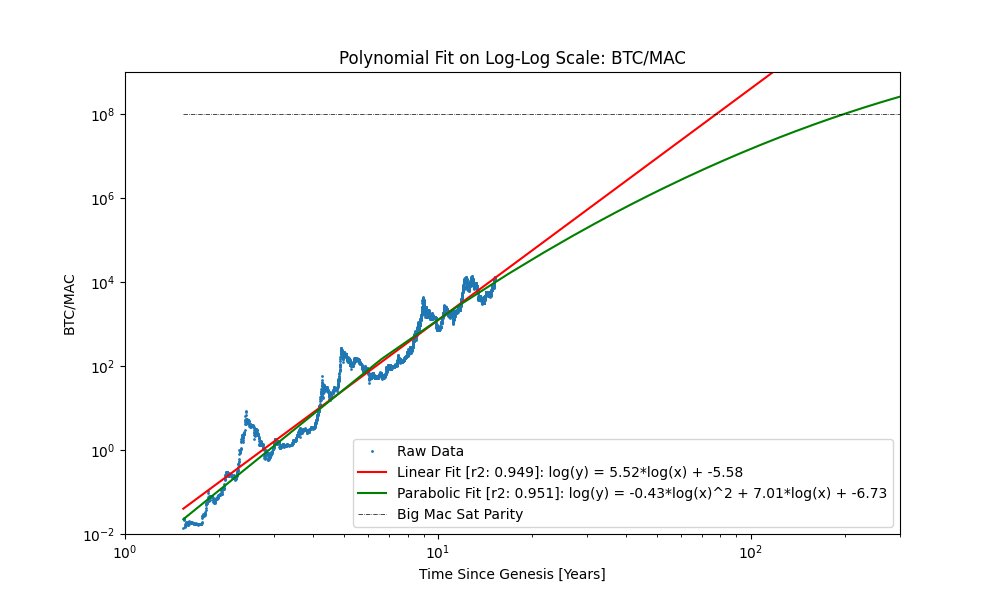
TL;DR: 🚫 The #Bitcoin Power Law's future price predictions are flawed for two reasons (@Giovann35084111 @dotkrueger ): 1) They ignore USD's future value. 2) Adding a quadratic term fits the data just as well!📈 The #Bitcoin Power Law's attempt at predicting future BTC prices is like measuring a tree's future height without knowing the future length of your ruler. 🌳➡️📏Even worse: it's trying to predict to variables at the same time. A better approach? Use BTC/MAC, anchoring #Bitcoin's value to the purchasing power of a Big Mac, à la the Big Mac Index by The Economist. 🍔 (see my pinned tweet for details.) This adjustment allows for predictions in terms of tangible purchasing power. The model’s steep prediction: 77 years post-Genesis block, a single satoshi should buy you a Big Mac 🔄🔮 Most importantly, a limited-growth polynomial fits the data just as well as a power law (linear fit).🚨 Adding a higher-order polynomial, like a quadratic term, actually improves the fit but significantly alters the timeline for achieving Big Mac sat parity—pushing it out to 200 years. 📊 Remember, the real world's resources aren't infinite; #Bitcoin's purchasing power can't be either. 🌍💡 (Don't trust; verify: I’ve used @glassnode 's full history of daily price data up to today. See my pinned post for a link to the Big Mac index data.) 🔍✅
QuantMario tweet mediaQuantMario tweet media
English
10
3
51
10.4K
Josh ⚡️
Josh ⚡️@joshprf·
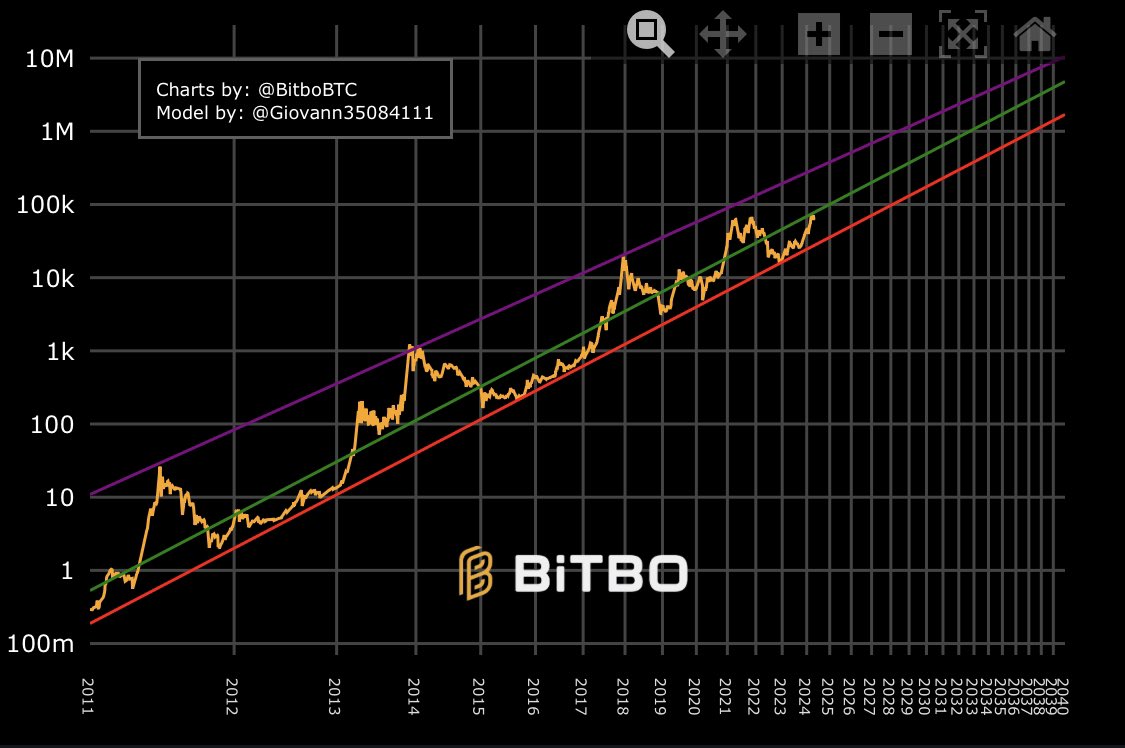
4 BTC charts/indicators that I’m going to be watching over the next 12 months so I can sell my alts and go full blown maxi 🟧 1. Power Law (@Giovann35084111) This chart uses a Bitcoin "power law" to set two key lines—resistance above today's price and support below, mirroring historical price trends to suggest future highs and lows. It predicts: 1 . Bitcoin may hit $100,000 between 2021-2028, staying above that after 2028. 2. Bitcoin could reach $1,000,000 between 2028-2037, never dropping below that post-2037. These forecasts rely on past trends indicating the future, though unexpected events could change outcomes. Remember, these predictions are not guaranteed.
Josh ⚡️ tweet media
English
44
240
1.3K
461.7K
Julio Moreno
Julio Moreno@jjcmoreno·
This has nothing to do with physics. You are doing an OLS linear regression of price and time. Both variables are autocorrelated. OLS linear regression assumes the variables are not autocorrelated (among other things). If your variables don't fulfill these assumptions the model is invalid. Moreover if you add the lag of price to the model it makes time irrelevant.
English
7
0
19
3K
Julio Moreno
Julio Moreno@jjcmoreno·
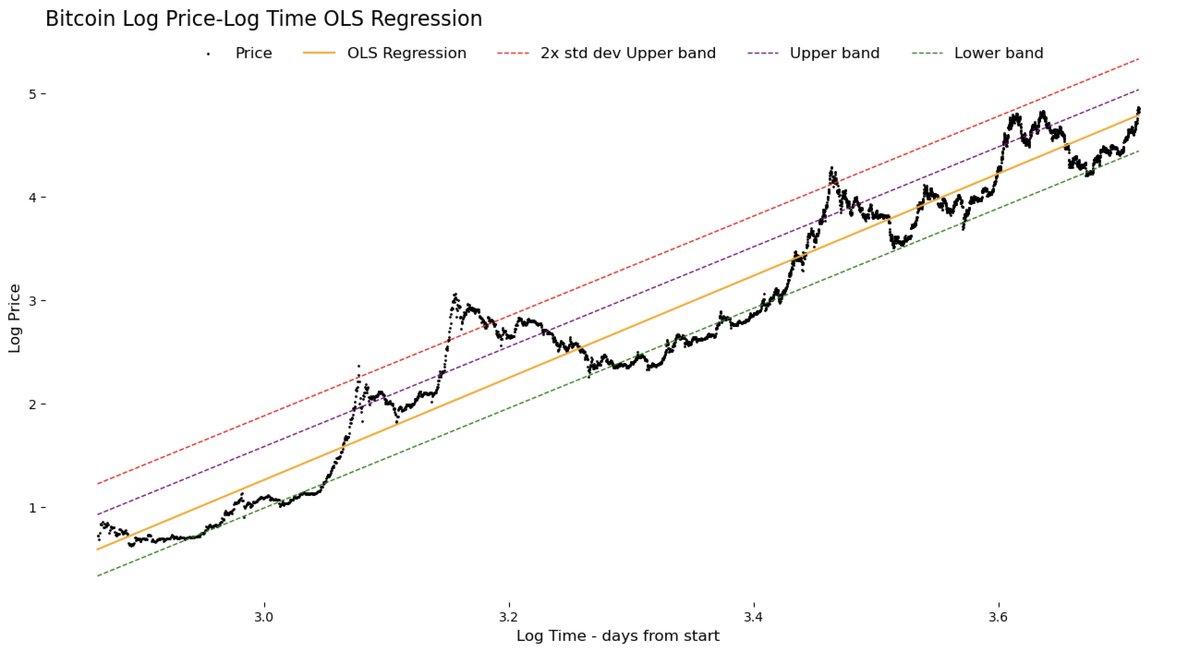
The Bitcoin power law model looks good, but is flawed. The relationship between price and time is spurious (fake). I'll explain below. 1. The model is flawed because it does't account for autocorrelation. You can see this in the regression results, particularly in the Durbin-Watson statistic (red rectangle). It should be 2 for autocorrelation not to be present, but it's basically zero (high positive autocorrelation). Autocorrelation violates one of the key assumptions of linear regression. It doesn't matter that the R-squared is high (orange rectangle), the high R-squared is explained by the autocorrelation. The model has also other problems (blue, yellow and green rectangles) that also violate some of the assumptions of linear regression (normal distribution, etc). 2. The price of Bitcoin is autocorrelated, meaning that past data helps explain the current price, this is very common in time series analysis. You can see this in the next chart (bars outside the shaded area). 3. Power law models seem to explain well some relationships, but this is for analysis that doesn't involve time (time series). I took this chart from @dotkrueger
Julio Moreno tweet mediaJulio Moreno tweet mediaJulio Moreno tweet mediaJulio Moreno tweet media
English
58
24
171
67.3K
QuantMario
QuantMario@QuantMario·
@jjcmoreno @cryptoquant_com Thanks for your analysis! I came to to the same conclusion that the model is flawed, but from an economic POV x.com/quantmario/sta…
QuantMario@QuantMario

TL;DR: 🚫 The #Bitcoin Power Law's future price predictions are flawed for two reasons (@Giovann35084111 @dotkrueger ): 1) They ignore USD's future value. 2) Adding a quadratic term fits the data just as well!📈 The #Bitcoin Power Law's attempt at predicting future BTC prices is like measuring a tree's future height without knowing the future length of your ruler. 🌳➡️📏Even worse: it's trying to predict to variables at the same time. A better approach? Use BTC/MAC, anchoring #Bitcoin's value to the purchasing power of a Big Mac, à la the Big Mac Index by The Economist. 🍔 (see my pinned tweet for details.) This adjustment allows for predictions in terms of tangible purchasing power. The model’s steep prediction: 77 years post-Genesis block, a single satoshi should buy you a Big Mac 🔄🔮 Most importantly, a limited-growth polynomial fits the data just as well as a power law (linear fit).🚨 Adding a higher-order polynomial, like a quadratic term, actually improves the fit but significantly alters the timeline for achieving Big Mac sat parity—pushing it out to 200 years. 📊 Remember, the real world's resources aren't infinite; #Bitcoin's purchasing power can't be either. 🌍💡 (Don't trust; verify: I’ve used @glassnode 's full history of daily price data up to today. See my pinned post for a link to the Big Mac index data.) 🔍✅

English
0
0
7
921
QuantMario
QuantMario@QuantMario·
@Prithvir12 @CryptoHayes Big Macs contain energy, too. x.com/quantmario/sta…
QuantMario@QuantMario

Why not measure Bitcoin in Big Macs instead of USD? 🍔💡 The USD is like a ruler that stretches and shrinks over time 📏🔄, making it tough to grasp the actual purchasing power of #Bitcoin. With the "Bit Mac Index," we unlock a tasty new perspective on #Bitcoin 's real worth. Say hello to BTC/MAC! 🎉 The Big Mac 🍔 offers a juicy, consistent benchmark 🎯 across years. It's a more solid reference because it's tied to real goods and services, reflecting actual purchasing power. 🌍💸 Yet, it's important to note we have not yet hit a new ATH in BTC/MAC. 😱 Data sources: @glassnode @TheEconomist (economist.com/big-mac-index)

English

0
0
0
1.5K
PJ
PJ@Prithvir12·
Interesting idea from @CryptoHayes on how to think about selling bitcoin. Don't look at BTC in fiat terms. Look at BTC's price in energy terms. Today 1 BTC is worth ~500 barrels of oil. If 1 BTC = 10k barrels of oil, maybe sell BTC to buy energy producing assets.. but not to hold fiat.
English
79
115
812
259.6K
QuantMario
QuantMario@QuantMario·
@BritishHodl The power law model will be invalidated because it must break to the bottom after inflation adjustment. Without that adjustment, it’s relying on the USD to go to zero. x.com/quantmario/sta…
QuantMario@QuantMario

TL;DR: 🚫 The #Bitcoin Power Law's future price predictions are flawed for two reasons (@Giovann35084111 @dotkrueger ): 1) They ignore USD's future value. 2) Adding a quadratic term fits the data just as well!📈 The #Bitcoin Power Law's attempt at predicting future BTC prices is like measuring a tree's future height without knowing the future length of your ruler. 🌳➡️📏Even worse: it's trying to predict to variables at the same time. A better approach? Use BTC/MAC, anchoring #Bitcoin's value to the purchasing power of a Big Mac, à la the Big Mac Index by The Economist. 🍔 (see my pinned tweet for details.) This adjustment allows for predictions in terms of tangible purchasing power. The model’s steep prediction: 77 years post-Genesis block, a single satoshi should buy you a Big Mac 🔄🔮 Most importantly, a limited-growth polynomial fits the data just as well as a power law (linear fit).🚨 Adding a higher-order polynomial, like a quadratic term, actually improves the fit but significantly alters the timeline for achieving Big Mac sat parity—pushing it out to 200 years. 📊 Remember, the real world's resources aren't infinite; #Bitcoin's purchasing power can't be either. 🌍💡 (Don't trust; verify: I’ve used @glassnode 's full history of daily price data up to today. See my pinned post for a link to the Big Mac index data.) 🔍✅

English
0
0
0
93
BRITISH HODL ❤️‍🔥🐂❤️‍🔥
In my opinion - with a price model the creator must be able to tell you at what price and what timeframe of events would need to happen to invalidate the model. Power Law is invalidated if #Bitcoin goes through exponential growth - as said by the “discoverer” himself on @BeagleBitcoin’s Twitter Spaces yesterday. Oh no wait, it’s not. Because if #Bitcoin goes through exponential growth now, and then 4 years later corrects to hit “the line”. Power Law is valid again. What a joke. In-fact was valid throughout that whole time. So the only way to prove it’s wrong is in 30 years after we see how many times it hit the line and if it stayed away from the line for some amount of time that was “enough” to make the nerds happy. Surely we can do better than this. Sure, okay, it might be hitting the line every few years, but how is any of this actionable? It might get people rekt who sell at $200k because “the line” told them to… Then we enter S Curve Adoption. And they never get to buy that #Bitcoin again. Now your Grandchildren are looking at you wondering how dumb you had to be to listen to “the line”. It’s so utterly useless - while being a little fascinating - I mean relate things to baby elephants and everyone will love you. If you believe in the exponential adoption of #Bitcoin by infinite Money, you cannot believe in Power Law - the discoverer himself said so. As I said - I’m not good at maths - but it just doesn’t make sense to me. I believe in the one model that all #Bitcoin-ers that have been through one full market trust, I call it the Gonadal Model. Are your balls big enough to hold the scarcest asset humanity has ever seen for long enough to make your last name proud?
English
46
8
330
55K
kuntah
kuntah@paulewaulpaul·
It's sad to observe the "discussion" about S2F vs. Power Law. We all have the same price data - Yet: This is not a dialogue but rather condescension. S2F contains fundamental flaws. One should openly discuss them. @Giovann35084111 @100trillionUSD @QuantMario
English
2
0
9
607
kuntah
kuntah@paulewaulpaul·
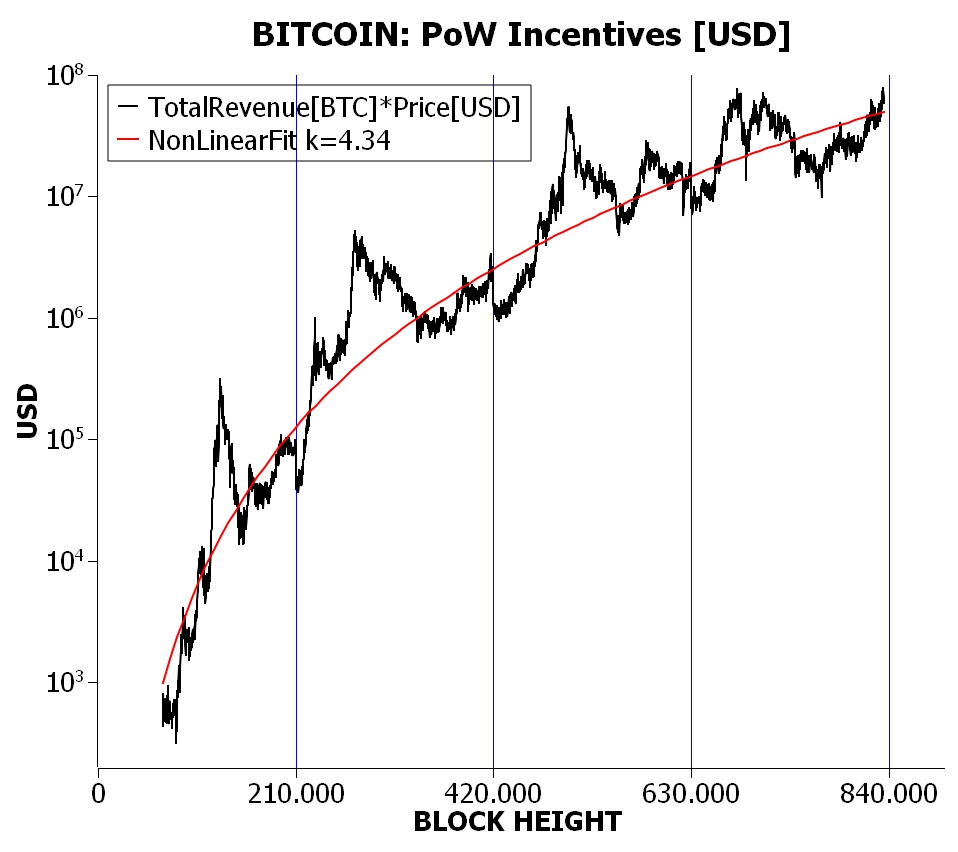
Indeed, it is possible to integrate Issuance and Fees ("Flow") into the formula to examine their influence. #bitcoin Here, for example, are the PoW incentives at market price for each block. And? What do we see? Data from @glassnode
kuntah tweet media
English
2
3
25
2.4K