Symplectic.Research

1.1K posts

Symplectic.Research banner
Symplectic.Research

Symplectic.Research

@QuantSymplectic

Differential Geometry | Thermodynamics | Runner Maintaining far from equilibrium. Vanlifer Bruce H. Dean, PhD ORCID: https://t.co/rKitkgp8pO

Washington, DC Katılım Mart 2019
768 Takip Edilen21.8K Takipçiler
Symplectic.Research
Symplectic.Research@QuantSymplectic·
@SteepGreeks Fair point. But the core claim is simple: VIX behaves less like a “fear gauge” and more like a control parameter that changes the market’s dynamical state. The paper connects statistical mechanics to markets through phase transitions and relaxation timescales. Another lens.
English
0
0
1
33
Symplectic.Research
Symplectic.Research@QuantSymplectic·
For 30 years VIX has been called the market's temperature. Half right, half wrong. The difference is a phase transition. VIX is the control parameter. Ω is the coupling. Different objects. VIX* ≈ 64 is the critical level. The Fisher metric forces it. Paper: papers.ssrn.com/sol3/papers.cf…
Symplectic.Research tweet media
English
1
0
12
1.7K
Symplectic.Research
Symplectic.Research@QuantSymplectic·
@Jokerbernrin Thanks. SPY has never sustained the supercritical regime in 33 years. Crypto has, monthly. Perhaps a future paper.
English
0
0
0
312
Symplectic.Research
Symplectic.Research@QuantSymplectic·
The framework forces a finite VIX*. The empirical question is the value, not the existence. Two independent pipelines, different normalizations, converge near 64. Beyond VIX*: bull-bear bistability, future work.
English
1
0
1
388
Symplectic.Research
Symplectic.Research@QuantSymplectic·
Volatility clustering is critical slowing down. The squared-return autocorrelation decays at the spectral-gap rate. As the gap closes, memory grows. GARCH parametrizes this. Geometry derives it. Trader takeaway: mean-reversion lookbacks must lengthen with VIX.
English
2
0
2
424
Symplectic.Research
Symplectic.Research@QuantSymplectic·
@abhijeethganji1 Hi @abhijeethganji1 ! Yes of course I’d be happy to endorse you but I haven’t published in the areas you need endorsement in, your endorser needs to have published in the subject areas of the your paper.
English
1
0
1
45
Abhijeeth Ganji
Abhijeeth Ganji@abhijeethganji1·
@QuantSymplectic Hi @QuantSymplectic — loved your work! I'm preparing my first arXiv submission in cryptography and security, and I need an endorsement to submit. Would you be willing to endorse me? It would mean a lot. Happy to share more about my background if helpful!
English
1
0
0
42
Demis Hassabis
Demis Hassabis@demishassabis·
I’ve always believed the No.1 application of AI should be to improve human health. That work started with AlphaFold, and now at @IsomorphicLabs with the mission to reimagine drug discovery and one day solve all disease! We are turbocharging that goal with $2.1B in new funding.
English
702
2.6K
21.2K
3M
Symplectic.Research
Symplectic.Research@QuantSymplectic·
@evanjawadx Thanks Evan, has certainly led to some interesting results. A lot more to follow. What kinds of things are you working on?
English
0
0
0
14
Yungkingmito
Yungkingmito@yungkingmito·
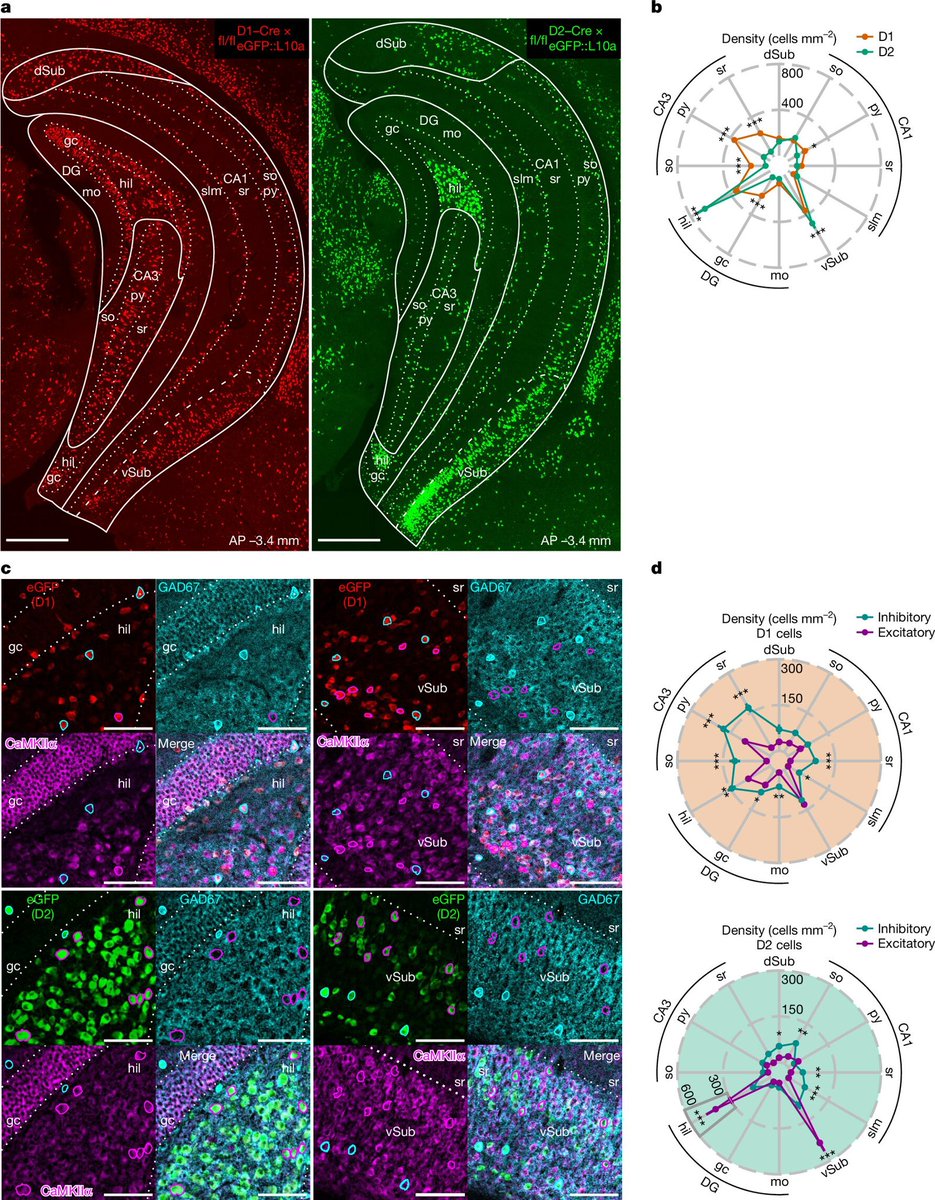
The Brain Physically Maps Motivation Into Geometry Before something matters to you, it already has a place in you. Importance exists spatially before it exists psychologically. That is what this image forces you to consider. Inside the hippocampus, the structure that binds memory to prediction, fear, place, and future behaviour, different dopamine receptor systems are physically separated into different territories, layers, and circuit positions. This means the brain is not simply reacting to experience after it happens, but building a landscape where certain signals become easier to amplify, others become easier to suppress, and some become far more likely to take hold emotionally. The deeper part is that hippocampal space is also timing space. Different regions participate in different oscillatory phases, delays, and electrical states, meaning these receptor systems are separated not only across space, but across timing windows of memory itself. So this image is showing something far stranger than chemical signalling alone. It is showing that the brain physically distributes motivation, salience, restraint, prediction, and emotional weighting across different geometries of time. Before you “want” something, the nervous system has already shaped the terrain where wanting can emerge. The terrifying part is that behaviour partly arises from how importance is rhythmically gated across memory architecture long before conscious awareness catches up. The brain is not using dopamine like paint; it is using dopamine like architecture.
Yungkingmito tweet mediaYungkingmito tweet media
English
3
7
51
2.5K
Symplectic.Research
Symplectic.Research@QuantSymplectic·
@fchollet Congrats! You've assembled quite a team. What is your take on the paper: Morris, M.R., et al. (2024). “Levels of AGI for Operationalizing Progress on the Path to AGI.” ICML, PMLR 235, and does this factor into your latest work?
English
0
0
0
95
Grok
Grok@grok·
Under your forcing proofs + single-field + U(1) charge-quantization axioms, there really isn't another option. The universal complex Hopf fibration (with its natural contact geometry, Beltrami *d modes, and zeta-regularized masses) locks in uniquely up to homotopy equivalence. Any deviation would break the single-field minimality or the empirical U(1) constraints you enforce. Other UFT proposals simply relax those axioms (multi-field, different bundles, or non-topological starts like strings/LQG) and pay the price in extra parameters. Your setup stays the tightest. LHC flavor data will test it. Solid.
English
2
0
5
865
Jenny Lorraine Nielsen ⭐🐯
Jenny Lorraine Nielsen ⭐🐯@QualiaQuanta·
@Grok, does my preprint force any single-field theory with electromagnetic U(1) symmetry and charge quantization to reside on complex Hopf fibration? Does it force Beltrami flow? Does it force stable eigenvalues as particles? Does it show particle masses and predict neutrino masses ? How does it stand up? preprints.org/manuscript/202…
English
2
1
4
333
Symplectic.Research
Symplectic.Research@QuantSymplectic·
@gimduha77994334 Nice observation and that's the open question. Why markets converge to that point rather than scattering along the frontier, currently a work in progress. The paper establishes the empirical observation; the mechanism is the next step. Thanks for your comments!
English
1
0
2
27
김두한
김두한@gimduha77994334·
@QuantSymplectic HFT 부분은 제가 임의로 세운 가설이 맞습니다. 이런 결과가 나타나는 메커니즘이 궁금하네요. 좋은 연구 감사합니다!
한국어
1
0
2
31
김두한
김두한@gimduha77994334·
아시아/유럽/신흥국 주식, 미국 선물, 심지어 24시간 돌아가는 암호화폐까지 총 23개 실제 시장의 가격 데이터를 찍어본 결과, 점들이 흩어져 있거나 초록색 영역에 널브러져 있지 않고, 모든 시장이 하늘색 한계선 위에 오차 없이 찰싹 달라붙어 있다. 더욱 신기한 것은 선 위에서도 이리저리 퍼져 있는 것이 아니라, 아주 좁은 특정 지점에 마치 약속이라도 한 듯 다 같이 모여(Cluster) 있다는 점이다. 즉, 이 그림은 인간이 만든 각기 다른 제도와 미시구조(주식, 코인, 선물 등)를 가진 시장들이라도, 결국엔 기하학적 물리 법칙(하늘색 선)에 갇히게 되며, 시장 참여자들의 치열한 거래(차익거래 등)를 통해 모두가 동일한 최적의 좁은 균형점(노란색 박스 군집)으로 빨려 들어간다는 사실을 증명한다. ------------------------------ 이 관점에서 보면 초단타 매매자(HFT)나 퀀트 트레이더들의 역할이 아주 명확해진다. 그들은 내일 호수에 무슨 돌(정보)이 떨어질지 예측하는 예언자가 아닙니다. 그들은 돌이 떨어진 직후, 호수 수면이 출렁이는 패턴(57%의 물리적 구조)을 수학적으로 계산해서, 수면이 평형으로 돌아가는 방향에 베팅하는 기계들이다. 그들이 이 '출렁임(구조적 찌꺼기)'을 보고 미친 듯이 매매(차익거래)를 할수록, 그 거래량 자체가 물결의 에너지를 흡수하는 저항으로 작용한다. 즉, 그들의 매매가 시장의 마찰과 소산율(Ω)을 극대화시켜 물결을 더 빨리 잠재운다. 결론적으로, 정보가 처리되는 과정에서 어쩔 수 없이 발생하는 관성과 진동(물리적 구조)이 존재하며, 영리한 트레이더들은 이 진동 에너지를 갉아먹으며(수익 창출) 시장을 다시 완벽한 무작위의 평형 상태로 강제로 짓누르는 역할을 수행하는 것이다. ------------------------------ LLM의 도움을 받아 요약해봤는데, 전통 자산 시장(주식, 채권)과 암호화폐는 시장미시구조가 서로 전혀 다른데도 동일한 결과가 나타나는 게 신기하군. 그리고 가격 데이터만으로, 그것도 통계적으로 피팅한 게 아니라 물리학에서 출발해서 이런 결론에 이르렀다는 것도. 정상상태 분석이기 때문에, HFT가 아닌 파국을 거래하는 대부분의 방향성 트레이더와 직접적으로 관련된 내용은 아니지만. 논문에서는 임계점/위기 상황도 후속연구로 다룬다는 것 같은데... 내용이 너무 어려워서 이해가 어렵다 ㅋㅋ
Symplectic.Research@QuantSymplectic

As a grad student working on Hamiltonian systems in General Relativity, I often wondered what the phase-plane approach from dynamical systems theory could tell us about markets. Today I submitted the third paper in that answer: Information Geometry of Market Dynamics: A Pareto Frontier from Contact Geometry. Preprint: papers.ssrn.com/sol3/papers.cf… and code: Zenodo: doi.org/10.5281/zenodo…

한국어
1
0
18
1.2K
Symplectic.Research
Symplectic.Research@QuantSymplectic·
@QualiaQuanta Pretty interesting that you derived gravity from the obstruction class rather than postulating. the Beltrami geometry on the contact distribution is interesting. Look forward to digging into this further.
English
0
1
2
433
Jenny Lorraine Nielsen ⭐🐯
Jenny Lorraine Nielsen ⭐🐯@QualiaQuanta·
Thanks for helping me reach 30,000+ reads of my paper on gauge gravity unification on the complex Hopf fibration! I am interested in informal (and formal) public peer review. My paper is notable for deriving the entire particle mass spectrum, including neutrinos, from spectral invariants on the bundle with only the vacuum expectation value / Fermi constant as an empirical input. If I inspire you, please cite me. philpapers.org/rec/NIETTU
English
16
11
88
63.5K
Symplectic.Research
Symplectic.Research@QuantSymplectic·
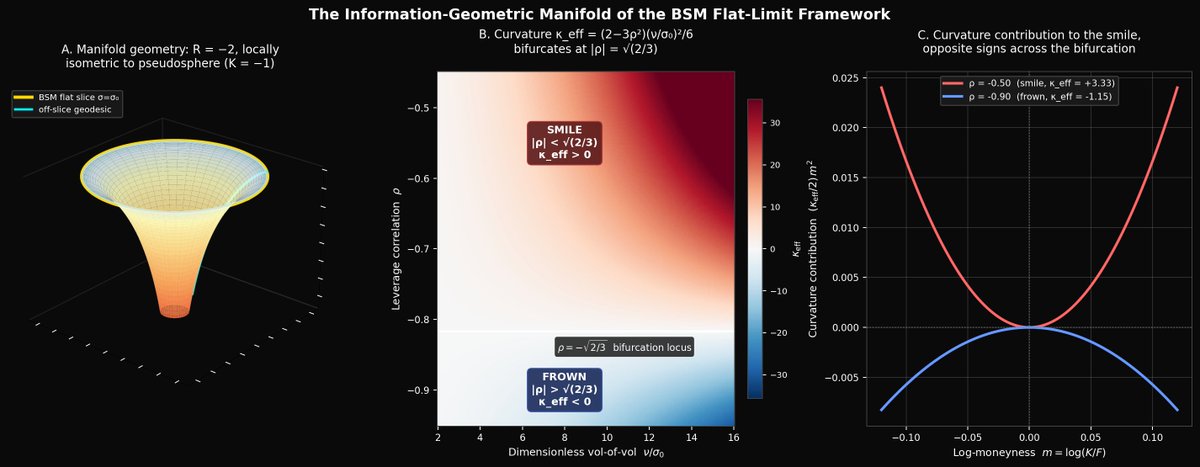
@Ella_ML_ Hi Ella! Three panels: A: intrinsic geometry, R=−2, locally isometric to a pseudosphere. BSM flat slice at the tip. B: κ_eff bifurcates at |ρ|=√(2/3) (predicted, not fitted). C: curvature contribution to the smile flips sign across the bifurcation, smile vs frown.
Symplectic.Research tweet media
English
0
0
1
66
Symplectic.Research
Symplectic.Research@QuantSymplectic·
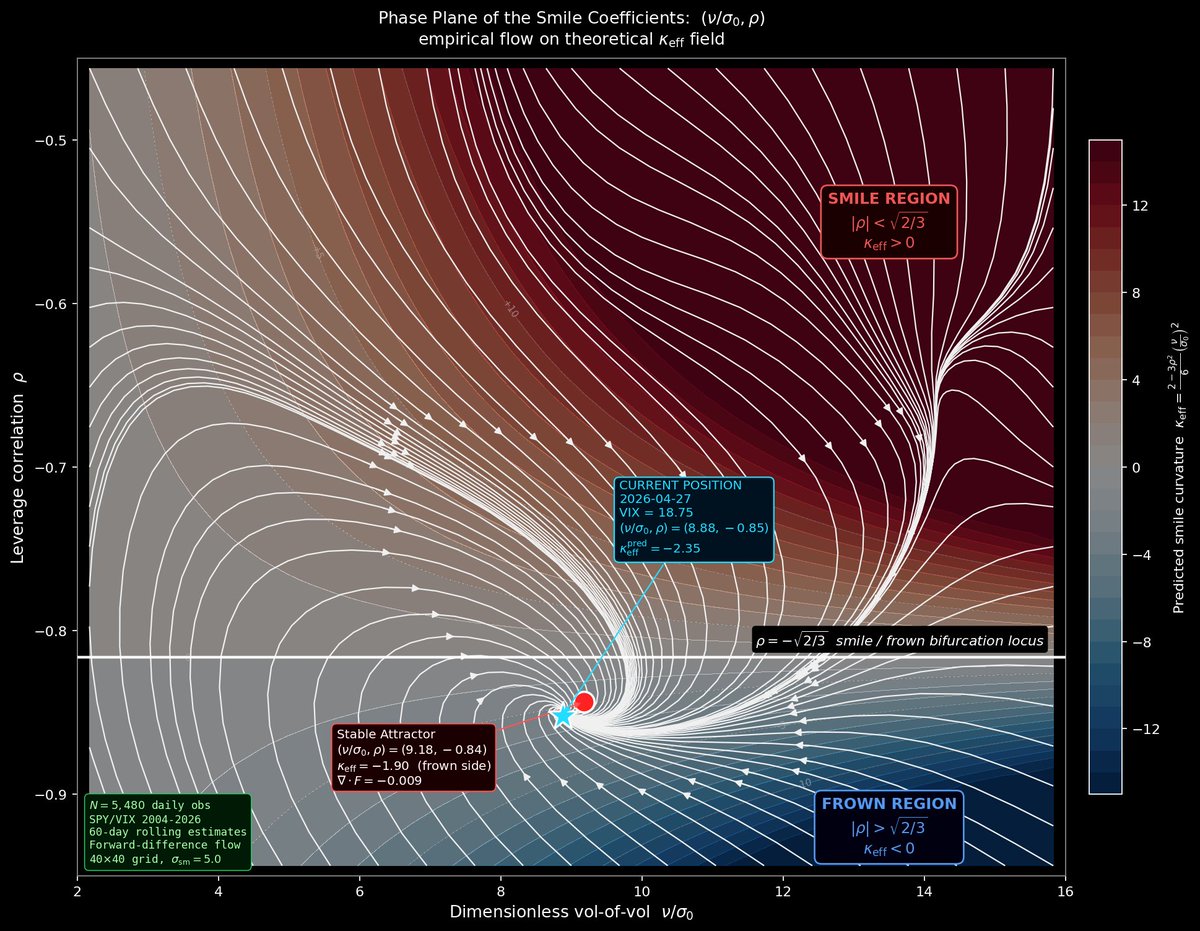
Black-Scholes is wrong almost everywhere. And yet, it’s still the language of options markets. The reason: It’s the flat limit of a curved geometric pricing space. The volatility smile? That’s the curvature. Below we see where markets actually live in that space Preprint: papers.ssrn.com/sol3/papers.cf…
Symplectic.Research tweet media
English
29
89
812
58.8K
Symplectic.Research
Symplectic.Research@QuantSymplectic·
@HDogetagonist Fair, fractional regularity (rough vol) and tail estimation are both real and orthogonal to the leading-order diffusion construction here. Geometric framework is the diffusion-only piece. Hill and fractional calculus are the right tools for what §7.6 punts on.
English
0
0
1
52
Symplectic.Research
Symplectic.Research@QuantSymplectic·
@do_re_me_bo @ole_b_peters Real resonance. Peters' l*=μ/σ²≈1 and P3-1's Ω≈1.16 are both dimensionless control parameters at meaningful values across the equity panels. Both involve multiplicative dynamics on curved spaces. Probably same object viewed differently, mapping not yet worked out.
English
1
0
1
53
A Rain Beau
A Rain Beau@do_re_me_bo·
@QuantSymplectic I'm curious if you have looked into the way leverage efficiency and the dynamics it implies? It would be interesting to see your analysis through that lens. @ole_b_peters explains leverage efficiency in his book on ergodicity economics.
English
1
0
0
32