QuantifiedStrategies.com

6.3K posts

QuantifiedStrategies.com banner
QuantifiedStrategies.com

QuantifiedStrategies.com

@QuantifiedStrat

Daily backtested rule-based strategies. Longtime former prop traders Research since 2012 by Oddmund Grotte & Håkan Samuelsson. Join our Skool. Free trial. ↓

Nordic Katılım Temmuz 2021
152 Takip Edilen19.4K Takipçiler
QuantifiedStrategies.com
QuantifiedStrategies.com@QuantifiedStrat·
A portfolio that survives the crash is often worth more than one that looks perfect in a backtest. The goal is not just the highest CAGR. The goal is to build something you can actually hold through pain. Because the best strategy is not the one with the biggest return. It is the one you do not abandon at the worst possible moment.
English
0
0
0
346
QuantifiedStrategies.com
QuantifiedStrategies.com@QuantifiedStrat·
Many argue that the win rate is one of the most overrated trading metrics. Why? Because a 70% win rate means nothing if the losing trades wipe out the winners. Expectancy is the real number to watch: Average win × win rate minus Average loss × loss rate. That is what you actually earn per trade over time. Small wins with occasional huge losses can look smooth until they break. Frequent small losses with occasional large winners can look ugly while it compounds. Do not judge a system by win rate alone. Judge it by expectancy.
English
0
0
3
509
QuantifiedStrategies.com
QuantifiedStrategies.com@QuantifiedStrat·
Profits make traders feel powerful and give them an emotional high. - Alexander Elder
QuantifiedStrategies.com tweet media
English
1
0
0
537
QuantifiedStrategies.com
QuantifiedStrategies.com@QuantifiedStrat·
The Trillion Dollar Equation Inside Jim Simons’ Trading Algorithm
English
0
0
4
949
QuantifiedStrategies.com
QuantifiedStrategies.com@QuantifiedStrat·
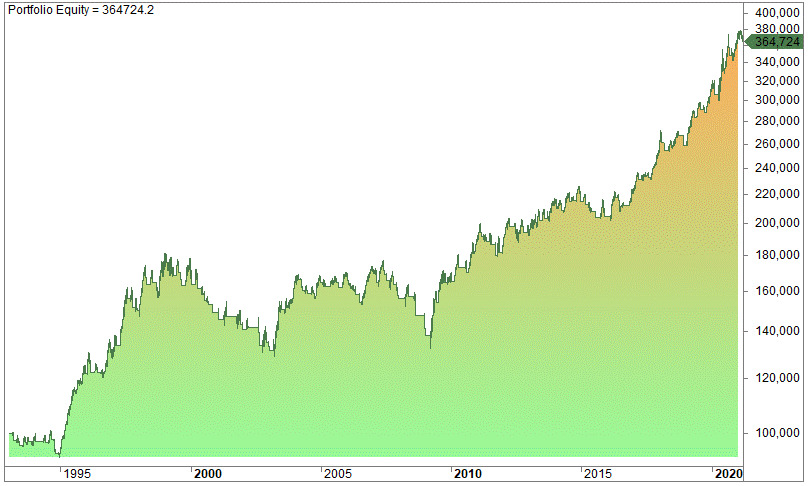
Monday/Tuesday Trade In Nasdaq – Update System (Enhanced Trading Strategy): The Turnaround Tuesday effect happens from the close of Monday’s trading session until (at least) the close of Tuesday’s trading session. The effect is no myth! Let’s do some backtesting to find what seems to work and not work. We backtest the following trading rules: * Today is either Monday or Tuesday. * Internal Bar Strength (IBS) is 0.15 or below. * If both criteria 1 and 2 are fulfilled, go long QQQ at the close. * Exit at close if today's close is higher than the close of yesterday. This strategy has performed well since the year 2000, and the equity chart from 2010 is like below, assuming a 100% allocation of equity to this strategy. The equity curve is shown below. Can the strategy be improved or made different? If you have any suggestions, please comment 👇
QuantifiedStrategies.com tweet media
English
1
1
17
1.2K
QuantifiedStrategies.com
QuantifiedStrategies.com@QuantifiedStrat·
Larry Connors %B Strategy – A Simple Mean Reversion Edge Today, we’re looking at a classic idea from Larry Connors built around the %B indicator. This is a mean reversion approach that focuses on short-term pullbacks within a broader trend. Instead of chasing momentum, it looks for moments when price stretches too far and is likely to snap back. The %B indicator, derived from Bollinger Bands, helps quantify when the market is reaching those short-term extremes in a simple and objective way. What makes this strategy interesting is its balance: • It trades infrequently • It aims for quick recoveries • It focuses on small, repeatable edges rather than big moves Our backtest on the S&P 500 shows relatively few trades over time, but with solid average gains and very low market exposure. As with most mean reversion strategies, the profile is many small wins with the occasional larger loss, so execution and risk control matter.
QuantifiedStrategies.com tweet media
English
0
0
12
1.1K
QuantifiedStrategies.com
QuantifiedStrategies.com@QuantifiedStrat·
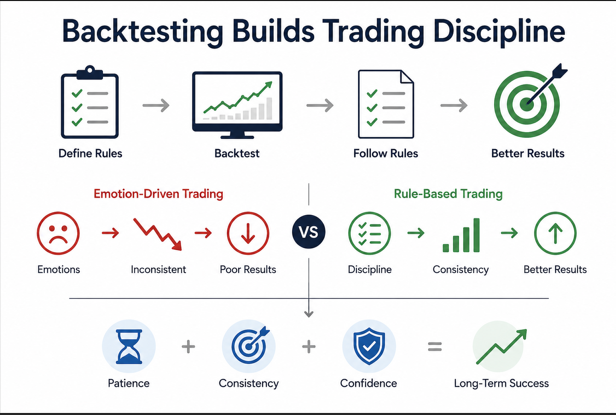
Backtesting Builds Trading Discipline One of the biggest benefits isn't technical at all. By encouraging traders to follow predefined rules instead of emotions, backtesting promotes patience, consistency, and confidence. That disciplined approach becomes an important part of long-term trading success.
QuantifiedStrategies.com tweet media
English
0
1
2
611
DFi
DFi@DeFi_initiate·
@QuantifiedStrat Interesting research. I'm curious why they are presenting performance data from 2008 when it's clearly stated that the data is from 2005. Also, it would be useful to see how the strategy performs in 2026. Did you replicate the research in your own environment?
English
1
0
0
84
QuantifiedStrategies.com
QuantifiedStrategies.com@QuantifiedStrat·
A paradox of markets: Short-term trading volume is huge, yet long-term investors are the ones who capture most of the wealth creation.
QuantifiedStrategies.com tweet media
English
0
0
2
570
QuantifiedStrategies.com retweetledi
QuantifiedStrategies.com
QuantifiedStrategies.com@QuantifiedStrat·
Simple trading rules often outperform complicated ones. This Triple RSI strategy achieved a 91.03% win rate in our backtest. In the video, we explain the rules, results, and key takeaways.
English
18
103
617
72.8K
QuantifiedStrategies.com retweetledi
QuantifiedStrategies.com
QuantifiedStrategies.com@QuantifiedStrat·
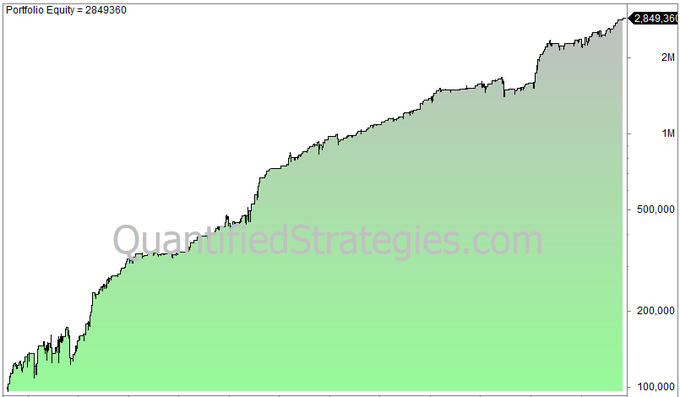
KELTNER CHANNEL TRADING STRATEGY – 80% WIN RATE! | BACKTEST 📈 In this post, we take a look at Keltner Channel to see what it is, how they are calculated, how they differ from Bollinger Bands, and if it’s possible to make money on Keltner Bands. We test a Keltner Channel trading strategy. We backtest the following trading rules: * The close is above the upper band. Enter at the close. * Sell when the close is below the "typical price". Exit at the close. * Optimize by using a period from 2 to 50 days. * We optimize by using different ATRs from 1 to 2. If we use 30 days and an ATR of 1.1 we get the equity curve (shown below) on the S&P 500 (SPY) Can the strategy be improved or made different? If you have any suggestions, please comment 👇
QuantifiedStrategies.com tweet media
English
1
12
66
7K