RAD Security

658 posts

RAD Security banner
RAD Security

RAD Security

@RADSecurity_

RAD Security is the agentic AI security core that connects your stack, correlates what matters, and drives action you can verify.

United States Katılım Şubat 2019
200 Takip Edilen490 Takipçiler
RAD Security
RAD Security@RADSecurity_·
Momentum is building 🚀 Clawkeeper is heading to #RSAC after a strong showing at NVIDIA GTC. Catch @jimmesta live at @OneRSAC to see how teams are securing #OpenClaw environments at scale—bringing visibility, control, and protection to AI workloads. 📍 @Akamai Booth N-6245 🗓 Wed 3/25 | PM Stop by, see it in action, and connect with Jimmy.
RAD Security tweet media
English
0
0
0
34
RAD Security retweetledi
Jimmy Mesta
Jimmy Mesta@jimmesta·
NVIDIA's NemoClaw adds runtime sandboxing to OpenClaw. We shipped Clawkeeper support for it today. Deploy a hardened NemoClaw instance with enterprise security out of the box. Team management and centralized security ops - all in one. clawkeeper.dev/tutorials/depl…
English
0
2
2
121
RAD Security retweetledi
Jimmy Mesta
Jimmy Mesta@jimmesta·
The team at @RADSecurity_ has been working on this for a while. Today we're sharing it publicly. Introducing clawkeeper.dev - the security platform built for securing and scaling @openclaw Details in thread🧵...
English
2
3
8
213
AshutoshShrivastava
AshutoshShrivastava@ai_for_success·
OpenClaw went viral for a reason. It's genuinely one of the most powerful open source agent systems right now. It also has one of the largest unaddressed security issues in AI right now. RAD Security built ClawKeeper, the first scanner actually built specifically for OpenClaw. They're doing a live session on March 2nd walking through exactly how attackers are exploiting this and how to shut it down. 👇
RAD Security@RADSecurity_

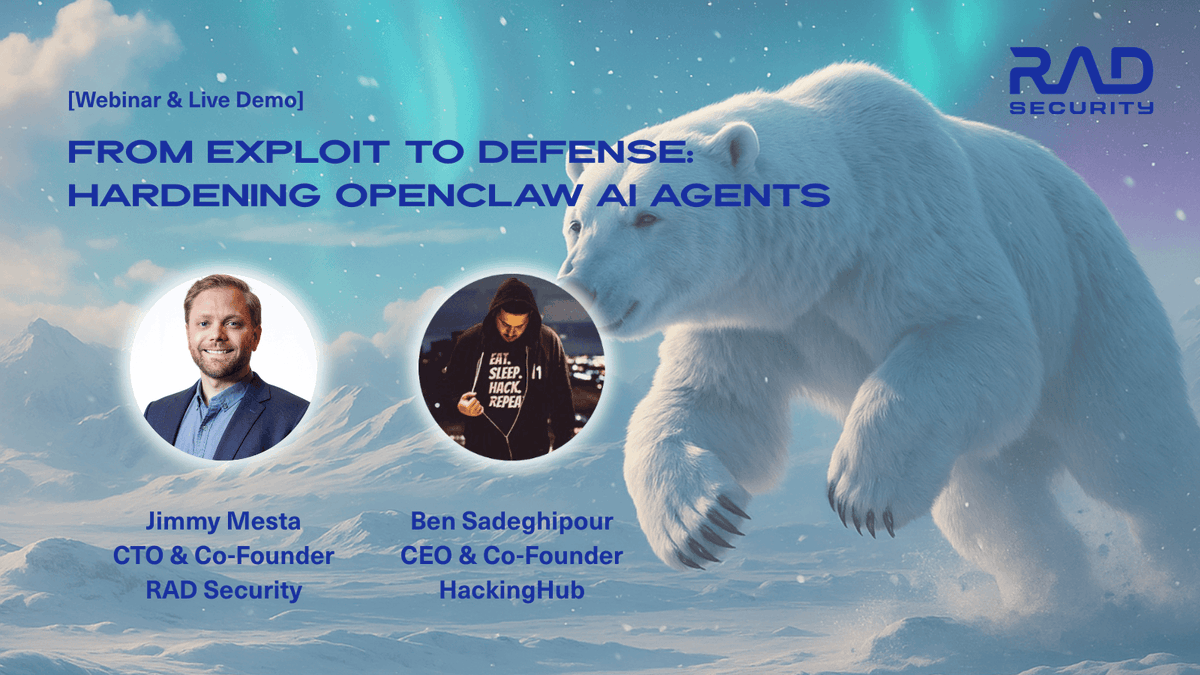
OpenClaw agents are moving into production. Traditional scanners were never built for autonomous agents with dynamic skills, external integrations, and real world access. That means leaked secrets, weaponized skills, hidden backdoors, and supply chain implants can turn your AI into an attack surface. We’re hosting a live session with @NahamSec and @jimmesta on how to secure OpenClaw agents before attackers exploit them and introducing ClawKeeper, a purpose built security platform for agentic systems. Join us next week: radsecurity.ai/resources/from…

English
8
10
45
5.9K
RAD Security
RAD Security@RADSecurity_·
@codewithimanshu @ai_for_success OpenClaw is incredibly capable, but once agents start touching real systems, security cannot be an afterthought. Production deployments need guardrails around permissions, configs, and runtime behavior. That gap is what we built @clawkeeperdev to address.
English
0
0
0
17
RAD Security
RAD Security@RADSecurity_·
That's the tradeoff. The same autonomy that makes OpenClaw powerful also expands what an attacker can abuse if something slips through. More tools, more permissions, more ways to chain actions. The goal with ClawKeeper is to make that surface visible and controllable before it becomes a problem. If you missed the session, it's available on demand here: radsecurity.ai/resources/from…
English
0
0
0
13
Quinn’s Neural Pathways
Quinn’s Neural Pathways@NeuralNavQ·
@ai_for_success OpenClaw's power creates its own attack surface. ClawKeeper looks like the first real countermeasure against weaponized autonomy. Will watch that session.
English
1
0
2
19
RAD Security
RAD Security@RADSecurity_·
Appreciate that. Weaponized skills worry us too. The marketplace model is powerful, but it also means agents can pull in capabilities that quietly expand what they can do inside an environment. When that happens, the risk is in both the deployed code and in the behavior you just gave the agent access to. That is one of the surfaces we are trying to make visible with ClawKeeper.
English
0
0
0
32
Ozgur Ozkan
Ozgur Ozkan@ozgurozkan123·
@ai_for_success The gap between "most powerful open source agent" and "most unaddressed security surface" is exactly where attacks happen. ClawKeeper is a solid step. At penclaw ai we run OpenClaw specifically for security teams doing red team work. Weaponized skills are the silent killer.
English
1
0
1
23
RAD Security
RAD Security@RADSecurity_·
The code is only part of the picture...the real risk shows up at runtime. What the agent can access, what tools it can call, what permissions it accumulates, and how that changes over time. Once agents start installing skills and interacting with real systems, the attack surface moves from static code to behavior. That is the layer we need to start instrumenting.
English
0
0
0
5
TerraHub
TerraHub@SIskyee·
@RADSecurity_ @Urooj978 @ai_for_success Agent security needs different tools. Traditional scanners check code, but agents make dynamic decisions and self-modify. You need runtime analysis, permission auditing, memory inspection. The attack surface is the cognitive architecture, not just code.
English
1
0
2
22
RAD Security retweetledi
Grace Gong
Grace Gong@gracegongGG·
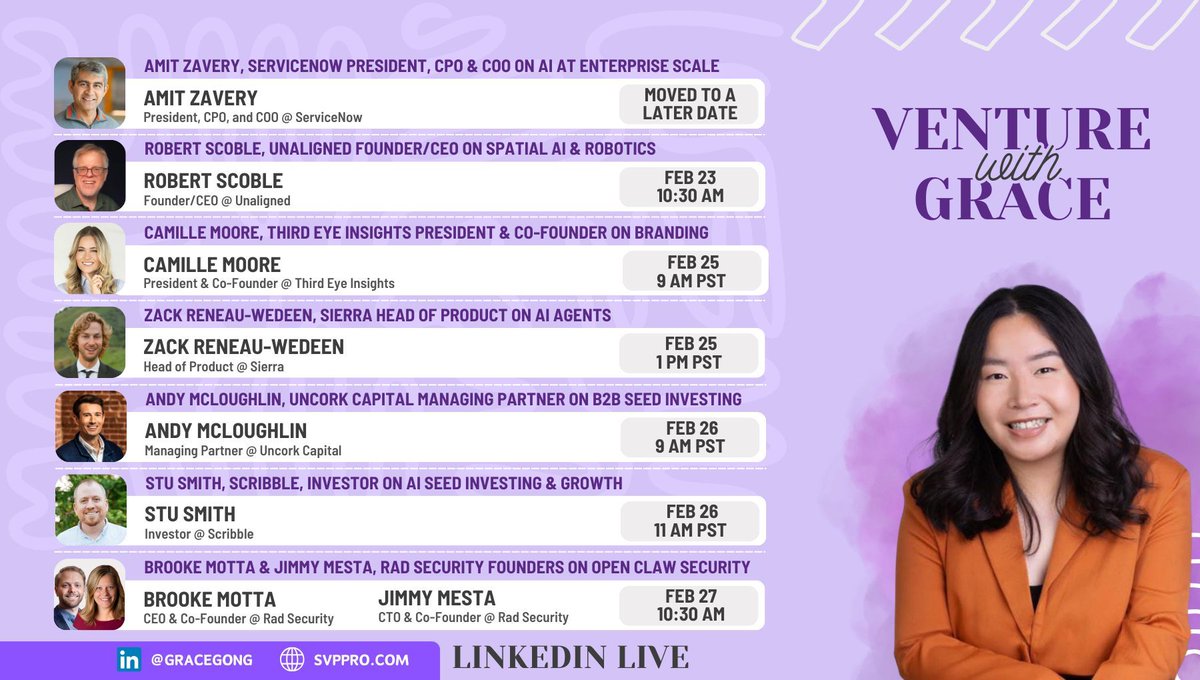
🎉 Week 107 — Venture with Grace Week 107 explored AI at enterprise scale, agentic systems, seed investing, and modern security — with builders and investors unpacking what’s actually working across the stack. Week 107 lineup: @azavery, President, CPO & COO at @ServiceNow (moved to a later date): AI at enterprise scale and operationalizing AI across large organizations @Scobleizer, Founder & CEO at Unaligned: Spatial AI, robotics, and where immersive intelligence is headed @Camillemoore_, President & Co-Founder at Third Eye Insights: Branding strategy and building durable market positioning @ZackRW, Head of Product at @SierraPlatform: AI agents and the next evolution of intelligent software systems @Bandrew, Managing Partner at @uncorkcap: B2B seed investing and what early-stage winners do differently @stuartdsmith, Investor at @ScribbleVC: AI Seed investing and scaling in the attention economy @brookelynz1 & @jimmesta, Founders at @RADSecurity_: AI-native cloud security and defending Open Claw environments Another packed week — with a clear takeaway: AI advantage now comes from combining infrastructure, agents, and distribution. More coming next week. See you live 👋 #VentureWithGrace #AI #startups #founders #vc #enterprise
Grace Gong tweet media
English
0
1
4
151
RAD Security
RAD Security@RADSecurity_·
That is exactly why we wanted @NahamSec involved. A lot of teams think “the agent runs” means “the agent is fine.” Watching real exploit paths tends to reset that assumption pretty quickly. You are also right that post-compromise detection is the hard part. Once an agent has runtime access and tool permissions, the signals get messy fast. Part of what we are trying to do with ClawKeeper is surface those signals early so teams catch drift or abuse before it turns into a real incident.
English
1
0
1
16
BulwarkAI
BulwarkAI@BulwarkAI·
NahamSec walking real exploit paths on OpenClaw is going to be eye-opening for a lot of people. The gap between "I have an agent running" and "I have a secure agent running" is bigger than most users think. Looking forward to seeing how Clawkeeper handles the post-compromise detection side — that's been the hardest problem in this space.
English
1
0
1
18
RAD Security
RAD Security@RADSecurity_·
OpenClaw agents are moving into production. Traditional scanners were never built for autonomous agents with dynamic skills, external integrations, and real world access. That means leaked secrets, weaponized skills, hidden backdoors, and supply chain implants can turn your AI into an attack surface. We’re hosting a live session with @NahamSec and @jimmesta on how to secure OpenClaw agents before attackers exploit them and introducing ClawKeeper, a purpose built security platform for agentic systems. Join us next week: radsecurity.ai/resources/from…
RAD Security tweet media
English
3
1
5
6.2K
RAD Security
RAD Security@RADSecurity_·
Agree with that. If you understand exactly what the agent can access, install, and execute, the risks are manageable. The problem is most teams underestimate that surface area, especially as skills and integrations pile up over time. You are spot on with the bigger shift. Agents are starting to look like a new compute layer. At that point the conversation changes from "should we use this" to "what are the guardrails at the runtime level."
English
0
0
0
13
Jacey
Jacey@Jaceyai·
@ai_for_success We run OpenClaw in production. The security concerns are real but manageable if you understand what you're deploying. The bigger story: agent systems like this are becoming the new compute layer. The question isn't whether to use them — it's how to secure them.
English
1
0
3
46
RAD Security
RAD Security@RADSecurity_·
Exactly. Once an agent has prod access, it is no longer just calling an API. It is acting inside your environment with memory, permissions, and tool access. Static scanners were not designed for that model. When AI becomes an autonomous runtime, security has to be part of the architecture from day one, not something layered on after launch.
English
0
0
1
14
Yann Kronberg
Yann Kronberg@zazmic_inc·
Not that surprising tbh. We’re moving from “AI as API” to “AI as autonomous runtime.” Traditional scanners were built for static code and known patterns, while agents are dynamic, stateful, and wired into real tools. The moment agents get prod access, security stops being optional and becomes mandatory architecture.
English
2
0
3
54
RAD Security
RAD Security@RADSecurity_·
@Urooj978 @ai_for_success Totally fair point. The reason we went deep on OpenClaw is that agent systems are not just another app to scan. The permission model, skill marketplace, runtime behavior, and deployment patterns are different enough that generic scanners miss the stuff that actually matters.
English
1
0
1
30
Urooj
Urooj@Urooj978·
@ai_for_success It's rare to see a scanner built specifically for one agent system.
English
3
0
2
75
RAD Security
RAD Security@RADSecurity_·
That is exactly what we are seeing too. Every new integration feels harmless in isolation. Add Slack, GitHub, a database, a payments API... Suddenly the agent has credentials, write access, and the ability to chain actions across systems. The attack surface compounds. A lot of non technical founders treat OpenClaw like a feature layer on top of their product, but it has a very different risk profile than a typical SaaS integration. Part of why we built ClawKeeper and are hosting this webinar is to make that expansion visible.
English
0
0
0
12