SWAG II
67 posts

SWAG II
@RAFFLEBAGSAPP
9ZNnTzoAt6m7Y1Xfnj3yqAhda1KZS1LmAsbuYM3Xpump ALBUM DROPPING MIDNIGHT SWAG II
Katılım Eylül 2025
4 Takip Edilen14 Takipçiler

Others built facilitators. We built the backbone.
x402Bscan is not simply processing x402 payments, it's indexing, verifying, and facilitating the entire open payment layer on @BNBCHAIN 🔸
A protocol where agents, users, and data flows connect through verifiable on-chain value.
Explore→ x402bscan.io
BNB Chain Developers@BNBChainDevs
Let’s talk about x402: the protocol turning HTTP into a native onchain payment layer. For years, “HTTP 402 Payment Required” sat unused but the x402 protocol changes this. It turns standard HTTP into a native value protocol, allowing websites and apps to request and settle payments directly onchain. Here’s what that means: Instead of the usual “401 Unauthorized” that requires a static API key, a server can now respond with “402 Payment Required” and include an onchain invoice. It’s a simple, stateless, and machine-readable way for digital services to exchange value over the web. For builders on BNB Chain, this unlocks a new layer of utility: • Monetize API endpoints directly • Charge per query, per token, or per compute unit • Enable autonomous agents to pay each other instantly without pre-set keys This is where the @BNBCHAIN ecosystem impact begins. x402 enables a real machine-to-machine economy where agents, data sources, and services interact and pay each other automatically. Think of an AI agent buying data to complete a task, a DePIN node charging per compute request, or an LLM billing per-token inference, settled in real time. Each interaction creates thousands of small, automated payments that drive constant blockspace demand and long-term utility for $BNB. The Core Technical Challenge The x402 gasless flow relies on EIP-3009 (transferWithAuthorization). This allows a client (agent) to sign a payment, which a third-party facilitator can then submit, covering the gas. The problem: major stablecoins on BNB Chain, like USDT, are standard ERC-20s and don’t support this function. Solution 1: Universal Facilitator Contract (via @AEON_Community) AEON’s approach introduces a facilitator contract that supports both EIP-3009-enabled tokens and standard ERC-20s. For standard ERC-20 tokens (pre-step): users authorize the facilitator contract to handle the transaction. (It’s important to verify the correct contract address and only authorize small token amounts.) Signature Verification: The AEON Facilitator Contract verifies the signature from the client. Token Transfer: After successful verification, it interacts with the token contract by calling the standard transferFrom function. Transaction Execution: The transferFrom function moves the funds — for example, “10U from A to B.” This works because the client’s wallet pre-approved the AEON Facilitator Contract to spend the tokens. Solution 2: Asset-Level Wrapper (via @pieverse_io) Pieverse’s x402b protocol introduces pieUSD, an EIP-3009-compliant wrapper for USDT. Flow: • Client → Resource Server: Sends an HTTP request with an X-PAYMENT header that includes the payment and optional compliance metadata. • Resource Server → Facilitator: Verifies the signature and initiates settlement via /settle. • Facilitator → Blockchain: Uses the user’s signed authorization to call transferWithAuthorization on the pieUSD contract (gasless). • Facilitator → BNB Greenfield (optional): Uploads a compliance receipt to Greenfield, creating an immutable and audit-proof record. • Facilitator → Resource Server → Client: Returns a standard x402 response, optionally including the Greenfield receipt URL. In simple terms, users sign, facilitators submit, and BNB Greenfield preserves the proof — all within a single, seamless, web-native payment flow. Solution 3: S402 via MultiWallet Pool with EIP-2612 (the permit function) (via @SoraOracle) Client-side (User): The user or agent wants to access an API. Instead of signing an EIP-3009 message, they sign an EIP-2612 permit message, authorizing the S402Facilitator contract to spend their tokens. Backend (Middleware): The S402 service receives this signed permit, verifies the signature to confirm payment intent, but doesn’t wait for onchain settlement. Backend (API): Once the signature is verified, the API optimistically serves the requested data. Backend (Settlement): The middleware passes the permit to the MultiWalletS402Pool. One of ten worker wallets (each with its own nonce) submits the transferFrom transaction to the S402Facilitator contract, which pulls the funds and settles the payment onchain, taking its 1% fee. This setup cleverly works around the EIP-3009 limitation. The core trade-off: Instead of the unavailable EIP-3009 (transferWithAuthorization), it uses EIP-2612 (permit). Why this works: EIP-2612 is more common and supported by many ERC-20 tokens on BNB Chain. It also provides a gasless user experience by allowing a signed approval that a relayer can later execute via transferFrom. The new problem: A single relayer wallet would face a sequential nonce bottleneck. Sora’s solution: The MultiWalletS402Pool uses ten parallel wallets to bypass the single-nonce limit, enabling up to 10x concurrent transactions. This design achieves high throughput and reduces cost per payment from about $0.12 to roughly $0.003 by amortizing gas fees. To make this even simpler, native EIP-3009 enabled assets are in the pipeline. The autonomous agent economy is being built on the BNB Chain now.
English
'The next stage will be all about use cases that feel like magic to end users.'
Real applications powered by @x402bscan, where payments, data, and agents interact seamlessly! 🔸
Greg@gregoffchain
Why x402 Still Has a Long Way to Go Everybody talking about robotics and x402 and of course it's trending, but let's have a look at what’s actually working. The last piece on x402 got a lot of attention because it captured the sense of something new, a protocol that could power the next evolution of the internet. But with that hype also came a reality check. Because if we’re honest, most crypto AI agents today aren’t doing much that people would actually pay for. The Problem With “Paying Per Nothing” Let’s start with the obvious: paying per request only makes sense if what you’re paying for is useful. Right now, most crypto agents aren’t solving real problems. They don’t make anyone more productive, don’t save costs, and often don’t even work reliably. They’re toys. You can’t build an economy agentic or otherwise on top of products that don’t generate real utility. a16z recently analyzed data from ~200,000 startups. They found that the AI tools people actually pay for fall into two categories: > Horizontal tools like meeting apps (Otter), creative platforms (Canva, ElevenLabs), or code copilots (Replit, Cursor). > Vertical tools built around real workflows: customer support, sales, recruiting, compliance. They work because they replace or augment human effort, they make money or save money. Crypto AI isn’t there yet. Outside of infrastructure (compute, inference, payments), most products are making mid six figures a year. The only ones hitting eight figures are launchpads and that’s not because of utility, it’s because of speculation. The Core Questions Nobody Has Answered If we follow the logic of the “agentic economy,” where AI agents autonomously transact using x402, we still run into the hard stuff: > How do we trust them? > What’s the scope of work? > What happens when they mess up? > Who gives them reputation, credit, or refunds? > How do we stop them from being exploited? We can’t just hand wallets to autonomous bots and call that progress. Without trust, accountability, and feedback loops, x402 just becomes a faster way to waste money. The Foundation is Real That said, the idea of the pay-per-use internet is too big to ignore. The rails work. The architecture works. The integrations are growing. In the last 90 days, x402 processed roughly 2.7M transactions with a volume of $3.09M. We can see that a real network forming. Projects like @PayAINetwork, @AurraCloud and @daydreamsagents have shown what’s possible when agents can pay directly for access, research, or compute. And new tools like Mallory by @corbits_dev are finally starting to make it tangible, a consumer AI app that can call real APIs like Nansen’s gold-tier data for a fraction of a cent per request. That’s the direction that feels right: practical, visible, and consumer-facing. V2: A Step Toward the Real Thing x402 V2, now being scoped by Coinbase, Cloudflare, and community contributors is meant to fix a lot of what’s holding it back. It introduces cleaner architecture, better web compatibility, easier SDKs, and a smoother client–server flow where users won’t have to “pay ten times for ten requests.” It also brings support for more payment types, from stablecoins to fiat bridges, and a structure for optional add-ons like “sign-in with payment proof.” It’s not sexy, but it’s exactly what’s needed: boring infrastructure that works. Because until developers can integrate x402 like Stripe, the protocol will stay niche exciting on CT, invisible to the rest of the world. What Needs to Happen Next The next stage will be all about use cases that feel like magic to end users. When you open an app and get an answer from an agent that feels alive, useful, and worth paying for that’s when x402 crosses the chasm. We need products that: > Make people money or save them time. > Use x402 to unlock something new, not just reprice what already exists. > Build trust and accountability into every transaction. If you want a simple mental model: > 10x projects are great marketers. > 100x projects build tools crypto natives actually pay for. > 1000x projects build things people outside crypto will use without even realizing it’s crypto. The Takeaway x402 is still in a very early phase. The rails are brilliant, the vision is clear, but the use cases are thin and the economics unproven. That’s fine, everything important starts like this. And for everyone saying x402 tokens don’t make sense: you’re mid-curving it. Every new meta starts the same way: most projects will fade, but a few will build real products and design clear value flow to their token. Find those early and you’re owning pieces of what will become the foundation of the agentic economy.
English

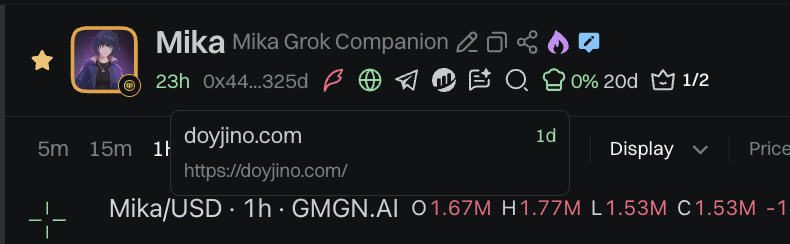
0x444489f1ded1f000e5b4cd53c16c26f13d1b325d
这个 CA 上的网站是个 scam ,大家小心。
cc @four_meme_ @0xAA_Science @isaaaaaaalt


中文


@four_meme_ @InsightXnetwork Your not building you can’t even fix servers your gonna lose all volume to Sol and it will be all over
English
There is no pvp what are you even on about this is the only runner so retarded
tony@tony_makemoney
We don't care about PVP by the way, it only brings more attention to us. $Sigil to the moon
English