Roger Waleffe

28 posts

Roger Waleffe

Roger Waleffe

@RWaleffe

Computer Sciences PhD student at the University of Wisconsin-Madison

Katılım Haziran 2020
25 Takip Edilen80 Takipçiler
Roger Waleffe retweetledi
Bryan Catanzaro
Bryan Catanzaro@ctnzr·
Today, @NVIDIA is launching the open Nemotron 3 model family, starting with Nano (30B-3A), which pushes the frontier of accuracy and inference efficiency with a novel hybrid SSM Mixture of Experts architecture. Super and Ultra are coming in the next few months.
Bryan Catanzaro tweet media
English
41
224
1.2K
503K
Roger Waleffe retweetledi
Bryan Catanzaro
Bryan Catanzaro@ctnzr·
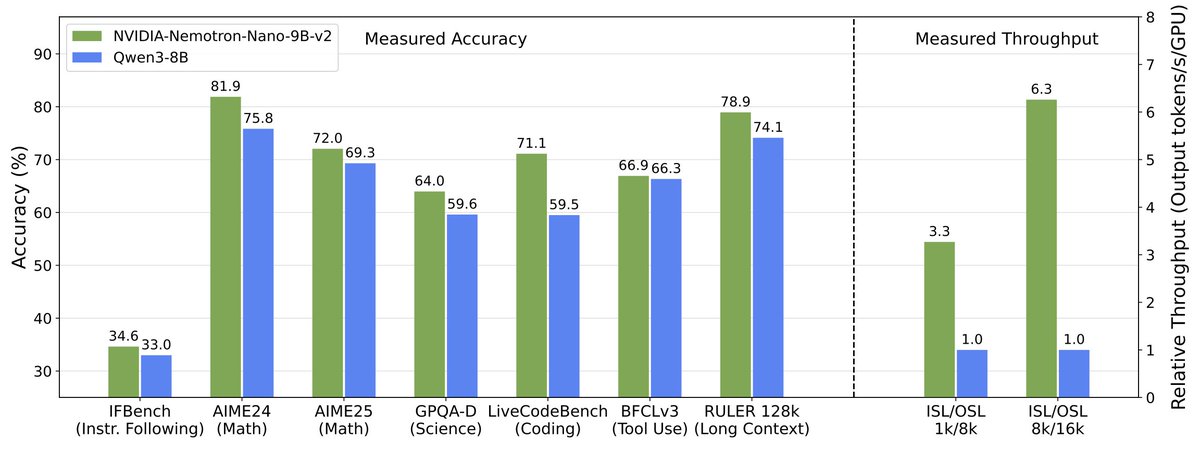
Today we're releasing NVIDIA Nemotron Nano v2 - a 9B hybrid SSM that is 6X faster than similarly sized models, while also being more accurate. Along with this model, we are also releasing most of the data we used to create it, including the pretraining corpus. Links to the models, datasets, and tech report are here: research.nvidia.com/labs/adlr/NVID…
Bryan Catanzaro tweet media
English
39
236
1.4K
275.7K
Roger Waleffe retweetledi
Bryan Catanzaro
Bryan Catanzaro@ctnzr·
Nemotron-H: A family of Hybrid Mamba-Transformer LLMs. * Hybrid architecture means up to 3X faster at the same accuracy * Trained in FP8 * Great for VLMs * Weights and instruct versions to come soon. research.nvidia.com/labs/adlr/nemo…
Bryan Catanzaro tweet media
English
18
102
632
200.9K
Bryan Catanzaro
Bryan Catanzaro@ctnzr·
A 8B-3.5T hybrid SSM model gets better accuracy than an 8B-3.5T transformer trained on the same dataset: * 7% attention, the rest is Mamba2 * MMLU jumps from 50 to 53.6% * Training efficiency is the same * Inference cost is much less arxiv.org/pdf/2406.07887
Bryan Catanzaro tweet media
English
18
77
436
118.7K
Roger Waleffe
Roger Waleffe@RWaleffe·
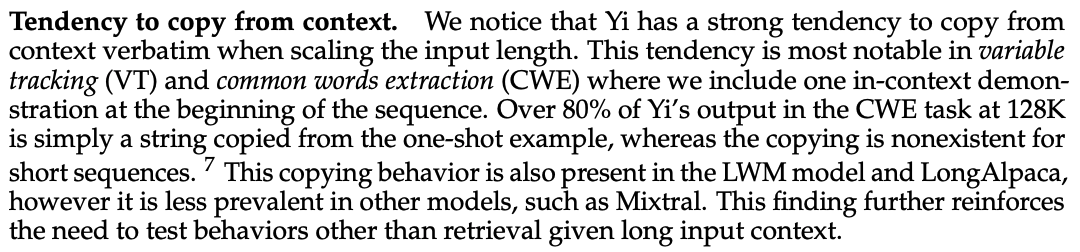
@WesleyYue @ctnzr The authors of the RULER benchmark observed something similar for some Transformers they tested.
Roger Waleffe tweet media
English
0
0
0
56
Roger Waleffe retweetledi
Theo Rekatsinas
Theo Rekatsinas@thodrek·
Data pruning to reduce pertaining costs is hot, but fancy pruning can take just as long to select data as to train on all of it! Patrik, @Rwaleffe, and @vmageirakos's work at #ICLR2024 tomorrow shows how a simple, low-cost tweak to random sampling outperforms trendy methods!
Roger Waleffe@RWaleffe

Not convinced about using random sampling for data pruning? Consider twice! In our recent work, we introduce Repeated Sampling of Random Subsets: arxiv.org/abs/2305.18424, where we sample a subset of data at each epoch of training instead of only once at the beginning!

English
2
4
15
2.4K
Roger Waleffe
Roger Waleffe@RWaleffe·
@rishiyer Thanks for sharing this!! Continuous random exploration had also been part of our motivation.
English
0
0
1
134
Rishabh Iyer
Rishabh Iyer@rishiyer·
@RWaleffe Nice work! We had also observed this some time back. The reason this kind of random sampling scales better (we call it random online) is that it explores new subsets very quickly. In recent work (MILO: arxiv.org/pdf/2301.13287…) we combined this idea with representation sampling..
English
3
0
2
308
Roger Waleffe
Roger Waleffe@RWaleffe·
Not convinced about using random sampling for data pruning? Consider twice! In our recent work, we introduce Repeated Sampling of Random Subsets: arxiv.org/abs/2305.18424, where we sample a subset of data at each epoch of training instead of only once at the beginning!
English
3
8
40
19K
Roger Waleffe
Roger Waleffe@RWaleffe·
@BlackHC Regardless of which ‘viewpoint’ one chooses to look at our method with, this algorithm had yet to be studied extensively (empirically and theoretically).
English
1
0
1
92
Roger Waleffe
Roger Waleffe@RWaleffe·
@BlackHC If the sampling of S’ across rounds is done without replacement (instead of with replacement), then our method can also be seen as training on the full dataset but with early stopping after a few epochs (discussed in the paper). This version is particularly useful for analysis.
English
1
0
1
107