
Raman Jha
1.4K posts


Raman Jha
@RamanRKJ
.Believe in 'EKLA CHALO RE'.A dreamer and always have urge to do good things.Passion for Music,Yoga
Delhi and Bihar Katılım Eylül 2010
510 Takip Edilen82 Takipçiler

🤔🚀 Comment your answer 👇👍⚡
#python #programming #codinglife #developers #pythonquiz #codingquiz #codingchallenge #100DaysOfCode

English
@GeminiApp Is Deep research equally good for web development projects?
English

Introducing Deep Research, your personal agentic AI research assistant. Rolling out starting today in Gemini Advanced.
With Deep Research, you can create in-depth research reports on complex topics, complete with source links, giving you hours of research at your fingertips in just minutes.
Visit gemini.google.com and select Deep Research from the Gemini Advanced model drop-down to get started.
English
💯 I'm excited to share that I'll be starting the #7daysofaicoding challenge soon!
Join me via #100school / @100schoolhq
100school.com/atomic-challen…
English
@Swetha_Srii Me too !! What is your level of expertise on backend tools ? What about dB : mySql, postGreSql or else?
English


@bobziroll Hello!! I m getting t error "U defined a loader for route '0-2' but didn't return anything from yr 'loader' fun,pl return a value or 'null'" instead of custom error as u showed on Scrimba in van-life app,pl help
English
Used @MetaAI_Lab and @MSFTCopilot to assist me understand @typescript Utility types,found the 1st one better
English
@AskAnshul These infiltraters prefer a non BJP ruled state. There is so much favaurtism for M in these states
English

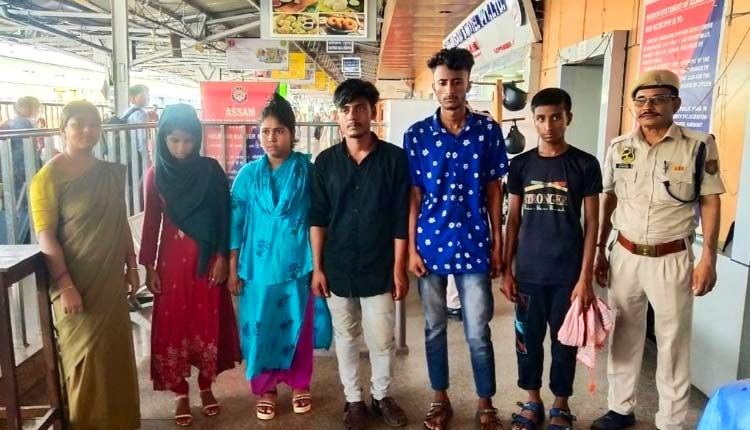
5 illegal Bangladeshis arrested at Guwahati railway station. They were about to travel to Bengaluru.
Why so many illegal Bangladeshis are going to Bengaluru must be investigated. There have been several such cases reported this year. This is serious concern for national security
English
@AskAnshul Biometric attendance has been implemented in states like Bihar, Jharkhand after some resistance. The UP govt must not succumbed to some teachers lobbies.
English
UP Govt introduced biometric attendance for teachers in govt schools to ensure:
1) Teachers arrive on time.
2) Stop proxy use, meaning a teacher cannot mark "Present" on behalf of a colleague.
But, teachers protested against biometric attendance and now UP Govt has cancelled it
English

I'm incredibly happy to share that MDN has chosen @scrimba as their recommended course partner 🔥
Read more in this thread 👇
Scrimba@scrimba
Big news! Scrimba is now Mozilla MDN's recommended course partner 🎉 MDN is one of the world's leading authorities on web technologies, so we are super proud that they picked us as their partner.
English
@bobziroll @scrimba @freeCodeCamp Big appalude 👏 Bob !! Launching on freecodecamp 'll definitely increase the course accessibility many fold.
English

The first section of my free @scrimba TypeScript course has launched on the @freeCodeCamp YouTube channel!
I’m planning to eventually add a 2nd and 3rd section to the TS course, but I’m taking a break from it to work on the 3rd iteration of my free intro React course for the next while. 🎉
youtu.be/SpwzRDUQ1GI?si…

YouTube
English
@AskAnshul BJP municipal councilors performance in civic works is not up to the mark That is why it lost many a seats to Aaps in last municipal elections. It is time for BJP to do a course correction in municipal works
English
When CM Kejriwal went to jail, analysts claimed that the BJP could not win all seven seats in Delhi.
However, the BJP swept the election with new faces and secured 54.35% of the vote share despite the AAP-Congress alliance.
All booth-level workers were managed by a mobile app with an entire UT dashboard.
BJP Delhi President Virendra Sachdeva made many strategic decisions, used technology, promoted youth leadership, and focused on groundwork and a door-to-door campaign. This is why the BJP was able to score a hat-trick sweep and performed well compared to other nearby states.
English
@bobziroll @scrimba For many React learner including I, CSS is still to be masterd. So practicing it along with React course is a bonus. Pl. Keep doing it, thanx
English
In my current Intro React course on @scrimba, I spend a fair amount of time and exercises (mostly in the beginning) writing CSS in the recordings to match designs. I originally chose to do this as a way to avoid anyone getting lost between cuts in the recording when a bunch of work was suddenly done.
I've gotten mixed feedback about this, and would like your opinion for my re-record of the course that I'm working on. Also, your specific thoughts in the comments are helpful!
English
@AskAnshul @AshwiniVaishnaw Some of the program and policies of Modi govt belie ground realities. Recent overcrowding of sleeper coaches in trains and commuters barge into ac coaches without proper tickets, is due to @RailMinIndia decision to add more ac coaches and reduce the no of non ac sl coach.
English
Hello @AshwiniVaishnaw Ji
We hope that at least in this term you will address:
1. Huge occupancy of unreserved/without-ticket passengers in reserved coaches.
2. KAVACH system in all trains
3. Installation of train-platform gap fillers.
4. Illegal encroachment of railway land
English
@narayananh Th cast politics played the decisive role, The Ayodhya Faizabad area is dominated by SC, OBC , Instead of ppl to ppl contact, BJP believed in big rallies, and road shows.
English

UP is a puzzle but Ayodhya is even worse.
I'm scratching my head over the BJP's loss in Ayodhya. They've got temples, hotels, jobs, and an airport - what more do they need?
Thoughts?
English
This is not surprising, the irony is that no party will condemn it and demand action against TMC goons
Ashwini Upadhyay@AshwiniUpadhyay
पूर्वी बंगाल तो पहले ही बंगलादेश बन चुका है और पश्चिम पंजाब अब पाकिस्तान कहलाता है घुसपैठ, धर्मांतरण और जनसंख्या विस्फोट के खिलाफ़ कानून नहीं बना तो भारत बर्बाद हो जाएगा @narendramodi @AmitShah
English

I have created a Twitter List: Just Developers
Drop a 👋. I'll add you there.
🔗 x.com/i/lists/179215…
Criteria
❯ Posting at least weekly once
❯ Posting technical content
Like & RT for better reach.
English
@LostTemple7 A billion dollar question, a surge in voting percentage will definitely happen, In Sir Annamalai, BJP has got a formidable arsenal.
English

How many seats BJP can win out of 39 in Loksabha Election 2024 in Tamil Nadu ?
English
Raman Jha retweetledi

HTTPS is used everywhere.
But most engineers can’t explain how it simply works.
Let’s change that.
HTTP is a protocol to exchange data, most popularly used between a web browser and a website. 💡
HTTPS is the secure version of that protocol. 🛡
Why is it secure?
Encryption. 😶🌫️
The data is encrypted so that only the web browser and the website can read it locally.
Without this, man-in-the-middle (MITM) attacks could intercept your traffic and read sensitive data like passwords, credit card details, etc. 😱
The protocol used to encrypt the data is TLS (Transport Layer Security).
HTTPS = HTTP + TLS. Simple as that.
HTTPS uses asymmetric cryptography to encrypt the data. You have:
🔑 a private key - the website’s SSL certificate’s secret key that isn’t shared with anyone.
🔑 a public key - the certificate’s public key, shared with everyone who wants to interact with the website.
💡 Asymmetric cryptography simply means information that’s encrypted by the public key can only be decrypted by the private key. And vice versa.
In contrast, symmetric cryptography is when only one key is used, and data can be encrypted/decrypted with that same key.
HTTPS actually uses both types! 😎
Asymmetric cryptography is used to verify the server and securely generate a session key that’ll be used for symmetric cryptography.
The session key, as it implies, only lives within the session and is used by both the client & server to encrypt/decrypt data.
Most interestingly, this key is deterministically generated by both the client and server independently - it never crosses the wire. 🪄
So. What are the steps?
1. Client (browser) connects to a server (web page)
2. Server sends its SSL certificate (includes the public key).
3. Client & Server do a TLS handshake & generate a session key to encrypt/decrypt future HTTP data.
4. Business as usual.
The details are in the TLS handshake, and that’s frankly the most interesting part of how HTTPS works.
The TLS handshake serves three purposes:
🧐 1. authenticate the identity of the server
✨ 2. generate session keys for encryption during this single session
🤝 3. decide which version of TLS and what cipher suites you’ll use
Step by step (RSA Algorithm):
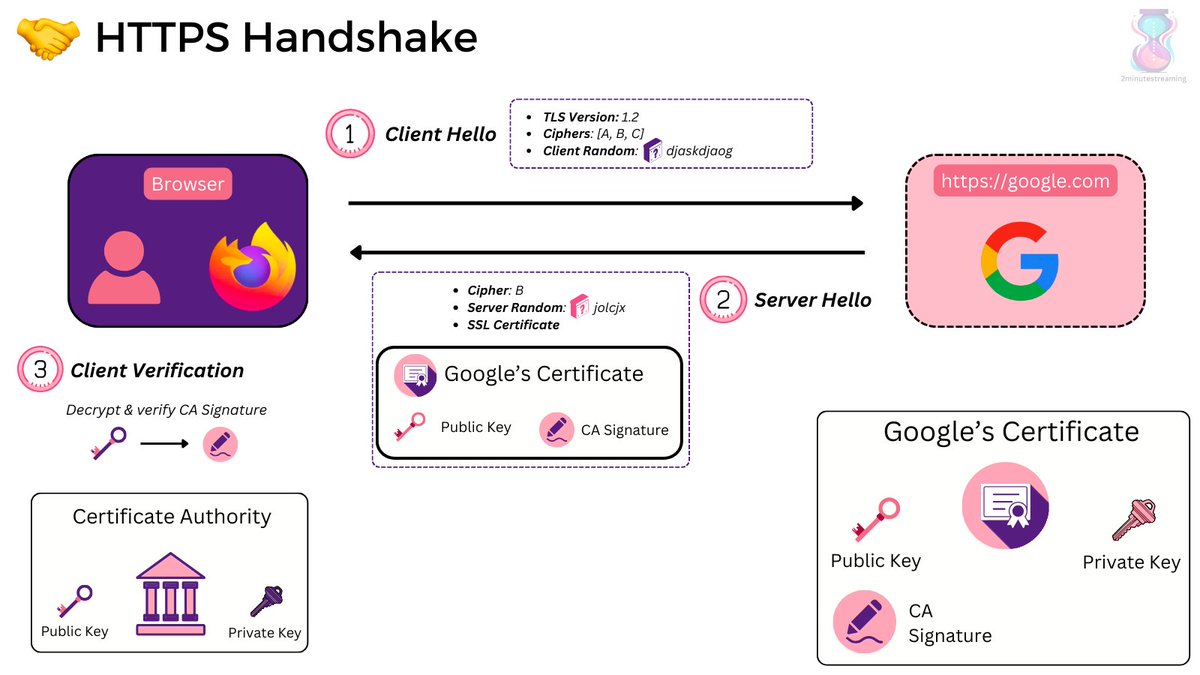
1. Client Hello Request: The client initiates the handshake with a message including what TLS version and ciphers it supports, including a string of random bytes (client random)
2. Server Hello Response: The server chooses a cipher suite and generates its own random string bytes (server random). It responds with the suite, its SSL certificate, and the server random.
3. Client Verification: The client verifies the certificate via the trusted certificate authority that issued it. The SSL certificate has a digital signature that’s signed by the CA’s private key so the client uses the CA’s public key to decrypt it.
After this step, the Client has verified that the certificate is the legitimate one verified via the CA - not one fabricated on the fly.
Note it still doesn’t know for sure whether the server actually owns that certificate (i.e has the private key)
Side note: who says what Certificate Authority can be trusted?
Your browser’s provider!
Apple, Microsoft, Google, Mozilla and etc. all maintain their own lists of CAs.
Your browser and operating system ship with this list of trusted CAs.
It’s all based on “trust”, so you better trust them!
Anyway, continuing...
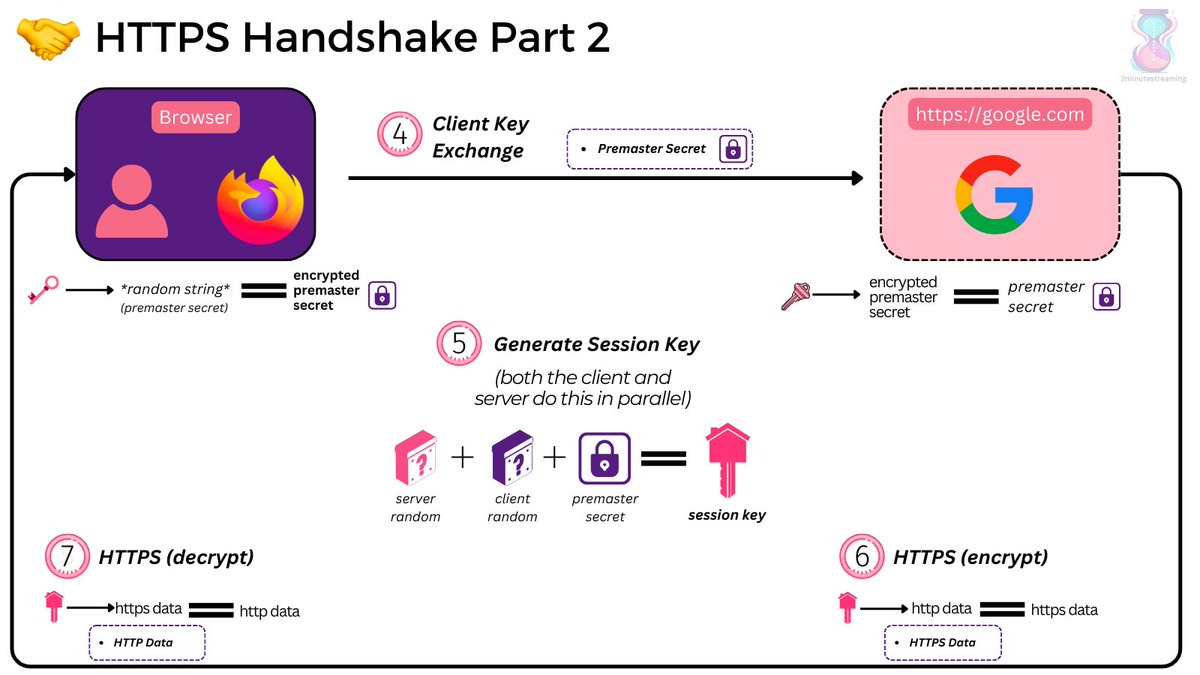
4. Client Key Exchange: The client creates a random string of bytes called the “premaster secret”. It encrypts it with the public key of the server it got from the SSL certificate and sends it over.
5. Session Key Generation: The server decrypts the premaster secret using the SSL certificate’s private key. Both the client and server, independently, generate session keys using the client random, server random, and the premaster secret.
Since they’re using the same data and deterministic algorithm, they should arrive at the same results. If they don’t - the subsequent encryption/decryption won’t result in the HTTP protocol.
💡 This step indirectly verifies to the client that the server has possession of the SSL certificate it presented (it didn’t just pretend to have it)
6. Done! The session key is now used to symmetrically encrypt/decrypt HTTP data.
English