E. Rankin

3.1K posts

E. Rankin banner
E. Rankin

E. Rankin

@RealEdRankin

Football Scout and 27 year coaching veteran. LV-NV/ YO-OH

Las Vegas, NV Katılım Nisan 2009
1.1K Takip Edilen1.2K Takipçiler
E. Rankin
E. Rankin@RealEdRankin·
@MRittCGS You're a wonderful content creator. Thanks for sharing your talents.
English
0
2
3
571
Mike Rittelmann
Mike Rittelmann@MRittCGS·
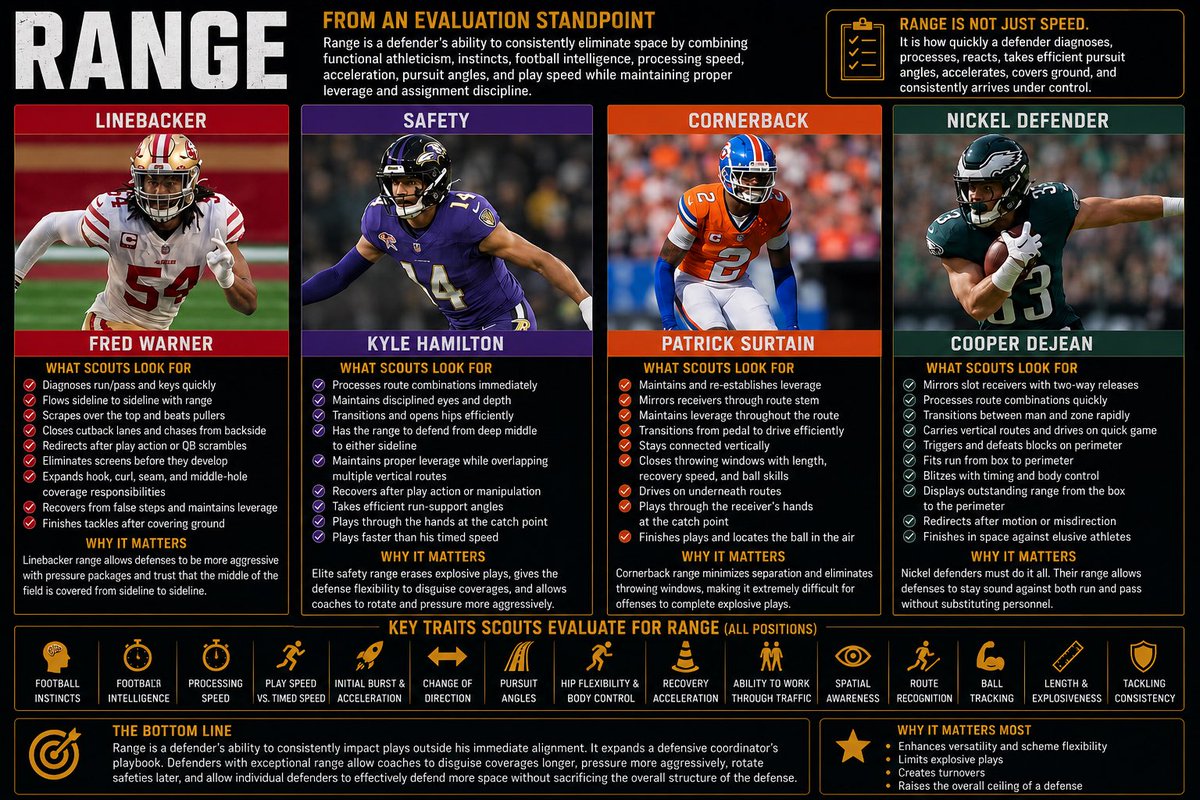
When evaluating linebackers and defensive backs, one of the most important traits I study is range Range is much more than straight-line speed. It’s a defender’s ability to consistently eliminate space by combining instincts, football intelligence, processing speed, pursuit angles, acceleration, body control, and play speed while maintaining leverage and assignment discipline For linebackers, range shows up in their ability to flow sideline to sideline, scrape over the top of blocks, close cutback lanes, expand coverage responsibilities, and consistently arrive at the football under control Safeties display range by covering significant amounts of field, overlapping routes, staying on top of vertical threats, and erasing explosive plays before they happen Cornerbacks demonstrate range through their ability to maintain leverage, transition efficiently, recover without panicking, and eliminate throwing windows throughout the route Nickel defenders may require the most complete version of range, as they are asked to cover the slot, fit the run, blitz, defend screens, and play effectively in both man and zone coverage One of the biggest misconceptions in scouting is that a great 40-yard dash automatically means a player has elite range. While speed certainly helps, true range is created by how quickly a defender processes information, trusts his keys, takes efficient pursuit angles, and plays with consistent urgency and discipline. Players who consistently “play faster than they test” often possess outstanding range because they see the game quicker and waste very little movement From a scouting perspective, defenders with elite range expand what a defensive coordinator can call. They allow defenses to disguise coverages longer, pressure more aggressively, limit explosive plays, create turnovers, and trust individual defenders to effectively defend more space without sacrificing the overall structure of the defense
Mike Rittelmann tweet media
English
3
9
66
8.3K
E. Rankin retweetledi
Kaiakea Kaai
Kaiakea Kaai@KaiakeaKaai·
Kaiakea Kaai | Bishop Gorman HS | C/O 28’ | Center | 6’ 2” | 320lbs. | 3.4 GPA | kaaikaiakea@gmail.com | (808)778-3575 |
Indonesia
0
1
19
7.9K
E. Rankin retweetledi
Nate Longshore
Nate Longshore@mrlongshore·
Online learning can become mundane when the player only watches, scrolls, and moves on. Learning material requires written notes, identification, and recall. Quarterbacks should not passively read defensive material. Mark it up. Identify the structure. Find the nickel or dime. Confirm who left the field, who entered, and what that substitution changes. Then test whether you can recognize the same picture on film. A 4-3 Nickel is not just a label. The defense replaced the Sam with a fifth defensive back to match speed. Dime adds a sixth defensive back, changing the available body types, pressure possibilities, and coverage answers. Command is built through identification, written notes, film confirmation, and recall testing. Do not just read the page. Learn to command the picture. Defensive Mastery: QBMethod.com
English
1
4
33
3.2K
E. Rankin retweetledi