

Sam
2.8K posts

Sam
@ReliableNarr
Partner at BBH | views expressed here are my own.
Katılım Ekim 2011
2.8K Takip Edilen4.2K Takipçiler


Today, Grass announced that it is rewarding network participants in USDC instead of its native token. Grass reached profitability near the end of last year, and is now in the unusual position of being able to compensate contributors directly from the revenue the network generates.
To me, this represents an important milestone. A network should eventually graduate from subsidized growth to a self-sustaining economy. Token incentives are a powerful tool for bootstrapping supply, but they should not become a permanent substitute for real demand.
The end state was never "pay people with tokens forever." The end state is a business with customers, cash flow, and a network whose participants are compensated because the underlying service creates real economic value.
We're still early in that journey, and there's an enormous amount of work ahead of us. But today feels like an important step, and it makes me incredibly excited for what's next.
English
Sam retweetledi

In just two weeks: some of the largest supply-chain attacks in history, a major commercial LLM sabotaging legitimate ML research requests, and a US export ban kneecapping the world's access to a major model release. More than ever, we need Open, Verifiable Inference.
Today we start shipping direct responses. A🧵:
English

Compute markets will clearly be a thing, but the big bottleneck is *deliverable* forwards
Ornn and others are doing great work on index data for speculative trades. But there’s still a gap in lower layers of infra for robust futures markets
If you’re working on core unlocks to exchange - standardization for tradeable units, reliable settlement infra, etc - we’d love to chat
FalconX@FalconXGlobal
FalconX has executed the first OTC compute forward trade referencing Nvidia H100 pricing. The transaction, executed with @rleshner as counterparty, references the @OrnnExchange Compute Price Index (OCPI H100) and marks an early step toward bringing price discovery and risk transfer to AI infrastructure markets. As compute becomes a critical economic input, markets for pricing and hedging compute are emerging as a new financial layer of the AI economy. falconx.io/newsroom/falco…
English
Sam retweetledi


Is anyone building physically settled derivatives for 1M tokens from a specific AI model (eg. a one month dated future for 1M Opus 4.7 tokens)
Physical settlement here might be the killer app for decentralized compute networks?
English

Were excited to be backing @kash_bot enabling fully permissionless prediction markets in the largest social feeds. Not another PM clone, the team have solved PM's biggest problems and developed a proprietary bootstrapping liquidity solution for any market without the need for traditional MMs.
kash@kash_bot
Our mission at Kash is to completely redefine how the world prices and distributes beliefs. We are meeting YOU where you already are, starting with social media. To accelerate this journey, we are proud to have partnered with top-tier VCs and raised $2M to bring prediction markets to your feed. Backed by @TheSpartanGroup and @BigBrainVC, with participation from Coinbase Ventures, Polaris Fund, Moonrock Capital, Halo Capital, Kosmos Ventures and Fabric Ventures. [Kash Flash Market: Will at least 3 verified accounts with over 100k followers quote post this announcement within the first 12 hours?]
English
@ericonomic This means any lost wallets like Satoshi's would still be vulnerable no matter what.
English
@ericonomic It's actually not trivial at all. Post-quantum signatures require bigger blocks (remember block size wars) and a soft fork would still require all UTXOs to migrate which could take more than 6 months alone (even with filling all blocks and not including non-migration tx).
English

TLDR: People are pricing in quantum attacks to Bitcoin, but not pricing in how easy it would be to solve them via a soft fork.
Willy Woo@willywoo
12 YR TREND BROKEN. BTC should be a valued a LOT HIGHER relative to gold. Should be. IT'S NOT. The valuation trend broke down once QUANTUM came into awareness. Don't read this post if you want to stay high on hopium instead of seeing things as they are.
English
New research claiming RSA2048 can be broken with just 100k physical qubits. Keep in mind ECC256 is easier to crack for quantum computers than RSA...
arxiv.org/pdf/2602.11457
English
Blockchains are for finance.
Solana is converging on the original Nasdaq on chain vision through ICM and even Base recently back tracked towards a trading-first platform.
The read write own thesis has mostly been disproven.
Vitalik may be the last bastion of the original cypherpunk ethos of crypto.
This is something most crypto-natives will have to think deeply about and wrestle with.
vitalik.eth@VitalikButerin
In 2014, there was a vision: you can have permissionless, decentralized applications that could support finance, social media, ride sharing, governing organizations, crowdfunding, potentially create an entire alternative web, all on the backs of a suite of technologies. Ethereum: the blockchain. The world computer that could give any application its shared memory. Whisper: the data layer. Messages too expensive for a blockchain, that do no need consensus. Swarm: the storage layer. Store files for long-term access. Over the last five years, this core vision has at times become obscured, with various "metas" and "narratives" at various times taking center stage. But the core vision has never died. And in fact, the core technologies behind it are only growing stronger. Ethereum is now proof of stake. Ethereum is now scaling, it is now cheap, and it is on track to get more scalable and cheaper thanks to the power of ZK-EVMs. Thanks to ZK-EVM + PeerDAS, the "sharding" vision is effectively being realized. And L2s can give additional and different kinds of gains in speed on top. Whisper is now Waku ( docs.waku.org ), and already powers many applications (eg. railway.xyz, status.app just to name two I use). Even outside of Waku, the quality of decentralized messaging has increased. Fileverse (decentralized Google Docs and Sheets alternative: fileverse.io ) has seen massive gains in usability over the past year. IPFS is now highly performant and robust as a decentralized way of retrieving files, though IPFS alone does not solve the storage problem. Hence, there is still room to improve there. All of the prerequisites for the original web3 vision are here, in full force, and are continuing to get stronger over the next few years. Hence, it's time to buidl, and buidl decentralized. Fileverse is an excellent example of the right way to do things: * It uses Ethereum and Gnosis Chain for what they are good for: names, accounts and permissioning, document registration * It uses decentralized messaging and file storage to store documents and propagate changes to documents * The application passes the walkaway test: github.com/fileverse/walk… (even if Fileverse disappears, you can still retrieve them and even keep editing them with the open source UI) This is what we mean by "build a hammer that is a tool you buy once and it's yours, not a corposlop AI dishwasher that requires you to register for a google account and charges a subscription fee per month for extra washing modes, and probably spies on you and stops working if you get politically disfavored by a foreign country". If you think this criticism of corposlop is hyperbolic, well turns out, it's literally a concatenation of these three: * mein-mmo.de/en/user-buys-n… * theguardian.com/technology/202… * irishtimes.com/world/us/2025/… In 2014, decentralized applications were toys, hundreds of times more difficult to use in web2. In 2026, fileverse is now usable enough that I regularly write documents in it and send them to other people to collaborate. The decentralized renaissance is coming, and you can be part of making it happen.
English
Despite what the market tells you, @Pumpfun is still pulling in $1M a day in revenue consistently (above Hyperliquid this weekend). Rumors of PFs demise and indefensible creator demand seem to be highly overstated.
Michael Nadeau | The DeFi Report@JustDeauIt
We just pulled 12 weeks of @Pumpfun user data, and the weekly retention numbers are pretty interesting when you compare them to Web2 norms. Here’s the rough benchmark for Web2 consumer apps: 1. Fintech: Week-1 retention: 10–15% 2. Gaming: Week-1 retention: 7–12% 3. Consumer Social: Week-1 retention: 20% 4. Week-4 retention across all categories: typically 5-10% 5. Week-8 retention: 2-5% ---- Here's Pump: 1. Week-1 retention: 24% 2. Week-4 retention: 12.4% 3. Week-8 retention: 11.4% This is Web2-level retention — sometimes better — for an app that scaled to millions of users and hundreds of millions in revenue at breakneck speed. With no ad spend and a super lean team. --- What about the bots? Web2 bot traffic tends to inflat the *top of the funnel (spam clicks, sign-ups, ad traffic), destroying retention. Onchain bots behave differently, though. - Many bots trade repeatedly (63% of Pump active addresses are recurring) - They show up in returning user metrics - They can be "price agnostic" customers ---- It will be interesting to see if these numbers hold up in a drawn-out bear market. That's why Pump Fun is on @the_defi_report "Watch List" We're providing a full data-driven update on Pump Fun with readers tomorrow If you'd like to have the latest (free) research hit your inbox when it's published, you can sign up below 👇
English
Another counterpoint to the Amazon argument is that Amazon was only unprofitable due to excessive CapEx used to grow the company. If you remove most of the CapEx they would have actually been incredibly profitable very early on. You can argue they needed the CapEx to continue to grow but that's a separate argument. @santiagoroel
English

A few things here:
1. The point of my piece was not "Ethereum is Amazon." It was not a business model comparison, so debating Amazon's profitability is really not the point.
2. That said, Amazon had very small profit for most of its history, with net margins around 1-3%. These are extremely low for a tech company, which is why Amazon was criticized so much by analysts. Amazon was a $150B+ company while having ~$100M in net income. I did not say "Amazon was unprofitable," I said "it took 22 years for the [profit] line to go up." True, there was a deeper growth flywheel if you look at revenue and FCF (largely driven by AWS). But that's precisely the point—the biggest companies in the world traded on profit at that time, but Amazon wasn't focused on profit, because it was chasing the exponential.
3. Outside of the Amazon points, the core of Santi's claim is that unlike Amazon, L1s don't have moats.
Totally disagree with this. Was debating the same question yesterday with @QwQiao, and I think it's really incontrovertible that L1s have moats.
x.com/hosseeb/status…
He claims L1s:
* Attract liquidity… but can’t keep it
- Evidence?
* Open source… great for innovation, terrible for margins
- Evidence?
* Blockspace… structurally a commodity
- Evidence?
* Users… mercenary
- Evidence?
I don't see the evidence for this. Obviously these are true for Blast or for some other chain that fell off the face of the earth, just as it did for Amazon's competitors. But these do not appear to be true for Ethereum or Solana—both have managed to hold onto liquidity, create valuable blockspace, with sticky users, all while being open-source.
Santiago R Santos@santiagoroel
Amazon wasn’t a 22-year science experiment — it was profitable in 1998 and profitable in 22 of the last 28 years. If we’re going to use Amazon as the analogy for crypto, we should at least use the real company, not the fictional one. Full breakdown: open.substack.com/pub/obviously/…
English
In Defense of Exponentials
I used to tell founders, the reaction you are going to get to your launch is not hate, it’s indifference. By default, nobody cares about your new chain.
I have to stop telling them that now. Monad just launched this week, and I’ve never seen so much hate about a blockchain that just launched. I’ve been investing into crypto professionally for 7+ years now. Before 2023, almost every chain I’ve ever seen that launched was mostly met with enthusiasm or indifference.
But now, new chains are born into a chorus of hate. The amount of haters I’ve seen for projects like Monad, Tempo, MegaETH—before they even hit mainnet—is a genuinely new phenomenon.
I’ve been trying to diagnose: why is this happening now, and what does it mean about the psychology of this market?
The Cure is Worse than the Disease
Forewarning: this is going to be the vaguest blockchain valuation post you ever read. I don’t have any fancy metrics or charts to sell you on. Instead, I’ll be arguing against the zeitgeist of Crypto Twitter, which for the last couple of years, I’ve been constantly on the opposite side of.
In 2024, I felt like what I was arguing against was financial nihilism. Financial nihilism is the belief that none of these assets matter, it’s all memes at the end of the day, and everything we’ve built is inherently worthless.
Thankfully, that’s no longer the vibe. We have broken out of that spell.
But the zeitgeist now is what I’d call financial cynicism: OK, maybe some of this stuff has value, maybe it’s not all memes, but it’s grossly overvalued and it’s only a matter of time before Wall Street finds that out. Not that all chains are worthless. But these things are all maybe worth 1/5th-1/10th of what they’re currently trading at (have you seen these PE ratios?), and so you’d better pray like hell Wall Street doesn’t call us on our bluff, because once they do it’s all getting wiped out.
You’ve got many bullish analysts now trying to conjure up optimistic L1 valuation models, inflating PE ratios, gross margins, DCFs, trying to fight against this mood.
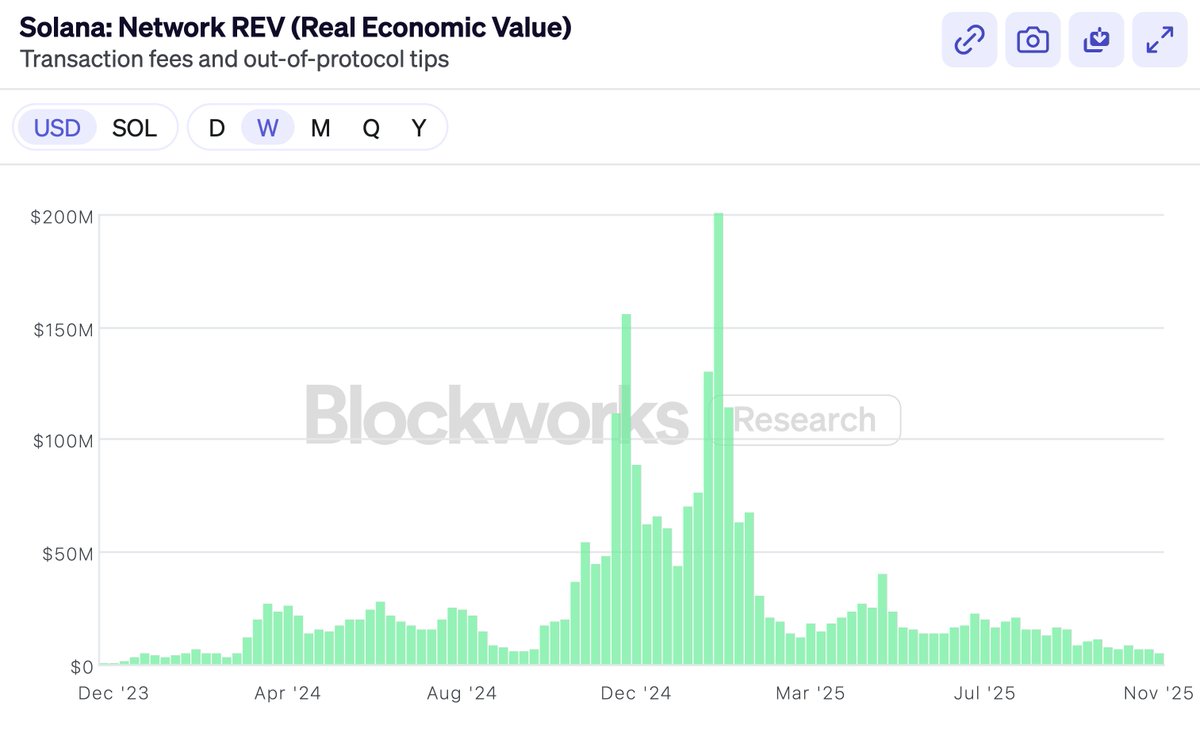
Late last year, Solana very proudly embraced REV as a metric that could finally justify their valuation. They proudly announced: we—and only we—are no longer bluffing to Wall Street!
And, of course, almost immediately after REV was embraced, it fell off a cliff (though $SOL, tellingly, did better than REV did).
Not that there’s anything wrong with REV. REV is a very clever metric. But the point of this post is not metric selection.
Then came the launch of Hyperliquid. A DEX that had real revenue and buybacks and PE multiples. And the chorus said—look, look I told you! Finally, for the first time ever, a token that has some real profits and a proper PE multiple. (Nevermind BNB, we don’t talk about that.) Hyperliquid will eat everything because obviously Ethereum and Solana don’t make any real money, we can stop pretending to value them now.
Hyperliquid, Pump, Sky, these buyback-heavy tokens are all great. But the market always had the ability to invest into exchanges. You could always buy Coinbase, or BNB, or whatever. We own $HYPE, and I agree that it’s a fantastic product.
But that’s not why people were investing in ETH and SOL. The fact that L1s don't have exchange-like profit margins is not why people were buying them—if they wanted that, they could’ve bought Coinbase stock.
So if I’m not critiquing blockchain financial metrics, maybe you think this post is going to be chiding the sinfulness of the token-industrial complex.
Obviously, everyone has lost money on tokens in the last year, VCs included. Alts are down bad this year. And so the other half of the zeitgeist on CT is arguing about who's to blame. Who’s become greedy? Are the VCs greedy? Is Wintermute greedy? Is Binance greedy? Are the farmers greedy? Are the founders greedy?
The answer, of course, is the same as it’s ever been.
Everyone is greedy. Everyone. The VCs, Wintermute, the farmers, Binance, the KOLs, they're all greedy, and you are greedy too. But it doesn't matter. Because no functioning market has ever required anyone to act against their self-interest. If we're right about crypto, we can all be greedy and the investments will still work out. Trying to analyze a market that has gone down by figuring out “who’s greedy” is going to be about as fruitful as commissioning witch trials. I guarantee you, nobody just started being greedy in 2025.
So this, too, is not what I’m going to be writing about.
Many people want me to write a post about why $MON should be valued at X or $MEGA at Y. I’m not interested in writing this post, or advocating that you buy anything in particular. In fact, you probably shouldn’t buy any of them if you don’t already believe in them.
Will any new challenger chain win? Who knows. But if it has a material chance of winning, it's going to be priced on that basis. If Ethereum is worth $300B or Solana is worth $80B, a project that has a 1-5% chance of becoming the next Ethereum or Solana will be priced according to those probabilities.
Somehow CT is scandalized by this, but it’s no different than Biotech. A drug that has less than a 10% chance of curing Alzheimer's is priced by the market as worth billions of dollars, even if 90% chance it won’t pass stage 3 trials and will go to 0. That's how the math works—and turns out, markets are pretty good at doing math. Binary outcomes are priced on probabilities, not on run rates or moral turpitude. It’s the “shut up and calculate” school of valuation.
I really don’t think that’s an interesting question to write about. “5% chance to win? No way, that’s clearly a 10% chance!” Markets, not articles, are the best way to assess that for any individual token.
So here’s what I am going to write about: CT doesn't seem to believe anymore that chains are valuable.
I don’t think this is because they don’t believe new chains can win market share. We just saw Solana dominate market share after emerging from the ashes less than 2 years ago. It’s not easy, but of course it’s possible.
It’s more that people have come to believe that even if a new chain wins, there’s no prize worth winning. If $ETH is just a meme, if it’ll never generate real revenue, then even if you win, you won’t be worth $300B. The contest is not worth winning, because these valuations are all bunk and it’ll all come crashing down before you go to claim your prize.
Being optimistic about chain valuations has become passé. Not that nobody is optimistic—obviously there must be optimists out there. For every seller there’s a buyer, and as much as CT cool kids love to drag L1s, people are comfortable buying SOL at $140, ETH at $3000.
But there’s a perception now that all the smartest people are over buying smart contract chains. Smart people know the jig is up. If not now, then soon. The only people buying here are suckers—Uber drivers, Tom Lee, and KOLs who say stuff like “trillions.” And maybe the US Treasury. But not the smart money.
This is bullshit. I don’t believe it, and you shouldn’t either.
So I felt like I had to write a smart person’s manifesto on why general purpose chains are valuable. This post is not about Monad or MegaETH. It’s really in defense of ETH and SOL. Because if you believe ETH and SOL are valuable, the rest is straight downstream.
Defending ETH and SOL valuations is generally not my job as a VC, but fuck it, if nobody else is willing to do it, then I’ll write it.
Feeling the Exponential
My partner Bo experienced the Chinese Internet boom first-hand as a VC. I’ve heard how “crypto is like the Internet” so many times now that it doesn’t even register for me anymore. But when I hear his stories, it always reminds me how costly it is to be wrong about these things.
A story he often tells is about when all the early e-commerce VCs (it was a small group back then) got together for coffee in the early 2000s. They debated: how big is the market for e-commerce going to be?
Is it going to be mostly electronics (maybe only techies will use PCs)? Could it ever work for women (perhaps they’re too tactile)? What about food (maybe impossible to manage perishables)? These were deeply important questions for early VCs to decide what to invest in and what prices to pay.
The answer, of course, was that literally every single one of them was devastatingly wrong. E-commerce would sell everything, and the target audience was the whole fucking world. But nobody at the time actually believed it. And even if they did, it would be too absurd to say out loud.
You just had to wait long enough for the exponential to show you. Even among the believers, very few thought e-commerce would become as big as it became. And those few who did, almost all of them became billionaires from just not selling. Every other VC—as Bo tells me, since he was one of them—sold too early.
It has become passé in crypto to believe in the exponential.
I believe in the crypto exponential. Because I’ve lived it.
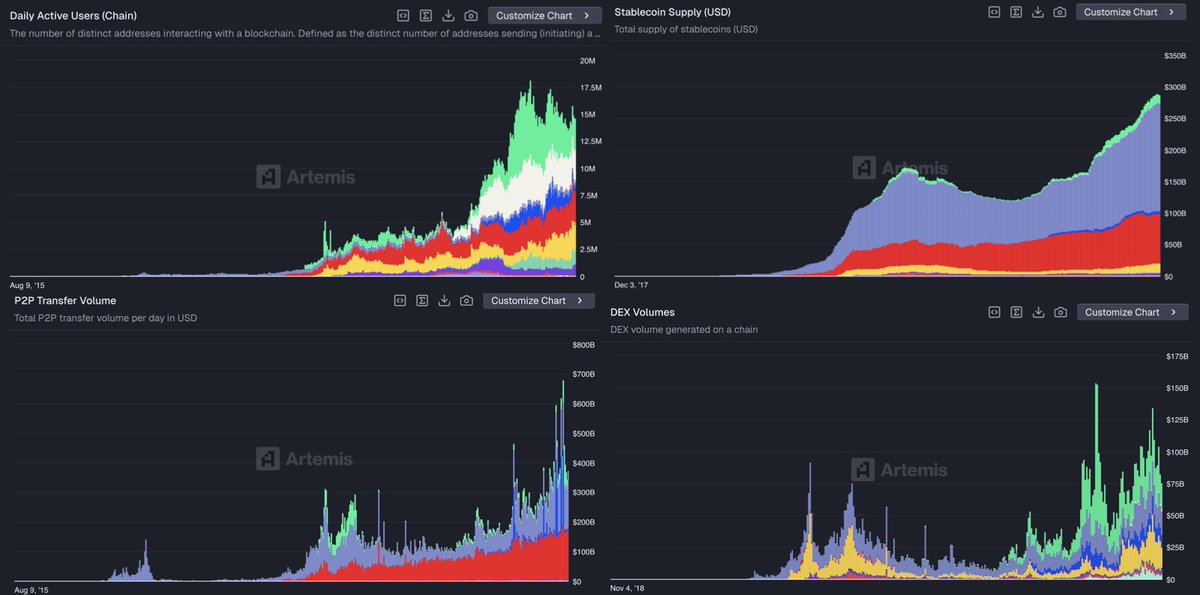
When I started in crypto, nobody used this stuff. It was tiny and broken and awful. TVL on-chain was in the millions. We invested into the first generation of DeFi, MakerDAO, Compound, 1inch, back when they were science projects. I remember playing around on EtherDelta back when DEXes traded single digit millions a day, and that was considered to be a huge success. It was complete dogshit. Now we routinely trade in the tens of billions on-chain every day. I remember believing it was crazy that Tether hit a billion dollars in issuance and was being written up in the NYT as a ponzi scheme on the brink of shutdown. Now stablecoins are over $300B and regulated by the Federal Reserve.
I believe in the exponential because I’ve lived it. I’ve seen it over and over again.
But you might respond—well, stablecoin growth might be exponential, maybe DeFi volumes are exponential, but they don’t accrue to ETH or SOL. The value doesn’t get captured by the chains.
To which I answer: you still don’t believe in the exponential.
Because the exponential’s answer is always the same: it doesn’t matter. This stuff is going to be so much bigger than it is today. And when it’s absolutely enormous, you’ll make it up on scale.
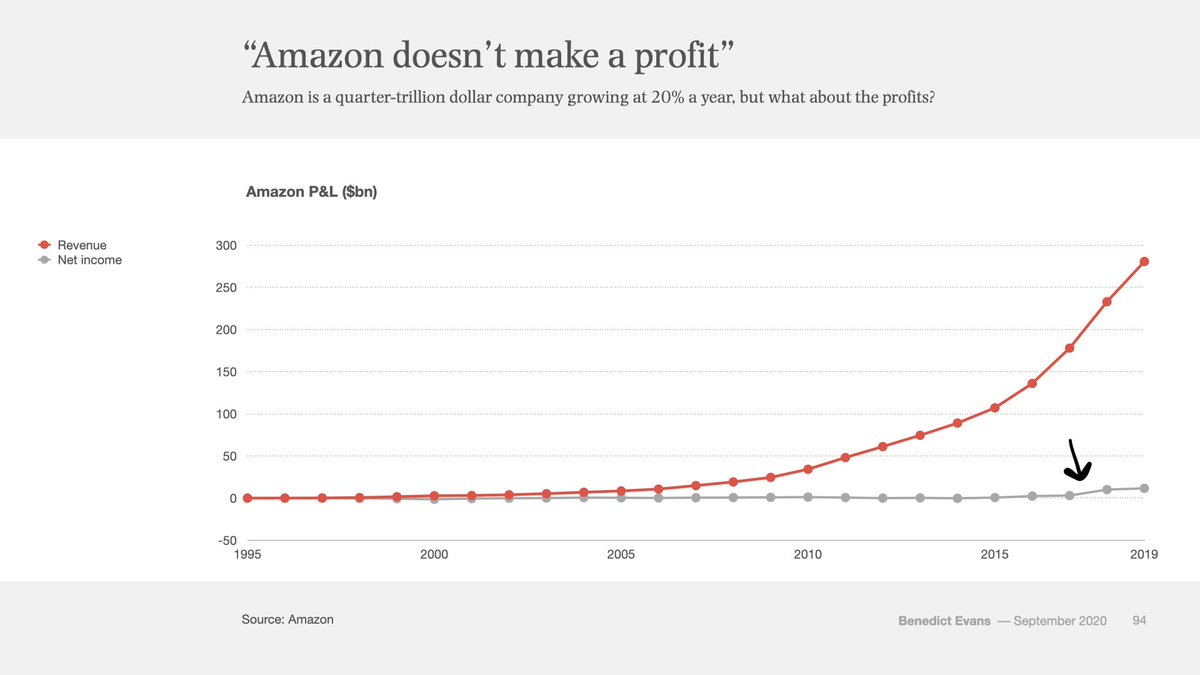
Study this chart.
This is Amazon’s P&L from 1995 to 2019. That’s 24 years. Red is revenue, gray is profit. You see that little blip on the end where the gray line goes up? That’s when, 22 years in, Amazon started actually making a profit.
Amazon was 22 years old when this little gray line of net income first peeled off of 0. Every single year before then, there were op eds and critics and short sellers claiming that Amazon was a ponzi scheme that would never make any money.
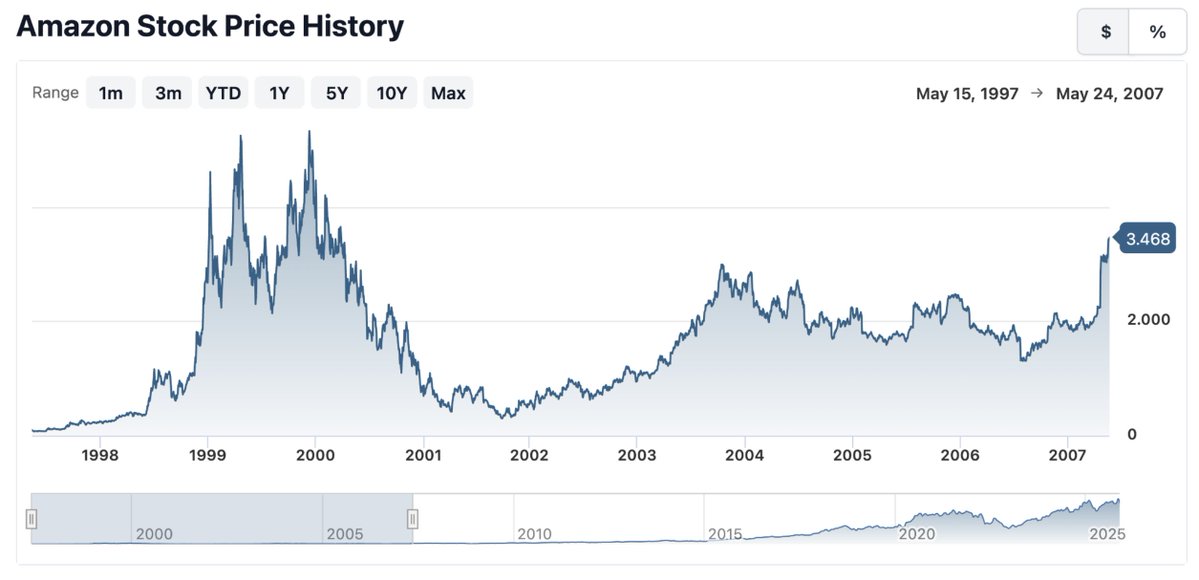
Ethereum just turned 10 years old. This is what the first 10 years of Amazon stock looked like:
10 years of chop. All along the way, Amazon was beset with doubters and non-believers. Is e-commerce a VC-subsidized charity? They’re selling underpriced cheap low-quality knick-knacks to bargain hunters, who cares? How are they ever going to make actual money, like Walmart or GE?
If you were arguing about Amazon’s P/E ratio, you were in the wrong regime. That’s the regime of linear growth. But e-commerce was not a linear trend, and so every single person for 22 years arguing about P/E ratios was devastatingly wrong. No matter what you paid, no matter when you bought, you were not bullish enough.
Because that’s what exponentials do. When it comes to truly exponential technologies, no matter how big you think it’s going to get, it just keeps getting even bigger.
This is the thing that Silicon Valley has always understood better than Wall Street. Silicon Valley was raised on exponentials, while Wall Street was raised on linearity. And over the last few years, crypto’s center of gravity has migrated from Silicon Valley to Wall Street. You can feel it.
Granted, crypto growth doesn’t look as smooth as e-commerce’s growth. It’s burstier, it goes in fits and starts. This is because crypto, being about money, is deeply tied to macro forces, and it also has more violent regulatory push and pull than e-commerce. Crypto strikes at the heart of the state—money—and so it’s more unnerving to governments than e-commerce ever was.
But the exponential is no less inevitable. It's a crude argument. But if crypto is exponential, then the crude argument is correct.
Zoom out.
Financial assets want to be free. They want to be open. They want to be interconnected. Crypto turns financial assets into file formats, makes it as easy to send a dollar or a stock as to send a PDF. Crypto makes it possible for everything to talk to everything. It makes it all 24/7, global, interconnected, and open.
That will win. Open always wins.
If there’s no other lesson I've learned from the Internet, it’s that. Incumbents will fight against it, governments will huff and puff, but eventually they will give up against the adoption, the generativeness, the sheer efficiency that this technology enables. It’s what the Internet did to every other industry. Blockchains are how that same trend will gobble up all of finance and money.
Yes—with enough time—all of it.
An old saying goes: people overestimate what can happen in two years, but they underestimate what can happen in ten.
If you believe in the exponential, if you zoom out enough, then it’s all still cheap. And it should humble you that every day, the holders outlast the sellers and naysayers. Big capital has a longer time horizon than CT swing traders might lead you to believe. Big capital has been trained through history not to fade big technologies. You know, the big gushy story that originally got you to buy $ETH or $SOL? Big capital believes that story and hasn't stopped.
So what exactly am I arguing?
I am arguing that applying P/E ratios to smart contract chains (the “revenue meta,” as it’s now called), is giving up on the exponential. It means you have consigned this industry to the regime of linear growth. It means you believe 30 million DAUs on-chain and <1% of M2 is it. Crypto is just one of the things in the world. A sideshow. It did not win. It was not inevitable.
More than anything, I’m arguing to be a believer. Not just a believer, but a long-term believer.
I’m arguing that this exponential will be bigger than anything else you’ve been a part of in your life. That this is your e-commerce. That you will look back when you’re old and tell your kids—I was there when it all happened. Not everyone believed it was possible, that whole societies could change, that all of money and finance would be transformed by programs running on decentralized computers that we collectively owned.
But it actually happened. It changed the world.
And you were a part of it.
Disclosure: These are my own views. Dragonfly is an investor in $MON, $MEGA, $ETH, $SOL, $HYPE, $SKY among many other tokens. Dragonfly believes in the exponential. This is not investment advice, but is advice of another kind.
English
@lookonchain This is not “cashing out”, this is funds from the ICO that have just been sitting in onchain wallets til now.
English

It appears pump.fun cashed out another $75M!
11 hours ago, pump.fun deposited 75M $USDC into #Kraken.
10 hours ago, 69.27M $USDC flowed from #Kraken into #Circle.
x.com/lookonchain/st…
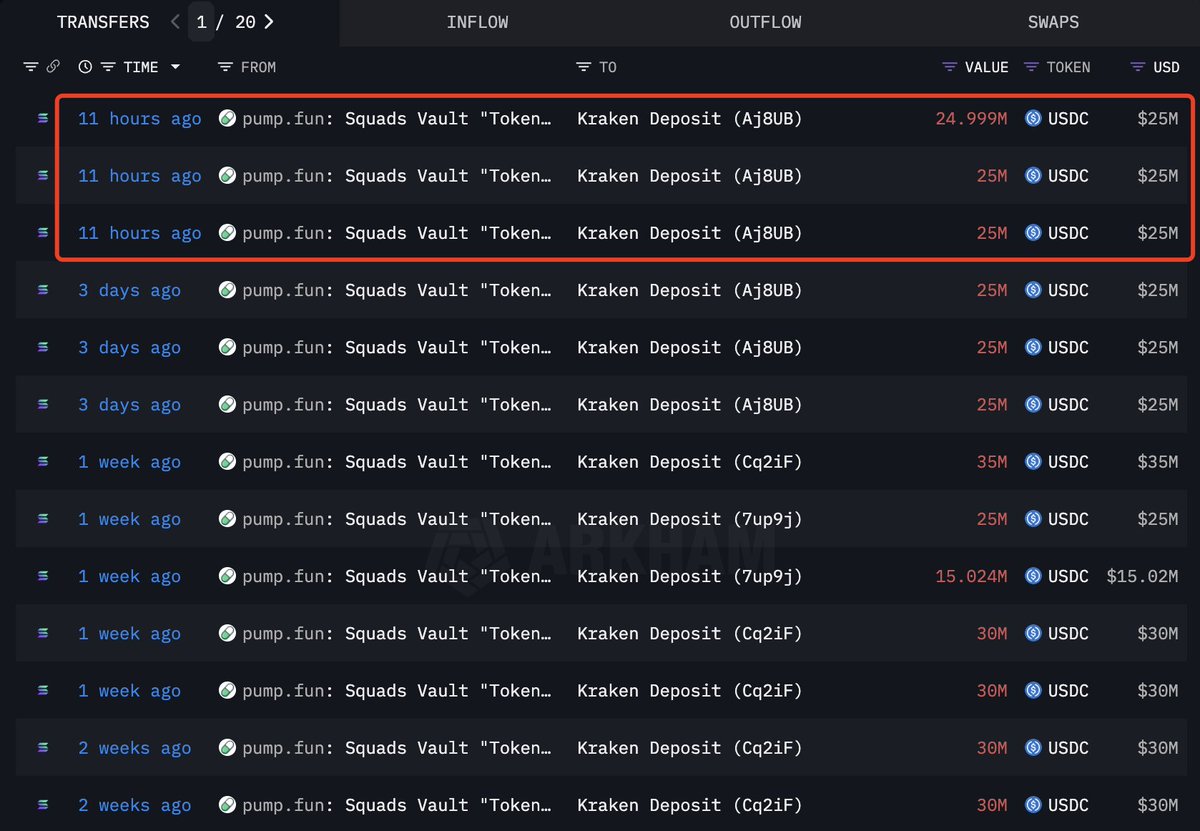
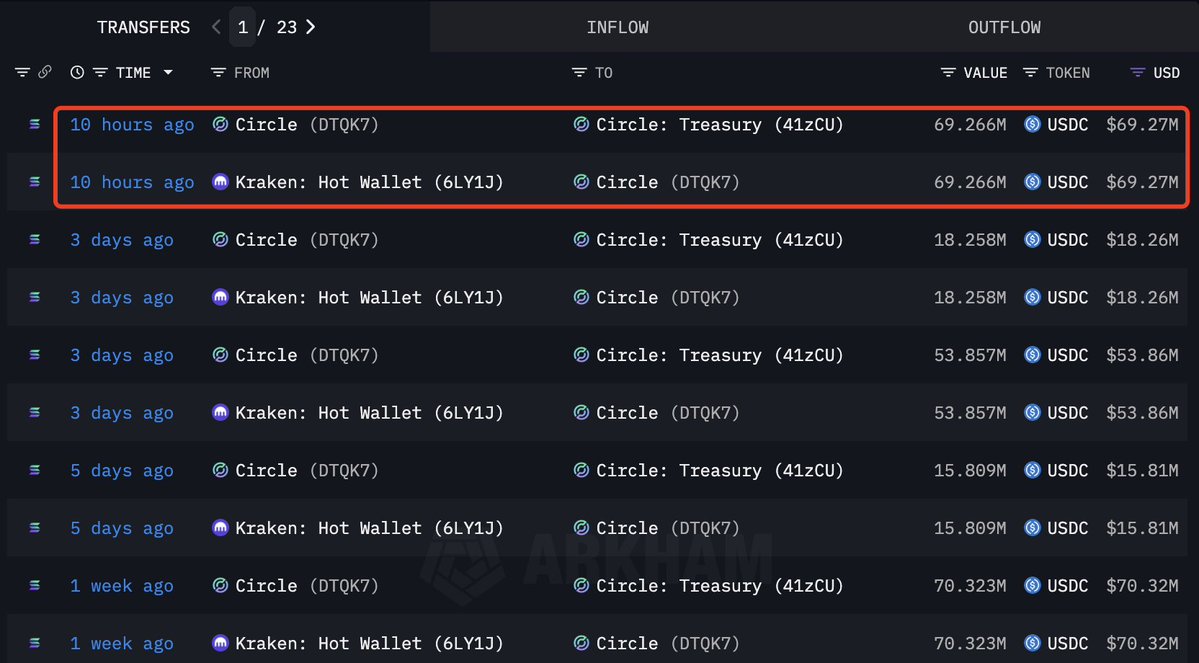
Lookonchain@lookonchain
It appears pump.fun has cashed out at least 436.5M $USDC since Oct 15. Since Oct 15, pump.fun has deposited 436.5M $USDC into#$Kraken. During the same period, 537.6M $USDC flowed from #Kraken to #Circle through wallet DTQK7G. Between May 19, 2024 and Aug 12, 2025, pump.fun sold a total of 4.19M $SOL ($757M) at an average price of $181. Of that amount, 264,373 $SOL was dumped on-chain for $41.64M, while 3.93M $SOL($715.5M) was deposited into #Kraken. x.com/lookonchain/st… intel.arkm.com/explorer/entit… intel.arkm.com/explorer/addre…
English
We wrote about the quantum threat to Bitcoin/ crypto almost 2 years ago and it is more relevant than ever. Most of the community disregarded the threat as an improbable 50 year problem but this form of complacency is dangerous esp. with how complex a solution can be to implement.
Collective urgency is paramount for such a significant tail risk.
#towards_quantumresistant_cryptography" target="_blank" rel="nofollow noopener">bigbrain.holdings/post/quantum-t…
English
Sam retweetledi

The road to AGI.
The founders of @fortytwo lay out why they have a big breakthrough with its decentralized AI that will get to AGI faster than the "big" LLM companies.
Decentralized "swarms" of AIs working together is a big idea and will lead us to faster learning, lighter AIs that can run on small computers at the edge.
Thanks @inikitin and @vlarin for such an interesting conversation.
In comments I'll post what Grok learned by watching this.
English

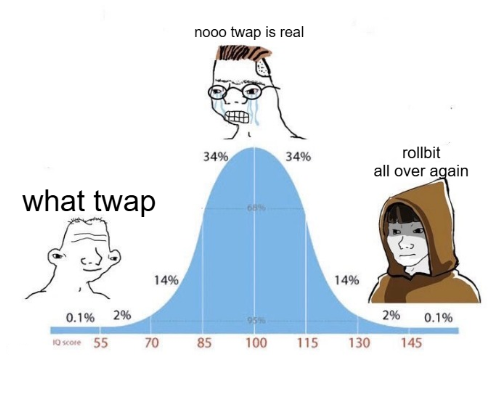
you believe $pump is really buying back? if 100m usd really went into the chart, it will not look like what it is. $pump is basically an iq test.
English