

Rev. Jim Pierce ✝️
1.5K posts

Rev. Jim Pierce ✝️
@RevJimPierce
Husband, Father, Lutheran Pastor (LC-MS). Serving Christ in the Tri Cities of Washington State. My views are my own.
Pasco, Washington Katılım Haziran 2025
269 Takip Edilen222 Takipçiler

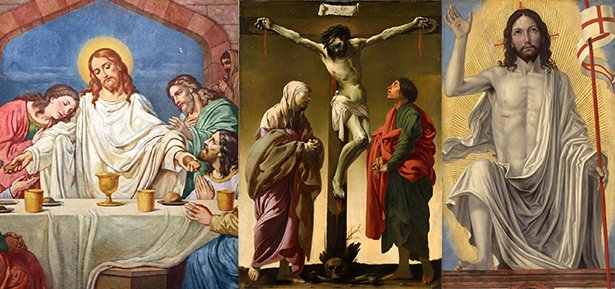
Just a reminder for Christians' celebrating Easter tomorrow. We don't know what Jesus actually looked like and it doesn't really matter, too. What we do know is He was crucified, died, and was buried. On the third day He arose from the dead. All this for your salvation!
MP Arizona☀️🏳️🌈💙🌵🐕🐕🦺🫂💦🏜🐟🌴🎙🌎🌻♍️🌊@AzPetrich
Just a reminder for Christian's celebrating Easter this week. Jesus looked like the guy in the first picture - not the second.
English
@McBrideLawNYC Where's the problem for Protestants here again? There is a problem there for Roman Catholics, though. Nowhere does Ignatius speak of a centralized episcopal power in the passages you share.
English

IGNATIUS IS A PROBLEM FOR PROTESTANTS!
He was St. John's disciple & wrote this in 108 AD!
Respect the Bishop as to Christ Himself.
If any one not be within the altar, he is deprived of the bread of God.
(Ignatius uses bread of God and Eucharist interchangeably in his letters)

English
Holy Saturday... Christ descends into hell and declares His victory over sin, death, hell, and the grave!
"1 Peter 3:[18] For Christ also suffered once for sins, the righteous for the unrighteous, that he might bring us to God, being put to death in the flesh but made alive in the spirit, [19] in which he went and proclaimed to the spirits in prison, [20] because they formerly did not obey, when God’s patience waited in the days of Noah, while the ark was being prepared, in which a few, that is, eight persons, were brought safely through water."
English
Artemis II sent back this video. Now we know why flat earthers and those who think the earth is spherical are wrong.
English


Type a word in German besides: Auf Wiedersehen, Ja, or Nazi.
Deutsch
With Easter Sunday on the horizon, it is fitting, I believe, to briefly write something concerning the Resurrection of our Lord, an event that occurred in history, is real, and is the very foundation of the Christian faith. Indeed, our hope in Christ rests upon the fact He lives!
Confessional Lutherans insist that the Christian faith is not built on myths, inner experiences, or abstract ideas, but on real events in history. As Martin Luther himself emphasized, the Gospel is something that happened: Christ was born, suffered under Pontius Pilate, was crucified, died, and was buried—and on the third day rose again. Facts matter because faith has an object: the crucified and risen Jesus. Yet we also confess that we “walk by faith, not by sight” (2 Corinthians 5:7). Faith does not ignore the historical reality; rather, it receives the promise of God given in those events. The resurrection of Jesus Christ is therefore both historically grounded and spiritually apprehended—true whether believed or not, yet saving only for those who trust in Him.
The first great fact is the empty tomb. Jesus was publicly executed under Roman authority and buried in a known tomb belonging to Joseph of Arimathea, a member of the Sanhedrin. This was no secret burial. On the third day, the tomb was found empty, and notably, it was women who first discovered it. In the cultural context of the first century, the testimony of women carried little weight, which makes it highly unlikely that such a detail would be invented. Even the opponents of Christianity did not deny the empty tomb; instead, they claimed that the disciples had stolen the body (Matthew 28:11–15). This admission is significant—it concedes the central point that the tomb was empty. Moreover, no body was ever produced, despite the fact that the proclamation of the resurrection began in Jerusalem itself, where such a claim could have been easily disproven if false.
Closely connected to the empty tomb are the post-resurrection appearances of Jesus. According to the earliest Christian testimony, preserved by the Apostle Paul in 1 Corinthians 15:3–8, Jesus appeared to many witnesses: to individuals such as Mary Magdalene, Peter, and James, and to groups including the twelve disciples and more than five hundred people at one time. This testimony is not a late legend but an early creed, received and passed on within just a few years of the crucifixion. The appearances were physical and tangible—Jesus ate with His disciples, invited them to touch Him, and showed them His wounds. These were not vague visions or subjective experiences. Hallucination theories fail to explain such events, especially group appearances, which do not occur in the way described. Furthermore, these encounters took place in various settings and included both believers and skeptics, resulting in lasting and dramatic transformations.
That transformation is itself another powerful piece of evidence. Before Jesus’ crucifixion, His disciples were fearful, scattered, and in hiding. Peter even denied knowing Him. Yet after the resurrection, these same men became bold proclaimers of the Gospel, preaching publicly in the face of persecution. They endured imprisonment, suffering, and ultimately death for their testimony. They had no earthly incentive—no wealth, power, or prestige to gain. The most natural explanation for this radical change is that they were convinced they had truly seen the risen Lord. People may die for a lie they believe to be true, but not for something they absolutely know to be a lie. The disciples’ courage is best explained by their genuine encounter with the risen Christ.
Further confirmation comes from the conversion of former skeptics and enemies. James, the brother of Jesus, did not believe in Him during His earthly ministry. Yet after the resurrection, James became a leader in the church, a transformation attributed to a personal appearance of the risen Jesus (1 Corinthians 15:7). Likewise, the Apostle Paul—once a zealous persecutor of Christians—experienced a dramatic conversion after encountering the risen Christ on the road to Damascus. He went from opposing the Church to becoming its most tireless missionary, suffering greatly for the name of Jesus. Both James and Paul had every reason not to believe, yet their lives were completely changed. Their conversions are difficult to explain apart from the reality of the resurrection.
Finally, the early and rapid proclamation of the resurrection in Jerusalem itself demands explanation. Within weeks of Jesus’ death, the apostles were preaching openly that He had risen from the dead (Acts 2). This message spread quickly despite intense opposition from both Jewish authorities and the Roman Empire. The core claims of Christianity were already firmly established within just a few years, as seen in the early creedal material of 1 Corinthians 15. If the resurrection were false, opponents could have easily refuted it by producing the body or discrediting the witnesses. Yet they could not. Instead, the Christian faith grew from a small group of followers into a worldwide movement. No alternative theory—whether theft, hallucination, or myth—adequately explains this explosive beginning.
The above arguments are not novel, and yet they have stood the test of time. The facts of the resurrection of Jesus are not isolated; they interlock and reinforce one another. The empty tomb, the appearances, the transformation of the disciples, the conversion of skeptics, and the rapid spread of the Gospel together form a coherent and compelling case. This is not blind faith, but faith grounded in history. As Paul writes, “If Christ has not been raised, your faith is futile” (1 Corinthians 15:17). But Christ has been raised.
This history is not merely a record for the archives; it is the Gospel for you. The Resurrection is the "Yes" of the Father to the sacrifice of the Son. It means that when Jesus cried out "It is finished," the debt of your sin was truly paid. Because He lives, the grave has no final claim on you. Your guilt is buried in His tomb, and your life is hidden in His victory. The Risen Christ does not stand at a distance in history; He comes to you today in His Word and Sacraments, offering the same physical certainty He gave to the disciples. He is risen indeed, and because He lives, you shall live also.
English
The only Trans I recognize!
Grumpy Veteran@ccanadian1965
In celebration of International Trans Day of Visibility…here ya go 👇🏻
English
While it may be the case that there are some individuals who believe they may interpret scripture as they please, detached from the Church and its teaching, most Protestants and certainly Confessional Lutherans (such as myself) believe that scripture is NOT given to isolated individuals to interpret as they please. Indeed, Confessional Lutherans believe, teach, and confess that the Church has a real responsibility to teach, preach, and guard doctrine. That pastors are called to rightly divide the Word of truth, not invent new meanings. Furthermore, while every Christian is encouraged top read Scripture, interpretation is bound to the text itself, guided by the Church's confession of it, and tested against the whole of Scripture (Sola Scriptura). What "Sola Scriptura" means is Scripture alone is the norm that norms (norma normans). The bottom line is that, for Confessional Lutherans at least, we have always strongly rejected the Schwärmer, "enthusiasts," who claim the Spirit apart from His Holy Word and the Church.
English
Who decides what "true faith" is? Who defines the "true Christ"? Who identifies the "true gospel"? In Protestantism, the answer is always the same: the individual, appealing to his own interpretation of Scripture, and however he feels that day. "Faith alone" functionally becomes: "faith, as I personally define it, in the Christ and gospel as I personally declare them to be." This is why they all run around shouting "faith alone" while continually fracturing into thousands of contradictory sects.
English
@Vitus_osst For all have sinned and fallen short of the glory of God and if we say we have no sin the truth is not in us.
English

Do you accept that the Pope is the holiest man on Earth?

English
@ImprecatoryOne Do you mean like all the Marian dogmas?
English

You should question your theology on a topic if it didn’t exist for the first 1500 years of the church.
English
Today marks our entry way into Holy Week. The journey from Palm Sunday to Good Friday is more than a historical reenactment of a tragic week; it is the unfolding of the theologia crucis—the Theology of the Cross. This week marks the climax of the "Great Exchange," where the sinless Son of God takes upon Himself the guilt of the world to bestow His righteousness upon the sinner.
Palm Sunday: The Humble King
Holy Week begins with the Triumphal Entry, but it is a triumph of a peculiar sort. Christ does not ride a warhorse like a worldly conqueror; He comes seated on a donkey, fulfilling Zechariah 9:9. This is the "humiliated" King who comes not to be served, but to serve. Theologically, we see the dual nature of Christ: the Lord of Glory veiling His majesty in flesh to approach His people in peace. The palms laid before Him are a bittersweet recognition; the same voices crying "Hosanna" (Save us, now!) will soon cry "Crucify Him."
The Triduum: Love to the Uttermost
As the week progresses into the Triduum (Latin, "Three Days"), the focus shifts to the sacramental and sacrificial heart of our faith.
Holy Thursday: On this night, Christ institutes the Lord’s Supper.
As Lutherans, we confess the Real Presence—that in, with, and under the bread and wine, Christ gives His true Body and Blood for the forgiveness of sins. This is the "New Testament in My blood," the means by which the sacrifice of the cross is delivered to the believer across time and space for the forgiveness of your sins.
Good Friday: The Victory of the Victim
The week culminates in the darkness of Good Friday. This is the day of Atonement. On the cross, the "Lamb of God who takes away the sin of the world" (John 1:29) becomes the propitiation for our wrath.
Theologically, this is where the Law and the Gospel meet. The Law’s demand for death is fully satisfied in Christ’s flesh. As He cries, "Tetelestai" (It is finished), the debt is paid in full. We do not view the cross as a defeat, but as Christ's greatest work. He reigns from the tree, crushing the head of the serpent through His own suffering. Our justification is anchored here: Christ died the death we deserved so that we might live the life He earned.
Holy Saturday: The Sabbath of God
Historically, this is the day Christ’s body rested in the tomb of Joseph of Arimathea. Theologically, it is the fulfillment of the Sabbath. Just as God rested on the seventh day after finishing the work of creation, the Incarnate Word rests on the Seventh Day after finishing the work of re-creation on the cross.
The Descent into Hell
As Lutherans we confess, as found in Article IX of the Formula of Concord, Christ's Descent into Hell (1 Pet. 3:18-20). We believe that between His death and His bodily resurrection, the whole person of Christ—God and man—descended into the realm of the damned.
He did not go there to suffer further or to offer a second chance at salvation. Rather, He went as the Victor over death and devil. In the darkness of Holy Saturday, Christ proclaimed His triumph over the devil and all the powers of darkness. He "led captivity captive" (Eph. 4:8), demonstrating that the gates of hell could not prevail against Him. For the believer, this means there is no place—not even the grave or the depths of Sheol—where Christ has not gone to claim His victory.
Through these days, we do not merely remember a martyr; we receive a Savior. The passion of Christ is the definitive revelation of God’s character—a God who enters into our death to bring us His life for the forgiveness of our sins.
The Lord's blessings on your Holy Week observance.
English
This looks orderly. 🤦♂️
Protestia@Protestia
This is some of the finest pew walking and pulpit stomping we've ever seen. 🤌🤌🤌
English
@gonefishin1948 @3catturds We have a merciful Lord and Savior, full of grace towards us!
English
@RevJimPierce @3catturds People who ridicule Luther for sinning must also ridicule me. "All have sinned and fallen short of the glory of God".
Yes, I know you didn't mention Luther.
English
Was the Last Supper meant to stop when Jesuys was crucified, just be a symbol to remember Jesus, or be the very thing Jesus said it was, is and always will be?
English
Very nice, Father! Yes, the connections to the Passover are wonderful. Remember the Passover where a lamb was slain. Its body was given for food, and its blood was given for life to all households marked by it. In a similar way, Christ gives His true body for food to our souls and His blood for life in Him, the forgiveness of sins!
English
@RevJimPierce @3catturds Do you know why Jesus chose Passover for what we call "The Last Supper"? Do you know what the Passover feast required?
English
@3catturds @gonefishin1948 Of course, He did. But THAT is not ALL He said. Right?
English

@RevJimPierce @gonefishin1948 Did Jesus say to do communion in remembrance? Yes or no?
English