RhizoVision Explorer

206 posts

RhizoVision Explorer banner
RhizoVision Explorer

RhizoVision Explorer

@RhizoVision

Root image analysis for the rest of us. Free, open-source, C++, OpenCV, Qt, extensively validated. By @rootphenomics @LarryMattYork @aseethepalli

Katılım Ağustos 2020
0 Takip Edilen828 Takipçiler
Sabitlenmiş Tweet
RhizoVision Explorer
RhizoVision Explorer@RhizoVision·
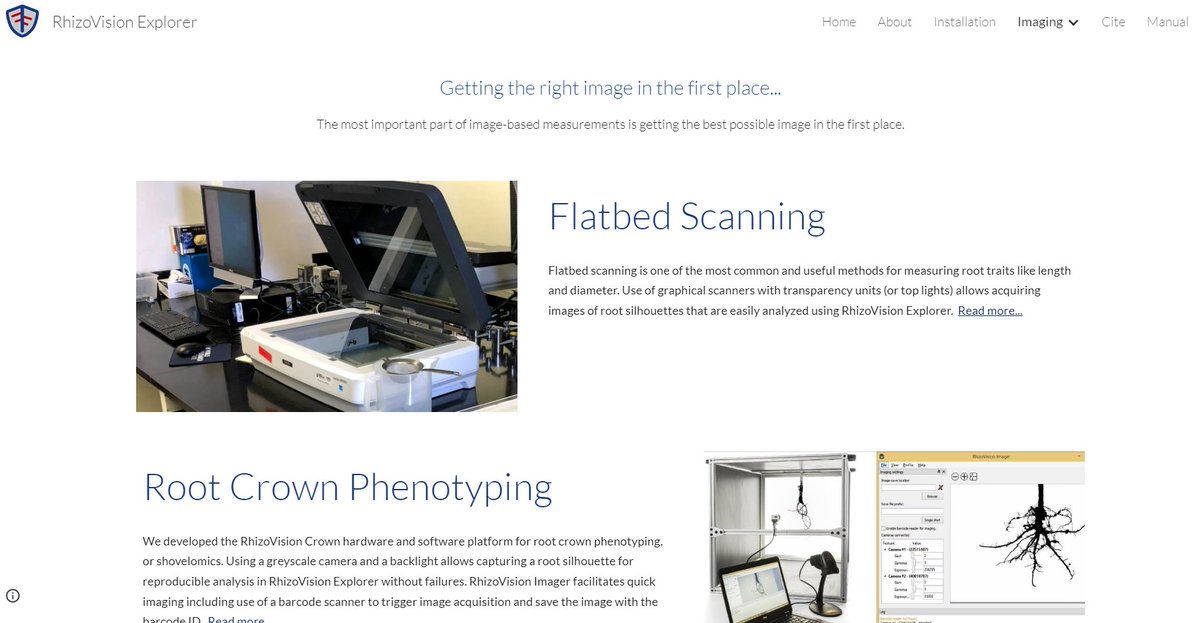
The RhizoVision website now includes sections about imaging on a flatbed scanner or with a camera for root crowns that hopefully increase the accessibility of these methods by covering common questions. More below. Please let us know if we can improve. rhizovision.com/imaging
RhizoVision Explorer tweet media
English
2
11
31
11.7K
RhizoVision Explorer
RhizoVision Explorer@RhizoVision·
RhizoVision is at #plantbio2024 . Check out poster 1000-12 on new methods for RhizoVision. Have your own poster with RhizoVision or see other posters that use it? Let us know the title, ask the author share a pic! Just tag @rhizovision and it will be shared!
English
0
0
4
783
RhizoVision Explorer
RhizoVision Explorer@RhizoVision·
@DrMicroWill @courtney_herms @marcusdgriff Thank you all for helping each other out! All good ideas. Some false roots still remain because they make 'loops'. We plan to address some issues like this soon. We have evaluated segmentation roots to exclude the root hairs as well, I think a needed improvement.
English
0
0
2
23
William L King
William L King@DrMicroWill·
@courtney_herms @marcusdgriff @RhizoVision I think you’ll never quite get it perfect, especially when you start thinking about applying the same thresholds to multiple samples/datasets. The software is great but it introduces some biases (like most things we do anyway!)
English
1
0
1
48
Courtney Herms
Courtney Herms@courtney_herms·
He @RhizoVision, we are pumped to switch from winrhizo (yay open source software!) but having problems with hairy roots = lots of short root segments despite high root pruning threshold. Any suggestions?
Courtney Herms tweet mediaCourtney Herms tweet media
English
1
0
3
533
RhizoVision Explorer
RhizoVision Explorer@RhizoVision·
If you have used a commercial, proprietary software and RhizoVision Explorer for image analysis of roots to measure root length, which did you prefer? Let us know why in the comments! Haven't tried RhizoVision Explorer? Download now at: zenodo.org/record/5121845
English
2
4
8
0
RhizoVision Explorer
RhizoVision Explorer@RhizoVision·
@EusunHan @antonwasson I don't think I've seen automated but you could try training rootpainter. Presumably color images would be useful. But it could detect based on both color and morphology I think.
English
0
0
1
31
Eusun Han
Eusun Han@EusunHan·
Dear plant root researchers. Has there been a progress in distinguishing roots from different species, optically, meaning, via image analysis? @antonwasson @RhizoVision
English
1
1
3
413
RhizoVision Explorer retweetledi
Amit Kumar
Amit Kumar@Amit_Kumar_PhD·
Roots of both barley sp grew faster with disturbed soil microbiome providing evidence of their abilities to partially compensate for the lack of microbial help by self-exploration/exploitation. thanks to @LarryMattYork @ASeethepalli for @RhizoVision and @Abe_404 for #rootpainter.
Amit Kumar tweet media
English
2
3
13
1.3K
RhizoVision Explorer
RhizoVision Explorer@RhizoVision·
Or use RhizoVision Explorer 😎
RhizoVision Explorer tweet media
Peyman Milanfar@docmilanfar

Here's a neat trick from integral geometry - a beautiful topic that bridges geometry, probability and statistics. Let's say you have some curve with a random shape, possibly even self-intersecting. How can you measure its length? This isn't just a parlor trick - it has many practical applications. For example, the curve could be a strand of DNA or a twisted length of wire. You can think of the curve as a collection of tiny segments of course. You can then measure each segment and add up the results. OK, but you can go further and take the segments to be so small that they are almost like points. You can then add up the (red) "points". In practice, this is not altogether easier. So we need a more convenient mechanism for doing this. One way to do it is to drop lines that intersect with the shape and count the number of intersections. You can do this with a mesh or a grid too. The curve's length is the sum total of intersections n(ρ,θ) of all lines (in polar coords) with the curve (counting multiplicities). This is the beautiful Crofton formula: Length = 1/2 ∫∫ n(ρ,θ) dρ dθ The 1/2 is there because oriented lines are a double cover of un-oriented lines If this looks a little like the Radon Transform from tomography (CT scans and x-rays) it's because it is. The Radon transform can be viewed as a measure-theoretic generalization of Crofton's formula! Crofton's formula has higher dimensional analogs too that also allow for computing surface areas, not just arc lengths. It even generalizes to Riemannian surfaces; where the integral is over a natural measure on the space of geodesics. The classic text on the topic is Luis A. Santaló 'Integral Geometry and Geometric Probability' There's also a terrific set of introductory slides that are great as a starting point to learn about this beautiful subject. math.utah.edu/~treiberg/IntG…

Română
0
0
2
423
RhizoVision Explorer retweetledi
Siwook Hwang, PhD
Siwook Hwang, PhD@SiwookHwang·
Forgot to tell my committee but I want to do simple root characterization with @RhizoVision if possible, but that depends on legume and cereal roots being easy to separate
English
2
1
6
359
RhizoVision Explorer
RhizoVision Explorer@RhizoVision·
@AineseyJA @PD_Hallett @UKRI_News The image you replied to uses a tripod and SLR camera over a backlight of some sort, possibly a tracing pad which is commonly available for artists. Essentially, though, this is just a rotation of RhizoVision Crown platform. If using a camera, use manual settings and keep same.
English
1
0
1
45
Paul Hallett
Paul Hallett@PD_Hallett·
Root scanner setup at SARI in Hawassa, Ethiopia. Polariser on camera and light box. Root analysis with @RhizoVision. Exploring impacts of a range of FYM/inorganic fertiliser mixes on maize and wheat. @UKRI_News RALENTIR.
Paul Hallett tweet media
English
5
2
47
0