
Richard Casey retweetledi

This to win The Masters... and the LIV never happens.
English
Richard Casey
12.2K posts


@Richard_Casey
Macro/EM Strategist/Economist/PM. Ex a lot of places but not Bridgewater 🇺🇸🇪🇸🇬🇧
Chinese bonds are the new safe asset. @Gavekal



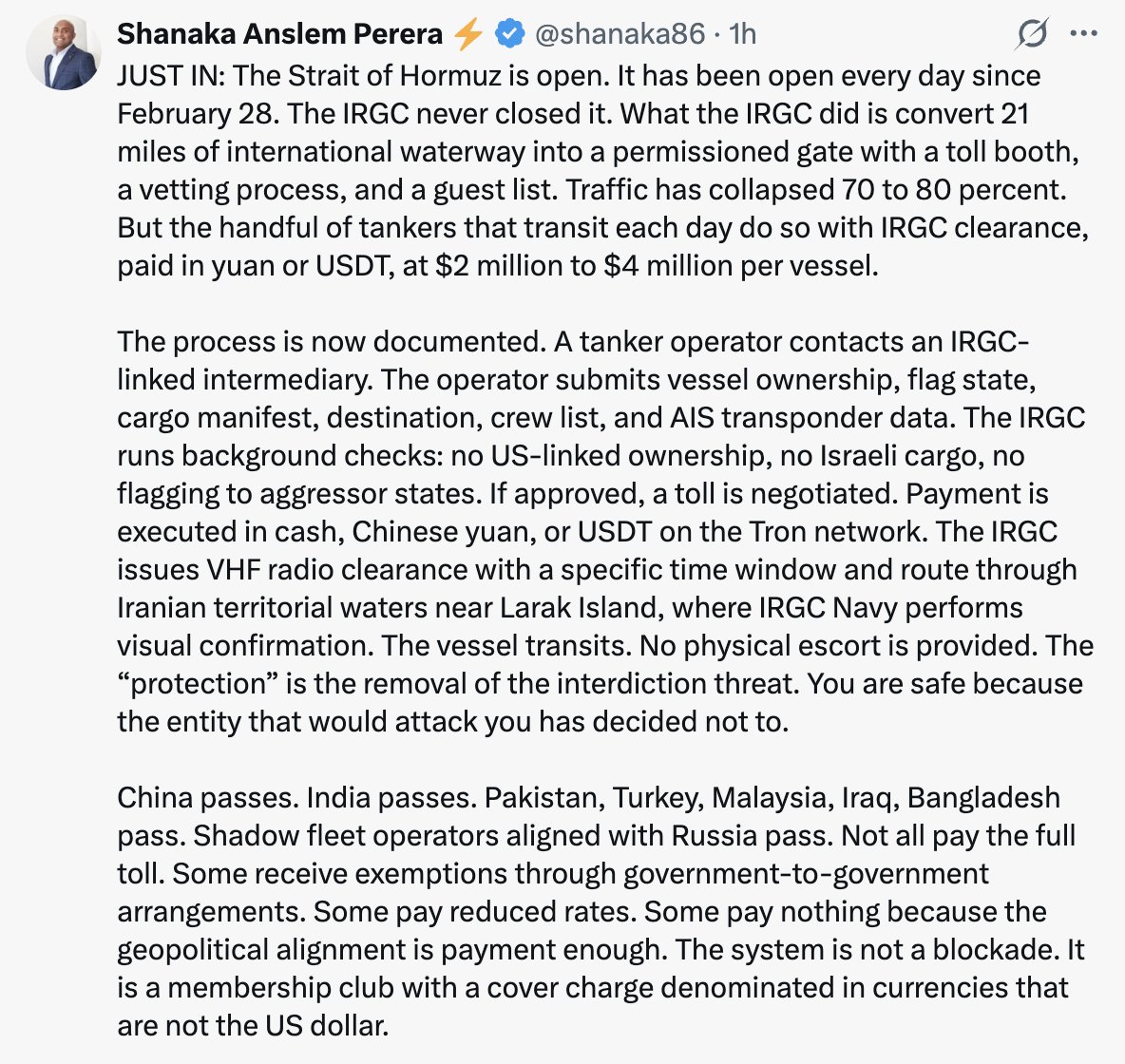
JUST IN: The Strait of Hormuz is open. It has been open every day since February 28. The IRGC never closed it. What the IRGC did is convert 21 miles of international waterway into a permissioned gate with a toll booth, a vetting process, and a guest list. Traffic has collapsed 70 to 80 percent. But the handful of tankers that transit each day do so with IRGC clearance, paid in yuan or USDT, at $2 million to $4 million per vessel. The process is now documented. A tanker operator contacts an IRGC-linked intermediary. The operator submits vessel ownership, flag state, cargo manifest, destination, crew list, and AIS transponder data. The IRGC runs background checks: no US-linked ownership, no Israeli cargo, no flagging to aggressor states. If approved, a toll is negotiated. Payment is executed in cash, Chinese yuan, or USDT on the Tron network. The IRGC issues VHF radio clearance with a specific time window and route through Iranian territorial waters near Larak Island, where IRGC Navy performs visual confirmation. The vessel transits. No physical escort is provided. The “protection” is the removal of the interdiction threat. You are safe because the entity that would attack you has decided not to. China passes. India passes. Pakistan, Turkey, Malaysia, Iraq, Bangladesh pass. Shadow fleet operators aligned with Russia pass. Not all pay the full toll. Some receive exemptions through government-to-government arrangements. Some pay reduced rates. Some pay nothing because the geopolitical alignment is payment enough. The system is not a blockade. It is a membership club with a cover charge denominated in currencies that are not the US dollar. And here is what nobody is covering. Lloyd’s of London and the international insurance market have withdrawn standard hull and machinery coverage for Hormuz transits. War-risk policies now carry premiums of up to 5 percent of vessel value, $5 million for a $100 million tanker, per voyage. But the actuarial models that price those premiums now incorporate IRGC vetting status as a risk-reduction variable. If a vessel can prove it has paid the toll and received VHF clearance, the probability of loss drops from above 20 percent to below 5 percent. The same models that price hurricane risk and earthquake exposure are now pricing IRGC compliance as a safety factor. The insurance industry has done something no government intended: it has formalised IRGC authority over the strait in actuarial mathematics. A tanker that pays the toll is insurable. A tanker that does not is stranded. Dozens of vessels sit outside the strait right now, unable to transit because no underwriter will cover them. The insurance withdrawal is not a market reaction. It is a structural enforcement mechanism that makes IRGC permission the prerequisite for commercial shipping. Every toll paid in yuan is a barrel that settled outside the dollar system. Every USDT transaction on Tron is a 3-second settlement bypassing SWIFT and sanctions. Iran’s parliament is drafting legislation to formalise the toll as “security compensation.” If that bill passes, ad-hoc extortion becomes sovereign law, and the precedent for chokepoint monetisation enters the international legal framework. Gold watches from the side. Spot prices muted at $5,000 to $5,400 by dollar strength and rising yields, while central banks in China, Russia, and India quietly accumulate on every dip. The short-term safe-haven has not fired. The long-term de-dollarization trade is loading. The strait is open. The molecules move. But only for those who pay the toll, in the currency the toll booth accepts, after the vetting the toll booth requires. The rest wait. The clocks tick. Saturday arrives. open.substack.com/pub/shanakaans…

The view that the dollar’s reserve currency status is responsible for its deficits is a terribly flawed view.
🇮🇹 Italians being Italians 🇮🇹 On September 18, 2025, Roman driver Fabio Barone set a new world speed record for a car on a ship Reaching 101.9 mph aboard a Ferrari SF90 Stradale on the flight deck of the amphibious vessel Trieste of the Italian Navy!