Rob Galdieri
1.7K posts
Rob Galdieri
@RobGaldieri
Sports Turf Manager at Marywood University
Scranton, Pa Katılım Mayıs 2013
476 Takip Edilen531 Takipçiler


@RobGaldieri A great day to have a GRWAT DAY HahA
English

@ChrisMartzWX RRFS shows this as do others. Hoping you’re correct!
English

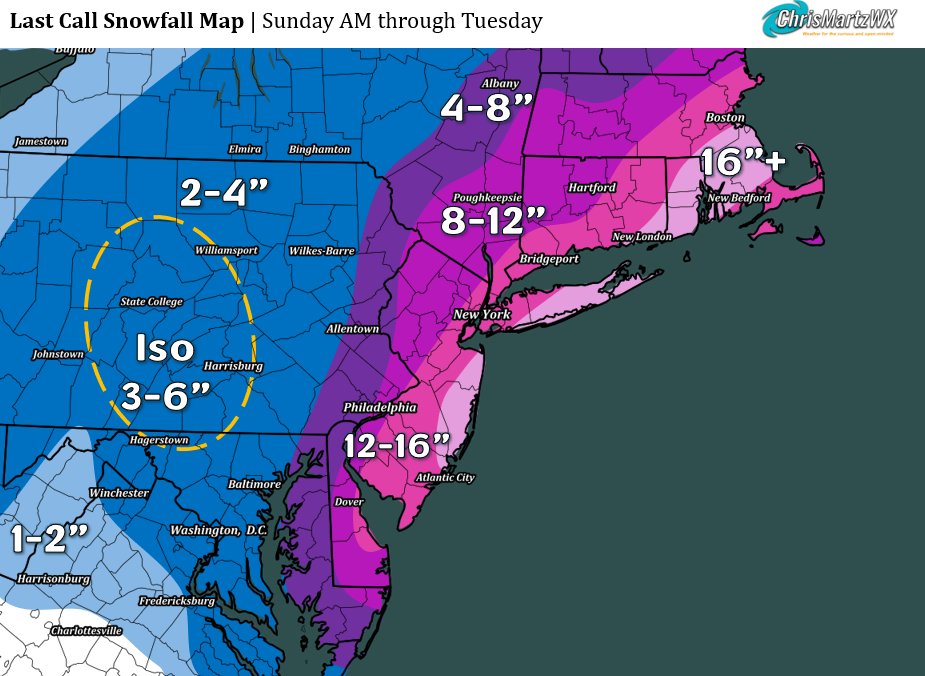
My LAST CALL snowfall map has received some criticism, mostly from people located in central / eastern Pennsylvania who think that my 2-4-inch range for much of the region is too low (see left image).
In their objections, they either cite computer models (e.g., the GFS and NAM 12km) or other meteorologists who have higher totals than I do on their forecast maps.
That's fine, you can criticize my map all you want. But I suspect that most of the criticism doesn't stem from genuine curiosity, but rather are informal complaints griping about me not forecasting the amount of snow that they want.
But let me offer you an explanation as to why I think there is a tight cutoff gradient west of Philadelphia / Allentown and why I think most of Pennsylvania will underperform compared to your expectations.
It all boils down to synoptic meteorology, specifically a process known as “frontogenesis.”
In the mid-latitudes, winds try to be geostrophic (i.e., pressure gradient balanced by Coriolis force). But in an extratropical cyclone (also called a "nor'easter" in this part of the U.S.), you have cold, continental air moving equatorward and warm, moist maritime air moving poleward.
As pressures fall at the surface, that circulation is enhanced, which results in the boundary between the cold and warm air being compressed horizontally. This tightening of the thermal gradient is called “frontogenesis,” and it breaks geostrophic balance, which creates a forced circulation that attempts to restore it.
So, on the warm side of the front, air begins to rise rapidly within a 30-60-mile corridor. This creates heavy lift that pushes the warm, moist air up into the "dendritic growth zone" where environmental temperatures surrounding those parcels are –12°C to –18°C, which creates snowflakes that are fluffy and dense. This creates high snow-to-liquid ratios and high snowfall rates on the order of 2–4 inches per hour, and in some cases 3–5 inches per hour.
However, behind that narrow banding is always subsidence (i.e., sinking air). This is because of mass continuity. If air goes up somewhere, it must come down in an adjacent location to compensate.
In mid-latitude cyclones like this weekend's storm, frontogenesis occurs in the 850–700 hPa layer (~5,000 to ~10,000 feet altitude) about 100ish miles north and west of the surface low. In this case, that banding zone is over New Jersey, Long Island, and Southern New England (you can see that on the NAM 3km image I attached below on the right to illustrate my point). This means that the subsidence zone will be over central / eastern Pennsylvania if the physics here are correct. It doesn't show up on the model output snowfall, hence the forecasts we see from your local TV stations and even the NWS.
But this happened in the December 30-31, 2000; December 26-27, 2010; January 26-28, 2015; and January 28-29, 2022 snowstorms without fail, which are my top four analogs.
I could be wrong about how this shakes out. Way wrong. But it's my gut feeling and I am willing to risk sticking with it going against the community's “consensus.” I'm sorry if it isn't what you want to hear, I am not your therapist.

English
@nynjpaweather Hoping for a sharp cutoff NW for NEPA. Some of the high res models showing it. Sinking air I assume? Time for spring and baseball.
English

Rob Galdieri retweetledi

Quite literally not a single positive thing has happened to the Twins franchise since October 2023
English

Agronomy has evolved fast — from better chemistries to technology like precision spraying, moisture management, and data-driven decision making.
Curious to hear from others: what advancements have had the biggest impact on how you manage turf today?
GIF
English
Spot of Bermudagrass thriving in northern Pa for over a decade. Survives the winter no matter how cold it gets.

English
@Patrick_Reusse Has a team ever won 12 games in a row one season and 13 the next, and missed the playoffs both years? I can’t imagine
English

Mighty Whiteys 8 games behind Twins with 16 to go. 15th place (out of 15) still possible for our guys.
And I’m going out on limb here to state no other team in MLB history w/ a 13-game winning streak managed to finish dead last in a league.
English
@Papipride05 @colincowherd Did you see the final two games of last season
English


They are protecting J.J. McCarthy. Nothing more. He’s a mile away and the Vikings staff knows it.
English


Rob Galdieri retweetledi

We are proud to announce that we are officially the newest member of the Middle Atlantic Conference!🏆
This is a huge step forward for our student-athletes, our fans, and our entire campus community.💪
marywood.edu/news/marywood-…
English