Stoked for this work to be out!
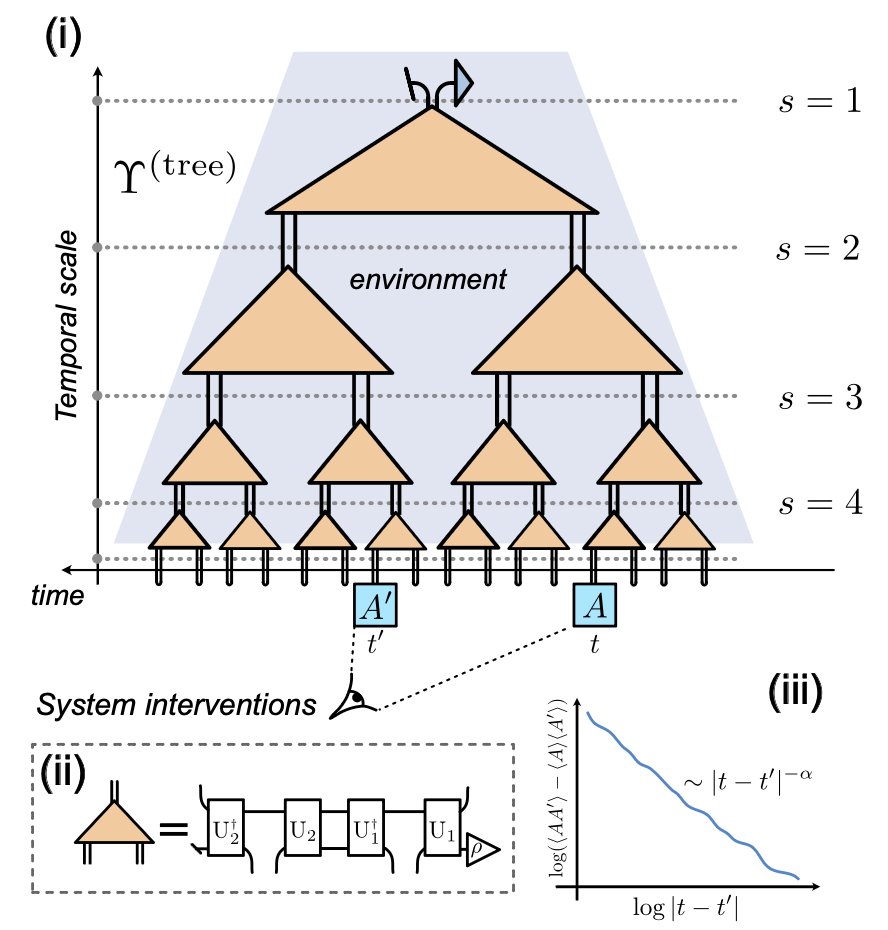
Complex systems often display long-range correlations. There is a notion of fine/coarse-graining in a spatial setting through hierarchical tensor networks to capture the relevant physics--but what about temporally?
scirate.com/arxiv/2312.046…
@ThosVarley Wishing you get well soon! The brain fog was also super real for me-- thinking anything useful felt like trying to squeeze peanut butter out of a syringe
I was not prepared for the psychological/cognitive dimension of COVID. The physical symptoms have been pretty mind, but apparently "brain-fog" actually means: "terrifying depersonalization/derealization."
I feel like someone's been putting ketamine in my Cheerios for a week.
@CatieSlaughts You can create new columns as you need, and sort the table by any of them!
Clicking the title of a paper opens up a new page where I can write my own summaries, and perhaps best of all is that I can make in text links to *any other* paper in my list.
It's great, 10/10, no regret
New preprint!
This is the last chapter for my PhD dissertation to see the light of day: I wrote it to be an accessible introduction to information theory explicitly written for the aspiring complex systems scientist. 1/n
arxiv.org/abs/2304.12482
The single most undervalued fact of linear algebra: matrices are graphs, and graphs are matrices.
Encoding matrices as graphs is a cheat code, making complex behavior simple to study.
Let me show you how!
The single biggest argument about statistics: is probability frequentist or Bayesian?
It's both, and I'll explain why.
Buckle up. Deep-dive thread below.
Quantum error mitigation (EM), a technique to correct quantum errors in (mostly) classical post-processing, is seen as a near-term waypoint towards the lofty goal of an error-corrected quantum computer. We point out limitations to how much EM can help.
scirate.com/arxiv/2210.115…
🚨New preprint!🚨
This is a shorter piece that came out of a side-project I've been working on off and on on the link between information theory and emergence. 1/N
arxiv.org/abs/2208.14502
@johncarlosbaez@mattecapu@mostlysafe@DaltonSakthi I'm a bit unaware of this basic math/physics fact. How can I learn more about the explicit link? Could I start by choosing to max entropy given some constraint and then turn it into a Lagrange multiplier problem? Maybe the Lagrange function turns into free energy when written out
And finally, I've officially passed my PhD 🎉🎂 now to race to get all my paperwork done so I can get into a graduation ceremony before I jet off to the USA!
@johncarlosbaez This is a great thread! Something I've always wondered, why the use of the logarithm outside of it having intuitive properties and nice additivity? Are there other monotonic functions one could choose to create an equally sound notion of information or is log provably it?