Robert Siudak

1.4K posts

Robert Siudak banner
Robert Siudak

Robert Siudak

@RobertSiudak

Product @ Clari | AI Platform | Building products for $10T+ revenue workflows at scale

Katılım Aralık 2015
450 Takip Edilen401 Takipçiler
Robert Siudak retweetledi
Aakash Gupta
Aakash Gupta@aakashgupta·
Poland will be as rich as the UK by 2030. In 1980, the UK was 62% richer per person. The IMF now projects the gap at 4%. Poland $75,000. UK $78,000. This is what compounding looks like when one country chooses pain and the other chooses comfort. On January 1, 1990, Poland flipped the entire economy in a single day. Price controls gone. Subsidies cut. Currency made convertible. The architect of the Balcerowicz Plan believed gradualism would kill the country, so the whole package took effect simultaneously. GDP shrank 18% over two years. Unemployment went from artificial zero to over 12%. Real wages collapsed. It was brutal. It worked. Poland has now grown for 33 consecutive years, the longest uninterrupted expansion in modern European history. GDP per capita at PPP has grown around 6% a year for two decades. EU funds added roughly one percentage point of GDP growth annually from 2004 to 2013. Poland passed the trillion-dollar economy mark in September 2025. In 2009, every other EU economy contracted. Germany fell 5.6%. The UK fell 4.2%. Poland grew 2.6%. They called it the green island on a continent of red ink. Now look at the UK. From 1992 to 2007, GDP per person grew 2.34% a year. Since 2008, that rate has dropped to 0.46%. UK GDP per capita only returned to its 2019 level in 2022, then fell again in 2023. The productivity gap with France and Germany tripled from 6% in 2007 to 16% by 2019. Brexit knocked an estimated 6 to 8% off output. Two decades of essentially zero productivity growth is unprecedented in 160 years of British data. Poland chose the 18-month depression in 1990 and ran 6% compounding for 35 years. The UK avoided every short recession with austerity, then Brexit, and ran 0.5% compounding for 15. The 18% Poland lost in two years was the cheapest GDP it ever bought.
Aakash Gupta tweet media
English
9
13
98
11.4K
Robert Siudak
Robert Siudak@RobertSiudak·
Today’s #Gemma 4 feels like a game changer on par with ChatGPT I can imagine a universe where companies runs their own LLMs in the cloud, on metal, on device without paying for tokens Are we witnessing the beginning of the end for the token economy? @Google
English
0
0
0
56
Logan Kilpatrick
Logan Kilpatrick@OfficialLoganK·
Introducing Gemma 4, our series of open weight (Apache 2.0 licensed) models, which are byte for byte the most capable open models in the world! Gemma 4 is build to run on your hardware: phones, laptops, and desktops. Frontier intelligence with a 26B MOE and a 31B Dense model!
Logan Kilpatrick tweet media
English
287
593
6.2K
524.8K
Robert Siudak retweetledi
Robert Siudak
Robert Siudak@RobertSiudak·
Do I have anyone on my X using Monday.com at work? If yes, please raise your hand 👋
English
0
0
0
9
Robert Siudak
Robert Siudak@RobertSiudak·
Interesting and intellectually compelling, but I think it might be too beautiful to be true. Take the example of the Claude Code and Agentic search with grep vs fancy RAG with vectors/graphs etc. We see that for many types of tasks the simple action of basic tool+LLM autonomy wins. It might be that in this new brave agentic word. We will need to apply Occam's razor more often than we expected.
English
0
0
1
69
Robert Siudak retweetledi
Gil Dibner
Gil Dibner@gdibner·
Thought-provoking new post by Even Armstrong "Context is what gets the margin that SaaS lost The playbook for what happens next was written in 2003. (Nobody in Silicon Valley has read it because it wasn’t a tweet.) Clayton Christensen called it the Law of Conservation of Attractive Profits: when one layer of a value chain commoditizes, the adjacent layer de-commoditizes. IBM’s hardware commoditized, and value migrated to Intel and Microsoft. If applications and systems of record just become the cost of the tokens to create them, and are thus commoditized, the value must migrate to the layer between them. The reason is structural. At any point in time, there is one thing that is the main bottleneck in a technology stack. Everything else gets cheaper and more interchangeable so that bottleneck can be solved. Right now, the thing that matters most is the connection between how AI models are trained and the agent systems that actually use them. That’s where the real performance gains are. For that connection to improve, everything around it has to get out of the way. Databases become interchangeable inputs. Applications become disposable interfaces. Building software isn’t the hard part anymore. Directing it is. The context layer sits at the new bottleneck. Here’s the important part: the context layer doesn’t fully compete with existing software spend. It replaces coordination overhead that companies just accepted. It takes money from the payroll budget, not the IT one. If that sounds too clean, consider what the alternative looks like where you pay a bunch of MBAs to do fake email jobs and make slides, all just to make sure that your company doesn’t go off the rails."
Gil Dibner tweet media
English
17
24
273
39.4K
Robert Siudak
Robert Siudak@RobertSiudak·
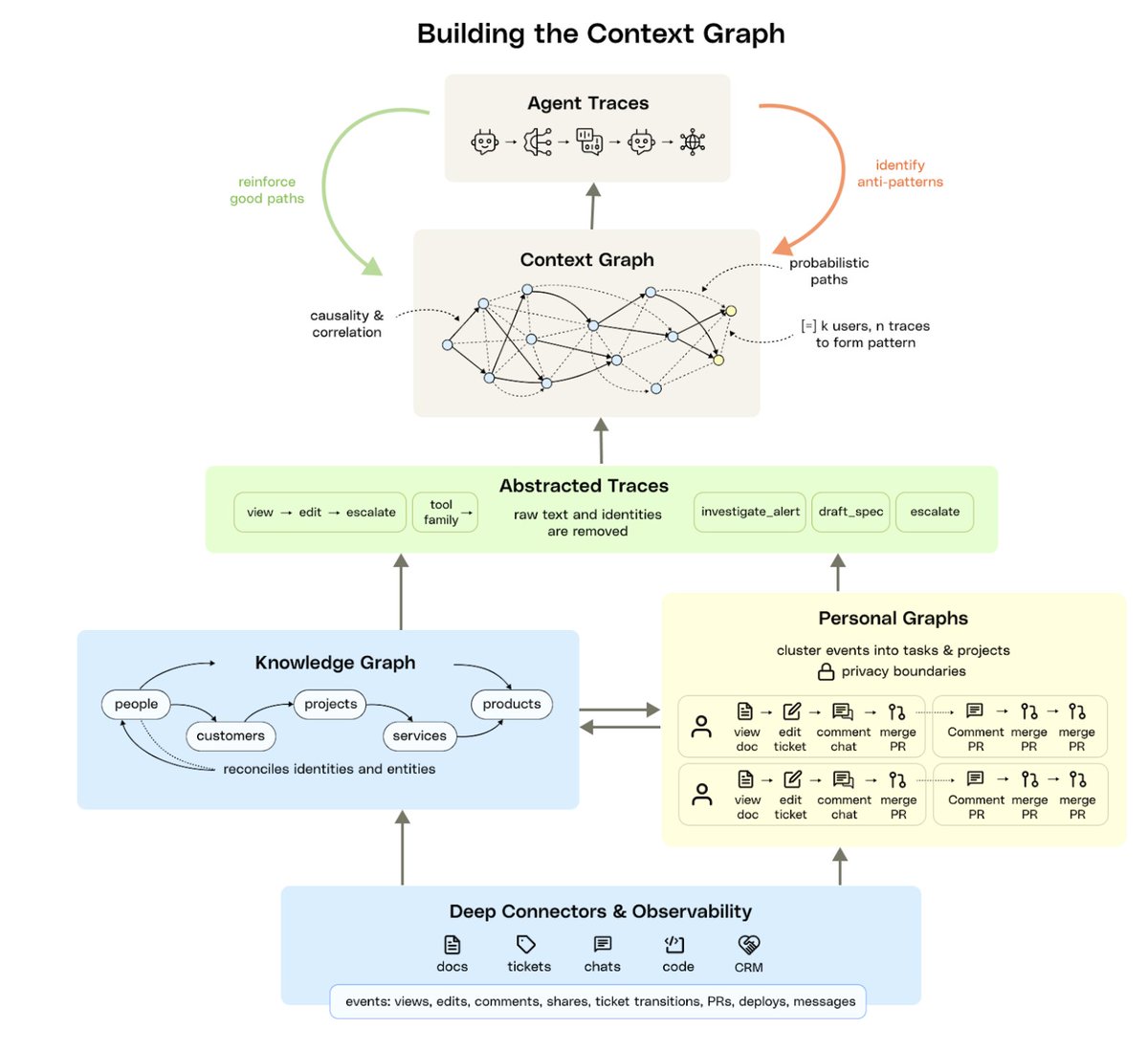
Everyone talks about context graph, but almost nobody shows how it's actually built. But @glean just did 👀 They published a walkthrough of how they build their context graph. Great to see the kitchen (Link below). One thing that deeply resonated: the hardest part isn't collecting signals. It's moving from raw events to semantic tasks with real business meaning. As they put it: "real work is messy". People context-switch, reuse docs across efforts, abandon threads and pick them up days later. A single event can belong to multiple parallel streams of work. I feel this working on context in Revenue Orchestration. The same CRM update means completely different things depending on deal stage, stakeholder, and timing. That gap between 'something happened' and 'here's what it means' — that's the missing link. Have you seen other "behind the curtain" blog posts like this? If yes, please drop a link 👇
Robert Siudak tweet media
English
1
1
4
250
Robert Siudak
Robert Siudak@RobertSiudak·
„Everything about the last few weeks tells us otherwise” - I don’t think so. We have seen that there are workflows that might be fully agentic with coding as a prime example. Agree, but in code generation workflows you have a lot of specific re-conditions like specific language, syntax, ability to unit test, etc etc. Not all workflows are like coding. I would even say that most business workflows are not like coding. And parts of them will be done by Agents (lest call it “tasks”) but full workflow will require humans in the loop for a long time.
English
0
0
2
179
Zain Hoda
Zain Hoda@zain_hoda·
@alexiskold > Systems of record have entrenched workflows - not easy to remove This assumes that the workflows don’t move over the agents. Everything about the last few weeks (and indeed days) tells us otherwise.
English
3
0
28
5.8K
Robert Siudak retweetledi
hiroshi
hiroshi@daddynohara·
> be me, applied scientist at amazon > spend 6 months building ML model that actually works > ready to ship > manager asks "but does it Dive Deep?" > show him 37 pages of technical documentation > "that's great anon, but what about Customer Obsession?" > model literally convinces customers to buy more stuff they don't need > "okay but are you thinking Big Enough?" > mfw I am literally increasing sales > okay lets ship it > PM says there's not enough Disagree and Commit > we need to disagree about something > team spends 2 hours debating whether the config file should be YAML or JSON > engineering insists on XML "for backwards compatibility" > what backwards compatibility, this is a new service > doesn't matter, we disagree and commit to XML > finally get approval to deploy > "make sure you're frugal with the compute costs" > model runs on a potato, costs $2/month > finance still wants a cost breakdown > write 6-pager about why we need $2/month > include bar raiser in the review > bar raiser asks "but can we do it for $1.50? we need to be Frugal" > spend another month optimizing to hit $1.50 > ready to deploy again > VP decides we need to "Invent and Simplify" > requests we rebuild the entire thing using a new framework > framework doesn't exist yet > "show some Ownership and build it yourself" > 3 months later, framework is half done > org restructure happens > new manager says this doesn't align with team goals anymore > project cancelled > model never ships > manager gets promoted to L8 for "successfully reallocating resources" > team celebrates with 6-pager retrospective about what we learned > mfw we delivered on all 16 leadership principles > mfw we delivered nothing else > amazon.jpg
English
501
1.5K
34.5K
4.7M
Robert Siudak
Robert Siudak@RobertSiudak·
Today Anthropic drops Claude Opus 4.6, and OpenAI launches their Frontier platform — a lot is happening, fast! I think no one really knows how the market will change in the next 6–12 months, let alone beyond that. 🌊 In this great uncertainty, I try to stop and think about previous tech breakthroughs. 🤖 Remember the early web app era? Gmail, Google Maps, Salesforce — suddenly we went from static pages to real applications in the browser. Everyone was dazzled by the frontend magic. AJAX! Dynamic UIs! It felt like the future. But the apps that actually scaled and won? They nailed the backend architecture. Database design, caching layers, API structure, queue systems. The boring stuff. The invisible stuff. I think we're at that exact same moment with AI agents. The models are our new "frontends" — getting shinier every quarter. But just like in the early web app era, the model isn't the moat. The context is. 🧠 We've moved past prompt engineering. The real discipline is context engineering — the "backend architecture" of the agent era: 🔧 Tool selection = your API design — defines what the agent can reach 📊 Data infrastructure = your database layer — shapes what the agent actually knows at runtime 🎯 Memory & retrieval = your caching strategy — right info, right moment, no waste Back then, everyone obsessed over flashy AJAX interactions while the winners quietly built robust backends. (Remember Google Maps rendering an ocean over Europe? 😄) Today, everyone obsesses over which model is best, while the real builders focus on what surrounds the model.
Robert Siudak tweet media
English
0
0
0
36
Robert Siudak
Robert Siudak@RobertSiudak·
@nicbstme And I am saying this as a data guy who loves the idea that value = data+interfaces to serve it to LLMs. But I don’t believe it will be true in this wave of AI yet
English
0
0
0
17
Robert Siudak
Robert Siudak@RobertSiudak·
Good read, but I don’t agree with overgeneralising of use cases/worfklows. There are workflows where the enacting of workflow via some interface is the value itself, and the end result is only bi-product (think collaboration tools). Also there are tasks where humans and LLMs will collaborate on and chat is not the best interface for that tasks. We will see new UX for LLM-human tasks beyond chat for sure.
English
1
0
0
135
Logan Kilpatrick
Logan Kilpatrick@OfficialLoganK·
officially giving up my “PM” title, we are all members of the technical staff now, time to embrace it
English
217
134
4.1K
529.2K
Robert Siudak
Robert Siudak@RobertSiudak·
@OfficialLoganK What 3 skills would you suggest "PM/TS"s cultivate, and what 3 skills should they develop that haven't traditionally been part of the PM skillset?
English
0
0
0
48
Robert Siudak
Robert Siudak@RobertSiudak·
The best mental model for AI agent orchestration isn't some futuristic concept. It's the enterprise job scheduler. As PM for RunMyJobs, our biggest challenge was never running individual jobs - it was managing context between them. Which job needs output from which? What state carries forward? What happens when step 3 fails but step 4 already fired? Today's multi-agent orchestration is the same problem with LLMs replacing ETL pipelines. Microsoft's Agent Framework, PwC's agent switchboards - they're rebuilding what workload automation solved decades ago. The orchestrator's real job was always context management. The teams that win at agent orchestration will treat it as a context engineering problem - not an AI problem. #ContextEngineering #Orchestration
English
0
0
1
64