

Md Robin
75 posts

Same same but different 😅🦅
@RAFA_AI is turning community engagement into real experiences.
A poker tournament isn’t just a game—it’s a smart way to reward activity, bring members together, and strengthen ecosystem culture.
• Link for registration: app.lepoker.io/m/56IDPsu
More Web3 projects should understand this: communities grow faster when participation feels fun, competitive, and rewarding. ♠️♦️♣️♥️
English

Spent some time researching @ConcreteXYZ, and it’s positioning itself as a serious layer in DeFi infrastructure. The core idea revolves around abstracting yield strategies so users don’t have to manage positions across multiple protocols and chains actively. What stands out is the focus on automated capital efficiency and risk-adjusted returns, which are still major pain points in DeFi. If execution aligns with the vision, this could significantly reduce friction for both retail and institutional participants. Still early, but the direction aligns well with where DeFi is heading simpler UX with smarter backend systems. Definitely worth keeping on the radar.
Join: discord.com/invite/concret…
@crypttoji , @concrete_intern

English
Good morning
Just like Moai starts the day calmly with a cup of coffee, @ConcreteXYZ is building a strong foundation in DeFi.
With secure vaults smart yield strategies and institutional grade infrastructure everything stays solid and steady.@crypttoji

English

Happy Sunday Rialo Family
Sunday isn’t simply a day of rest but it should be considered as an opportunity to rethink your mind and prepare for the coming days.
While we think so, it’s also quite interesting to know how technological innovations are progressing.
@RialoHQ is one of those platforms that create a brighter future by balancing the idea of personalized services without compromising on people’s privacy.
Just wait for Rialo. Stay with Rialo.

English
Not stone but force
Gray concrete hardens into a rock and the Concrete project stands unshakeable in the volatile crypto market This Moai art is the symbol of our solid security and lasting trust With Concrete build your foundation strong @ConcreteXYZ @crypttoji

English
English


This picture is not just a sceneit's a feeling.
A calm atmosphere, a depth of thought, and a silent moment of creativity This is where the future is being created.
Donut AI is just such a place where not hype, but real value is created.
Where ideas don't just come, they grow
Where data isn't just seen, it's understood.
Where AI isn't just a tool, but a partner to think together.
In today's world, many platforms just want attention, but Donut AI is creating engagement, consistency, and real impact.
Like the girl in this picture sitting quietly, immersed in her work, slowly creating something big
Donut AI is just like that silent but powerful.
Less noise, more value
Less hype, more trust
Not short-term, long term vision
Future belongs to those who build quietly.
And @DonutAI is building.

Adnan Habib@AdnanHabib59327
Golden hour light, a warm cup of coffee, and a quiet moment with yourself… 🌅☕ These are the moments where clarity is born and ideas flow naturally. With Donut Browser 🍩 your workflow feels just like this no noise, no distractions, just a smooth and smart experience. ⇨ Stay focused on what matters ⇨ Let ideas come effortlessly ⇨ Move forward at your own pace Productivity isn’t just about getting things done, it’s about feeling calm, clear, and in control. Create your moment. Grow with clarity. Stay ahead effortlessly. @DonutAI @GigiWillliams 👀💜
English
@SouravAhmed89 @muhtasimmuiz @RialoHQ Multisig verifies who approves not whether the action is truly safe
English

@muhtasimmuiz @RialoHQ Multisig solves authorization, but not contextual risk
English
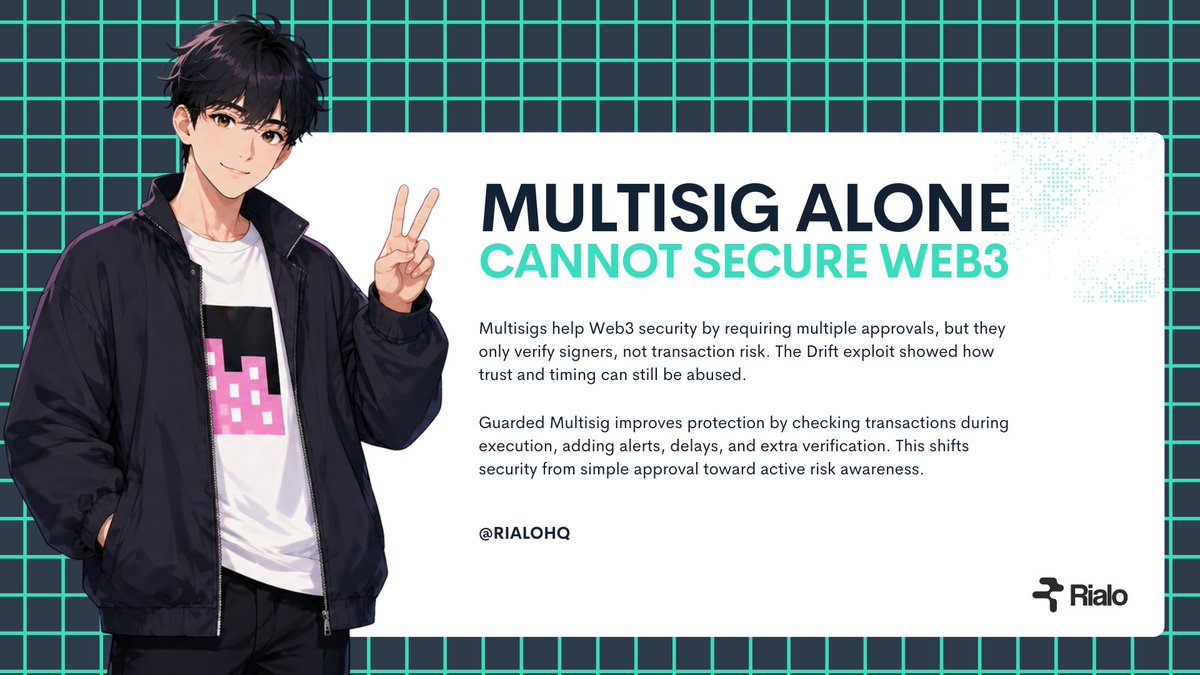
Why Multisig Isn’t Enough: Rethinking Onchain Security
For years, multisig wallets have been treated as one of the strongest security layers in Web3. And to be fair, they solve an important problem: they make sure no single person can move funds or approve critical actions alone.
But the bigger question is this: does multisig understand what it is approving?
That is where the real weakness begins.
A multisig can confirm that the right people signed a transaction, but it does not always know whether the transaction is dangerous, poorly timed, or part of a larger attack path. The Drift Protocol exploit showed this clearly. The attacker did not need to break cryptography. Instead, they used trust, timing, and system design gaps to turn valid approvals into a serious security failure.
This is why Web3 security needs to move beyond simple approval systems. External bots and monitoring tools can help, but they often react after risk has already entered the system.
Guarded Multisig on Rialo takes a more active approach. It adds real-time transaction checks, alerts, delays, and extra verification for high-value actions. Yes, it creates friction. But in security, the right friction can save millions.
The future of onchain security is not just about verifying signatures. It is about understanding risk before execution.
English
The @soneium ecosystem will become a significant milestone on the path to Web3's bright future.
It should be noted that the project isn't developing only an ordinary blockchain environment.
It is developing a whole ecosystem that includes scalability, usability and adoption aspects.
This ecosystem aims to make decentralized technologies more convenient and user friendly for various communities, including developers, content creators and common people.
The central platform in the Soneium ecosystem is @StartaleGroup Labs and its core product is @StartaleApp
This application is aimed at facilitating user's interaction with blockchain based applications and projects.
Instead of interacting with a complex interface and using numerous different tools, users can now perform many operations related to digital assets and other decentralized products more conveniently and intuitively.
The most critical aspect of this ecosystem is that it allows users to own their data and assets.
This idea perfectly matches the main purpose of the Web3 ecosystem, allowing users to enjoy greater freedom and convenience without giving up their assets and data.

English

Decentralized finance emerged as a structural alternative to legacy systems, yet its foundational design introduced a constraint that remained largely unaddressed.
In the absence of identity and context, most on-chain protocols converged on a single governing principle: require more value than is borrowed. That principle protects the system. It does not serve the participant.
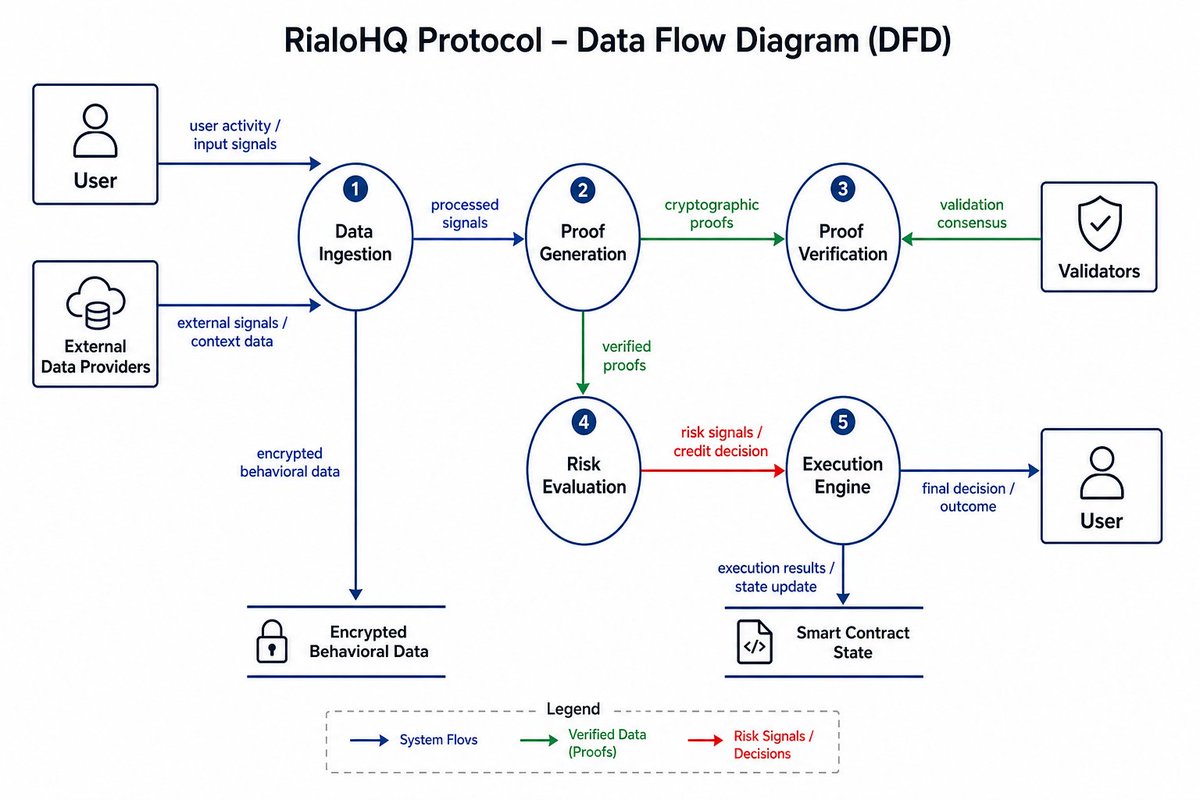
RialoHQ is advancing a fundamentally different framework, one in which financial decisions are shaped not solely by pledged assets, but by verifiable signals of demonstrated reliability.
Rather than exposing sensitive personal or financial data, participants can present cryptographic proofs that attest to specific behavioral attributes including repayment consistency, transactional discipline, and financial stability over time. The protocol validates the conclusion. It never accesses the underlying record.
This distinction restructures how credit is underwritten. Collateral ceases to function as the singular instrument of protection. Risk becomes a dynamic variable, continuously informed by evolving verified signals rather than static assumptions established at origination.
Execution follows the same logic. Financial conditions no longer respond on delayed schedules or through manual oversight. Terms adjust, obligations are enforced, and actions are initiated in direct response to real-time conditions. What once required external coordination becomes native to the protocol itself.
The broader consequence is equally significant. As regulatory standards intensify, systems must demonstrate the capacity to enforce compliance without compromising the privacy of the individuals they serve. Embedding these requirements directly at the protocol layer eliminates dependency on disparate external services and ensures consistent application across the entire system.
The resulting model represents a more sophisticated stage of decentralized finance: credit decisions informed by verified behavioral data rather than locked capital, accountability preserved without the exposure of private information, and financial logic that operates continuously rather than intermittently.
The evolution is precise in its scope. Decentralized finance is transitioning from infrastructure that manages assets to infrastructure that interprets trust, without surrendering control.
@RialoHQ | @AhmedNir | @RollinsR79
Ryve@ryvexbt
Data replication is one of the foundational bargains of modern distributed systems. You gain speed, resilience, and geographic reach. You accept that truth, for a brief moment, may differ depending on where you look. Consider a familiar situation. A deposit clears. A confirmation arrives. Yet a query from a separate endpoint returns a stale balance. This is not a malfunction. It is a deliberate architectural decision, one that reflects how the system was designed to behave under load and across distance. Contemporary infrastructure rarely lives on a single machine. Copies of data are distributed across multiple nodes and regions simultaneously. Updates do not propagate everywhere in an instant. For a narrow window of time, replicas can hold conflicting versions of the same record. Consistency models exist to govern that window. They define what a user is permitted to observe after a write completes, how current that observation must be, and what degree of temporal drift the system considers acceptable. @RialoHQ frames this as a spectrum rather than a binary choice. At one extreme, strong consistency guarantees that every read reflects the most recent confirmed write. At the other, eventual consistency permits the system to converge over time without requiring immediate agreement across all replicas. Most production systems occupy a carefully chosen position somewhere between those two poles. Stronger guarantees carry weight. In financial services, healthcare, and any domain where precision is non-negotiable, even marginal inconsistency can compound into serious downstream consequences. That assurance requires coordination overhead, introduces measurable latency, and occasionally demands that the system withhold a response rather than serve data it cannot fully verify. Relaxed models operate on different terms. They favor throughput and availability, accepting that certain reads will reflect a version of reality that has since been superseded. There is no universally correct answer. The appropriate consistency model is always a function of what the system must prioritize and what its users can reasonably tolerate. That decision is not abstract. It surfaces directly in behavior, in trust, and in the moment a user looks at a number and wonders whether it is real. @RialoHQ | @AhmedNir | @RollinsR79
English



Been digging into @ConcreteXYZ and it’s actually a pretty interesting direction for DeFi. Instead of manually chasing yields across chains, it abstracts everything into a single-layer deposit once, and the protocol handles allocation, rebalancing, and risk optimization automatically. The multi-chain angle is what stands out most, especially in a fragmented liquidity environment. Still early, but if they can consistently deliver risk-adjusted returns without added complexity, this could be a strong piece of infrastructure for both retail and institutional users. Not risk-free (nothing in DeFi is), but definitely a project worth watching as “one-click yield” becomes a real narrative.
@crypttoji, @concrete_intern

English
Data replication is one of the foundational bargains of modern distributed systems. You gain speed, resilience, and geographic reach. You accept that truth, for a brief moment, may differ depending on where you look.
Consider a familiar situation. A deposit clears. A confirmation arrives. Yet a query from a separate endpoint returns a stale balance. This is not a malfunction. It is a deliberate architectural decision, one that reflects how the system was designed to behave under load and across distance.
Contemporary infrastructure rarely lives on a single machine. Copies of data are distributed across multiple nodes and regions simultaneously. Updates do not propagate everywhere in an instant. For a narrow window of time, replicas can hold conflicting versions of the same record.
Consistency models exist to govern that window. They define what a user is permitted to observe after a write completes, how current that observation must be, and what degree of temporal drift the system considers acceptable.
@RialoHQ frames this as a spectrum rather than a binary choice. At one extreme, strong consistency guarantees that every read reflects the most recent confirmed write. At the other, eventual consistency permits the system to converge over time without requiring immediate agreement across all replicas. Most production systems occupy a carefully chosen position somewhere between those two poles.
Stronger guarantees carry weight. In financial services, healthcare, and any domain where precision is non-negotiable, even marginal inconsistency can compound into serious downstream consequences. That assurance requires coordination overhead, introduces measurable latency, and occasionally demands that the system withhold a response rather than serve data it cannot fully verify.
Relaxed models operate on different terms. They favor throughput and availability, accepting that certain reads will reflect a version of reality that has since been superseded.
There is no universally correct answer. The appropriate consistency model is always a function of what the system must prioritize and what its users can reasonably tolerate. That decision is not abstract. It surfaces directly in behavior, in trust, and in the moment a user looks at a number and wonders whether it is real.
@RialoHQ | @AhmedNir | @RollinsR79

Ryve@ryvexbt
The Infrastructure Gap That Blockchains Keep Ignoring Every major blockchain network has spent the last several years solving the same problem is making transactions faster. BNB Chain expanded throughput. Sui introduced object-centric parallelism to process independent transactions simultaneously. Aptos engineered Block-STM, its parallel execution engine, targeting hundreds of thousands of transactions per second. Ethereum continued scaling through its rollup ecosystem. The numbers improved. Adoption did not. The reason is architectural, not technical. Despite the impressive throughput of newer chains, adoption remains frustratingly limited. Today's blockchains exist as islands, blind to real-world events. They cannot directly interact with the rich ecosystem of real-world services built over decades. Faster throughput does not solve that isolation. Sui can settle a transaction in under half a second. Aptos can process it in parallel with ten thousand others. But neither chain can natively make an HTTP request, read a live price feed, verify a credit score, or react to an event happening outside its own state. That gap forces every serious application into the same uncomfortable architecture. Web calls, data feeds, timers, and cross-chain actions become outside dependencies rather than native instructions. BNB Chain applications rely on Chainlink or Band Protocol for external data. Sui and Aptos developers wire together oracle integrations, off-chain bots, keeper networks, and bridge middleware just to build something that reacts to the real world. Every additional component is an additional trust assumption. Every external dependency is a point of failure the chain itself cannot audit or guarantee. Rialo consolidates the essential functions including bridging, oracles, scheduling, stable gas, and web calls into the core. Not bolted on, not outsourced. This is a fundamentally different design philosophy. Where Aptos and Sui optimized the execution environment, Rialo reimagined what the protocol layer is responsible for. The practical implications are significant. Rialo's native asynchronous execution model allows transactions to run as workflows that span multiple blocks, pause while external processes run in the background, and resume once required results are available. No relays. No keeper networks. No off-chain monitoring scripts. Logic that previously required three separate systems can now be expressed as a single smart contract operation. Oracles, bridges, indexers, and other traditional infrastructure are not just unnecessary, they are rendered obsolete. The real world asset vertical illustrates this most clearly. Most tokenized assets cannot prove anything without a third party. Dividend payouts, stock splits, and corporate buyouts all require manual checks before the chain updates. Markets move in milliseconds, but tokenized assets crawl. Rialo's native oracle architecture addresses this at the protocol level, not through middleware, not through a third-party feed, but through execution logic the chain itself controls and verifies. Streaming real-world data to the blockchain in real time is achievable without relying on expensive middleware. With the right design, on-chain systems can process external information as quickly and reliably as traditional networks. What separates Rialo from every performance-focused chain that preceded it is precisely this reorientation of priorities. The problem has less to do with cost and speed and more with the inability of public blockchains to handle sensitive information privately, interact with external systems natively, and support the kind of asynchronous workflows that modern software demands. BNB Chain, Sui, and Aptos built better versions of what blockchains already were. Rialo brings convergence to blockchain the way the smartphone brought convergence to mobile are embedding connectivity, identity, and real-world interaction into a single unified environment where entirely new categories of applications become possible. That is not an incremental improvement. That is a different thesis entirely. @RialoHQ | @AhmedNir | @RollinsR79 | @ericargent31113
English

At a time when innovation is sometimes equated to complexity in the tech world, Concrete takes a different stance one that favors simplicity intuitiveness and user centricity.
Having reviewed their website documentation (docs.concrete.xyz), it appears that significant thought has been put into making sure everything feels intuitive and straightforward.
While other frameworks tend to impose on developers layers upon layers of abstraction which do not add any value, Concrete gives its users a smooth and streamlined experience.
What stands out about Concrete is their approach towards infrastructure development.
In this case the company has decided to perfect the existing solution rather than try something new at least this approach will allow the project to become more robust and flexible.
Developer experience seems to be the key factor for Concrete. User friendly interfaces clean architectures and comprehensive documentation are some of the reasons why it is safe to assume that this framework was built by developers for developers.
It might also be worth considering what kind of tone they create. They don’t make noise they don’t create hype they concentrate on the essentials.
In an environment filled with distractions concentration always seems to attract more attention.
For any project being created in Web3 Concrete should definitely get some consideration.
When friction is minimized and developers are empowered their potential is far greater than those that simply predict it.
I’m very interested in seeing where @concretexyz goes from here. Their base seems solid but most importantly it feels sustainable.

English
In the future, the question won’t be What does AI think? — it will be “What does verified intelligence conclude?”. As AI becomes more powerful, the real risk is no longer lack of intelligence, but lack of certainty. Unverified outputs may be acceptable for casual use, but in high-stakes environments like trading, finance, automation, and critical decision-making, probably correct is not enough. Intelligence in these systems must be auditable, outputs must be validated, and decisions must be provable.
@RAFA_AI Protocol is building toward that future by redefining how AI systems operate. Instead of relying on a single model’s output, it introduces a framework powered by multi-agent coordination, where multiple AI systems analyze problems from different perspectives, cross-check results, and refine conclusions. This is combined with decentralized verification, removing single points of trust, and real-time validation, ensuring that outputs are continuously checked before being accepted.
The result is a fundamental shift from AI that simply generates answers to AI systems that actively test, challenge, and prove their own correctness. This transforms AI from a passive tool into a system of verified intelligence one where trust is not assumed but computed.
Because in the next era, the most valuable output won’t be the fastest answer it will be the most reliable one. And that is the direction RAFA is building toward: a world where AI doesn’t just speak, but proves.

English
@tanvirnabil25 @RialoHQ @RialoBangladesh @JanCamenisch AI needs freedom with guardrails, and Rialo delivers exactly that.
English
Rialo has come up with an important solution for what appears to be one of the biggest challenges in current AI space, agent guardrails.
These days, AI agents are becoming smarter and more sophisticated.
Not only can they make decisions, execute tasks and actions but they can engage with other AI and even perform financial operations.
The question that arises in connection with such abilities is quite obvious:
How do you guarantee that AI agents will use their power properly and will not cause any harm to their owners?
That’s precisely the problem Rialo aims to solve.
Instead of creating yet another AI system, Rialo develops an environment in which control, safety, privacy and accountability lie in the user’s hands.
Unlike the majority of platforms, Rialo provides users with:
▪ Agent guardrails
▪ Data sovereignty
▪ Complete traceability
@RialoHQ returns control over AI actions to the user while providing complete transparency and security at the same time.
This is precisely the approach the AI market requires.

ade | rialo.io@itachee_x
Who is solving the AI/agent guardrail problem?
English
@TheBoy02020 Privacy needs standards before institutions can trust it.
English

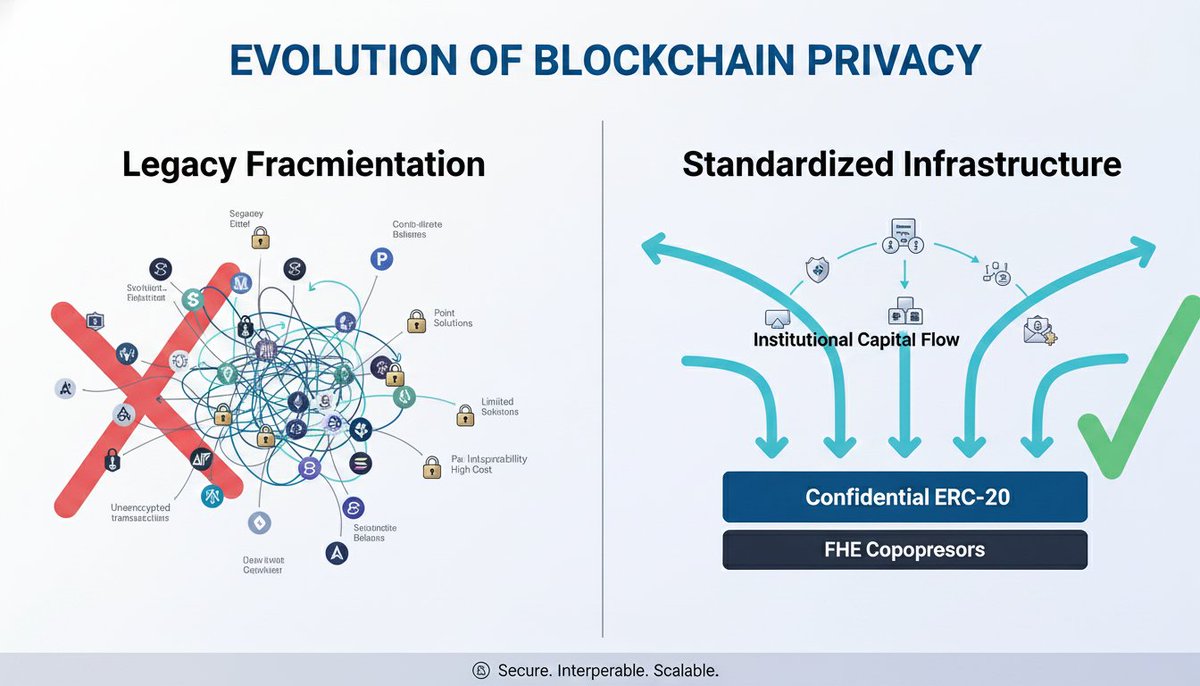
The fragmentation of confidentiality protocols has historically served as a barrier to institutional entry. Capital requires predictability. This is only achieved through rigorous standardization. We're finally seeing a pivot where privacy is no longer a modular additive, but a foundational infrastructure layer.
@Fluton is leading this shift by establishing a baseline for Confidential ERC-20 standards. By leveraging FHE coprocessors and smart account factory logic, they're providing the framework for native, unlinkable anonymity within the Ethereum ecosystem. Honestly, it's not just about security. It's about building the professional-grade rails required for the next decade of capital deployment.
The thing is, growth is driven by toolkits that abstract cryptographic complexity. Standardized confidentiality is the prerequisite for institutional scale. Once these layers become a baseline feature, the entire landscape shifts.
English