Robin P. Zander 🤸

5.4K posts

Robin P. Zander 🤸 banner
Robin P. Zander 🤸

Robin P. Zander 🤸

@RobinPZander

writing Snafu ✍️ • curating @Responsive_Con 🌎 • narrative strategy @Zander_Media 🎥 • sold @robinscafesf • handstands 🤸 • relentless optimist
Read the Snafu newsletter 👉 Katılım Nisan 2009
1.7K Takip Edilen1K Takipçiler
Robin P. Zander 🤸
Robin P. Zander 🤸@RobinPZander·
Across the United States, millions of children lose access to learning opportunities when the school year ends. The National Summer Learning Association (NSLA) is working to change that. Their mission is ambitious: bring high-quality summer and out-of-school learning opportunities to 9 million children by 2030. Zander Media has had the privilege of partnering with NSLA to help tell that story. In 2026, we traveled to Fairhope, Alabama, to capture their annual Summer Solutions Leadership Forum – a national gathering of educators, nonprofit leaders, policymakers, and innovators focused on expanding learning opportunities for young people. Events like this are where ideas move forward. Leaders from across the country come together to share what’s working in summer programs, after-school initiatives, and community partnerships. They compare notes, learn from one another, and build the collaborations needed to scale these programs nationwide. Our team filmed conversations, panels, and moments throughout the week to create a highlight video that captures the spirit of the forum. But the project went beyond a single video. The footage we captured will also support NSLA’s broader storytelling efforts – helping them communicate their mission, engage partners, and strengthen fundraising initiatives in the years ahead. For Zander Media, it’s always meaningful to work with organizations that are investing in the future of young people. Stories like these remind us that when communities come together around a shared goal, real change becomes possible. You can watch the full video here: youtube.com/watch?v=-1Z-cv…
YouTube video
YouTube
English
0
0
0
2
Robin P. Zander 🤸
Robin P. Zander 🤸@RobinPZander·
When I was in college, my friend Devin died in my arms. He didn’t actually die but in that moment, it felt real. We were taking a nine-day 12-hour-a-day Wilderness Emergency Responder course, rotating through rescue simulations. Devin was the victim in mine. He was wedged between two trees on a steep snowy slope, and I had three minutes to stabilize his spine, check his breathing, and move him to safety. I rushed in. Devin, an acting student, committed fully to the scenario. He struggled, convulsed, foamed at the mouth. Adrenaline took over and instead of assessing the situation, I tried to force him free. By the time our instructor stopped the exercise, fifteen minutes had gone by and Devin had “died.” Later, the instructor showed me something painfully simple. I could have slid him safely downhill. My mistake was speed without awareness. There’s a phrase often attributed to Navy SEALs: slow is smooth, smooth is fast. Had I paused for even one breath, I likely would have saved him. We often treat slowing down as failure, laziness, hesitation, or lack of urgency. But slowing down can be a way to pay attention. When we slow down, we notice more, make fewer mistakes, and process information in larger, clearer patterns. Speed absolutely matters. In business and in life, moving quickly can be a competitive advantage. But panic masquerading as speed is costly. I still feel adrenaline when I remember that snowy hillside. Devin “died” because I confused urgency with effectiveness. I carry a photo of him in my medical kit to this day as a reminder that sometimes the fastest way forward begins with slowing down long enough to truly see what’s in front of you.
English
0
0
0
13
Robin P. Zander 🤸
Robin P. Zander 🤸@RobinPZander·
How do you challenge a broken system at work–especially when you’re not the boss? This is a question I recently explored with Rebecca Hinds, PhD, and her answer was quite practical. Many people in organizations see problems clearly. Meetings that go nowhere. Processes that waste time. Decisions that should have been made by email. But raising your hand and saying, “Maybe this could work differently,” can feel risky – especially if you’re in middle management or early at a startup. Rebecca says the reality comes down to psychological safety. In some organizations, people are eager to fix broken systems. In most cases, speaking up feels like a personal challenge to someone’s authority. Her advice is to lead with curiosity instead of criticism. Instead of calling out a bad meeting or a flawed process directly, ask questions. For example: “I’m not sure I’ll contribute much to this discussion – would it be okay if I sit this one out?” Another strategy is to rely on objective metrics and systems rather than personal opinions. Rebecca is seeing more organizations use technology to set meeting standards. For example, if a meeting doesn’t have an agenda, or if half the attendees haven’t accepted the invite 24 hours in advance, the meeting gets automatically canceled. When expectations are codified – through metrics, rules, or shared frameworks – it's easier for employees to point to the standard rather than making it personal. Changing culture can start with a question.
English
0
0
1
25
Linda Chen
Linda Chen@linderps·
how to find a gf in sf: - dress nicely. no tech bro logos. style your hair, wear a nicely fitted tee, go to the gym - go where she goes. farmer's markets, coffee shops, dinner parties. get a sexy hobby - say hi. compliment her style, her bag, her hair. find out what she's doing there. dont bring up AI or agents lastly, don't give up. you don't find her by waiting, you find her by trying. good luck 🫶
Don@donatelli2026

question for the tech bros: what's the best way to find a girlfriend in San Francisco?

English
100
15
853
421K
Don
Don@donatelli2026·
question for the tech bros: what's the best way to find a girlfriend in San Francisco?
Don tweet media
English
174
3
194
605K
Eric Bahn 💛
Eric Bahn 💛@ericbahn·
Our flagship event, Camp Hustle, is back May 11-13! This is our event specifically for investors, drawing in family offices, institutions, and angels. We keep it small--no more than about 250 people are accepted--and hold it in the forest. It's an amazing way to meet to form authentic connection to other great investors/humans. You should see the alumni WhatsApp chat, it's still active from last year's event! Join us: camphustle.co
Elizabeth Yin 💛@dunkhippo33

A strong investor network isn’t about LinkedIn connections—it’s about who you can call for advice or a deal lead. At Camp Hustle, investors don’t just swap cards—they build real connections. That’s why they return every year. See you there? camphustle.co
English
2
3
12
6.2K
Robin P. Zander 🤸
Robin P. Zander 🤸@RobinPZander·
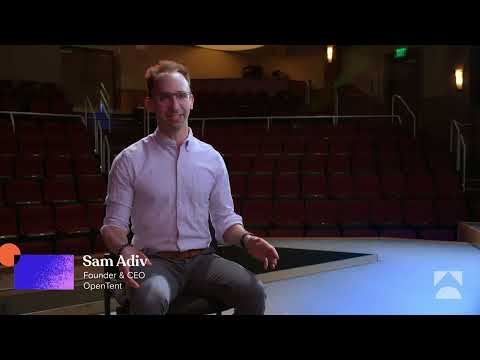
When nonprofits grow, their systems need to grow with them. That was the challenge facing the JCC Denver, a thriving community center serving thousands of families through cultural programming, education, wellness, and community events. OpenTent partnered with the organization to bring their systems into alignment – connecting tools, streamlining workflows, and giving staff the visibility they needed to better serve their members. Zander Media traveled to Denver, Colorado, to document that collaboration. Over the course of a full day of filming, we spoke with leaders and team members about what it means to run a dynamic community organization in a modern world – and how technology plays a role behind the scenes. One of the key innovations highlighted in the film is the integration of Amelia, the JCC’s virtual storefront and member-facing platform, with Salesforce. By connecting these systems, the organization gained a complete, 360-degree view of its members while reducing the number of tools staff needed to manage. What once required juggling spreadsheets and disconnected systems can now happen in a single integrated workflow. Our job at Zander Media was to translate work into human stories. The result is a film that shows how thoughtful technology implementation empowers organizations like the JCC Denver to stay focused on what they do best: creating vibrant spaces where communities come together. You can watch the video here: youtube.com/watch?v=NxtCCR…
YouTube video
YouTube
English
0
0
0
29
Eric Bahn 💛
Eric Bahn 💛@ericbahn·
We're just one week away (Mar 23, 6pm PT) from our next Founder Friends SF. I really hope that folks in San Francisco can join me for this special event because we're doing something that we've never done before. First, we're going to be speaking with @alexmodon, who is the CEO of Unlimited Industries, which is an AI native construction company for building critical industries. They raised $12 million led by a16z. I'm really excited to be personally interviewing him. But before that, we're going to be bringing in @willsclips_, who's been developing a popular documentary series called "INSIDE," where he profiles high-growth startups. We're going to preview a trailer of his full-length INSIDE video on Unlimited Industries, and then also bring him up to be a part of this fireside chat. Our Founder Friends events are enormously popular, there's only five spots remaining. Hope you can join us! See the link to sign up in the next comment:
Eric Bahn 💛 tweet media
English
6
3
28
5.7K
Vishal Kumar
Vishal Kumar@KumarVishal_·
@RobinPZander The force multiplier that movement based training supports so many aspects of life is truly amazing!
English
1
0
1
12
Robin P. Zander 🤸
Robin P. Zander 🤸@RobinPZander·
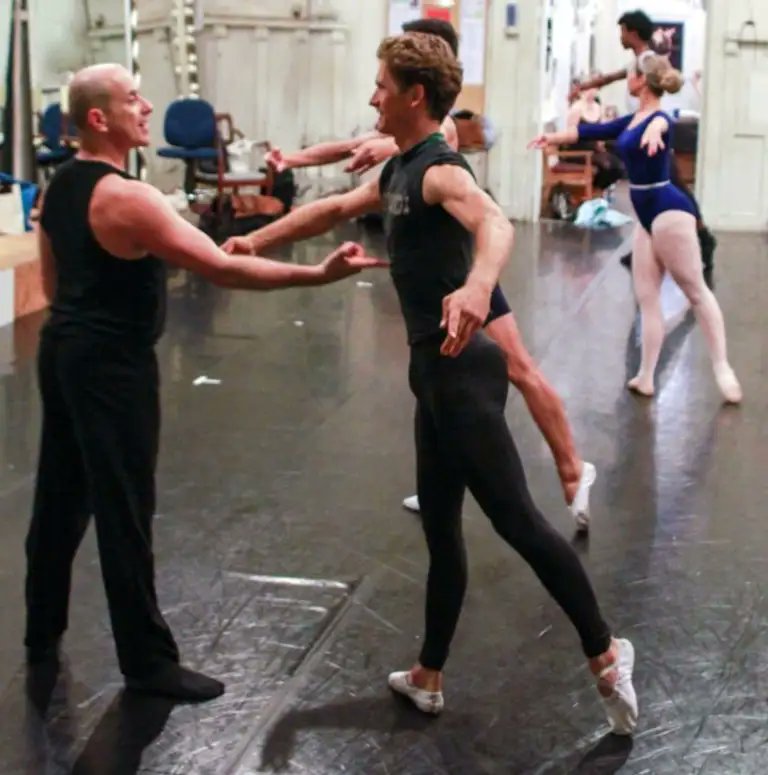
Last year, my wife and I spent an afternoon looking at rental homes just south of San Francisco. We toured seven different properties and assumed we’d rent something sensible and move on. The next evening, she sent me a Zillow listing for a house for sale instead. I walked over, wrote her a note that said, “Fuck it, let’s buy,” and within hours, we were deep down an entirely new rabbit hole. What followed were weeks of research, hundreds of conversations, calls with friends and brokers, and four separate offers on houses. Most of our attention today is pulled toward shallow distraction: the lure of the infinite scroll, breaking news, endless updates that leave us depleted. A good rabbit hole feels different. It has structure, stakes, and momentum. Instead of scattering your attention, it gathers it. Some of the most meaningful shifts in my life have started this way. -Learning gymnastics as a teenager. -Studying ballet obsessively 40 hours/week for a year. -Building Responsive Conference to better understand the future of work. -Starting Zander Media to practice storytelling. Each began as curiosity and turned into immersion. Not escapism, but expansion. We tend to think learning should be fast optimized and efficient. But depth is slow, sometimes obsessive, and oddly restorative. Spending real time understanding something new gives your attention somewhere useful to land. I’ve found three questions helpful when entering a new rabbit hole: -Why this subject? -Why now? -And what deadline forces action instead of endless preparation? The world isn’t going to get quieter. Going deep into something meaningful isn’t withdrawal from reality it’s a way of regaining focus inside it. Rabbit holes matter because they give curiosity direction and, in a noisy world, that kind of focus is often what keeps us sane.
Robin P. Zander 🤸 tweet media
English
1
0
1
56
Robin P. Zander 🤸
Robin P. Zander 🤸@RobinPZander·
How do you deal with rejection? I asked Mandy Mooney this recently, and her answer stuck with me. She said no one knows rejection quite like theater people. When she was living in New York pursuing music, she went through countless Broadway auditions. And with auditions comes the inevitable: a lot of “no.” Her perspective on getting through it comes down to a few things. First, surround yourself with people who genuinely support you. Whether it’s family, friends, or your chosen community, having people who remind you of your worth makes a huge difference when the world tells you otherwise. Second, developing a strong sense of self-worth. Mandy believes resilience starts with knowing—deep down—that you are worthy of the role, the opportunity, or the job. That internal confidence becomes the anchor when rejection inevitably happens. And third, creating the right conditions for success. She told a story about being 11 years old and auditioning for her very first play, a local production of Will Rogers’ Follies. Someone dropped out at the last minute, and through a connection—her aunt who was in the play—she got a chance to audition that same night. Standing outside the theater in the freezing cold, the director asked her to sing something. The only song that came to mind was “Hold On” by Wilson Phillips, and she belted it out on the spot. She got the part. Looking back, Mandy says that moment wasn’t just about talent. It was about the conditions around it. Someone told her about the opportunity. Her mom said yes and brought her there. And the director was willing to take a chance on someone new. Resilience, she says, isn’t just about enduring rejection. It’s also about building the support systems, confidence, and opportunities that make success possible in the first place. Rejection may be inevitable, but the conditions you create around yourself change everything.
English
0
0
0
22
Robin P. Zander 🤸
Robin P. Zander 🤸@RobinPZander·
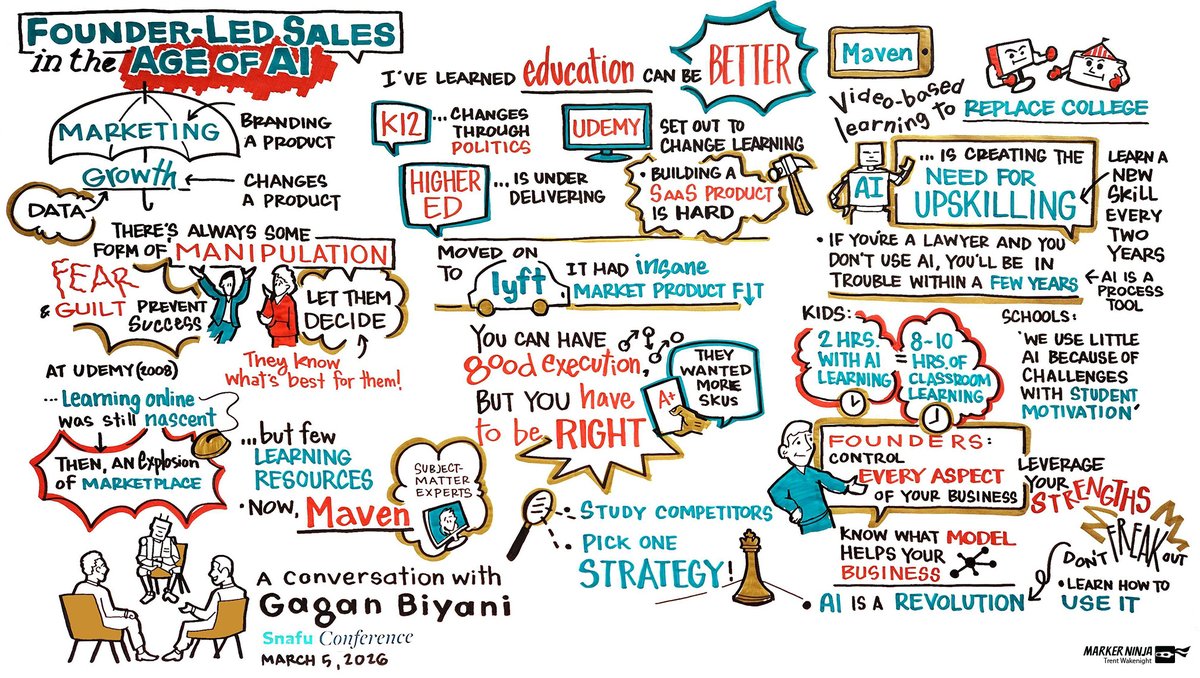
What does founder-led sales look like in the age of AI? That was the focus of a conversation I had with Gagan Biyani at Snafu Conference, and the discussion went far beyond just sales tactics. One idea that stuck with me: marketing changes a product, but growth changes the company. Data, messaging, and branding all shape how people experience what you build—but ultimately the market decides what works. Gagan shared lessons from his time at Udemy, when online learning was still in its early days. Back then, the marketplace was exploding with content, but what people actually needed was trusted expertise and high-quality learning resources. That insight led him to Maven, which focuses on expert-led courses and a different model for learning. Another theme was the massive shift AI is creating. AI isn’t just another tool—it’s changing the pace of learning and work. The idea that you might need to learn a new skill every couple of years is quickly becoming reality. In many professions, ignoring AI won’t be an option. For founders, the takeaway was clear: you have to be deeply involved in the business early on. Founder-led sales means understanding your customers, your competitors, and the model that actually works for your company. You can execute well, but you also have to be right about the strategy. And when it comes to AI? Don’t panic. It’s a revolution—but it’s also a process tool. The real advantage goes to the people who learn how to use it well. And most importantly: keep learning.
Robin P. Zander 🤸 tweet media
English
1
0
1
17
Robin P. Zander 🤸
Robin P. Zander 🤸@RobinPZander·
Over the years running Responsive Conference, we’ve had many dozens of sponsors promoting HR tech platforms and organizational software. The challenge was that I was rarely the buyer. I’m not a CHRO evaluating enterprise tools or a Fortune 500 manager choosing systems for thousands of employees. So I relied on others to tell me what actually worked. With the Snafu Conference, that changed. Snafu is for founders, operators, and people in transition — roles I’ve lived myself many times. So at the Snafu Conference, I thought I’d share the tools I actually use. My criteria are straightforward: Spend as little money as possible. Use software that works immediately. Choose tools that save time instead of demand more. The foundation of everything I do is Google Workspace. Email, docs, spreadsheets, calendar — you can build an entire company here before needing anything else. For thinking, I’ve oddly returned to Apple Notes. After years trying more sophisticated systems, simplicity won. Sometimes you just need a place to capture an idea quickly. Once a team grows, Slack is helpful. My primary rule: turn off notifications. Meetings happen on Zoom, still the cleanest default for conversations. A small upgrade I recommend is adding a video or image to your waiting room — a five-minute change that improves first impressions. For managing work, I rely on Asana, which scales from personal task lists to full team collaboration without unnecessary complexity. Scheduling runs through Calendly, one of the rare tools that stayed simple even as it grew. Earlier this year, I switched CRMs to Clarify.ai, which automatically tracks relationships and communication history — removing much of the manual work older systems required. For communication and feedback, Loom has become indispensable. Recording a quick walkthrough often replaces long meetings or written instructions. I also regularly use ChatGPT and Gemini for writing feedback, research, and idea development. At this point, they function less like software and more like thinking partners. None of these tools are revolutionary on their own. But together, they create something more valuable than optimization — a system that reduces friction and allows momentum. That’s ultimately what a tech stack should do.
English
0
0
2
26
Robin P. Zander 🤸
Robin P. Zander 🤸@RobinPZander·
Sometimes the most meaningful projects come with the shortest timelines. In 2025, XQ Schools — the nonprofit founded by Laurene Powell Jobs as part of the Emerson Collective — came to Zander Media with a challenge. They were preparing to promote enrollment for Lattice High, one of the innovative schools supported by the XQ initiative to rethink high school education in the United States. And they needed a launch video fast. We had a week. There was no time for a traditional production schedule. No new filming. Instead, the XQ team provided a library of existing footage and trusted us to shape it into something compelling. What followed was a tight, collaborative sprint. We reviewed the material, identified the emotional throughline, and crafted a one-minute story that captured the spirit of Latitude High School — a place where learning moves beyond textbooks and classrooms and into real-world problem solving. The result is a 60-second launch film designed to inspire students and families. It highlights how Latitude students design projects, build businesses, explore careers, and engage directly with their communities — showing that high school can be a launchpad for curiosity, creativity, and leadership. At Zander Media, we love projects like this. They remind us that storytelling isn’t about how much time or footage you have. It’s about finding the heart of the story and bringing it to life. You can watch the full video here: youtube.com/watch?v=yvynxT…
YouTube video
YouTube
English
0
0
0
37