Ron Lafleur
13.5K posts

Ron Lafleur
@RonLafleur2
Communicator, Author, Healer, Public speaker, Jester, Observer of Life. Working my way up to RonLafleur1. @ronlafleur.bsky.social
BC Canada Katılım Ekim 2017
2.9K Takip Edilen1.1K Takipçiler

Hi, I’m Kylie 🥰🤍 writing from Australia 🇦🇺🐨
We kind of speak English here… most days 😄
I write about love, kindness, miracles,
and the quiet beauty of being human
My mum is from Spain
and my dad is Bosnian & Slovenian
so seeing your messages
from all around the world
has meant more to me than you know
Wishing you the loveliest blessings 🤍
Where are you reading this from?


English
Congratulations to Cole Caulfield! It's been a long time coming. Major Boo to the @CanadiensMTL for putting profits over team building.
Cole Caufield becomes first Canadien to score 50 since 1990 with goal vs. Lightning ca.sports.yahoo.com/news/cole-cauf… via @@YahooCASports
English
One might think this could be a good time for an @SECGov investigation. You know to assure the fairness of markets. Things like that.
White House Sends Warning to Staff After Mysteriously Well-Timed Bets ca.news.yahoo.com/white-house-se… via @@Yahoo
English
Ron Lafleur retweetledi

A community college professor taught the same study skills lecture for 30 years, and the video quietly became one of the most watched educational recordings on the internet.
His name is Marty Lobdell. He spent his career as a psychology professor watching students fail not because they were lazy, but because nobody had ever taught them how their brain actually works under the pressure of learning something hard.
The lecture is called "Study Less Study Smart." Over 10 million views. Passed around in Reddit threads, Discord servers, and university study groups for over a decade. And the core insight buried inside it has been sitting in cognitive psychology research for years, waiting for someone to explain it in plain language.
Here is the framework that completely changed how I think about effort.
Your brain does not sustain focus the way you think it does. Studies tracking real students found that the average learner hits a wall somewhere between 25 and 30 minutes.
After that, efficiency doesn't just decline. It collapses. You're still sitting at your desk, still looking at the page, but almost nothing is going in.
Lobdell illustrated this with a student he knew personally. She set a goal of studying 6 hours a night, 5 nights a week, to pull herself out of academic probation. Thirty hours of studying per week. She failed every single class that quarter.
She wasn't failing because she lacked effort. She was failing because she had confused time spent near books with time spent actually learning. The 25-minute crash hit her at 6:30pm every night. She spent the next five and a half hours sitting in the wreckage of her own focus and calling it studying.
The fix sounds almost too simple. The moment you feel the slide, stop. Take five minutes. Do something that actually gives you a small reward. Then go back. That five-minute reset returns you to near full efficiency. Across a six-hour window, the difference is not marginal. It is the difference between thirty minutes of real learning and five and a half hours of it.
The second thing he taught destroyed something I had believed about how memory actually works.
Highlighting feels productive. Going back over your notes and recognizing everything feels like knowing. But recognition and recollection are two completely different cognitive processes, and your brain is very good at making you confuse them.
You can see something you've read before and feel completely certain you understand it, even when you couldn't reconstruct a single sentence from memory if the page were blank.
He proved this live in the room. He read 13 random letters to his audience. Almost nobody could recall them. Then he rearranged the same 13 letters into two words: Happy Thursday. The whole room got all 13 without effort.
Same letters. Same count. The only thing that changed was meaning.
The brain stores meaning. Not repetition. The moment new information connects to something you already understand, the retention changes entirely.
This is what the cognitive psychology literature calls elaborative encoding, and it is the mechanism underneath every effective study technique.
The third principle was the one that hit me hardest, and the one almost nobody applies.
Lobdell cited research showing that 80 percent of your study time should be spent in active recitation, not passive reading. Close the material. Say it back in your own words.
Teach it to someone else, or to an empty chair if no one is around. The struggle of retrieval is where the actual learning happens. Reading your notes again is watching someone else do the work.
His parting line has stayed with me longer than almost anything else I have read about learning.
He told the room that if what he shared didn't change their behavior, they hadn't actually learned it. It would just live in their heads as something they had heard once and felt good about.
He was right. And most people leave every lecture exactly like that.
The students who remember everything aren't putting in more hours.
They stopped confusing the feeling of studying with the fact of it.
English
Ron Lafleur retweetledi

We have the technology to dump oil forever. #Solar #wind, #geothermal and now #tidalpower from ocean waves.
We have so many solutions. Implement them.#ActOnClimate
#climateaction #Energy #tech #go100re #renewableenergy #GreenNewDeal #ClimateWeekNYC
English


51 came upon me fast, yet today it’s here & it’s the age I’m supposed to be. While I have thoughtfully closed old chapters & bravely opened new ones, I’m proud that I did it by being myself. Today I celebrate being me! Please do a random act of kindness to help me celebrate!🎊🎉

English

🥀IM OFFICIALLY A PUBLISHED AUTHOR🥀
Thank you to everyone who had a hand in shaping this book. And to you, the reader, for letting me share this world.
All I have to say now is: Welcome to Vaccarium, darkness awaits.🖤🥀
#writingcommunity #publishedauthor

English
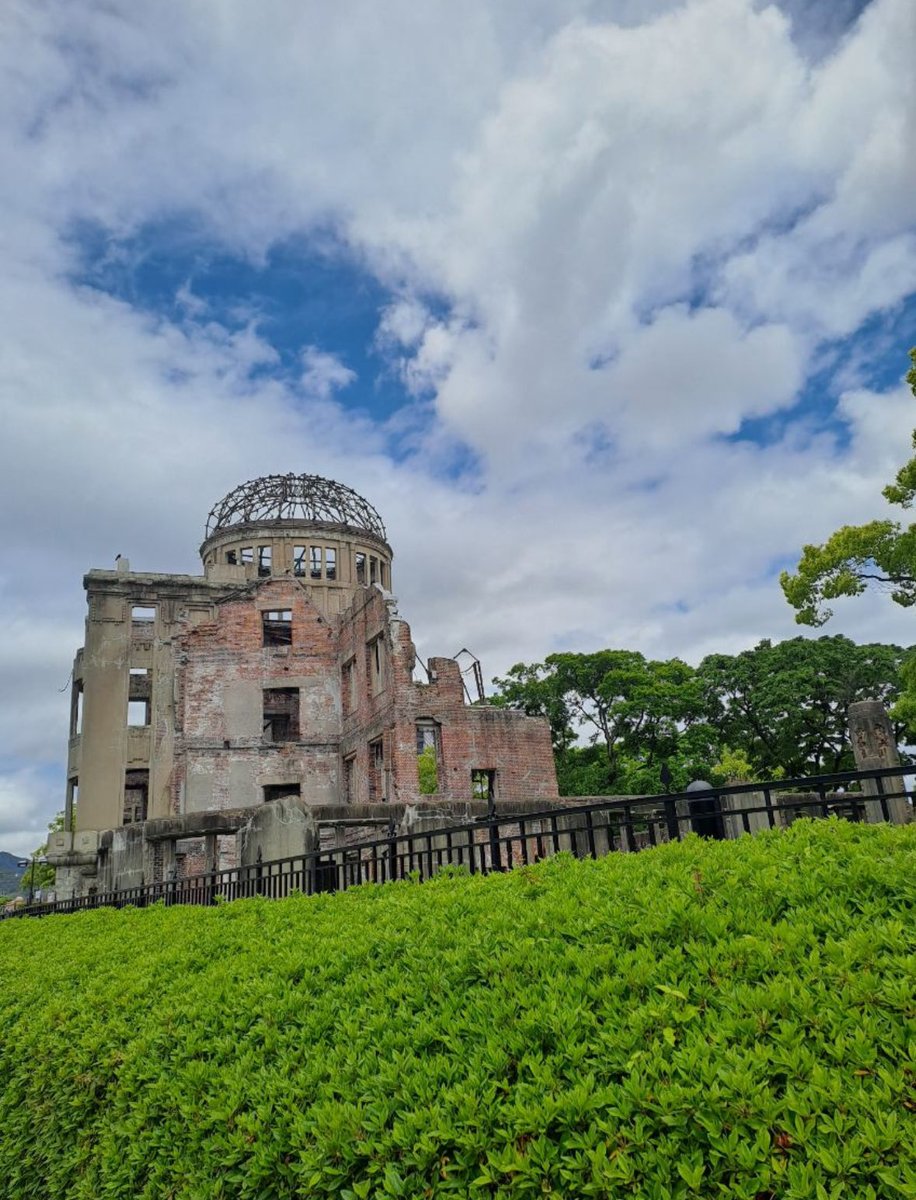
I’ve stood in Hiroshima Peace Memorial Park, not as a tourist, just as a person trying to take in what happened there.
It’s not something you can fully understand. You feel it more than you think it. The quiet holds everything. Lives that were ordinary one moment and gone the next. Families. Children. A whole world changed in seconds.
What stayed with me wasn’t only the devastation. It was the people. The way a place that went through something so unimaginable chose to rebuild with peace at its centre. That kind of courage is different. It’s soft and steady and deeply human.
Right now things feel tense and uncertain. There’s a lot of fear in the air. It’s easy to get pulled into that and feel powerless.
But courage isn’t in the noise or the threats. It lives in us. In how we speak to each other. In how we hold each other. In whether we let fear make us smaller or choose something better.
No one should ever have to live through what happened in Hiroshima. That truth sits heavy, but it also reminds us what really matters.
We still get to choose. Kindness. Care. Humanity. Even now.
And that choice, quiet as it is, might be the most powerful thing we have.
Kr 🤍
English
You don’t need a new life.
You need:
better boundaries
more rest
and to stop betraying yourself to keep the peace
That’s the tweet.
English
@_debramessing Glad you were able to reconnect with yourself. 🙏
English

Sometimes you just have to run away…
I have been open about the struggles I’ve had, like all of you, with the hate and violence seen across the globe. Feeling impotent. Heartbroken. Enraged. Overwhelmed. And, the feeling that the city I love is on fire had left me despondent.
I realized I needed to reset. The majesty of Nature is always the answer for me. So, I went to Iceland. Alone. And it was transformational. I knew seeing the Northern Lights would wake me up and remind me of the the Awesomeness of the Universe. The vast unknowable Design. And It brought me back to life.

English

Can you all take a sec to wish my mother Jeanette Tuitt a Happy Birthday. Today she turned 85 years of age!

English

On a scale from 1–10, how worried are you about the disappearance of our remaining forests? 🌳

English
Ron Lafleur retweetledi

Sadio Mane, a Senegalese soccer star, earns approximately $10.2 million annually. He gave the world a rude awakenng after some fans were flabbergasted when they saw him carrying a cracked iPhone 11. His response was awesome:
"Why would I want ten Ferraris, 20 diamond watches, and two jet planes? I starved, I worked in the fields, played brefoot, and I didn't go to school. Now I can help people. I prefer to build schools and give poor people food or clothing. I have built schools and a stadium, provide clothes, shoes, and food for people in extreme poverty. In addition, I give 70 euros per month to all people from a very poor Senegalese region in order to contribute to their family economy. I do not need to display luxury cars, luxury homes, trips, and even planes. I prefer that my people receive some of what life has given me.

English

My grandmother rode in a go kart at her 98TH BIRTHDAY party last night! 🎉
Just look at the JOY!
The THRILL!
The GRACE on her face!
Please join me in wishing her a HAPPY 98th!🎈
She is the most amazing woman I know!
#writingcommunity #birthday #author #5amwritersclub #clifi #98thbirthday

English
If you're looking for a good definition of "antisocial" this might be it.
#Greed
English
Ron Lafleur retweetledi

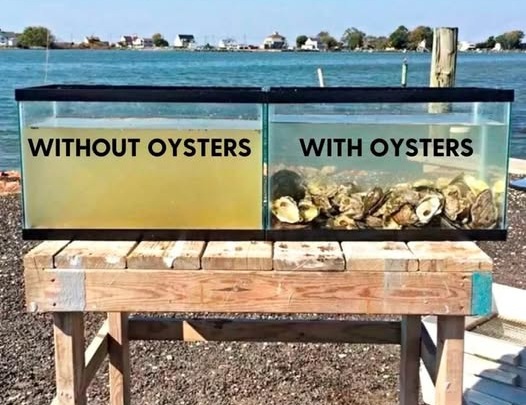
Same water. Same tank.
But the one on the right has oysters.
A single oyster can filter up to 50 gallons of water a day.
Oyster reefs in the Chesapeake Bay once filtered the entire Bay, 19 trillion gallons, in under a week.
Today, with less than 1% of the original oyster population remaining, it takes over a year.
We ate them. We dredged their reefs. We dumped nitrogen into their water until the algae blooms choked what was left.
And now we build billion dollar water treatment plants to do what oysters did for free.
The Billion Oyster Project is working to restore oyster reefs in New York Harbor.
Restored reefs in Maryland's Harris Creek can now filter the entire creek in under 10 days and remove nitrogen equivalent to 20,000 bags of fertilizer every year.
Nature had this figured out. We just have to restore the oysters and get out of the way.
English

A great package arrived today. Almost 4 years of writing and it’s out in the world 🙏
English