Ryan Low

85 posts

Ryan Low

Ryan Low

@RyanLow63537990

Katılım Mayıs 2020
2.1K Takip Edilen109 Takipçiler
Ryan Low retweetledi
MaxO
MaxO@_MaxO22_·
I bet almost no one throwing around the word liquidity truly understands what it means. For most, it’s just a pattern on a chart an Order Block, Breaker Block, Supply & Demand, or Support & Resistance. While not entirely wrong, since these formations are indeed where liquidity tends to cluster, relying solely on textbook patterns leaves the bigger picture hidden. Liquidity is liquid: It flows and constantly shifts. In its rawest essence, liquidity is the act of buying and selling. Once you grasp this, you realise that every move traders make, whether retail or professional, is actively creating liquidity. Every execution provides the "other side" of someone else’s trade. However, there is a fundamental distinction between the two primary forms of liquidity: Planned and Forced. For the retail trader, liquidity typically manifests in the forced variety. Forced Liquidity consists of: · Stops&Liquidations: Automatic orders triggered when a price level is breached. · Unplanned Executions: Panic selling or FOMO buying where the trader is forced by emotion or margin calls to act. Unplanned trades are often triggered by the calculated actions of market makers, whales, and institutions. The moment a trade is executed, liquidity is either added to or removed from the order book, depending on the type of execution. For those in control, a forced, unplanned trade is the ideal mechanism to build or offload large positions. Institutional Size requires deep liquidity to operate without massive slippage. To generate this, they utilise every tool at their disposal: Social media figures, news cycles, political agendas, and most commonly, classic TA formations that trigger retail entries. These forced trades create a secondary wave of liquidity when they are eventually stopped out or liquidated. As this happens, capital flows back through the order books, ready to be harvested by the other side of the trade once again. Stops are either the direct result of these forced trades or simply a standard component of a disciplined execution. For the professional, a stop loss is a resting order in the book, a pre-planned exit placed behind a technical barrier that, if breached, invalidates the trade thesis. Even though a stop loss is technically forced liquidity (as it triggers against the trader’s primary direction), the prepared trader does not suffer because it was a calculated risk within their counter-thesis. To put it simply: Forced liquidity is almost always the result of a larger participant needing a counterparty to build or exit their own position. In the real world, institutions use sophisticated methods to engineer this, from news cycles to social media. While many traders focus only on these often messy external factors, they often miss the bigger picture. The market is a highly efficient wealth-transfer mechanism for those who understand its true nature. In reality, every common knowledge chart formation is a potential trap, just another tool in the arsenal used to manufacture the liquidity necessary for the smart money to operate. Your pattern might sound more sophisticated than the rest, but if it's shared across the internet and utilised by thousands, it isn't the secret weapon you imagine. When it comes to isolated formations, success often boils down to pure statistics. It is entirely possible to trade the market without understanding the mechanics behind the candles, provided you can execute a statistical edge while removing yourself from the equation. In reality, most traders are too emotionally and intellectually involved to maintain that level of detachment. They transition from zero knowledge to basic technical analysis and believe they’ve finally found the key. They find themselves stuck in the gap between seeing the full picture and maintaining statistical discipline. Simply put: They try to outsmart a market that thrives on their attempts to do so. Not everyone processes the market the same way. My approach is tailored for the discretionary thinker. My edge isn't found in repetitive statistical execution of static patterns, but in understanding fluidity, the constant, shifting movement of capital and the mechanics of the "trap." The game has many layers, each designed to trap players based on their specific level of knowledge. If you survive long enough and stay consistent, you eventually cycle through these stages yourself. You begin to recognise where others are in their journey, watching them fall into the same traps you once did. This perspective is invaluable. By listening to the opinions of others and assessing their level of competence, you can integrate their likely mistakes into your own decision-making process. The Second Form: Planned or Intentional Liquidity Every time you place an order, whether limit or market, you are participating in the creation or consumption of liquidity. One side makes (adds to the book), and the other takes (removes from the book). If these terms are unfamiliar, studying market microstructure is essential to understanding how the engine actually runs. As a small fish, you have the luxury of instant execution. You will almost always find enough resting liquidity to fill your orders, even at market price. Your trades do not create walls that price must struggle to breach. In short: Without significant size, your actions have no active influence on price movement (excluding, of course, the lowest-tier shitcoins or stocks). For a participant with size, the game changes entirely. To execute a large position, they require a counterparty, someone willing to sell to them or buy from them in equal volume. At a certain scale, the order books are simply too thin to execute a plan in a single transaction without causing massive, unfavorable price slippage. Consequently, they utilise limit orders, letting them rest in the books and waiting for the market to come to them. MMs are the grease in the gears. They are incentivised to provide a certain level of depth to keep the market liquid. They profit primarily from the bid-ask spread and small transaction fees. The real controversy arises with the second form of market making, where the house takes the direct opposite side of your trade. This is the behavior many crypto exchanges are accused of. However, in strictly regulated markets, the incentive is different: The exchange profits from frequency. Their goal is to keep you in the game and trading often. While they might use psychological tactics to encourage over-trading, they aren't hunting your specific stop loss on a chart while having all your data, they simply want you to keep clicking buttons. While the term market maker is used loosely in trading circles, we can define them as the entities that provide the structural liquidity required for the market to function. However, the true adversaries you face are the whales, institutions, and heavyweight traders. The nature of your opponent shifts depending on the asset class: Low-Cap & Unregulated (e.g., Altcoins, Shitstocks): You are often trading against faceless whales and predatory exchanges. In this wild west, influence is manufactured through social media hype and coordinated news cycles to lure retail into the wrong side of a trade. On shadier platforms, you may even face execution issues or flash events designed to wipe out the books. The supply of these assets is, more often than not, monopolised and used against you. High-Cap & Regulated (e.g., $BTC, $SPX): As volume and regulation increase, the shadiness diminishes, but the sophistication grows. In these markets, you aren't fighting a guy or group on twitter, you are fighting high-frequency algorithms and global macro-funds. There is no better or worse market, only different environments. While an edge can be found in either, regulated assets offer a level of safety and structural clarity. In these high-volume environments, price tends to move with less erratic noise. This structural stability provides a dual benefit: It often allows the discretionary thinker to read the fluidity of the tape with greater precision, while simultaneously providing the mechanical trader with the clean, repetitive data necessary to maintain a statistical edge. Ultimately, the market doesn't care how you perceive it. Whether you see it as a shifting sea of human emotion or a sequence of mathematical probabilities, the underlying engine remains the same: The constant search for liquidity. By recognising that size views forced liquidity as a structural necessity, you begin to see what the candles actually represent. Their options are not endless: If the goal is to move massive volume, they must engineer scenarios where large groups of traders act simultaneously. They bend the rules and they shape the game board, but they cannot break the fundamental laws of the market. This reveals their greatest weakness: They cannot move without being seen. You can't win against them, you can only trade alongside them by truly understanding the game they play. Every formation creates liquidity upon execution. Trendlines, Swing Highs/Lows, FVGs, Order Blocks, and Support & Resistance are all markers where liquidity is manufactured. Institutional players even spoof order flow software to create false signals. The layers are endless, and there is no perfect TA that works with 100% certainty. The most robust strategies integrate these tools while remaining fluid. To understand what your opponents are up to, you must learn to read their footprints. You need to see where they executed and why. In every move the market makes, you must be able to identify the winners and the losers. You can certainly choose any single method, accept its win rate, and manage your risk to remain profitable in the long run. However, if your personality isn't naturally mechanical, you will likely become your own greatest obstacle. You must either learn to get out of the way and let statistics play out over hundreds of trades, or, if you simply cannot shut your brain off, move past the middle ground. This is where most traders are stuck: They are too emotionally and intellectually involved to be mechanical, yet not sophisticated enough to shift their perspective with the flow of the market. If you want to leave the middle of the bell curve, you must make a conscious choice about the trader you intend to become. There is no right or wrong, only the path that aligns with your psychological DNA. The Mechanical Trader: The System To be a mechanical trader, your strategy must be so objective that it could be executed by a computer. It is simple, repetitive, and anchored in proven statistics. This is arguably the fastest route to profitability because it removes the burden of constant choice. In this model, you accept that you will be forced liquidity (stopped out) 50% or even 70% of the time. It doesn't matter, because you trust the math to resolve in your favour over the long run. To build a strategy with a genuine statistical edge, you must still accept the universal truths about how the market truly works. The Discretionary Trader: The Intuition To be a discretionary trader, you must outplay the computer. Your edge is your adaptability. You do not remain static. You move with the tides, shifting between statistical probabilities by trusting a refined intuition and a subconscious mind trained on thousands of hours of screen time. This path requires you to feed your mind information that goes far deeper than "trading a key level." You must understand the market's deepest layers, the intent, the sentiment, and the traps. Because you are constantly involved in the decision-making process, you must maintain absolute self-control. You cannot afford to become forced liquidity due to an emotional lapse: You must be the one observing the force, not the one feeling it. Liquidity, order flow, buying and selling, whatever you choose to call it, is the foundation of everything in this game. To build a strategy that truly resonates with you, you have to understand its core mechanics. Look beyond "key levels" and the superficial definitions of these terms. Take the time to look behind the candles and into the order book. Learn to read the game for what it truly is, instead of hunting blocks you don’t understand, like you're playing Tetris. Stop being forced liquidity and start becoming intentional liquidity.
English

2
5
67
1.9K
Ryan Low retweetledi
MisterPA
MisterPA@studentoffew·
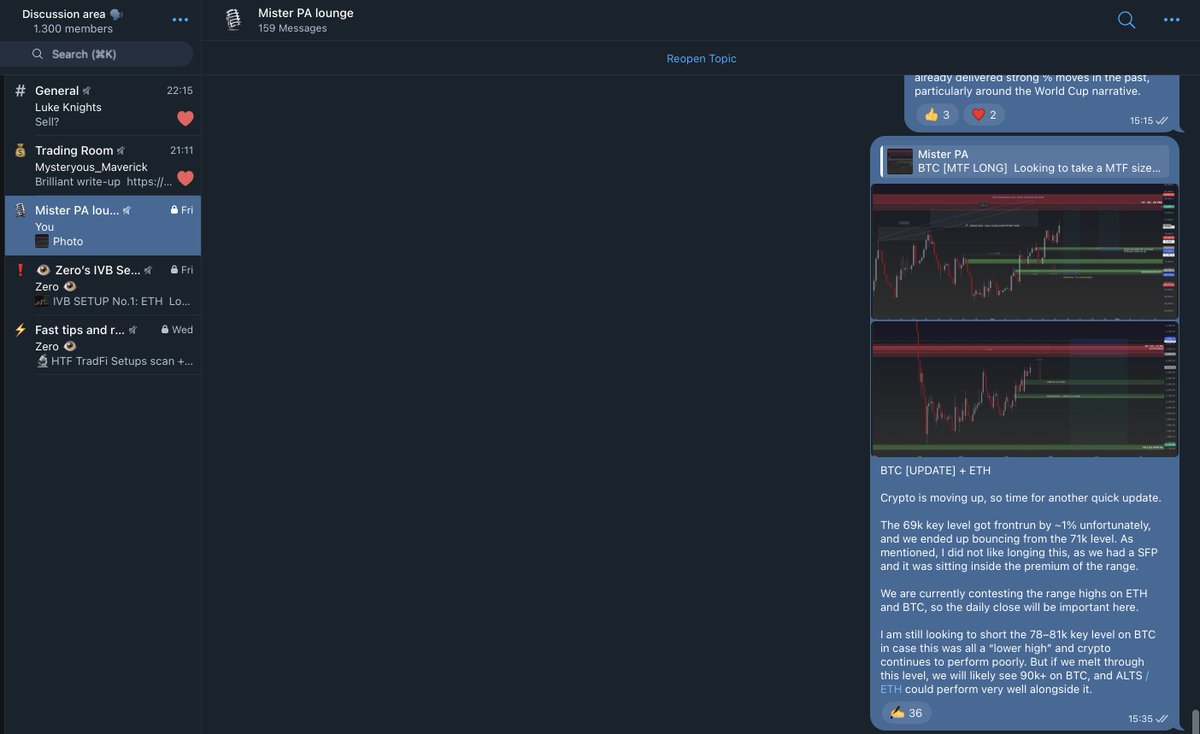
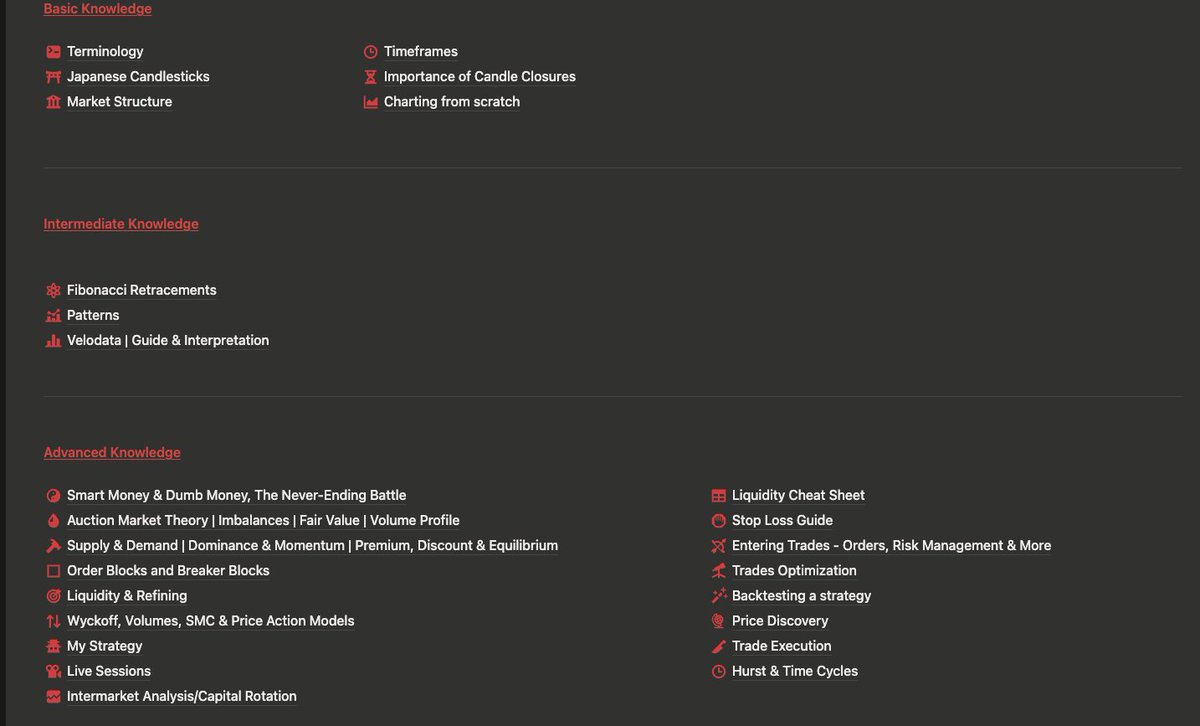
Most people have no idea what they’re actually getting inside our Telegram. (The Dojo 🔴⚪️) So here’s a clear breakdown of what <$10/month gives you in there: zeroika.com • Main Channel 0⃣ @IamZeroIka shares his highest conviction HTF setups + key market insights & announcements. • Trading Room + General Chat 1⃣ 2⃣ Active community where traders connect, share setups, ask questions, and improve together. • MisterPA Lounge (my side) 3⃣ My personal HTF / MTF setups (+ occasional LTF) – Crypto, stocks, commodities – Live updates on positions – Trade management breakdowns – Educational videos when needed • Fast Tips & Reflections 4⃣ Zero’s frequent updates, including live portfolio insights and quick market reads. • Zero’s IVB Setups (NEW) 5⃣ Focused channel purely on IVB trades. Real setups, real execution → showing how effective this strategy actually is. • The Dojo 2.1 (Notion) 📚 This alone could be a paid product. A full “book of knowledge” with: – Psychology – Technical analysis – Structured learning paths – Simplified video explanations Thousands of hours condensed into one place. • Weekly Livestreams (1 per week) 🎥🍿 – Market breakdowns – Live setups – Trade management – Focus on HTF swing trading (high ROI, low time commitment) It’s: Learning + real execution + community + structure. All for less than $10/month. So if you’re serious about improving and want to actually understand what you’re doing: The price is heavily underpriced right now - take advantage while it lasts. zeroika.com Take a look inside and you’ll immediately see why people stay. 👀
MisterPA tweet mediaMisterPA tweet mediaMisterPA tweet mediaMisterPA tweet media
English
24
26
142
7.6K
Ryan Low retweetledi
Abundance | Capital Rotation
Abundance | Capital Rotation@mr_abundance_·
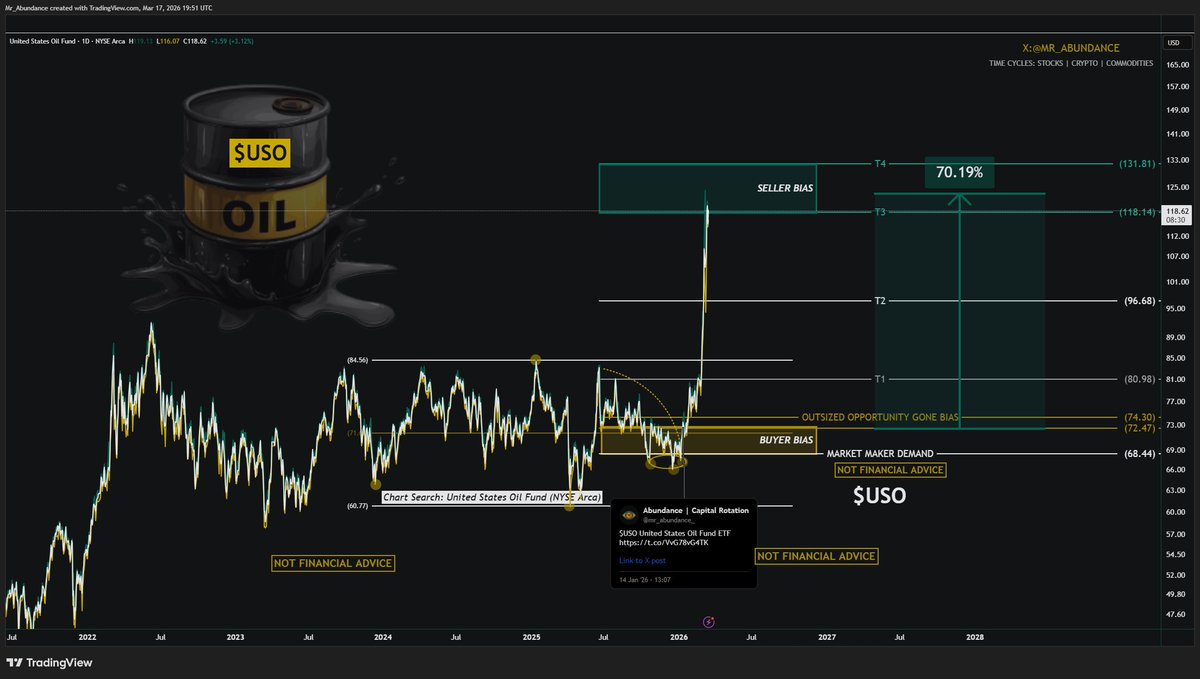
$USO I was taking profit, a friend was taking his life... Has been a challenging week personally for me. 2 loved ones with cancer, supporting others emotions even when fine myself can still be quite draining emotionally. A hedge fund trader, a mutual friend took his life after being on the wrong side of these oil trades. I think a lot of men tie self worth to net worth. It's often tied to wanting to provide a better quality of live for our family, community or causes we care for. But then that positive intention to give becomes a toxic belief that... 'If I lose money, I lose my value as a person' and hence feeling worthless (shame, guilt, embarrassment, hopelessness) This toxic belief is only amplified by a lot of low frequency culture on financial social media - people constantly trying to shame each other "clown, loser etc". I want to take this moment to encourage men out there to consider the fact that we are worth more than our PNL. There's an incredibly ignored value in simply being present. You know those moments where you put the phone completely away, actually listening to your kids, friends, lover. Those moments are priceless. They feel it, you feel it. Even if you print, but you're never present... like when you make money but you stare at the screen or are thinking about trades during conversations that's much more painful to loved ones than some temporary money challenges. I also want to encourage men to be bold not just with taking money risk but relationship risks. Stop that 'lone wolf' , 'can't talk to anyone because I'm locked in' bullsh** Stop pretending like you're the only one who is looking to level up in all areas but going through challenges. There's amazing people just like you waiting to meet you. Stop waiting for someone else to be the change you're looking for Stop pretending you're "getting outside your comfort zone" by - pushing yourself in the gym - listening to a podcast in isolation - starring at the charts for longer That's comfortable for you, do the actually uncomfortable actions. Dare to reach out to people to start a friendship. Dare to open up to people about needing help in any area of life - especially mental health. Dare to work on your psychology and communication. Dare to put your phone down, completely off around people be so present that they feel compelled to tell you how much they appreciate it. Life is about people not printing. People is about being present not giving presents. The funny thing is the more present you become the more profitable you become. Let's live more fully, love more fully, give more generously not just to others but ourselves, keep stepping into the uncomfortable unknown you've been avoiding. Whatever has happened has happened. There's always a new moment offering a new start, a fresh opportunity to cast a vote for the kind of man you want to be. Don't lose the moment by lingering in the past, cease the moment by living in the present. ~ Mr. Abundance
Abundance | Capital Rotation tweet media
Abundance | Capital Rotation@mr_abundance_

$USO - Raise your standards as an investor. Don't buy and ' hope things go up'. Systematically allocate your capital Learn to read capital rotations. Only accept and enter markets where there is 'Out sized opportunity'. #OilPrices

English
35
19
268
15.4K
Ryan Low retweetledi
Barncore
Barncore@barnc0re·
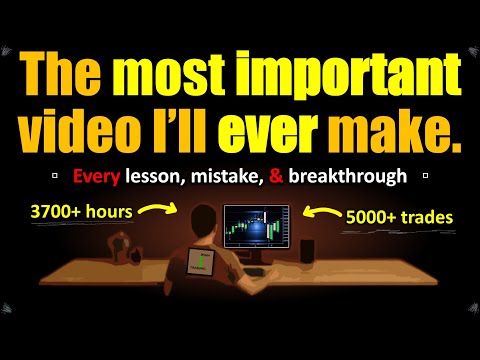
Want to learn about the learning process of learning how to trade? Yeah that was a mouthful. I found this gem of a video by a humble lad named @imantradingYT. This guy was recording voice notes as far back as 2022 purely for the purpose of documenting the growth process with trading, and he put it all together in this 1.5hr video. So you basically get to experience 3.5 yrs worth of growth crammed into 1.5hrs, warts and all. Even if you're not a beginner this is a very interesting video. Everybody learns differently, everybody structures it differently, and it's interesting to see how someone else's experience with it is regardless of if you agree with it or not. With that said, i definitely picked up a few useful pointers about optimization. My advice is, don't focus on the particular strategies he experimented with, it's not the point, focus on the learning methods. What worked for him, what didn't. Well worth watching imo. It provokes useful thoughts, and it's very well put together/edited. And he's quite a funny chap too, so there's that. youtube.com/watch?v=pnG_Da…
YouTube video
YouTube
English
3
3
80
5.6K
Ryan Low retweetledi
MisterPA
MisterPA@studentoffew·
These are all the (public) educational videos I’ve made so far. 📽️👇 If you’re serious about improving, they’re worth your time: • May 24, 2025 — How I chart from scratch (ETH) x.com/studentoffew/s… • July 31, 2025 — The Art of Refining x.com/studentoffew/s… • Sept 8, 2025 — How to execute your trades x.com/studentoffew/s… • Nov 10, 2025 — 1-month collab update w/ @IamZeroIka (trade walkthroughs) x.com/studentoffew/s… • Dec 9, 2025 — 2-month update w/ @IamZeroIka (ETH breakdowns) x.com/studentoffew/s… If it helps you, a like or share is appreciated (small payback 🙂) Study → apply → refine.
MisterPA@studentoffew

Video 2 ✅ "The Art of Refining" 🧘 In this video, I walk through how I refine my entries for higher precision, better risk-to-reward, and higher probability trades. Resources mentioned in the video: - 📝 BTC 98k case study (The trap): x.com/studentoffew/s… - 🎯 How I enter at refined levels (DCA method): x.com/studentoffew/s… Prefer YouTube? Watch it here: 📺 @studentoffew" target="_blank" rel="nofollow noopener">youtube.com/@studentoffew It took a few hours to put this 25-minute video together — if you find value in it, feel free to share it so more people can learn from it. Really appreciate the support 🙏 Hope you enjoy it 😁

English
6
20
133
5.5K
Ryan Low retweetledi
Minty
Minty@DeFiMinty·
Really felt this piece in my bones. People don't realize how important optimism is. Not blindly believing that things will magically work out but putting your best foot forward every single day despite everyone else telling you it's over. When you are a doomer your upside in life is capped. You only think about what can go wrong. When it comes time to make a decision you hesitate because your mind is conditioned to do so. The optimist instead chooses to look for opportunity even when it feels like there's none. Not out of naivety but because it's the only option. There is zero benefit to giving up in life because you perceive things won't get any better. Believing in the worst case scenario doesn't alter the reality of it happening or not. The doomer accepts their fears for what it is. The optimist takes active steps to make their ideal scenario a reality.
apewood@apewoodx

The Doomer is Mid-Curve some snippets + full link for anyone who enjoys reading open.substack.com/pub/apewoodx/p…

English
23
6
88
7.3K
Ryan Low retweetledi
ZERO IKA 🗡️
ZERO IKA 🗡️@IamZeroIka·
- My trading routine - Read, implement and share if you think it can be valuable.
ZERO IKA 🗡️ tweet media
English
19
60
507
23K
Ryan Low retweetledi
Minty
Minty@DeFiMinty·
Always make time for friends and family. The past year I've been sucked into maximizing my time. If I wasn't making content I was working or trading. I got so obsessed with making the best use of my day that I was neglecting everyone I cared about. Every lunch outside felt like a waste of time and money. In the back of my head I was always thinking about what else I could have been doing this moment. But seeing loved ones running into health issues recently put things into perspective. When you are on your deathbed, what matters isn't the money you made. It's about the people that will remember you. It's about the positive connections that you made along the way. It's ok to have some fun. It's ok to make time for friends and family. Not every relationship needs to be transactional. Not every moment needs to be +EV. Enjoy the company you are with and be genuine. So yes, hustling is important. But don't forget the people you love and the reason why you are doing this in the first place. Money will always be somewhere. The people you care about won't.
English
41
7
104
6.4K
Ryan Low retweetledi
MisterPA
MisterPA@studentoffew·
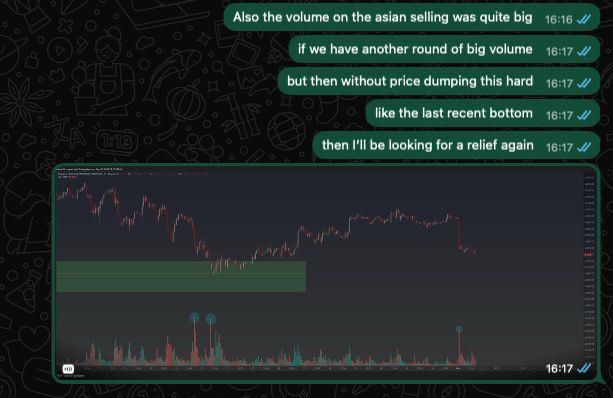
📝One of the most underrated technical tools is VSA (Volume Spread Analysis). 📝 I included a simple $ETH chart breaking down what to look for when timing bottoms using VSA - specifically how unusual volume without strong downside follow-through often hints at absorption. [Details are on the chart 🔎] Yesterday, I was talking to @IamZerolka and pointed out that we might see relief based on this exact signal - and it ended up playing out with precision. Sharing this to highlight how powerful VSA can be when you actually know what to look for.
MisterPA tweet mediaMisterPA tweet media
English
13
22
218
16.5K
Ryan Low retweetledi
MaxO
MaxO@_MaxO22_·
Don’t take advice from people who aren’t living the life you want to live. It’s like asking someone who’s unhealthy and overweight how to build the body of your dreams. They might talk, but they clearly can’t walk it. Today the world is drowning in opinions. Millions of voices, thousands of podcasts, endless “experts” telling you how to live, sleep, eat, train, think and succeed. There’s nothing wrong with learning, I enjoy it too, but every few months there’s a new “groundbreaking” discovery that suddenly makes you feel like you’re doing everything wrong. You see people who look visibly unhealthy explaining the best sleep schedule, the best nutrition, the best supplement stack, yet they can’t seem to apply any of it themselves. Maybe they’re driven by something else entirely, but that’s hard to detect when you only see a neatly packaged 1.5-hour showcase of them as an “expert.” So here’s the simple question: If someone isn’t living the life you want, why take advice from them? Like Ray Dalio emphasises: Opinions are worthless without evidence. Without evidence, results, or real-world proof, they’re worth nothing. There’s the scientist who can talk for hours about the perfect path to health, yet his own lifestyle shows he has no idea how to implement it. What’s all the theory worth then? On the other hand, there might be someone who can’t explain everything in fancy, scientific terms, but lives a healthy, fulfilled, disciplined life and clearly knows how to make it work in reality. For me, the answer is obvious: I listen to the person who knows how to do it, not just how to explain it. Another factor you should consider is that some people might be excellent in one area of life, but complete disasters in others. That’s why it’s wise to never judge a person by a single achievement. No matter how good someone is in one field, you should take a closer look at what price they paid and how they’re doing in the rest of their life. Today, if someone is materially successful, society often praises them like some kind of god. But behind the scenes, that same person might be depressed, constantly stressed, physically unhealthy, or living a life you would never want for yourself. Success in one dimension doesn’t automatically mean success in life as a whole. And in our polished, filtered social media world, it’s almost impossible to know whether someone is actually who they claim to be. You only see the highlights and filtered moments, not the reality. So instead of categorising life simply as successful or not, look at the full picture. Consider health, peace of mind, relationships, purpose, and overall well-being. Material success alone doesn’t tell you anything about the true quality of someone’s life. In a world overflowing with noise, I keep it simple: I take advice only from people who truly live the life I want to live in this specific area. Then I experiment, try things for myself, keep what works, and trust my own results instead of doubting everything every time a new opinion goes viral.
English
2
7
64
3K
Ryan Low retweetledi
ZERO IKA 🗡️
ZERO IKA 🗡️@IamZeroIka·
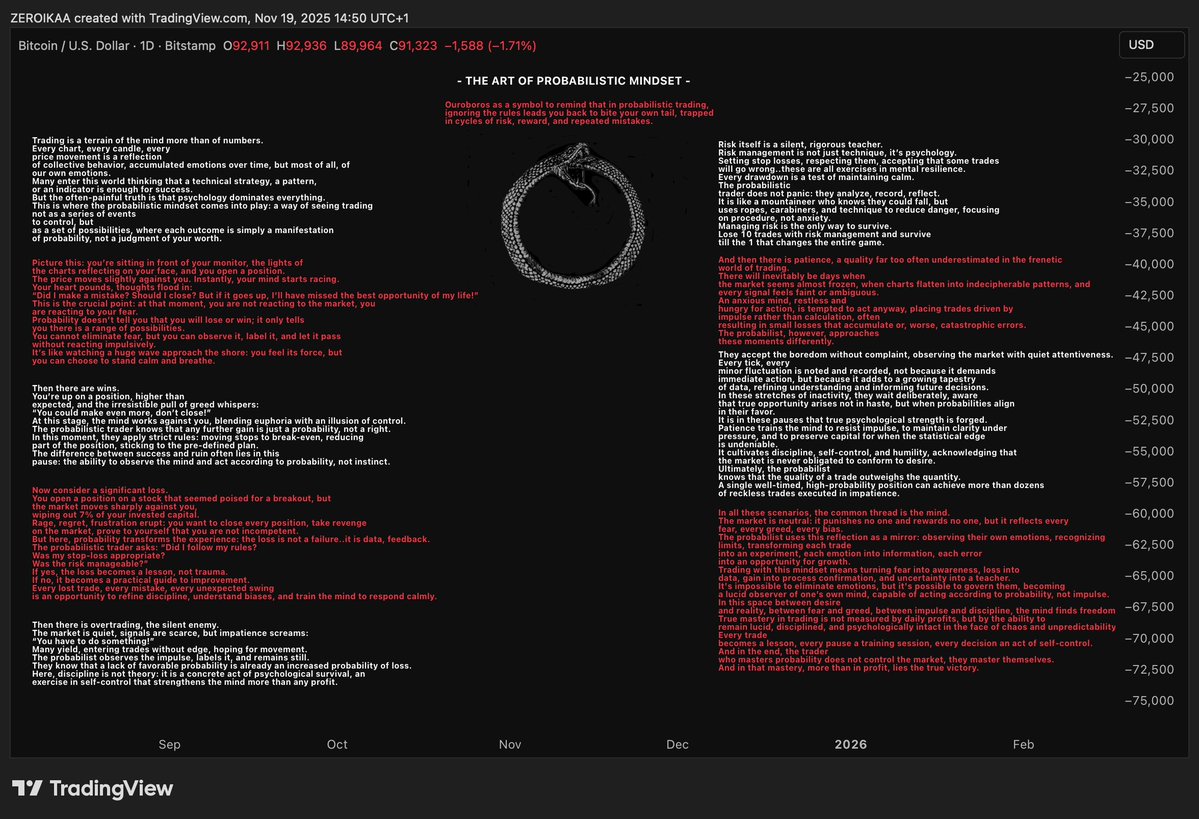
The art of probabilistic mindset. Read, save, implement and share if you think it can be valuable.
ZERO IKA 🗡️ tweet media
English
30
111
744
44.6K
Trading Hustler 📈
Trading Hustler 📈@tradinghustlr·
"They can manipulate Price, but cannot manipulate volume: Richard D. Wyckoff" Institutions leave their footprint in Volume form. So, I have created my own Screener to determine the Institutions (FIIs & DIIs) Footprint. Criteria: - Daily Move > 5% - Volume > 2*SMA(20) = 100% up than 20DMA avg Volume If you want this scanner, comment "Volume". I will DM you. You must follow me so I can DM you! #Scanner | #StockMarket | #Nifty
Trading Hustler 📈 tweet mediaTrading Hustler 📈 tweet media
English
1.7K
299
2.2K
281.8K
Ryan Low retweetledi
Hoodstock
Hoodstock@hoodstock_80·
- MARKET STRUCTURE - - Basics @Moneytaur_ does not reference market structure often, not because its not important, but because these basics should be learned elsewhere. For this writeup, here’s a brief refresher before moving to some MT-specific concepts. ------- - Trends Trends are always relative to the timeframe. Higher timeframe trends dominate lower ones. Bullish Trend Consists of a series of higher highs and higher lows. Bearish Trend Consists of a series of lower highs and lower lows. 📝A sideways trend is made up of smaller trends confined to a range. ------- - Structure Market structure is the foundation on which all key concepts in MT’s trading style are built. Liquidity, imbalances, and supply and demand are all rooted in structure. Price action is the process that builds this foundation. PA follows liquidity, and this constant search for liquidity shapes structures. Imbalances between buyers and sellers create directional moves (FVGs), while balance creates fair value zones (Ranges). Balance → Imbalance → Balance → Imbalance “If there’s no significant imbalances, there will be OBs and Supply/Demand fresh levels. If there’s no OBs and Supply/Demand fresh levels, there will be significant imbalances. If there’s none at all it will ⚡️ into a ‘fresh’ level and build a new trading range. Few…” x.com/Moneytaur_/sta… The higher the timeframe, the more robust the structure and the more reliable the signal. HTF > LTF. Structure defines supply and demand, premium & discount, and creates liquidity zones. It also defines ranges. When price action moves beyond these range boundaries, there are four main possible outcomes: • Break out/down: price breaks through the range and keeps moving. • Rejection: price fails to break the range. • Break out/down plus retest: price closes relevant candle bodies past the range and continues after retracing back into key liquidity. • Fake-out: price breaks out/down, and then reverses. Outcomes 3 and 4 differ clearly. Fake-outs are usually sharp and aggressive, often leaving large wicks from stop hunts or liquidity grabs. Retests tend to be slower and more deliberate, usually following higher timeframe candle closes past the prior range boundaries. “Look for HTF body close above previous most significant swing highs. If not, it’s likely a false breakout. If it does, the highest probability play is waiting for a pullback into key level before continuation into the next HTF liquidity level, and if there’s none to take it will likely go to new ATH.” x.com/Moneytaur_/sta… - Internal vs. External Structure External Structure • The overall trend visible on a higher timeframe (relative to a lower timeframe). • A weekly chart is made up of seven daily candles; compared to the daily, the weekly is external structure. Internal Structure • The smaller movements within the higher timeframe, seen on lower timeframes. • Shows smaller trends inside the larger move. Internal structure can shift short-term without changing the external trend. Always let the external (HTF) structure guide your HTF bias; internal structure offers early clues. Example: (📈 in comments) This 2W chart is external structure and clearly in an uptrend. On this daily chart of the grey box, we are in a downtrend. This is internal structure. The examples highlight the importance of always seeing structures in relation to each other. M > W > D > H > M > S Internal structure shifts can be the early clue that external structure may change. Let the higher timeframes define the macro structure and watch for early signs on lower timeframes. ------- - Market Phases The Four Market Phases Accumulation • Typically follows a downtrend but can appear anywhere market makers prepare for markup. • The range lets market makers accumulate while pushing news to fit the narrative. Buy Program (Bull Market/Markup) • Follows accumulation or re-accumulation. • The asset appreciates in value. Distribution • Typically follows an uptrend but can appear anywhere market makers prepare for markdown. • The range lets market makers offload while pushing news to fit the narrative. Sell Program (Bear Market/Markdown) • Follows distribution or re-distribution, depending on context. • The asset depreciates in value. (📈 in comments) - The Psychology of the Phases Accumulation Emotion: Skepticism, disbelief, apathy Psychology: Most traders are fearful or disinterested. Market makers are quietly buying. Behaviour: Retail avoids the market; volume is low; sentiment is bearish or indifferent. Media manipulation: The most bearish news marks the bottom. “Markets are dead.” Bull Market (Markup/Buy Program) Emotion: Optimism, excitement, euphoria Psychology: Confidence builds as prices rise. Retail starts buying in; FOMO. Behaviour: Volume increases; media turns positive; public participation grows. Media manipulation: Coverage increases and sentiment turns bullish in line with price. 🔺Intensifies with trend Distribution Emotion: Greed, overconfidence, denial Psychology: Retail believes the trend will continue; smart money is offloading. Behaviour: Volatility increases; price chops; bullish sentiment remains high. Media manipulation: News remains bullish; influencers push FOMO narratives. Bear Market (Markdown/Sell Program) Emotion: Anxiety, fear, panic, capitulation, despair Psychology: Retail sells in panic. Smart money prepares to accumulate again. Behaviour: Heavy selling; negative news cycle; retail sells at loss. Media manipulation: After the initial selloff, fear-driven headlines dominate. 🔺Intensifies with trend 🔺Understand that the system runs on predictable human behaviour. Stay hyper-aware of your own emotions and learn to flip them into signals instead of traps. “When you feel you will make a lot of money by holding, it is close to the top. When you feel you will lose all your money by holding, it is close to the bottom. Your own fear and greed emotions are two of the most powerful indicators you will ever find.” x.com/Moneytaur_/sta… ------- - Market Structure Shifts Changes in structure are vital for gauging the probabilities of the next move. Understanding these shifts and the patterns that reveal them is essential for becoming consistently profitable. BOS – Break of Structure A BOS occurs when price closes relevant candle bodies past a significant high or low. It confirms a change in structure. CHoCH – Change of Character A CHoCH happens when price breaks structure in the opposite direction of the current trend. It’s the first signal of a possible trend reversal. BOMS – Break of Market Structure A BOMS is a clear break of market structure, usually on higher timeframes and significant levels. It confirms a shift in intent when validated and often shows higher volume and leaves FVGs behind. - Trend Changes Using trends, BOS, CHoCH, and BOMS helps identify key structural shifts in the market. Knowing when the market transitions from a buy to a sell program is crucial for being profitable. “Buy program: Bullish BBs work wonders. Buy program: Bearish BBs can often fail, unless optimal. Sell program: Bearish BBs work wonders. Sell program: Bullish BBs can often fail, unless optimal.” x.com/Moneytaur_/sta… Putting all learned concepts together helps us spot potential tops forming. Using the ideas above gives us further confirmation. (📈 in comments) ------- - MT’s 1,2,3 System (Squiggles) For MT, structural shifts are an essential part of his setups. The system has three parts: • A valid break of a key level (BOS) • A retrace into liquidity • Entry at the refined level to ride the reversal This approach ensures we get the optimal entry after fuel is taken, letting us ride the trade longer with clearer invalidation and better RR. “There’s no MTF or HTF candles closing above key PSH, so you don’t long here. For the highest probability long it’s the squiggle on the chart, with MTF (at least) close above key PSH plus pullback (the entry) before bullish continuation.” x.com/Moneytaur_/sta… “All “squiggles” mean the strategy is to wait for close above or below HTF key levels as stage 1 of 3, pullback or retracement into key levels if you can find them, and most of the time you can because bots always leave such levels with fuel behind, to come back later and reverse price again as stage 2 of 3 and this is your entry, and then continuation into the direction of the first move, stage 3. This is how these liquidity games work.” x.com/Moneytaur_/sta… Breakout trading is popular, but charts like the one below, and the effectiveness of squiggles, show its weakness clearly. “You can always choose to long the breakout, but this isn’t going for high probability as it’s what all retail traders do, and the game’s designed to stop or liquidate them all, collecting fuel, and then proceed in the direction retail traders expected, which will then make them start revenge trading as they were ‘right but wrong’.” ------- - Using Liquidity as a Guide Market makers leave footprints that help us assign probabilities to the next move. Liquidity is key. When key levels are left behind and price action approaches a level without taking the liquidity first, chances are high, it will revisit to grab that fuel before continuing. “A helpful hint to determine if a breakout will reverse into a key level before trend continuation is to check if there’s a key level left behind in the previous range that price is attempting to break out from. If the key level is present, especially on HTF and you can refine it into lower timeframes, the probability of a pullback into that level before continuation becomes significant, as price tends to gravitate toward such levels. Additionally, if there’s a key level above the swing high that can be taken, it could act as fuel for a drop into the lower level, setting up for a subsequent pump.” x.com/Moneytaur_/sta… Alternatively, when no such levels exist, the probability is higher that the breakout/down is real and price action will continue in the direction. “If you cannot find such, the probability for breakout into price discovery, without looking back for a while, is higher.” x.com/Moneytaur_/sta… ------- - Confirming a BOS In general, higher timeframe structures need higher timeframe confirmations. Use timeframes relevant to the trade. For higher timeframe levels MT often looks for closures 12h or higher. Further HTF closures add confluence and reinforce the likelihood the break is real. Always watch for body closes above or below the swing high or swing low. (📈 in comments) Without a confirmed BOS, we risk falling for fake moves. A confirmed BOS marks clearer intent. Wait for the signal, place orders where the fuel sits, and ride the continuation. 🔺Lately, more HTF closes have resulted in reversals. Market makers are aware that retail is looking at daily closes. “Don’t fall for false moves. Learn to identify confirmed BOS on HTF and you will level up instantly.” (📈 in comments) There’s no single timeframe that automatically invalidates every setup. The last five minutes of a HTF candle can close below a level without any real prior price action in that area. Zoom in on lower timeframes and check what’s happening. Look for signs of strength or weakness to support your decision. Stay flexible and weigh all factors. Things to consider: • How optimal is the level? • Where is the level located? • Is the asset high volume? • What are majors doing? • How does price behave around the level? • Are newly formed LTF structures being respected? • Is there spoofing? • What is order flow showing? MT has posts calling for 12H+ closes to confirm or reject a level; others rely on 2H. This is closer to an art than a rule, an edge that only comes through screen time and real experience. “Take notes on this PA, because it will change your game. You can go through timeframes up until 2H and you will notice there’s no candle bodies closing below the level where the 2D BB is at. The hint is there. From here I’ll wait for key SH or SL to be taken and find an entry on pullback or retracement. 0 candle bodies closed below 2D BB. Body, not whisker. At least a 2H full body, specifically for SOL as it’s a high TV coin.” x.com/Moneytaur_/sta… ------- - Timeframes Moneytaur has his own definitions of timeframes. You can either adopt his schematics or come up with definitions that are a better fit for you. “micro TF: 5min and lower LTF: 15min > 2H MTF: 2H > 12H HTF: 12H > M+” x.com/Moneytaur_/sta… HTF (12h+) • Hold the most liquidity and are the most reliable. • The higher the TF, the clearer the signal of the predominant trend. • 1W+ are macro timeframes. • HTF plays = up to 3% of trading account, max 5% if optimal. MTF (2h–12h) • First reliable validations of BOS, CHoCH, BOMS. • Key for refining levels. • MTF plays = up to 2% of trading account. LTF (5m–2h) • Super-refined entries, exits, and stops. • First possible signs of BOS, CHoCH, BOMS. • Less reliable as they hold less liquidity. • LTF plays = up to 1% of trading account. mTF (<5m) • Ultra-refined entries, exits, and stops. • Entries or exits based on micro structure reactions to key levels. “In micro timeframes, you can better see when a price reversal is likely, since the ⚡️ at key levels is a powerful sign of that. If you spend time in those timeframes when the price is reaching key levels where you expect a reaction, you’ll start to notice a pattern and better understand whether a reversal can actually occur or if the reaction is too weak. As for the ‘ping-pong’ at key levels, it’s the same, but weaker than in lower timeframes and harder to read, since you don’t see proper candle bodies, so you just have to get used to it.” 📝Note on Timeframes and TradingView • TradingView anchors all intraday timeframes to the daily close. • Timeframes that do not evenly divide into 24h will produce one partial candle at the end of each daily session. • This shorter candle is always the last candle before the session reset at 00:00 UTC. • So a 23h candle is 1 x 23h + 1 x 1h candle. When trading a 23h level, the chance is high that you are in reality taking a trade based off a 1h hOB.
Hoodstock tweet mediaHoodstock tweet mediaHoodstock tweet mediaHoodstock tweet media
English
69
156
1K
90.9K
Ryan Low retweetledi
DonJim🌱
DonJim🌱@Donjim95·
Moneytaur’s theory about Fibonacci levels isn’t the typical retail “draw from swing low to swing high and wait for a bounce” approach — he treats Fibs as a liquidity confluence tool, not as a standalone signal. Here’s the breakdown of his full logic: 🔹 1. Purpose of Fibs: Confluence with Liquidity He uses Fibonacci retracements to identify confluence with hidden liquidity and refined order blocks, not to “predict” reversals in isolation. “Fibonacci levels help you to add confluence to liquidity levels, so in case they match them, you’ll likely know that their reliability is stronger.” So the Fib is meaningful only when it aligns with a HOB, FVG, or refined liquidity zone. 🔹 2. Preferred Levels Moneytaur focuses almost exclusively on: 0.5 (Equilibrium) 0.618 (Golden zone) 0.705 (Algorithm Fib) 0.786 (Deep discount) He explicitly avoids 0.236 and 0.382, calling them “less impactful.” “0.5 + 0.705 + 0.618 + 0.786 are the most powerful fib levels, especially the first two… that’s why you never see me adding 0.236 or 0.382.” The 0.705 is crucial — he refers to it as the “algorithm Fib”, the midpoint between 0.618 and 0.786 that more accurately represents algorithmic/market maker behavior, especially in crypto’s high-volume markets. 🔹 3. Multi-Timeframe Fib Refinement He layers Fibs across different TF swings to identify overlapping retracement zones: “0.705 on a higher TF swing + 0.5 on a lower TF one = extra confluence = very powerful level.” Example: Draw Fib on the macro swing (HTF) → find 0.705 retracement. Draw Fib again on a micro swing (LTF) → find 0.5 retracement. If both align near a hidden liquidity zone or HOB → that’s his “sniper entry.” 🔹 4. Premium vs. Discount Framework In his rulebook, he uses Fibs to define premium (short zones) and discount (long zones): “Look for short setups in PREMIUM zones and long setups in DISCOUNT zones. This is very important as it will help you invalidate setups.” This means: Above equilibrium (0.5) → premium area → look for shorts. Below equilibrium (0.5) → discount area → look for longs. 🔹 5. Fib Extensions for Targets He also uses Fib extensions for take-profits or next liquidity targets: “Extensions to calculate targets are another crucial part of my strategy, with the area of 1.618 + 1.454 + 1.272 that often helps me to find amazing 🎯.” 🔹 6. Summary — His Fib Logic Core Fibs: 0.5, 0.618, 0.705, 0.786 Purpose: Liquidity & OB confluence (not standalone) Algorithm Fib: 0.705 – midpoint between 0.618 and 0.786 Multi-TF Approach: Stack Fibs from HTF and LTF swings for confluence Zones: Long in discount (<0.5), short in premium (>0.5) Targets: 1.272, 1.454, 1.618 extensions Avoid: 0.236 / 0.382 (weak retail zones) In short — Moneytaur uses Fibonacci retracements as a precision tool for liquidity alignment, not as a predictive indicator. He seeks where the fib equilibrium overlaps with hidden liquidity — that’s where the market reverses hardest.
English
14
40
322
12.9K
Ryan Low retweetledi
VD
VD@hmalviya9·
close your eyes, and listen to these devotional chants for an hour, all your worries would be absorbed, and you would channel a new wave of courage in you in moments you feel like its all over. youtube.com/watch?v=PpQyvw…
YouTube video
YouTube
English
6
3
48
7.5K
Ryan Low retweetledi
🎯 Master
🎯 Master@Moneytaur_·
Everyone who said "i'll make it" in 2021 lost everything. In 2022, they doubled down and lost more. In 2023, they were too scared to buy. In 2024, they swore they would finally make it but failed miserably. Now it's 2025, and they're still repeating the same line with nothing to show for it. At some point, you'd think they'd recognize the pattern 🫠
🎯 Master@Moneytaur_

Soon will be 2026 and somehow many people still believe that showing a wallet publicly equals transparency, as if private wallets don't exist. It's the oldest trick in the book: show one hand, hide the other. Transparency isn't a screenshot of a wallet. Transparency is a track record that can't be faked. Everything else is smoke and mirrors.

English
9
10
373
37.9K
Ryan Low retweetledi
🎯 Master
🎯 Master@Moneytaur_·
Everyone wants a Trading 101 Encyclopedia. It doesn’t exist. It never will. No two trades are identical. No single fixed strategy works in every asset. This is why trading courses fail to make anyone consistently profitable. Most traders can't even tell if the market's trending or ranging, let alone spot SOS or SOW across multiple timeframes. If you can't read that, you're blindfolded in a minefield. What you really need is experience, and the right network. A mentor. A small, proven group of traders who've been consistently profitable for years, who can guide you through any market. Most people refuse to accept this truth, and that's why they'll never find consistency. They want "the book" when there is no book. Sure, you can collect golden nuggets from books and certain strategies, but cooking them into a masterpiece? - That comes from playing the game, day in and day out, while only listening to sources with a track record that spans years. Work on yourself: health, mindset, body. Buy yourself time. Get a pair, step out of your comfort zone. Because the only way to grow in trading, or in life, is through discomfort.
English
16
52
727
28.6K
Ryan Low retweetledi
MaxO
MaxO@_MaxO22_·
Purpose & Happiness Many people spend their lives striving for happiness. Often, they define it through material achievements, proving themselves to others, or indulging in consumption. But while reaching these goals can bring moments of joy, it often leads to chasing the next milestone as soon as one is achieved. There’s nothing inherently wrong with this pursuit, but I wouldn’t call it true fulfilment. If your sense of wholeness always depends on the next achievement, then those who build and control the material world will always have power over your inner being. That path can easily lead to addiction, dissatisfaction, or even darker states like depression. I speak from experience. At one point in my life, I had everything I had ever dreamed of: I was healthy, financially free (at least for the moment), and had complete control over my time and where I wanted to be. Yet, after the initial excitement faded, I felt the same way I always had. Not necessarily unhappy, but carrying the same old feeling I thought I’d finally escape once I reached all those goals. When my inner world didn’t change, I felt disappointed, even depressed for a while. It forced me to confront a hard truth: No matter what I achieve in life, my inner world is not defined by external accomplishments. This realisation was painful, but it was also the turning point. I realised I had been searching in the wrong place. I began turning inward. I had read about inner work before, and wise people throughout history had always tried to share this message, but some part of me still believed that external freedom alone would bring lasting fulfilment. Around that time, i met an incredibly inspiring person. Talking to him felt almost like speaking to a higher being. He was overflowing with life and purpose. We met at a birthday celebration and spoke for hours. In those hours, i learned more than i had in reading ten books. At the end of the evening, everyone was invited to make a wish in a ceremonial circle. My girlfriend and i, already living what we thought was our dream life, wished simply for health and peace. When it was his turn, this man wished for nothing for himself. Every wish he made was for others. Most people there, still trapped in their own struggles, wished something against their personal or general worries, poverty, health issues, injustice. But he, along with just two others, wished only for peace, justice, love, and fulfilment for everyone. Those three were among the most genuinely fulfilled and inspiring people I have ever encountered. What struck me most was that they were certainly not rich or powerful, yet they already seemed to have everything they could ever wish for. That moment changed the way I viewed the world forever. I began creating a new set of goals: 🔹Material goals 🔹Mental and Spiritual goals 🔹Goals that had nothing to do with serving myself I read these goals every day. The material ones were easy, I’d always known what I wanted in that area. Spiritual goals required more effort, but I was ready to do the work. The hardest part, however, was the selfless goals. Not because I didn’t want to do good for others, but because I realised that even my most “selfless” goals had still been, in some way, about me. About feeling good, being seen as kind, or proving I was a good person. When I finally began doing things with no connection to my own benefit, I discovered something rare: True fulfilment. Not the fleeting high from buying something, eating something, or achieving a personal goal. This was different. It came from within. I didn’t depend on external rewards anymore. Even the desire itself, to help whenever and however I could, began to fulfil me on its own. I started including daily prayers in my meditations, not for myself or my family, but for everyone and everything in the universe. Through this, I found what I had been missing all along: Purpose. Purpose is what so many people are searching for while trapped in the endless cycle of chasing material happiness. It’s what I lacked. Purpose is something greater than oneself, something that gives direction no matter how dark life feels in the moment. A purpose that serves all of life. A purpose that fills the void so many try to stuff with money, food, drugs, or endless distractions. Of course, playing the money game makes it easy to get pulled back into focusing too much on numbers and possessions, they seem to measure your worth in exchange for your time and energy. It changed me and sometimes pulls me away from the peace I had begun to build. But it also gave me the freedom to live life on my terms for longer. For me, that path was necessary. Still, I remind myself daily: True happiness, fulfilment, and peace will never be found in a bank account or in possessions. True happiness comes from purpose, a purpose not meant to serve my own needs.
MaxO tweet media
English
6
10
81
2.9K
Ryan Low retweetledi
MisterPA
MisterPA@studentoffew·
Video 2 ✅ "The Art of Refining" 🧘 In this video, I walk through how I refine my entries for higher precision, better risk-to-reward, and higher probability trades. Resources mentioned in the video: - 📝 BTC 98k case study (The trap): x.com/studentoffew/s… - 🎯 How I enter at refined levels (DCA method): x.com/studentoffew/s… Prefer YouTube? Watch it here: 📺 @studentoffew" target="_blank" rel="nofollow noopener">youtube.com/@studentoffew It took a few hours to put this 25-minute video together — if you find value in it, feel free to share it so more people can learn from it. Really appreciate the support 🙏 Hope you enjoy it 😁
MisterPA@studentoffew

I’ve been putting more time into creating detailed educational content. Lately, I’ve been focused on going deeper — not just showing levels, but sharing how I think, the context behind setups, what retail might be thinking, the traps, and the probabilities I weigh up. I always try to use charts from recent events (like this BTC 98k level, shared 1–2 months in advance), because I think that’s way more effective for learning — it’s fresh and easier to connect the dots. I’m building a Notion full of this kind of content — the same kind of thinking and breakdowns that helped me level up in my own trading. 📝Let me know what you think — any feedback is welcome. I want to keep improving this and make it as useful as possible. 👉 Also, I’m working on something bigger — not just more educational content, but real support around the harder parts of trading: execution, mindset, journaling, daily planning, handling drawdowns, passing prop challenges. That’s where most people struggle — and that’s where I want to help most. More soon.

English
37
37
304
27.8K