In all our results suggest that Starships play a major role in the rapid adaptation of filamentous fungi to human-impacted environments. This adds to the rapidly growing body of evidence that rapid adaptation in many cases has its roots in Starship cargo acquisition.
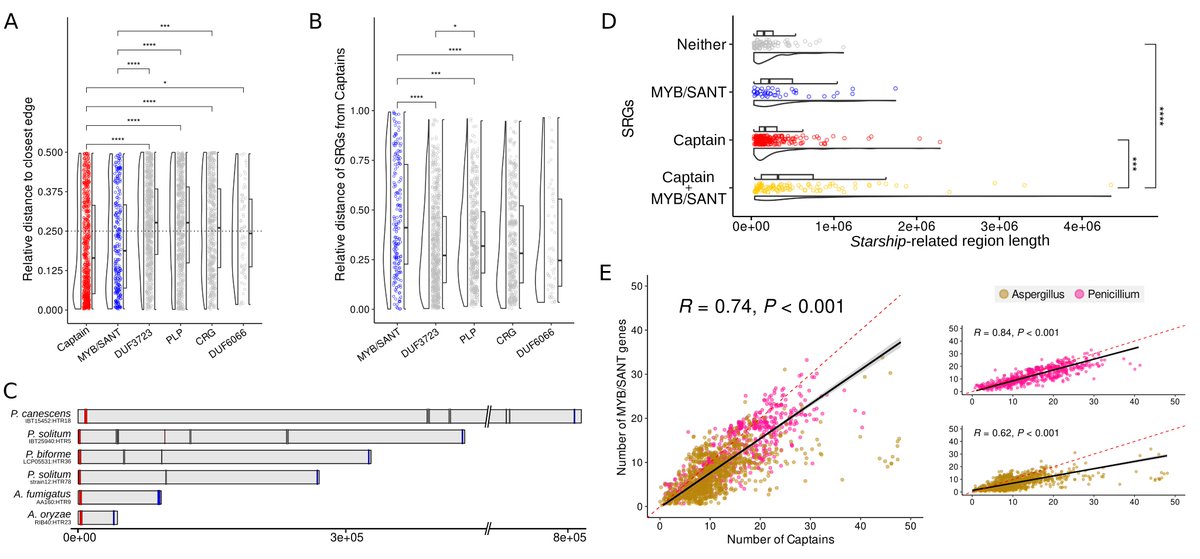
Lastly (unrelated to adaptation), a MYB/SANT domain containing gene with a structurally conserved position in a subset of Starships...close to the opposite edge of the captain. i.e. Captain in front at the bridge and the MYB/SANT at the back in the engine room.
🔴New paper online! I am super happy 2 share our latest story on the Domestication of a Non-Saccharomyces yeast
journals.asm.org/doi/10.1128/ms…
Structural variants are an excellent way to rapidly adapt 2 fermentative environments (like what S.cerevisiae does)😃 @pablovilla81@ibiochile
Happy to share our most recent preprint 'Domestication signatures in the non-conventional yeast Lachancea cidri' biorxiv.org/content/10.110…' Msg: Nanopore-seq revealed that structural variants are a fast alternative to adapt to fermentation environments Work done by: @pablovilla81
@TonyH_Futurist@PeterDiamandis While there has been great progress in sequencing technology the first genome that my team did had to be independently assembled as there was no prior reference. Todays genome sequences cannot be independently assembled without a reference genome.
In 2001 Craig Venter sequenced his genome in 9 months (6,480 hrs) for $100 m. This year a new record was set, sequencing a single genome in 7 hours for only $100
cc @PeterDiamandis
Sequencing the genome will be a major part of #personalized nutrition
#foodfuturist#futureoffood