
Sabitlenmiş Tweet
Sam Elrad
291 posts

Sam Elrad
@SamElrad
Leading Enterprise AI Strategy | AI is changing everything and most of the coverage is noise. I break down what actually matters and why.
Katılım Temmuz 2025
200 Takip Edilen79 Takipçiler
Sam Elrad retweetledi

Really interesting article here. It is so much easier for an individual to understand a visual vs a markdown file, even if it is in plain text.
I predict that the future of what LLMs consume best is also what humans consume best, and HTML files are clearly helping pave the way.
Thariq@trq212
English
When these packages are build, I am curious what kind of impact this will have on the emerging vertical AI companies in the space.
Will be interesting to see how a company like Rogo competes or evolves with these new offerings in their market.
Josh Kale@JoshKale
Anthropic just automated the first-year analyst job at every bank on Wall Street. They released these 10 AI agents for finance: → Pitch builder → Meeting preparer → Earnings reviewer → Model builder → Market researcher → Valuation reviewer → GL reconciler → Month-end closer → Statement auditor → KYC screener The analyst pyramid just got a lot flatter.
English
This this holds true across all AI innovation. You can use AI to enhance your productivity, but unless you fully understand the underlying functionality, you will very likely face long term headwinds
Andrej Karpathy@karpathy
This is the the quote I've been citing a lot recently.
English
Very interesting perspective on the startup landscape. Great read @ShahRathin!
Rathin Shah@ShahRathin
English
This is what will unlock exponential opportunity for Enterprises. If you can solve the context and memory problem, you will become a truly AI native company.
Y Combinator@ycombinator
Company Brain @t_blom Every company has critical know-how scattered across people's heads, old Slack threads, support tickets, and databases, and AI agents can't operate like that. We think every company in the world is going to need a new primitive: a living map of how the company works that turns its own artifacts into an executable skills file for AI.
English
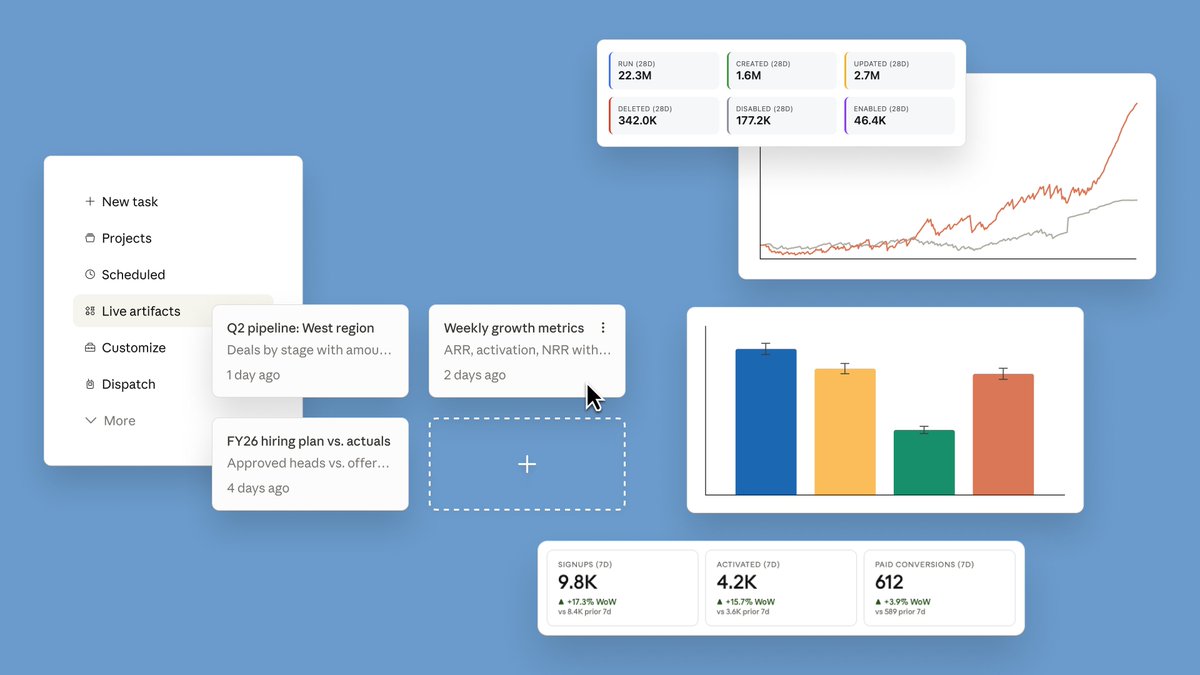
The final piece that Anthropic was missing. Where Lovable, Replit, and Figma were winning just got a lot more crowded.
Claude@claudeai
Introducing Claude Design by Anthropic Labs: make prototypes, slides, and one-pagers by talking to Claude. Powered by Claude Opus 4.7, our most capable vision model. Available in research preview on the Pro, Max, Team, and Enterprise plans, rolling out throughout the day.
English

@claudeai @AnthropicAI Launched 4 minutes ago… who has cool use cases using Opus 4.7? 😂
English
Sam Elrad retweetledi

Another week on the road meeting with a couple dozen IT and AI leaders from large enterprises across banking, media, retail, healthcare, consulting, tech, and sports, to discuss agents in the enterprise.
Some quick takeaways:
* Clear that we’re moving from chat era of AI to agents that use tools, process data, and start to execute real work in the enterprise. Complementing this, enterprises are often evolving from “let a thousand flowers bloom” approach to adoption to targeted automation efforts applied to specific areas of work and workflow.
* Change management still will remain one of the biggest topics for enterprises. Most workflows aren’t setup to just drop agents directly in, and enterprises will need a ton of help to drive these efforts (both internally and from partners). One company has a head of AI in every business unit that roles up to a central team, just to keep all the functions coordinated.
* Tokenmaxxing! Most companies operate with very strict OpEx budgets get locked in for the year ahead, so they’re going through very real trade-off discussions right now on how to budget for tokens. One company recently had an idea for a “shark tank” style way of pitching for compute budget. Others are trying to figure out how to ration compute to the best use-cases internally through some hierarchy of needs (my words not theirs).
* Fixing fragmented and legacy systems remain a huge priority right now. Most enterprises are dealing with decades of either on-prem systems or systems they moved to the cloud but that still haven’t been modernized in any meaningful way. This means agents can’t easily tap into these data sources in a unified way yet, so companies are focused on how they modernize these.
* Most companies are *not* talking about replacing jobs due to agents. The major use-cases for agents are things that the company wasn’t able to do before or couldn’t prioritize. Software upgrades, automating back office processes that were constraining other workflows, processing large amounts of documents to get new business or client insights, and so on. More emphasis on ways to make money vs. cut costs.
* Headless software dominated my conversations. Enterprises need to be able to ensure all of their software works across any set of agents they choose. They will kick out vendors that don’t make this technically or economically easy.
* Clear sense that it can be hard to standardize on anything right now given how fast things are moving. Blessing and a curse of the innovation curve right now - no one wants to get stuck in a paradigm that locks them into the wrong architecture. One other result of this is that companies realize they’re in a multi-agent world, which means that interoperability becomes paramount across systems.
* Unanimous sense that everyone is working more than ever before. AI is not causing anyone to do less work right now, and similar to Silicon Valley people feel their teams are the busiest they’ve ever been.
One final meta observation not called out explicitly. It seems that despite Silicon Valley’s sense that AI has made hard things easy, the most powerful ways to use agents is more “technical” than prior eras of software. Skills, MCP, CLIs, etc. may be simple concepts for tech, but in the real world these are all esoteric concepts that will require technical people to help bring to life in the enterprise.
This both means diffusion will take real work and time, but also everyone’s estimation of engineering jobs is totally off. Engineers may not be “writing” software, but they will certainly be the ones to setup and operate the systems that actually automate most work in the enterprise.
English
I have never seen anything like this before. This is amazing!
Anthropic@AnthropicAI
Our run-rate revenue has surpassed $30 billion, up from $9 billion at the end of 2025, as demand for Claude continues to accelerate. This partnership gives us the compute to keep pace. Read more: anthropic.com/news/google-br…
English

Computer use in Claude Cowork and Claude Code Desktop is now available on Windows.
Claude@claudeai
You can now enable Claude to use your computer to complete tasks. It opens your apps, navigates your browser, fills in spreadsheets—anything you'd do sitting at your desk. Research preview in Claude Cowork and Claude Code, macOS only.
English
This is the future of AI for Startups and Enterprises. If you can dream it, you can build it.
The Startup Ideas Podcast (SIP) 🧃@startupideaspod
Sam Altman predicted the first one-person billion-dollar company. Matthew Gallagher built a $401M company in year one with $20,000, AI tools, and zero employees. This year he's on track for $1.8B. With 2 people. The playbook has changed: Old path: - Come up with an idea - Fundraise from friends or VCs - Hire a team - Build the product - Hope it works New path: - Start with an audience (X, Instagram, TikTok) - Vibe code something for that audience - Build a community around it - Automate fulfillment with AI agents - Repeat That's the new barrier to entry is a laptop and an idea.
English
IPO must be on the horizon here!
OpenAI@OpenAI
Today, we closed our latest funding round with $122 billion in committed capital at an $852B post-money valuation. The fastest way to expand AI’s benefits is to put useful intelligence in people’s hands early and let access compound globally. This funding gives us resources to lead at scale. openai.com/index/accelera…
English