I'm at #config, excited to finally see an evals talk at a design conference.
Designers belong in evals. Defining what "good" means is a design call before it's an engineering one. Designers need to carve out the rubric, not just QA whatever the model ships.
Somewhere in Spain there are paving tiles you can't lay wrong. Rotate it any direction and the paths never dead-end.
I couldn't stop thinking about it, so I rebuilt it with Claude. Turn any tile and the flow must go on. 👇
#truchetoutriderindustries.com/flowtiles
Three patterns for defining how much UI an AI agent controls: Mad Libs → Legos → Blank Page.
Each is a different answer to: How much of the screen holds still between turns?
Framework from @CopilotKit. Best practical writeup by @Saboo_Shubham.
from apps to material
software used to be something you opened
an app was a room with walls: calendar here, notes there, music there, work there. each one had its own logic, buttons, its own little kingdom. the user moved between kingdoms, carrying context in their head
but ai starts to break the walls
software becomes less like a destination and more like material. something you shape, combine, stretch, ask, remix, and leave behind as traces. a document can become an app. a conversation can become a workflow. a song can become a memory. a task can become an agent. the boundary between using and making gets blurry
the old model was: choose the right tool for each task
the new model is: express the shape of the thing you want, then refine it with the system you built
this changes the role of the interface. ui is no longer only fixed views for fixed functions. it becomes a surface where intent turns into structure. the best interfaces will feel less like menus and more like clay – responsive, persistent, inspectable, and alive
apps won’t disappear. rooms are still useful. but the deeper shift is that software stops being a set of sealed containers and becomes a medium people can think through
like paper, but executable
like language, but spatial
like memory, but programmable
software stops being something only programmers make
it becomes material anyone can shape
@akashtattva Agreed: the category is dissolving.
"Weirdly high leverage" is true but that carries risk of just outputting the wrong things (like: authoring mockups) faster. We need to refocus that leverage; the job's shifting from authoring to directing.
This is exactly where I keep landing too. The encoding problem ("can you articulate what better looks like in a way the LLM understands") has a directorial shape to it.
In improv terms it's the notes session: after the run, the ensemble reviews what worked and what fell flat, and the director chooses what carries forward.
The LLM is the ensemble. Evals are the notes sessions where we encode the 100 small things that define what better looks like.
Full AI Improv framework:
medium.com/user-experienc…
Taste is invisible until you try to write it down.
This is probably my biggest lesson with AI building as of late.
At @TeamSundial, I get to work with really friggin' amazing analysts who know the art, and I see how much of our collective time now is now spent turning that art into playbooks or skills for an LLM.
Encoding things like: "How would a great analyst actually look at this metric move?" or "What is ACTUALLY the interesting signal in this story versus noise?" or "How can we know if a product change actually moved the needle?"
It's really humbling work!
You write an instruction set. The LLM misses. You add more context. It still misses. You add even more. Now it's confused. You strip it back. Now it's too vague. You try a different framing. Better, but inconsistent. Works on Monday, fails on Tuesday. You go again.
I've come to realize the gap between 70% quality and 95% quality is not 3 or 4 big things. It's more like 100s of small things. Which is exactly why you can't write an article about it, or copy it, or shortcut it!
This gap *is* taste, quantified. The accumulated weight of a thousand small judgments you don't notice you're making, until you sit down to externalize them and realize you can't.
Being good at something is not the same as being able to articulate why you're good at it.
I now see two bottlenecks to making something better than today's generic AI:
1. Can you *see* what better looks like in the first place?
2. Even if you can see, can you *articulate* what that is in a way that the LLM can understand and systemize?
#2 is now a new craft, the art of distilling the art.
The people who can do it well are the ones building standout products.
@zan2434@eddiejiao_obj@drewocarr Flipbook points to the future of AI product design.
You can't script the performance. The AI improvises.
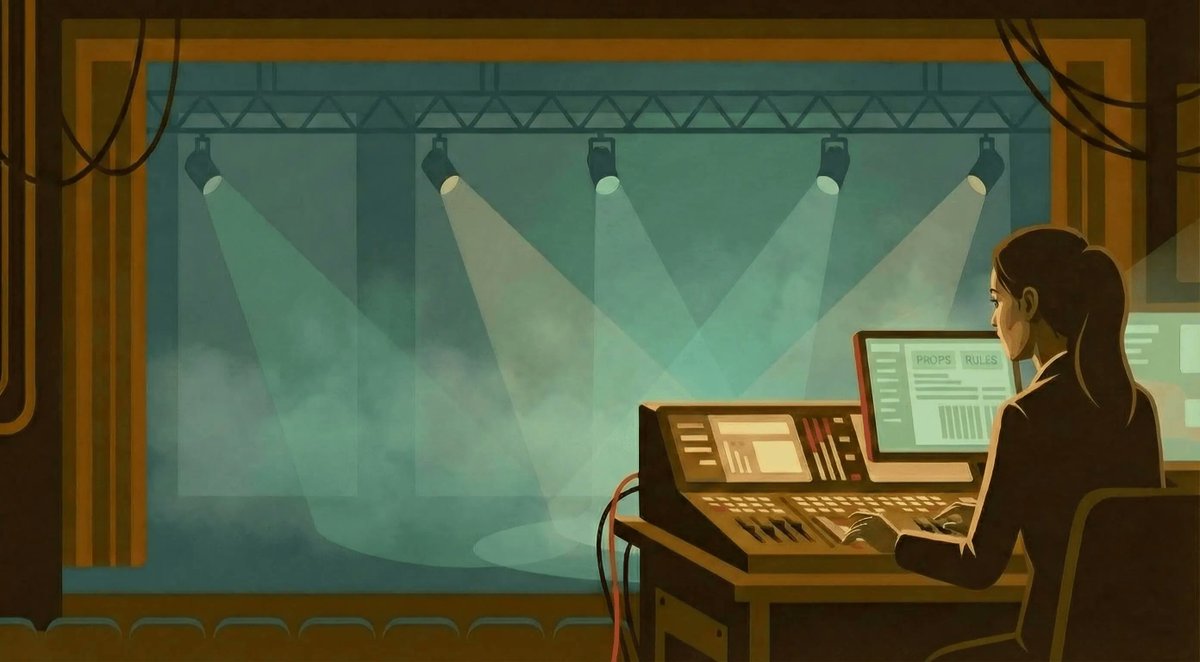
Your new job as designer:
Build the stage.
Set the guardrails.
Stock the props.
Shape the visual language.
The illustrations are the performance.
Imagine every pixel on your screen, streamed live directly from a model. No HTML, no layout engine, no code. Just exactly what you want to see.
@eddiejiao_obj, @drewocarr and I built a prototype to see how this could actually work, and set out to make it real. We're calling it Flipbook. (1/5)
Everyone's watching Claude Design.
Quieter move: Google just shipped A2UI v0.9 - an open standard for agent-rendered UI. Building on what stage managers know: You can't rebuild the set from scratch every night.
Why this matters for designers and how to plan for it: uxdesign.cc/ai-improv-34a4…#GenerativeUI#A2UI#AIDesign