
Scouse Wolfy 🏳️🌈🏳️⚧️🌿 retweetledi
Scouse Wolfy 🏳️🌈🏳️⚧️🌿
116.3K posts

Scouse Wolfy 🏳️🌈🏳️⚧️🌿
@ScouseWolfy
NW UK, left & Green, didn’t leave Labour - it left me, #BackZack , Cis Gay He/Him, Trans ally 🏳️🌈🏳️⚧️
North West, England Katılım Temmuz 2023
1.1K Takip Edilen1.3K Takipçiler

Scouse Wolfy 🏳️🌈🏳️⚧️🌿 retweetledi

Shame, Labour did previously pledge for PR,
More of the same than from Burnham.
Reform and change tomorrow, neoliberalism today
Stats for Lefties 🍉🏳️⚧️@LeftieStats
🚨BREAKING | Andy Burnham confirms he will NOT scrap first-past-the-post before #GE2029 Burnham said electoral reform must be "in a manifesto", and revealed he does NOT back proportional representation, instead praising the non-proportional Supplementary Vote (SV) Via @itvnews
English
@MaryamI06713475 @carreg_y_defaid Then @AndyBurnhamGM shouldn’t have started this @UKLabour psychodrama and risked it should he?
But now that he has - @TheGreenParty have an obligation to fight it!
And we will be backing them!
Sorry if democracy upsets you 🤷🏼♂️
English
@ScouseWolfy @carreg_y_defaid My original acc was deleted by Elon. You hopes and dreams don't get votes. Learned the hard way. Don't want more Reform in govt. Why is that so bad?
English
@MaryamI06713475 @carreg_y_defaid Good for you!
While we will be cheering on @TheGreenParty candidate in Makerfield 🤷🏼♂️
English
@carreg_y_defaid @ScouseWolfy For those of us that can think bigger and don't want more division, have been through all of this several times, yes, we come to different, more reality based conclusions. I'm old af.
English
@carreg_y_defaid @MaryamI06713475 Yes, they post a graph or table - and a democratic nationwide party thinks ‘fuck our members, NobodyLotsOfNumbers makes an excellent point - stand down everyone’???
English

@ScouseWolfy @MaryamI06713475 Presumably that Zack should kneel based on previous votes, when it's no longer clear that the voting arithmetic is what it was.
At best, it's blue-sky thinking, at worst it's arrogant delusion that anybody still thinks that Labour Party would worth pissing on if it was ablaze.
English
Scouse Wolfy 🏳️🌈🏳️⚧️🌿 retweetledi

The natural end point of all the bullshit assertions about how leftists use the word "Zionist" as code for "Jews", is that the far-right earnestly adopts it as a disguise.
Zionists love Israel, but *hate* Jews.
thelefttake@thelefttake
There has never been a more confused political movement in history than the one led by these jokers.
English
Scouse Wolfy 🏳️🌈🏳️⚧️🌿 retweetledi
The grandfather of Labour CabinetMinister @sarahsackman was one of these terrorists that killed British soldiers and cooperated with Nazi Germany.
Sackman is an Israeli lawyer and zionist.
Who do you think Sackman represents in the British government?
Ivor Cummins@FatEmperor
Fascinating history...grabbed from fb post below: The Zionist Underground and the End of British Rule in Palestine.📷 - Martin Michael I went down a historical rabbit hole researching this and honestly, some of it genuinely took a minute to process. Before Israel was created in 1948, Britain governed Palestine under what was known as the British Mandate, following the collapse of the Ottoman Empire after World War I. In the final years of British rule, several Zionist underground organisations launched an armed insurgency aimed at forcing Britain out of Palestine and paving the way for the creation of a Jewish state. The main organisations involved were: Irgun A nationalist paramilitary group responsible for bombings, assassinations and attacks on British military and administrative targets. Lehi (The Stern Gang) A smaller but even more radical organisation that carried out assassinations and attacks against British officials and infrastructure. Haganah The largest Jewish paramilitary organisation in Palestine. Although it often operated differently from Irgun and Lehi, it did at times cooperate in coordinated operations against British targets. At the time, British authorities officially referred to some of these groups as terrorist organisations, while supporters viewed them as anti-colonial fighters resisting British rule. Historians generally refer to this period as the Jewish insurgency in Mandatory Palestine (1944–1948). Some of the major events included: 1944 — Assassination of Lord Moyne Walter Guinness, Britain’s Minister of State in the Middle East, was assassinated in Cairo by members of Lehi. He was the highest-ranking British official killed during the insurgency. 1945 — Escalation of attacks Militant groups intensified attacks on: • railways • bridges • police stations • government buildings • immigration control infrastructure Several groups temporarily worked together in a coordinated campaign known as the Jewish Resistance Movement. 1946 — Night of the Bridges A coordinated sabotage operation destroyed bridges linking Palestine with neighbouring territories, severely disrupting British transport and military infrastructure. 1946 — King David Hotel Bombing Irgun militants planted explosives inside the King David Hotel in Jerusalem, which housed the British administrative headquarters. The explosion killed 91 people: 28 British 41 Arabs 17 Jews It remains one of the deadliest attacks carried out against British rule during the Mandate period. 1947 — Acre Prison Break Irgun fighters attacked Acre prison and freed dozens of imprisoned militants. 1947 — Execution of British Sergeants Two British soldiers, Clifford Martin and Mervyn Paice, were kidnapped and later hanged by Irgun after Britain executed imprisoned militants. The killings caused outrage across Britain. By 1947–48 the situation had become increasingly unmanageable for Britain. Eventually Britain announced it would end the Mandate and hand the issue over to the United Nations. On 14 May 1948, the state of Israel was declared. What happened next is where the story becomes even more significant. Many members of these underground organisations later moved directly into mainstream Israeli politics and state leadership. Menachem Begin, leader of Irgun during the insurgency, later became Prime Minister of Israel. Yitzhak Shamir, a senior member of Lehi, also went on to become Prime Minister. Meanwhile Haganah became the foundation of the Israeli military itself. All of this took place in the shadow of World War II and its aftermath, at a time when Britain had been financially and militarily devastated by war. By 1944 British ministers were being assassinated. By 1946 British headquarters were being bombed. By 1947 British soldiers were being kidnapped and executed. Yet this history is rarely discussed in Britain today. And it raises a question that still follows conflicts across the world now: Who gets labelled a terrorist — and who later gets remembered as a freedom fighter or statesman? Because history often seems to answer that question differently depending on who eventually wins power.
English
Scouse Wolfy 🏳️🌈🏳️⚧️🌿 retweetledi
The process of replacing Starmer is going to show just how much anyone has learned from the disastrous and dishonest process of installing Starmer in the first place. So far the evidence is: very little indeed!
English
Scouse Wolfy 🏳️🌈🏳️⚧️🌿 retweetledi
Urgh. Seeing straight c!s BBC people this morning telling each other they have:
⭐️Checked with the BBC Identity Correspondent (who isn’t trans)
⭐️Checked with groups “involved” in the “trans debate” (we know what this means).
And they all say how we treat trans folk is fine. Arghhhhhhhhh!
Guess who they don’t ask or listen to?
English
Scouse Wolfy 🏳️🌈🏳️⚧️🌿 retweetledi

He was a white british man and he did get away with it.
El Borto@bortinez_
Banner spotted at the Unite the Kingdom protest today. Beyond words 🤦♂️
English
Scouse Wolfy 🏳️🌈🏳️⚧️🌿 retweetledi

If you believe this load of bollocks, I have a bridge in London that I can sell you.
The i Paper@theipaper
Andy Burnham says one of the key reasons he wants to return to parliament is because he wants to see more nationalisation of public services. Follow live updates: inews.co.uk/news/starmer-l…
English
Scouse Wolfy 🏳️🌈🏳️⚧️🌿 retweetledi
Josh Simons is the man who commissioned smear operations against journalists who were investigating the faction controlling Labour.
This is all about changing the figurehead while the faction remains untouched.
English
Scouse Wolfy 🏳️🌈🏳️⚧️🌿 retweetledi

Has anyone told him, he hasn't even won the by-election yet

English
Scouse Wolfy 🏳️🌈🏳️⚧️🌿 retweetledi
Jesus, this man Dale Vince really believes that we should allow Reform UK to win the next election, doesn't he? 🙄
Has he not seen the figures and unfavourability of Keir Starmer?
Sorry Dale Vince, but #LabourIsDead!

Dale Vince@DaleVince
I just don’t think there should be a leadership challenge. Keir Starmer has a massive mandate given to him by the British people at the general election. I don’t think anybody in the Cabinet has a right to try to overturn that. I still hope there won’t be a leadership contest. If there is, it’s probable that Keir will stand himself and in which case, I’d be in his camp. What we need now is continuity. We need Labour to deliver on their manifesto. We haven’t even been two years into this government. telegraph.co.uk/gift/d0332ac86…
English
Scouse Wolfy 🏳️🌈🏳️⚧️🌿 retweetledi

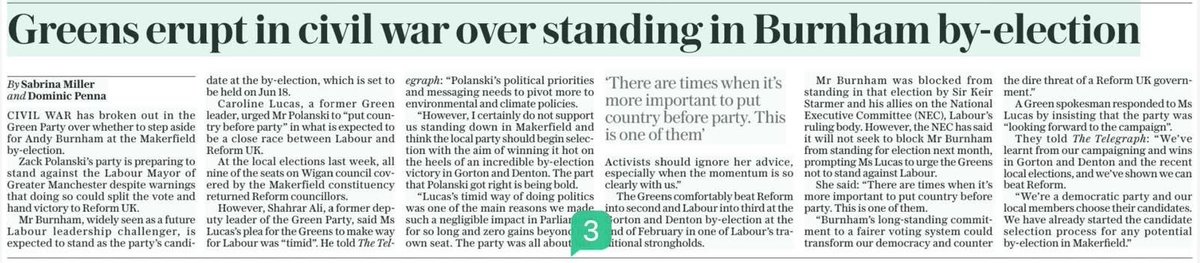
It’s amazing how the right wing press can turn “members of a democratic party discussing the best course of action” into “civil war”.
English
Scouse Wolfy 🏳️🌈🏳️⚧️🌿 retweetledi
You mean... the government of which he was a part? Which, along with his friend Mandelson, he helped form, in makeup and policy? Which he supported constantly and vocally? Of which he made not the tiniest criticism? That government?
megan kenyon@meganekenyon
Speaking at Progress conference, Wes Streeting is scathing about the government he has just left. “We then had a dishonest leadership contest, followed by an overcautiousness in opposition. Interesting policy ideas couldn't be floated because we were too afraid of what the Tories might say, so we said nothing. Instead of a willingness to challenge ideas and kick the tyres, debate was viewed as division and shut down. As a result, we arrived in government underprepared in too many areas and lacking clarity of vision and direction.”
English
Scouse Wolfy 🏳️🌈🏳️⚧️🌿 retweetledi

If Labour advised against formal or informal arrangements with the Tories, why are Brent Labour reportedly seeking cooperation to remain in office?
x.com/antongeorgiou_…
Nafsika Butler-Thalassis@NafsikaT
@JENBROOK8 @GreenPrtyNilton Actually we were expressly told by the Labour party that we can’t work with the Tories in a formal or informal coalition. How are things going in Enfield?
English
Scouse Wolfy 🏳️🌈🏳️⚧️🌿 retweetledi

PM Streeting would make PM Starmer look like a giant of a man. A selfless visionary.
Wes Streeting@wesstreeting
Change begins with an argument. You don’t make progress without one. 👇
English
Scouse Wolfy 🏳️🌈🏳️⚧️🌿 retweetledi

She won't, because Our Media were active participants in the Labour Together Project, which is still VERY much alive & thriving through Andy Burnham's Election campaign, But sure… Let's all keep pretending
Saul Staniforth@SaulStaniforth
Josh Simons is on #bbclaurak this morning. Will Laura Kuenssberg ask him about his role as the head of Labour Together, when he organised a smear campaign against a journalist investigating the organisation, and for which he had to subsequently resign as a minister?
English
Scouse Wolfy 🏳️🌈🏳️⚧️🌿 retweetledi

