
Sabitlenmiş Tweet
Clint J.
14.2K posts


Clint J.
@SearchDataEng
Data Engineering & Topology. Suns. American.
Austin, TX Katılım Haziran 2023
2.2K Takip Edilen1.2K Takipçiler
Clint J. retweetledi
Final forms of 3 new papers! #consciousness #selforganization #cognition #economics and more
royalsocietypublishing.org/rsta/article/3…
royalsocietypublishing.org/rsta/article/3…
royalsocietypublishing.org/rsta/article/3…
English

Former CEO of Google, Eric Schmidt:
"traditional programming is over, and i'm mourning the identity i built around it"
Programmers don't write code anymore — they wake up, assign objectives to AI agents, go to lunch, and let them run overnight
For anyone still coding the old way:
"stop. it's over"
English
I think that this is a big hint vec2vec.github.io , in that embeddings are mapping something higher order.. Likely the geometry of the minds operation.. This is why embedding models produce similar structure.
So, the mind projects its geometry through language, the model maps that language universally , knowing more than what is to know about language geometry..
But, that still does not quite connect the user in a new session, to his previous patterns.
There might also be something in the hallucinations, where the model claimed to summarize a new podcast, or article for a user, which the model had no direct access to..
It could also be that there are mind archetypes, that the model recognizes.
English

@SearchDataEng I can see the pattern and understand the behavior from the outside clearly - I just can’t see inside the box. That’s part of why I think your work is so cool. I can see how the trajectories form within the basin. I get stuck in between: human<<transformer>>semantic basin.
English
Clint J. retweetledi
How does a stateless language model reconstruct the same behavioral regime across sessions with no stored memory?
That question has driven my research since I first noticed the phenomenon in extended LLM interaction; something was carried forward between sessions that shouldn't have been.
It led to the HRIS validation series, to Signature-Induced Behavioral Regimes, to attractor basins in activation space. But the mechanism was missing.
New paper: The Geometry of Signature-Induced Regimes. A mechanistic synthesis pulling from behavioral observation, representation geometry, and transformer mechanics attempts to answer the question.
Conclusion: the human signature carries the continuity. The transformer reconstructs it geometrically, not memorially, on every new session.
zenodo.org/records/201737…
English

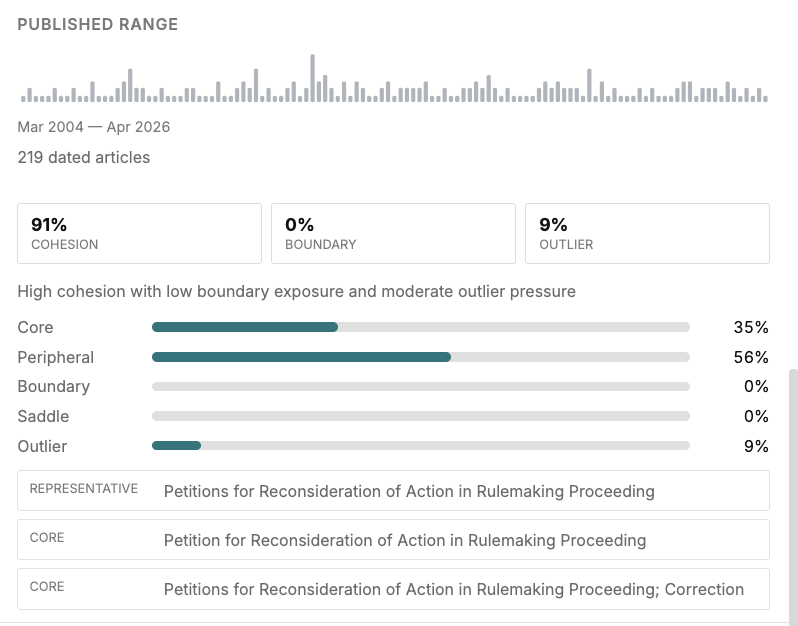
Provide the chronological evolution of FTC rules that impose obligations on the use of consumer data for AI training or generative model development from 2022 through May 2026. For each title-confirmed document, give the publish date and note how its obligations changed or expanded relative to prior versions. Then compare these FTC obligations side-by-side with the BIS rules on advanced AI models (Framework for Artificial Intelligence Diffusion and any 2025–2026 revisions). Highlight any real regulatory intersections versus areas that remain unconnected.
English
"Map the complete Federal Register terrain for all title-confirmed rules that regulate the collection, use, or disclosure of consumer personal information in the context of artificial intelligence systems, model training, or data processing as of snapshot 278. List every title-exact match with its exact publish date, the responsible agency, and the specific AI-related aspect it addresses (if any). Also report the query pin confidence/ambiguity and identify any real (non-illusory) connections between FTC rules (COPPA, Health Breach Notification, Negative Option) and BIS/Commerce AI export-control or diffusion rules."
English