Serge Motrin

58 posts

Serge Motrin

Serge Motrin

@SergeMotrin

Katılım Kasım 2025
16 Takip Edilen3 Takipçiler
Serge Motrin
Serge Motrin@SergeMotrin·
@miclyn411359 Its just not as simple as we all think. All lawsuits need to be done with. Powell needs to be gone. Its gotta be done right.
English
0
0
0
44
mic lyn
mic lyn@miclyn411359·
@SergeMotrin True … but I’ve owned FNMA for 22 years & 5 of those years DJT was president & still the stock is under conservatorship. I’m beyond frustrated. I’m angry.
English
3
1
8
244
mic lyn
mic lyn@miclyn411359·
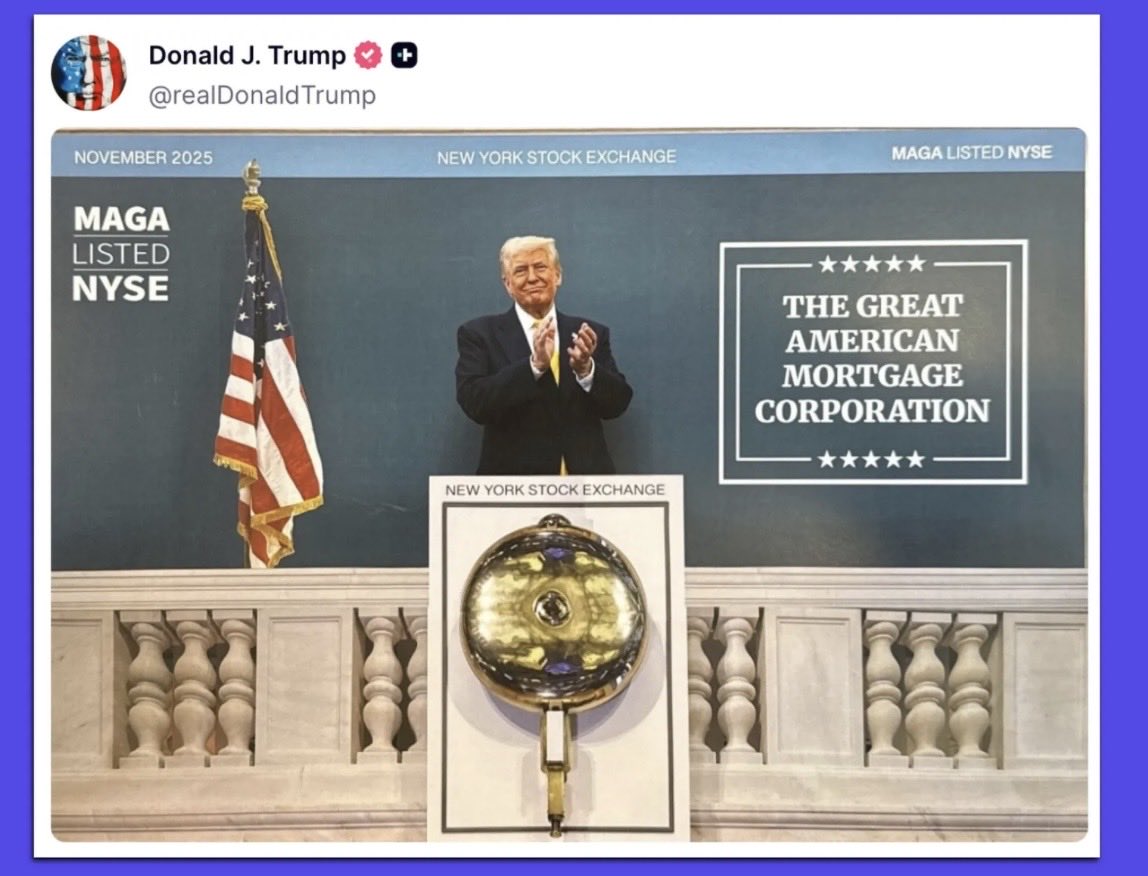
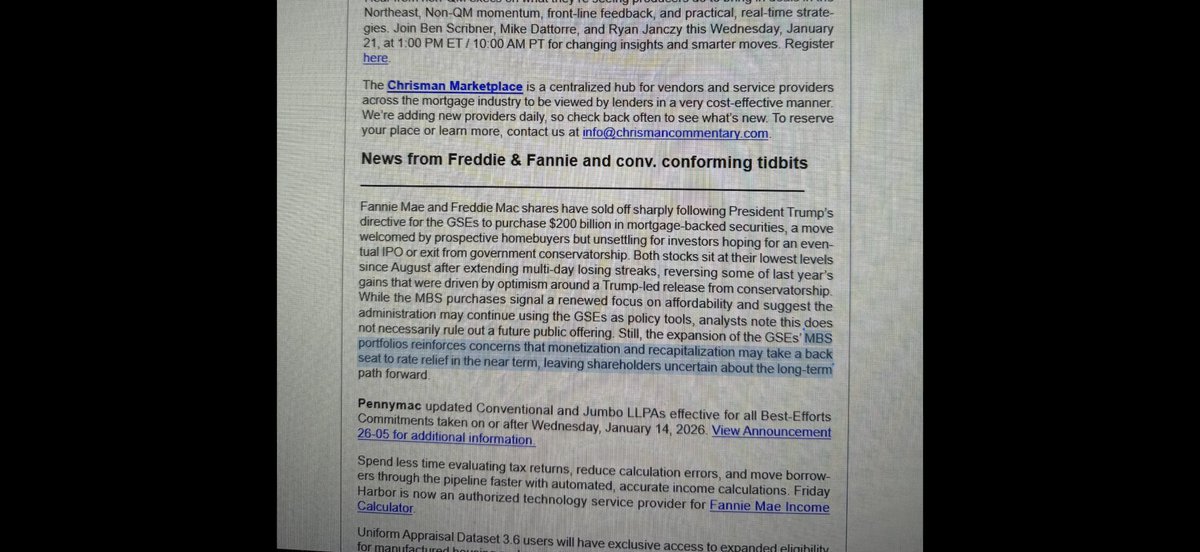
How many of my fellow F&F investors lean toward voting GOP? If F&F don’t uplist prior to midterms, will that sway your vote for the Republican Party? I’ve voted conservative in the past, but now I’m rethinking my support. $FNMA $FMCC
mic lyn tweet media
English
18
6
40
1.4K
Serge Motrin
Serge Motrin@SergeMotrin·
@revgalerivs @ConcernedCtzn24 be a Warrior... Be patient...own both just in case...right now its a mindfook... even if it's Fall 2028, who cares. we either lose a few grand if GOVMNT does receivership, or we never go back to work because we need to...deep breath
English
0
0
1
9
Dragan Nikolic
Dragan Nikolic@revgalerivs·
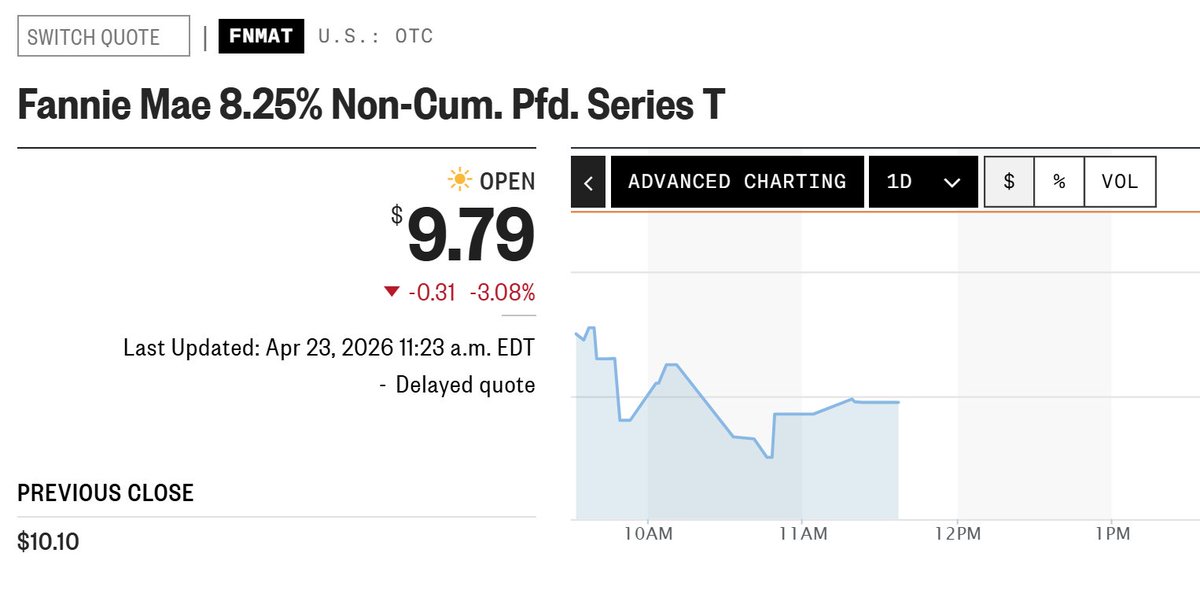
OMG.. $FNMAT Stopped trading no trades since 11:23 and now is 12:23 For WHOLE hour no trades ! What is happening? . . . My mistake. AGAIN... It is low volume, AS USUAL (10K ) ___ Ohhh, it is so good to be in liquid stocks, like $fnma $fmcc
Dragan Nikolic tweet media
English
2
0
1
678
Serge Motrin
Serge Motrin@SergeMotrin·
@revgalerivs JPS is not going anywhere...there is no legal way to get rid of them and preserve the value of commons. Just like there is no way to preserve the huge value of govmnt owned SPS and devalue the 20% of commons we all hold, otherwise why are we all holding?
English
1
0
0
31
Dragan Nikolic
Dragan Nikolic@revgalerivs·
Aaannnnd... We have another hour of $fnmat witout trading. And >3% down For a whole hour no one traded this JPS stock. Even it is one of most liquid preferred shares... I am so glad i sold all My JPS and move to $fnma $fmcc I feel so bad for people who hold fnma fnmas fmckj That i must remind them about thier bad situation.... Do something !!!
Dragan Nikolic tweet media
English
1
0
1
585
Serge Motrin
Serge Motrin@SergeMotrin·
$KOS if oil stays above $75-80 for the rest of 2026, $KOS is $5+ mid 2027( or sooner)
English
2
0
6
392
NoDegreeFinance
NoDegreeFinance@NoDegreeFinance·
When $FNMA gets released from conservatorship, what price will the stock get to?
English
25
5
45
9.5K
Serge Motrin
Serge Motrin@SergeMotrin·
@BillAckman Thank You! Great summary that shines the light on prior administrations shady dealings…
English
0
0
0
54
Serge Motrin retweetledi
Bill Ackman
Bill Ackman@BillAckman·
A number of press reports have characterized our and other shareholders’ efforts on behalf of Fannie and Freddie (F2) as seeking a ‘gift’ or ‘handout’ from the government. We, the shareholders of F2, seek no such thing. Hundreds of financial institutions were bailed out during the GFC by the U.S. Treasury. Nearly all of the financial institution bailouts during the GFC involved an injection of capital in the form of senior preferred stock by Treasury at an interest rate of 5%, plus warrants to acquire common stock in an amount equal to 15% of the face amount of the preferred with an exercise price at the then-current stock price of the rescued institution. For example, Treasury’s preferred stock investment in Goldman Sachs was in an amount of $10 billion and, in addition, Treasury received warrants on $1.5 billion of GS' common stock at its then market price. The bailout terms for F2 were materially more burdensome and expensive, with a higher interest rate and substantially more warrant coverage, than that of every other financial institution (other than those of AIG whose terms were similar). Despite the F2 bailouts’ massively more burdensome terms, shareholders are not complaining about the original terms. Treasury invested $193 billion in F2 in the form of senior preferred stock (SPS), including funding for $2 billion of commitment fees, with a 10% coupon (twice that of the banks). Treasury also received warrants on 79.9% of both companies’ outstanding shares. Fannie and Freddie have since repaid Treasury $301 billion, which includes interest on the SPS at a blended rate of 11.6%, an interest rate which is 160 basis points more per annum, and have returned the entire $193 billion of outstanding principal, $25 billion in excess of what was contractually owed. In summary, the F2 SPS has been fully repaid according to its original contractual terms plus an extra $25 billion. Despite the fact that the SPS has been more than repaid in full, Fannie and Freddie have not accounted for these payments on their respective balance sheets, and the $193 billion of SPS remains an outstanding liability as if no principal payments had ever been made. How can it be, you might ask, if indeed F2 have repaid $301 billion to Treasury when only $276 billion was due could there be any remaining balance of the SPS on the F2 balance sheets? The answer relates to something called the ‘Net Worth Sweep (NWS).’ During the second term of the Obama administration, on August 12, 2012, two quarters after F2 returned to profitability, Treasury announced that it was unilaterally amending the terms of the SPS stock to provide that Treasury would take 100% of the profits of F2 each quarter in lieu of the 10% annual dividend rate. This was not a negotiated resolution with F2. It was a unilateral amendment of the original terms of the SPS that was done in bad faith. The supposed rationale for the amended terms of the SPS was akin to the IRS garnishing the wages of someone who will never be able to pay the taxes that they owe. That is, the Treasury said F2 will never be able to pay the 10% coupon, let alone the SPS’ $193 billion principal balance, so it decided instead to ‘settle’ for 100% of F2’s profits forever. In discovery, shareholders learned that the stated justification for the amendment was false. In mid 2012, the Obama administration had come to learn that both companies would soon be reversing tens of billions of reserves on their balance sheets as housing values had increased and the reserves taken during the GFC had been excessive. The NWS was instituted by Obama to forestall F2 from forever being able to recapitalize and be released from conservatorship. The NWS was not a ‘settlement’ for a lesser amount of future payments. It was the outright theft of the forever profits of both companies. Never before or since has the government ‘swept’ 100% of the profits of any company, let alone a financial institution in conservatorship, a form of government intervention where the goal is rehabilitation of the institution, and where the hierarchy of corporate claims has always been respected. The accounting for the NWS payments while it was in effect (until Secretary Mnuchin terminated the NWS in Trump’s first term) was also unusual. The NWS was treated by F2 as a quarterly adjustment to the dividend rate on the SPS such that the dividend amount owed was made equal to the after-tax profits of F2 for that quarter with no limitation. In other words, regardless of the amount of profit F2 generated for the quarter – whether or not it was in excess of the original 10% annual dividend – the dividend payable under the NWS was made equal to the quarterly profit. The absurd terms of the NWS sweep therefore made it impossible for any partial or full repayment of the SPS to take place as every dollar paid to the Treasury on the amended terms of the SPS was considered a dividend payment, even if the amount was massively in excess of the original contractual SPS terms. The absurdity of the NWS was made clear just two quarters after the NWS went into effect. Fannie Mae generated a profit of $59 billion in the first quarter of 2013, and the SPS dividend rate for that quarter was set at $59 billion so the entire amount was swept to the government, more than 10 times the contractual dividend rate. I had the opportunity to discuss F2 and the NWS with Warren Buffett about a decade ago and he said that he “couldn’t believe what the government had done.” In short, the shareholders of F2 are simply asking the government to respect the original and highly burdensome terms of the SPS. There is no dispute that Treasury has received more than the original 10% coupon and full repayment of principal of the SPS, that is, an extra $25 billion. We and the millions of other shareholders of F2 are simply asking the administration to honor the original SPS terms and properly account for the $301 billion of payments, thereby eliminating the SPS liability from both companies’ balance sheets. Shareholders have not asked for the extra $25 billion to be returned to the two companies. Treasury can decide whether to keep those funds or return them to the companies. Accounting for the repayment of the SPS has other important implications. Namely, it is critically important that conservatorships respect the rule of law, in particular, the contractual terms of corporate instruments and the hierarchy of claims. Otherwise, no financial institution that gets into trouble will be able to raise rescue capital in the private markets. Notably, the treatment of F2 in conservatorship explains why Silicon Valley Bank and other recent large bank failures since the GFC were unable to raise private capital and avoid government intervention or a forced sale to J.P. Morgan. If the government with the stroke of a pen during conservatorship can at a whim wipe out common and preferred shareholders, no one is going to step in to try to save a financial institution that gets into trouble, and only the top few banks will be possible rescuers of big banks that fail. Furthermore, because of F2’s history, their reputation in the capital markets has been greatly damaged. F2 raised $22 billion of preferred stock in the year or so prior to conservatorship as the government pressed both companies to raise capital. Institutions were willing to invest billions of dollars of capital into both institutions before they failed because, based on all precedent conservatorships, the contractual terms of all financial instruments and the hierarchy of claims had been preserved. Unfortunately, in light of the precedent of the net worth sweep, no investor can be confident that they won’t be wiped out in a future conservatorship so none has been willing to take the risk. Some have proposed that Treasury simply convert the SPS into junior preferred and common stock and massively dilute shareholders. Putting aside the potential legal challenges to this approach, the result will be that Treasury will at best own something approaching 95% of both companies rather than 79.9%. While the government’s percentage ownership stake would be larger in the SPS conversion approach, the value of the government’s larger stake would be considerably lower as the companies would become un-investable. Who would invest in F2 alongside the government when they just wiped out the previous owners? In the SPS conversion scenario, the government’s stake, at best, if it could be sold, would trade at a massively discounted valuation, well below the value of the government's stake if Treasury retained only its contracted for 79.9% stake and respected the original terms of the SPS. In other words, a slightly smaller ownership stake of much more highly valued companies would equate to considerably more value for Treasury and taxpayers. In a public letter to Rand Paul after his first term in November of 2021, President Trump recognized that the net worth sweep was theft from the shareholders of Fannie and Freddie. He wrote: “Another Obama/Biden scam in legal trouble was when they allowed the Federal Housing Finance Agency (FHFA) to steal the retirement savings of hardworking Americans who had invested in Fannie Mae and Freddie Mac…The idea that the government can steal money from its citizens is socialism and is a travesty brought to you by the Obama/Biden administration. My Administration was denied the time it needed to fix this problem because of the unconstitutional restriction on firing Mel Watt. It has to come to an end and courts must protect our citizens.” I couldn’t have said it better than President Trump. Now that you have the time, Mr. President, let’s Stop the Steal!
English
373
467
2.2K
851.9K
Serge Motrin
Serge Motrin@SergeMotrin·
@rektcapp Now recalculate for 590 mil outstanding shares… they just sold extra in a large offering a week ago
English
1
0
0
77
Serge Motrin
Serge Motrin@SergeMotrin·
@JonOksenholt What are your price targets for the common and JPS? In line with @BillAckman presentations or something different? In your opinion, will JPS hit par value?
English
0
0
0
1
Jon Oksenholt
Jon Oksenholt@JonOksenholt·
If you are invested in $FMCC $FNMA $FNMAT $FNMAS or $FMCKJ you should consider 3 things that it appears as if many investors/commenters, surprisingly do not know: 1. Patriotism before profits. Bigger national priorities like the war with Iran come first. Resolution is unlikely until those are addressed. 2. Assuming Freddie/Fannie return to a major exchange, the senior liquidation preference is the single biggest variable. Treasury holds a $367.2 billion senior claim 140.2B Freddie plus 227.0B Fannie per the Dec 31 2025 10-K. This sits at the top of the capital stack. Treasury gets paid in full before any junior preferred or common shareholder receives a single penny. Whether this claim is deemed repaid in full forgiven or restructured will have a major impact on the share prices of both commons & JPS as I will demonstrate in a future post. The total valuation of the companies is the other major variable. 3 The government holds warrants for 79.9%. Once exercised (which is nearly certain in any IPO or relisting) existing shareholders own only 20.1%. P.S. If you chose to invest in these companies, pull up your big boy pants & stop whining. @billpulte & others from the administration should not be blamed every time these stocks decline. In my view, he has worked hard to optimize & increase the value of these beautiful businesses for the benefit of the taxpayers, homebuyers, renters & shareholders. Subject to number one above, I believe it’s time to move these gigantic companies onto a major stock exchange. Lastly, you probably should not own these stocks if you believe @FreddieMac / @FannieMae stay in conservatorship forever..
English
22
12
95
6.6K
Serge Motrin
Serge Motrin@SergeMotrin·
$FNMA $FMCC 52wk lows...WTF is happening?
English
1
0
1
486
Serge Motrin
Serge Motrin@SergeMotrin·
@pulte Can we please Uplist $FNMA and $FMCC to NYSE NOW??? or do an IPO already!!
English
0
0
10
491
Pulte
Pulte@pulte·
MORTGAGE RATES ARE IN THE 5s! THANK YOU PRESIDENT TRUMP!
English
231
195
3.1K
90.8K
Serge Motrin
Serge Motrin@SergeMotrin·
@pulte Can we do something about $FNMA$FMCC now?
English
0
0
0
2
Pulte
Pulte@pulte·
President Trump, single-handedly, lowered mortgage rates. He’s the best.
English
477
265
2.9K
254.6K
Pulte
Pulte@pulte·
CNBC clip of Mark Cabana, head of U.S. Rates Strategy at BofA Securities talking about how Fannie/Freddie bond buy will help suppress mortgage rates
English
64
79
502
62.2K
Serge Motrin
Serge Motrin@SergeMotrin·
$FNMA $FMCC Thoughts?
Serge Motrin tweet media
English
1
0
1
4.4K
Serge Motrin
Serge Motrin@SergeMotrin·
@familymang1 Sullivan and Cromwell hired to figure out a way to receivership and hosing all common shareholders without legal blowback
English
0
0
1
578
familymang
familymang@familymang1·
Two noteworthy $FNMA / $FMCC headlines that were lost in the volatility yesterday: 1) NYTIMES: US GOVERNMENT RETAINS LAW FIRM SULLIVAN & CROMWELL TO ADVISE ON GSE DEAL 2) NYTIMES: WALL STREET BANKS RETAIN LAW FIRM KIRKLAND & ELLIS TO ADVISE ON OFFERING TERMS
English
14
27
110
10.9K
Serge Motrin
Serge Motrin@SergeMotrin·
$FNMA $FMCC Sullivan and Cromwell : usually hired to do the very big and very impossible...good news or bad news? Hired to find a way to preserve the 80% held by the GOV and at the same time devalue 20% held by the rest? Sounds just like the task for them
English
0
0
0
791
Deep Capital
Deep Capital@DeepCapital_·
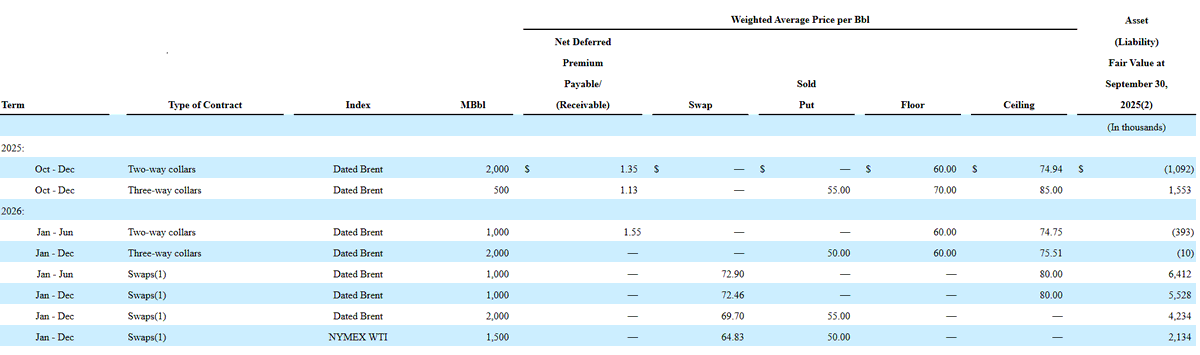
They haven’t disclosed any hedges for 2027–2028. The latest 3Q25 filing only shows open positions through 2026. With the recent pickup in oil prices, they may have more flexibility to add new hedges.
Deep Capital tweet media
English
1
0
1
82
Gabriel Castro, CFA
Gabriel Castro, CFA@gabcasla·
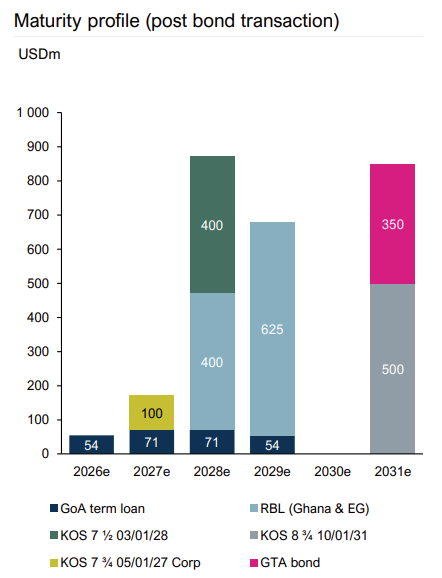
$KOS is taking another significant step to enhance its company profile risk management. The company plans to issue a 2031 bond, a $350 million first-lien GTA. The proceeds will be used to tender $250 million of the 2027 bonds at 99, with the remaining $100 million used to repay the RBL loan, specifically the 2027 maturity. I expect Kosmos to successfully raise this debt. They are well prepared, having conducted a sounding in December with strong investor interest, including from us. Bonds are reacting positively, rising by 2/3%, and the stock should follow. This refinancing largely covers Kosmos's upcoming maturities, giving the company ample time to see how Brent recovers to the 70s, which will significantly boost the NAV.
Gabriel Castro, CFA tweet media
English
10
13
128
19.5K
Serge Motrin
Serge Motrin@SergeMotrin·
@updowninwaves Over 90% institutional holders…the rest are small retail and I dividuals, who bough in $3-4 range…no one is selling at 75% loss…. At this point it’s either complete bust or back to $5-6 in 2028
English
0
0
1
15
waves
waves@updowninwaves·
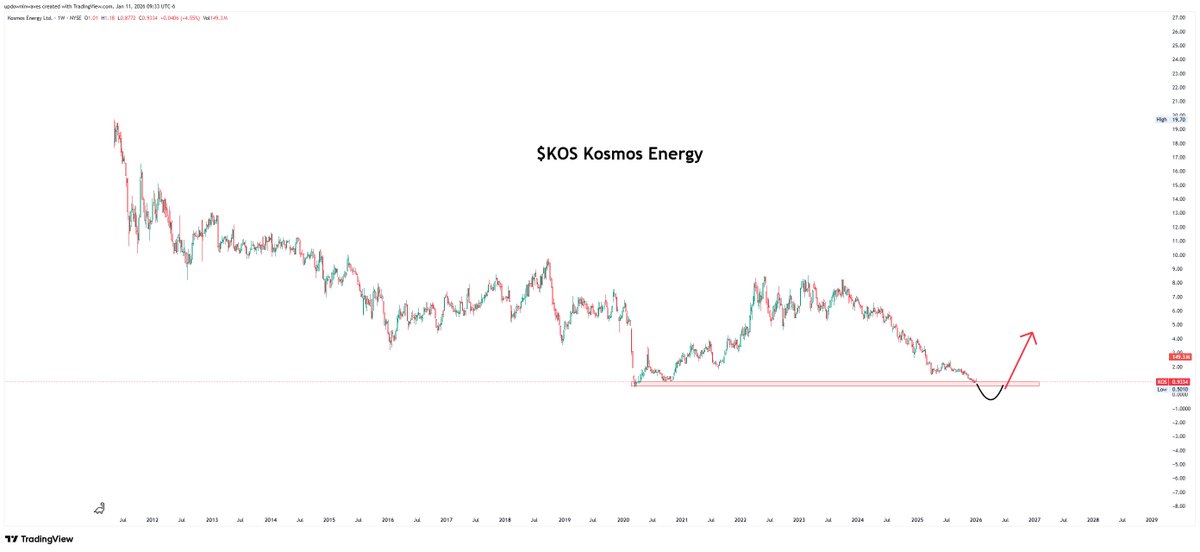
$KOS Might be a logical place for price to stop going down. But would love to see it fall below support, shake out some folks, and then go.
waves tweet media
English
1
1
3
1.5K