

Seulgi
4.5K posts

Seulgi
@SeulgiVLR
economics researcher in content/brand strategy | growth in gaming/tech/creator economy | 300M+ views generated for clients
Katılım Mart 2022
1.6K Takip Edilen10.7K Takipçiler

It’s been a week since I mutually parted ways with Wolves Esports.
What’s next?
Well I’m still deciding,
whether that’s a new VCT team or doubling down on a personal project.
I genuinely believe has a lot of potential.
Let’s see where this path takes me.
English
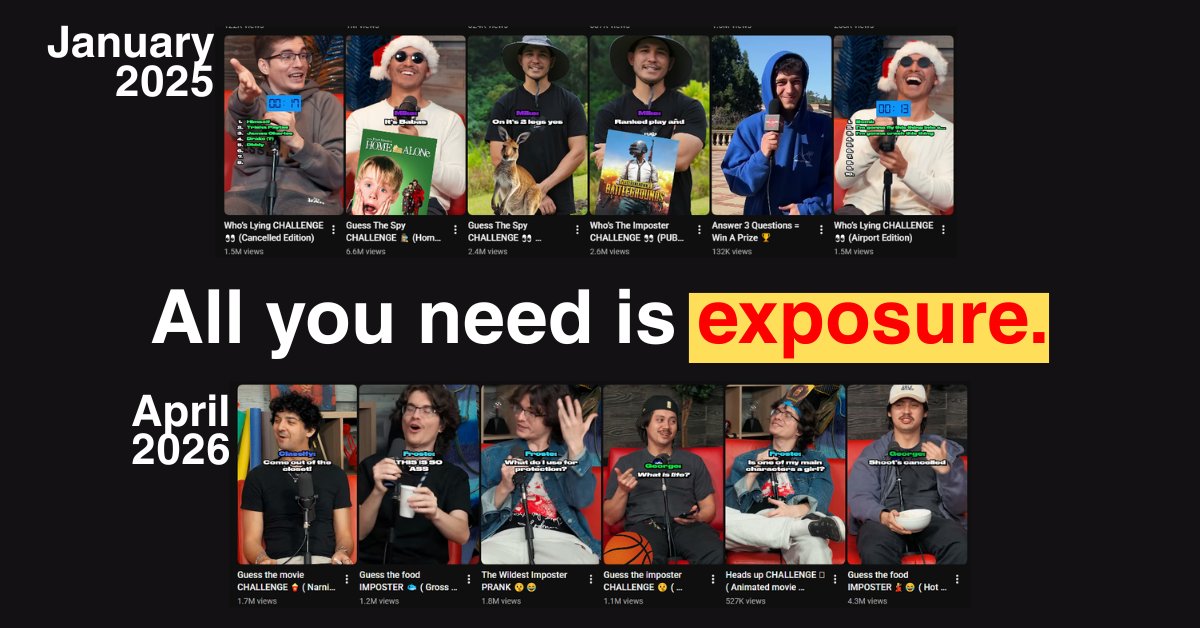
Full Squad Gaming, NRG's entertainment channel, changed its entire cast and is amassing billions of shortform views. So how did viewers accept the new personalities entirely despite initial pushback?
Full Squad has no NRG branding and no competitive esports identity. It's built entirely around recurring casual party game formats that anyone can understand.
The comment sections show why the transition worked; viewers reference current cast members like they know them personally. This is parasocial attachment formed through format consistency alone instead of individual identity. Full Squad's format became the personality.
In the past, I've discussed organizational brand equity as a solution to player dependency. But Full Squad demonstrates a second pathway to the same outcome by building attachment to the format itself. The personnel become interchangeable without audiences fracturing.
The most durable audience attachment doesn't require your name on it at all.
English
@CrazyTrainLive interesting! do you think the return was what carried the transition or might it have been that the format had already built enough familiarity that one face was enough to bridge it?
English

@SeulgiVLR Yes and no. We had a returning cast member which made a massive impact.
English

LFT for the remainder of 2026.
I can provide sample works upon request and I'm also ready to start trialing for teams prepping for EWC quals or London.
References @FaydeVLR @_SushantJha @Secret_Rbtx
English

Seulgi retweetledi


lol - all of the "physically unscrollable titles" "Unstoppable scrolling VS Immovable title" |
stuff I outlined in January. You all had 5 months to take this direction and lock in. Instead, 95% of people did nothing or spent time and effort copying and pasting paint explainer slop.
There are levels to this.
Vexian - YouTube Strategy@Vexian
English
Sentinels' Masters Madrid content hit 2 million views. So why does their content today struggle to reach 10% of that on the same subscriber count?
Much like most esports teams, Sentinels suffer from "the winning trap."
Instead of building audiences, winning content creates one-time viewership injections. These are fans whose only attachment condition was the winning narrative. When wins stop, subscribers stay but become ghosts.
Sentinels' post-Madrid content only amplified this. Every video was result-dependent: voice comms from winning, championship vlogs, match reactions. None of these build brand retention that survives without winning.
Outliers like "Every Kill Sentinels Gain 5 FPS" work because there's a narrative understandable to anyone who plays Valorant. That's the blueprint they haven't built on.
Winning gives you an audience for the moment. Making it last requires building organizational identity while the attention exists, not more content about winning.

English

Miss valorant, time to run it back for a while 🥹
LFT as coach/ac
- open to all opportunities
- open to all regions
- fluent in English and Chinese
All offers appreciated! 📩
Over here/ discord (@/Altiz)
vlr.gg/player/25716/a…
English
@ashnichrist @StreamsCharts does the data break down non-twitch metrics by genre too? ie; youtube live vs gaming etc
English

Q1 2026 livestreaming data report by @StreamsCharts just dropped:
29B+ hours watched across major platforms. This matters to every founder, investor, and media exec paying attention to live content
Here's what stands out:
- TikTok Live fell 11.92% to 8.8B, steepest decline in the industry. Timing aligns with the US restructuring. Unsure if this will recover and ETA
- Twitch grew 4.46%, but growth came from esports season launches & viewership incentive programs. This is not from organic creator growth. Institutional content, not individual streamers, drove the growth
- YouTube Live barely moved (−0.24%) at 13.5B hours. Bigger than Twitch, Kick, and TikTok Live combined. Scale is a moat (stream on YouTube pls)
- TheBurntPeanut was the #1 most-watched creator on both YouTube Live and Twitch simultaneously, more popular than Speed. Multi-streaming works when you have the content to back it up
- Kick grew 1.79% with its top creators coming from Jordan, not the US. The next wave of live content isn't geographically locked, live is global
- Rumble grew 3.14% entirely off US political coverage & geopolitical instability. Top channels are exclusively American political commentators. Niche platform, niche moat. Unsure if they can or should break out of this
- Trovo is shutting down livestreaming entirely this summer
- Just Chatting and conversational content is the #1 category on almost every platform
That last point is huge. Live is the best trust & relationship-development format that exists and unscripted human presence drives retention.
I posted my thesis on this earlier this year. The data keeps confirming it...
Live = trust, credibility, retention, audience intimacy.
And in a world where reach becomes even more competitive and "distribution is a moat", live is how you keep people around when everyone wants to command their attention away from you.
Live, human, conversational content is the defensible layer that help you survive...

English
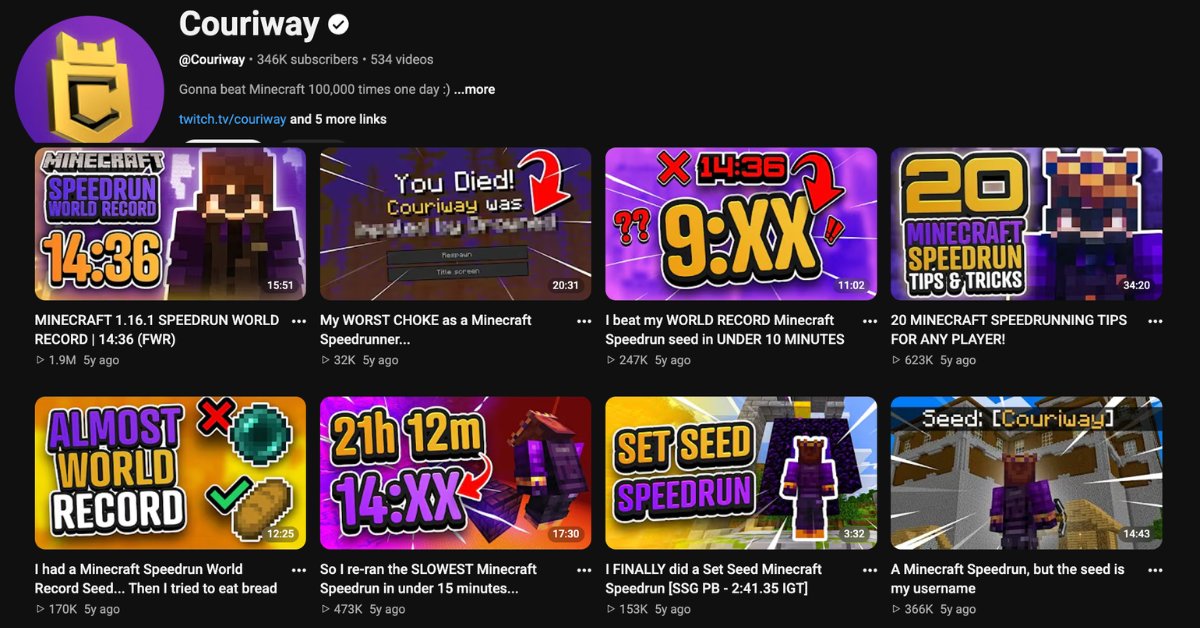
Minecraft has more monthly active players than the entire global esports viewership combined. Its audience is also the most creator-parasocial fanbase in gaming.
Evil Geniuses just signed one of its most recognizable competitive personalities, built a first-of-its-kind speedrunning circuit around him, and is centering all of their marketing on skill.
Here's the problem: Couriway already ran this experiment on himself.
His world record content got the initial spike in popularity. What built and sustained his audience was everything that came after: the personality, the narrative around the attempts... His skill was the entry point, and the person is what made people stay.
EG is investing entirely in the entry point and ignoring the retention mechanism.
Minecraft Monday failed in 2019, while Minecraft Championship thrives six years on. Not because of production quality or prize pools, but because MCC puts personality first and competition second.
The Minecraft audience doesn't know what esports is and doesn't need to. They follow people. The circuit gives Couriway something to do on camera while EG has the asset itself in the creator.
What's missing is content that lets the broader Minecraft audience attach to him (and EG) as people before fans care about the skill represented.
Lean into the person. The appreciation for the skill follows on its own.
English
Similarly, the prevailing assumption in tech's new media wave is that 'creator audience' is a meaningful consumer category, when it really isn't. An AI-consuming audience doesn't behave like a finance TikTok audience.
The parasocial dynamics and brand attachment mechanisms are categorically different across each and distribution quality doesn't change that.
Firms competing for creator economy reach are optimizing for the least predictive variable. Raw follower counts and engagement rates flatten the behavioral differences that actually determine whether an audience converts through identity signaling, utility purchasing, or parasocial trust.
The idea that owning creator distribution means owning consumer attention assumes audiences are fungible: except they aren't. The behavioral segment you're reaching matters more than how many people you're reaching.
Firms that win in new media will be the ones that understood which behavioral segment they are actually reaching before starting a single video.
Seulgi@SeulgiVLR
I've been a big advocate for this ideology and I think this is something esports is significantly lacking! For years the prevailing organizational strategy has been "what roster can we pick up to win" without accounting for the region-specific relationships and cultural dynamism. What about the purchasing dynamics of an ML ID player? If you push out a product for that market, how do you compare their behavioral habits with that of an EU CS watcher? How do parasocial dynamics between fans and players in a specific title trickle down into brand equity? These are the missing questions the scene is facing and your past posts on forcing a sports view of esports is where I see this disconnect. Fully believe we need more economic and behavioral level thinking of our audience
English
@saltzman_jason @a16z so cool! would love to learn more about how youre mixing behavioral info into your data if at all too. think i could shoot a message?
English

I've joined @a16z to build the Insights function on the New Media team.
Every company at the frontier is sitting on a goldmine of exhaust data. Data that, when interrogated, becomes the most honest record we have of how people actually decide, work, and spend.
Almost none of it makes it into the stories these companies tell about the worlds their customers operate in or the markets they're building in.
Instead, the internet is flooded with takes. Generic content has never been cheaper to crank out, and feeds are full of opinions that could've been written by anyone (or any LLM) about anything at any time. Most tech commentary is opinion in a trenchcoat.
The real signal is in the data. When you turn that data into insight, you get something much harder to fake: a vantage point that actually shows how the world works.
The companies that do this well don't just publish more content. They shape how their category is understood.
Now I get to build that function with the founders, operators, and investors closest to the signal… and make some truly banger charts along the way!
If you're sitting on data that tells a story nobody else can tell, let's build an insights engine around it.
And if you're already doing this (looking at you @PeterJ_Walker), let's trade notes. I’ll be putting together what will become the most "insightful" group chat on the internet.
More to come, straight from the data at the frontier of tech.
P.S. Stoked to join the all-star team that @eriktorenberg has assembled cc @tdoggyholhol, @david__booth, @liangsays, @katiekirsch, @humford, @Alex_Danco, and more!

English
@roaldvanbuuren Far too often than not we see teams pick up players in entirely new regions while carrying out the exact same strategy hoping that they'll win and audiences follow
In 2026 we cannot standardize this one-dimensional mindset when it has almost never worked historically
English
I've been a big advocate for this ideology and I think this is something esports is significantly lacking!
For years the prevailing organizational strategy has been "what roster can we pick up to win" without accounting for the region-specific relationships and cultural dynamism.
What about the purchasing dynamics of an ML ID player? If you push out a product for that market, how do you compare their behavioral habits with that of an EU CS watcher? How do parasocial dynamics between fans and players in a specific title trickle down into brand equity?
These are the missing questions the scene is facing and your past posts on forcing a sports view of esports is where I see this disconnect. Fully believe we need more economic and behavioral level thinking of our audience
English

Each esports title has its own audience, and we keep lumping them all together under one banner and user profile..
I’ve already covered that we don’t build products for what the audience actually wants, and that each region has a different audience. But to add to complexities: we lump esports into one thing, while each game has its own culture, its own fanbase, its own economy. A Counter-Strike fan in Europe doesn’t look like a Valorant fan in NA. A MLBB fan in SEA doesn’t necessarily behave like a Dota fan in the same country.
Yes, they’re all “esports fans.” But treating them as the same is like saying F1, NBA and WWE fans are one group. Or that horror, romcom and thriller audiences are identical. Or that RnB, classical and rock listeners are all the same. They might be the same umbrella, but completely different audiences.
Until we start building for the game-specific cultures and communities, we’ll keep selling esports short. Esports is a collection of lots of different scenes/niches. And niches are where the real value and opportunities lie.
(This is Part 3 of 3 on esports audiences. Part 1 speaks about a misidentification of the esports audience and Part 2 on the differences between geographical audiences. I have a ton more content coming related to all these topics so stay tuned :)
English
New sustainable revenue streams are always coming and teams need to adapt. Vitality just added another data point to this.
They've recently signed a strategic partnership with Fortnite org Havok that gives them something more important than players: a direct position in Fortnite's UGC economy. HavoK already generates 25% of its revenue through map creation infrastructure alone.
This follows the same logic as their SEA acquisition of Bigetron. Both moves acquire established community relationships and revenue infrastructure in markets Vitality couldn't build organic presence in quickly. Competitive teams are entry points, and what those fanbases carry come to be the actual acquisition.
Misfits has taken the UGC model the furthest; they've pivoted almost entirely into Roblox game acquisition, holding stakes in some of the most played games on the platform. They've since stopped buying teams that play games and started buying into the games themselves.
UGC is where the M&A path goes next. Creator economy revenue doesn't leave with talent, doesn't depend on competitive results, and scales with platform growth rather than one-off cash injections.
This spells out great ambitions for Vitality that the rest of the esports industry should take note of.

Seulgi@SeulgiVLR
What have these four organizations figured out that most esports teams haven't? They all fund something that don't need a scoreboard to survive. 100 Thieves has Higround. Gen.G has their Global Academy. TSM has Blitz. S8UL has a 3x award-winning content studio. Most esports teams are one bad season away from financial pressure. In contrast, these four are building revenue the roster can't walk out the door with. And these brands last for years after people leave. Organizations have two paths to get here: M&A of consumer brands, or building in-house product from scratch. But both of these options don't require fans to derive value from players. Players are the marketing funnel, not the foundation.
English
Completely agree! The concept itself has clear legs and the data seen thus far backs that up - although the packaging assumption was the specific variable I was flagging rather than the format being exhausted. And yup, testing cadence is what separates a good idea from a refined one and there are always takeaways in the gap between the two!
English

Ah thanks for the clarification. I'd argue that it's too early to assume that a concept like "100t players w/ JJK explainer" is broken. I think most social accounts fail to test concepts enough and lose out on refining a "good idea" to become a great performing post. To your point, content adheres to algorithmic variability - the way to navigate and understand performance signals is by testing multiple times, which I believe you cover extremely well in a previous post.
English
A few weeks on - 100 Thieves found the formula that made their shortform work, then they immediately broke it.
At the peak of the JJK series, they pushed a video explaining their Valorant duelist in the same format. It didn't get anywhere near peak views. No shortform has crossed 100k since.
This wasn't a creative problem as the format was identical. The failure was an assumption about who was watching.
The JJK series worked because it required zero prior knowledge to enter. Valorant abilities explained through anime terms is legible to anyone who knows either property, and anime's audience dwarfs Valorant's by orders of magnitude.
That meant the viewers didn't know who 100 Thieves were, and they didn't need to.
In contrast, the duelist video assumed familiarity with 100 Thieves, their Valorant roster, competitive esports, and why a specific player's role would be interesting. It assumed the casual audience that drove the JJK numbers had converted into esports-aware viewers.
But those viewers were never there for Valorant and were only there for the format.
What followed hurt metrics even further. More esports content, team comms, sponsor integrations: each one is legible only to an audience that already cared about the competitive team. The algorithm had learned to serve the JJK content to a casual anime-adjacent audience. The new content couldn't hold that audience and confused the distribution signal entirely.
The lesson here applies beyond 100 Thieves and goes for any company investing in short form media.
- Viral shortform audiences don't transfer to adjacent content automatically.
- The audience attaches to the specific legibility mechanism that made the original content work, and not the channel or brand producing it.
- Building on viral success requires identifying what the audience was actually rewarding and staying inside that legibility window rather than assuming the audience has moved with you into new territory.
The verdict: viral audiences immediately belong to mechanisms and not brands. Building as though the conversion already happened is how a brand loses both.

Seulgi@SeulgiVLR
100 Thieves' longform content gets less than 10,000 views in six months. Their shortform gets 200k+ in a week. Can you guess why? Their shortform accidentally solved two problems their longform never did. "VALORANT abilities explained in Jujutsu Kaisen terms" works for someone who has never watched a VCT match. Universal legibility makes it so the video is accessible before any game knowledge is required. "Guess the Rank" works because they've framed it as an easy to understand recurring series with a consistent identity. The viewer knows exactly what they're getting before clicking. Parasocial formation has a pathway. The pivot is visible in the data, as can be seen from the last two Shorts. The lesson here is structural, not creative.
English
Thanks for the support! Just as a bit of a clarification (since the post was framed for a non-endemic audience as much as an esports one) the duelist video I was referencing was the Timotino explainer rather than the Neon one; the metrics on the former were what I was mainly building the legibility argument around.
Although the metrics on the latter between platforms are quite interesting too - I wrote about something similar in regards to multi-platform discoverability a few weeks back arguing that the same video posted across TikTok, Shorts, and Reels rewards content in vastly different, intriguing ways: shortform is an uphill battle and algorithms are unrelenting with discoverability after a single pivot. Variability does admittedly make any diagnostic much more nuanced than what we see from raw metrics alone!
English
@SeulgiVLR With this said, I love your analysis and how in-depth you go into content strategy. Keep it up my guy!
English