Shailesh Goyal

3.9K posts

Shailesh Goyal banner
Shailesh Goyal

Shailesh Goyal

@ShaileshGoyal

Consulting Strategic Communications, Practising Public Relations & Reputation Management, Reads often, Writes seldom. Believer in power of love and blessings.

Ahmedabad, Gujarat, India Katılım Nisan 2009
1.7K Takip Edilen1.2K Takipçiler
Shailesh Goyal
Shailesh Goyal@ShaileshGoyal·
Healing consumer confidence through AI-powered, human-centered healthcare Restoring consumer trust starts with delivering on the brand—how healthcare organizations show up internally and externally. Those using AI well enable more effective, personal, and transparent Healthcare is deeply personal and yet, for millions of US residents, it feels distant, costly, and confusing. High costs, limited transparency, uneven coverage, and fragmented experiences have eroded confidence across generations. In the 2025 McKinsey Consumer Health Insights Survey, about one in three consumers say the healthcare industry performs below their expectations, and half feel it fails to meet society’s needs. The result: Trust, long strained, is breaking. For healthcare organizations, restoring trust requires more than operational improvement.. Instead, organizations should intentionally define their brands and fulfill their brand promises by offering experiences, products, and services that consumers genuinely need, value, and can afford. Every healthcare organization has a brand, either one it actively shapes or one that is shaped for it by consumer experience. Brand reflects how credibly the organization shows up for consumers and other stakeholders externally and how it shows up for its people internally. Neglecting brand has widened the trust gap. Organizations that invest in their brand are now using AI to help deliver value at scale, making interactions more personal, responsive, and transparent. This in turn can help close the gap between what healthcare organizations offer and what consumers actually experience. AI has the potential to enable deeper insight into consumer needs and to translate those insights into personalized experiences. Notably, our 2025 Consumer Health Insights Survey shows that consumer respondents who engage with AI-enabled healthcare tools are more satisfied with the industry compared with nonusers, underscoring AI’s potential to strengthen trust.. mckinsey.com/industries/hea…? mck.co/4rTx2SK
English
0
0
0
11
Shailesh Goyal retweetledi
Dr.Sayajirao Gaikwad
Dr.Sayajirao Gaikwad@DietDrsayajirao·
Most people are “normal”… and still metabolically unhealthy. Don’t chase “within range.” Aim for optimal markers.
Dr.Sayajirao Gaikwad tweet media
English
13
142
738
25.7K
Shailesh Goyal retweetledi
Anish Moonka
Anish Moonka@anishmoonka·
If you're an AI startup in India, renting processing power from the government to train your model costs about $0.7 per hour. The same hardware on Amazon Web Services costs $3.7. On Microsoft Azure, $6.6. The Indian government is subsidizing AI infrastructure at rates that would make most Western startups do a double-take. I read all 26 pages of the white paper this tweet links to. The numbers inside are wild. The IndiaAI Mission has a budget of about $1.2 billion over five years, approved in March 2024. Almost half of that, roughly $500 million, goes straight to building the processing power AI companies need to train their models. The original plan was to deploy 10,000 processors. By December 2025, they had 38,000 running. 3.8x what they promised. A government open call in January 2025 pulled 506 proposals. The four startups picked first were Sarvam AI, Soket AI, Gnani AI, and Gan AI. Eight more were added by September. India now has 12 separate teams building AI models, ranging from tiny ones for basic chatbots to massive ones rivaling those from the US and China. They cover language, voice, vision, medical diagnosis, material science, and even brain-computer interfaces. The one I keep coming back to is Sarvam AI. They raised $41 million from Lightspeed, Peak XV, and Khosla Ventures. In May 2025, they released a model built on top of a French AI system (Mistral Small) and customized for Indian languages. It got roasted online. Critics said it was a foreign model in Indian clothing. So they went back and built Sarvam-105B completely from scratch, using Indian hardware under the government mission. It outperformed China's DeepSeek-R1 on certain tests, even though it was a model six times larger. Both were released for anyone to download and use in March 2026. There's something else buried in the paper I haven't seen another country try at this scale. India is building a copyright system specifically for AI training data. Under a December 2025 government proposal, AI companies can train their models on any copyrighted content they can legally access, books, articles, music, anything. Creators cannot say no. But the moment an AI product makes money, royalties are collected by a centralized government body and distributed back to creators. Singapore allows AI companies to use content without payment. China requires strict consent before training. India is trying a middle path, and publishers are already calling it forced participation. Stanford's AI Vibrancy Index, which measures a country's overall AI strength across research, talent, infrastructure, and investment, ranked India third globally in 2025. Up from seventh in 2023. But the actual scores tell you how far the gap still is: US at 79, China at 37, India at 22. And India's $1.2 billion budget sits next to China's $47.5 billion semiconductor fund and Saudi Arabia's $100 billion Project Transcendence. India is currently spending 40x less than the frontrunners. This white paper is the most detailed public bet yet that smart infrastructure design can close that gap.
Office of Principal Scientific Adviser to the GoI@PrinSciAdvOff

𝐀𝐬 𝐩𝐚𝐫𝐭 𝐨𝐟 𝐭𝐡𝐞 𝐨𝐧-𝐠𝐨𝐢𝐧𝐠 𝐀𝐈 𝐏𝐨𝐥𝐢𝐜𝐲 𝐖𝐡𝐢𝐭𝐞 𝐏𝐚𝐩𝐞𝐫 𝐒𝐞𝐫𝐢𝐞𝐬, 𝐭𝐡𝐞 𝐎𝐟𝐟𝐢𝐜𝐞 𝐨𝐟 𝐭𝐡𝐞 𝐏𝐫𝐢𝐧𝐜𝐢𝐩𝐚𝐥 𝐒𝐜𝐢𝐞𝐧𝐭𝐢𝐟𝐢𝐜 𝐀𝐝𝐯𝐢𝐬𝐞𝐫 𝐭𝐨 𝐭𝐡𝐞 𝐆𝐨𝐯𝐞𝐫𝐧𝐦𝐞𝐧𝐭 𝐨𝐟 𝐈𝐧𝐝𝐢𝐚 𝐫𝐞𝐥𝐞𝐚𝐬𝐞𝐬 𝐚 𝐰𝐡𝐢𝐭𝐞 𝐩𝐚𝐩𝐞𝐫 𝐨𝐧 “𝐀𝐝𝐯𝐚𝐧𝐜𝐢𝐧𝐠 𝐈𝐧𝐝𝐢𝐠𝐞𝐧𝐨𝐮𝐬 𝐅𝐨𝐮𝐧𝐝𝐚𝐭𝐢𝐨𝐧 𝐌𝐨𝐝𝐞𝐥𝐬. The versatility of Foundation Models makes them a critical layer of today’s AI ecosystem and a key area for innovation in India. Therefore, developing indigenous foundation models is a strategic priority. India’s objective is to harness foundation models for inclusive growth and public good, while ensuring they are governed in a manner consistent with the country’s values, legal framework, and security interests. This white paper provides an understanding of India’s approach to advancing indigenous foundation models through public–private collaboration and to governing these systems that support trust, accountability, and responsible adoption. The White Paper also provides details on India’s approach - which is centred on building indigenous capability across the foundation-model stack. Rather than relying on a single model, India is developing an ecosystem that combines (i) shared compute access, (ii) India-centric data and model repositories, and (iii) multiple model-building efforts across text, speech, multimodal, and sectoral systems. Read the White Paper here: psa.gov.in/CMS/web/sites/…

English
61
614
3.2K
291.4K
Shailesh Goyal retweetledi
Ahmedabad Management Association
Ahmedabad Management Association@ama_ahmedabad·
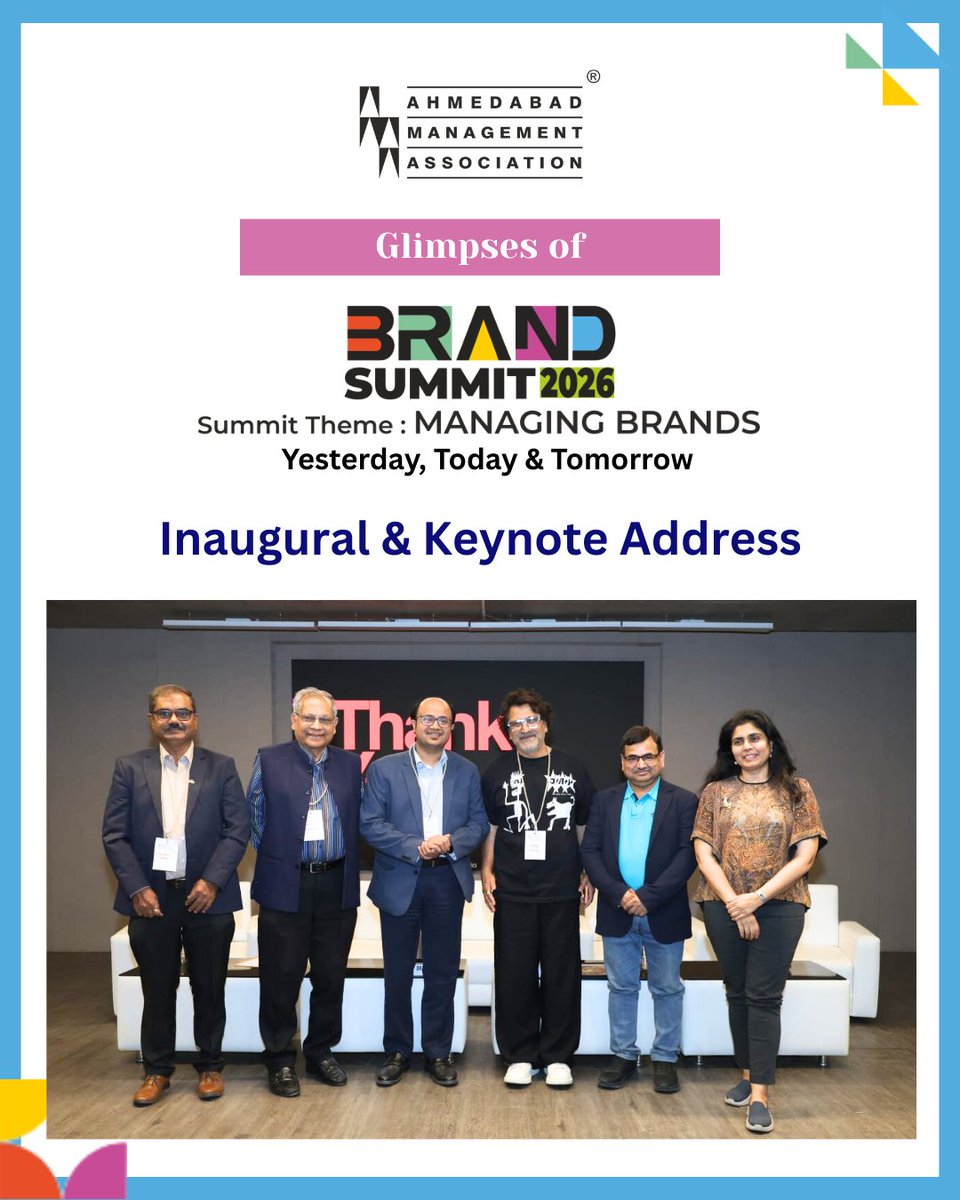
Brand Summit 2026 commenced with an insightful inaugural address by Mr. Unmesh Dixit, Executive Director, AMA, setting the tone for conversations on brand legacy, leadership, innovation, and the evolving business landscape. The session was chaired by Dr. Jainil Shah, Member, AMA, Executive Committee, guiding the dialogue. The summit further featured a compelling keynote by Mr. Sonal Dabral—Award-Winning Creative Consultant, Screenwriter, and Film Director—who explored the power of creativity, storytelling, and brand purpose in building brands that create lasting impact. #amaindia #brandsummit2026 #brandmanagement #brandbuilding #inauguraladdress #keynoteaddress
Ahmedabad Management Association tweet mediaAhmedabad Management Association tweet mediaAhmedabad Management Association tweet media
English
1
1
2
56
Ramesh Balasubramanian
Ramesh Balasubramanian@Ramesh_Bala·
We didn’t run out of laws—we ran out of will. Writing new rules won’t fix failure to enforce the old ones.
Ramesh Balasubramanian tweet media
English
1
0
0
22
Shailesh Goyal retweetledi
Wisdom Stoics
Wisdom Stoics@WisdomStoics·
Cheat codes I know at 42 , I wish I knew at 22: 1.
Wisdom Stoics tweet media
English
12
193
1.5K
91.4K
Shailesh Goyal
Shailesh Goyal@ShaileshGoyal·
It was an informative session with good takeaways for new avenues... Was happy to be part of it
Indo-American Chamber of Commerce@iaccindia

IACC Gujarat | 32nd Networking Tuesday The Indo-American Chamber of Commerce (IACC), Gujarat Branch successfully hosted the 32nd Networking Tuesday on January 20, 2026, at GVFL Limited, Ahmedabad. Session Topic: “From Cost Centers to Control Towers: How GCCs Are Redefining Global Business Operations” Guest Speaker: Mr. Tapan Pathak, Chief Revenue and Operations Officer, SPEC INDIA Mr. Tapan Pathak delivered an insightful and impactful session on the strategic evolution of Global Capability Centers (GCCs) from traditional support functions to pivotal hubs of global business operations. He highlighted how GCCs are increasingly driving operational excellence, process standardization, and strategic decision-making, enabling organizations to manage complex global workflows more effectively. Drawing from real-world experiences, Mr. Pathak discussed how GCCs now handle end-to-end business processes, centralize key functions, and act as control towers that provide visibility, consistency, and quality across regions and functions. His session underscored how modern GCCs contribute significantly to global efficiency, talent optimization, and scalable operations moving beyond cost efficiency to become integral parts of corporate strategy and value delivery. Key Takeaway: The transition of GCCs into strategic enablers helps organizations achieve greater operational agility, standardization of processes, and enhanced global collaboration. IACC Gujarat remains committed to creating knowledge-driven platforms that help members Engage • Enable • Empower, while strengthening Indo–U.S. collaboration in business excellence and global operations. #NetworkingTuesday #EngageEnableEmpower #IACC #IACCGujarat #BusinessNetworking #ProfessionalGrowth #IndustryInsights #LeadershipTalks #KnowledgeSharing #BusinessCollaboration #GlobalCapabilityCenters #GCCStrategy #BusinessTransformation #ControlTowerModel #RevenueLeadership #OperationsExcellence #DigitalBusiness #FutureOfWork #CorporateLeadership #AhmedabadEvents #GujaratBusiness #CXOInsights #BusinessCommunity #LearningAndNetworking @GvflLimited @SwarnimTouch @specindia

English
0
0
2
26
Prof.(Dr.)Shirish Kashikar 🇮🇳
વાસ્તવમાં જે મુદ્દે વિવાદ ઉભો કરાયો એ મુદ્દો માત્ર આ સરકારી એપ માટે નહીં પણ બધી જ ખાનગી કંપનીઓની એપને પણ લાગુ પડે.ફોન ખરીદીએ ત્યારે એમાં ઘણી પ્રિ ઇન્સ્ટોલ્ડ એપ હોય છે ત્યારે આપણે પૂછતા નથી કે આ સુરક્ષિત છે કે નહીં,તો પછી આમાં પ્રશ્નો શું કામ? સરકારી છે એટલે?
Prof.(Dr.)Shirish Kashikar 🇮🇳 tweet mediaProf.(Dr.)Shirish Kashikar 🇮🇳 tweet media
GU
1
1
12
166
Shailesh Goyal
Shailesh Goyal@ShaileshGoyal·
Good storytelling will have lasting impact: in building Trust, Advocacy and reputation.. Always keep audience centric approach, build trust and drive advocacy through engaging storytelling, shared Insights by Bella Ling-Nair, Senior Director, Communications & Patient Advocacy, JAPAC (Japan, Greater China & APAC), Edwards Life sciences, in her session on 'Insights to Impact: Stories Only Matter if They Matter to Someone' @PRAXISInd @RepTodayMag @bellaling
English
2
0
0
41