Shashank

994 posts

Shashank banner
Shashank

Shashank

@ShashankShet

Backend Developer | Building AI-Powered Systems | Sharing Projects, Tips & Tools Daily 🚀

Remote Katılım Ağustos 2016
372 Takip Edilen256 Takipçiler
Shashank retweetledi
Vaishnavi
Vaishnavi@_vmlops·
DSA becomes much easier when you learn from the right resources These underrated GitHub repos can genuinely level up your skills 1. Tushar Roy’s Algorithms github.com/mission-peace/…⁠ 2. Coding Interview University github.com/jwasham/coding…⁠ 3. Ashishgup1 Competitive Coding github.com/ashishgup1/Com…⁠ 4. The Algorithms github.com/TheAlgorithms⁠ 5. LeetCode Patterns github.com/seanprashad/le…⁠ 6. Tech Interview Handbook github.com/yangshun/tech-…⁠ 7. JavaScript Algorithms github.com/trekhleb/javas…
Vaishnavi tweet media
English
0
41
287
12.1K
Shashank
Shashank@ShashankShet·
Letting go of your first car hurts deeper than any breakup.
English
0
0
0
12
Shashank retweetledi
Daily Dose of Data Science
Daily Dose of Data Science@DailyDoseOfDS_·
Connect any LLM to any MCP server! MCP-Use is the open source way to connect any LLM to any MCP server and build custom agents that have tool access, without using closed source or application clients. Build 100% local MCP clients.
Daily Dose of Data Science tweet media
English
7
84
369
16.8K
Shashank retweetledi
Krishna Agrawal
Krishna Agrawal@Krishnasagrawal·
🔥 Struggling with DSA? You didn’t fail, you just learned it the wrong way. That’s why I’ve created a 𝗖𝗼𝗺𝗽𝗹𝗲𝘁𝗲 𝗗𝗦𝗔 𝗖𝗵𝗲𝗮𝘁𝘀𝗵𝗲𝗲𝘁 a clean, structured guide to build real problem-solving skills step by step. 📘What’s Inside? – Core Data Structures (Arrays, Strings, Linked Lists, Stacks, Queues) – Key Algorithms (Sorting, Searching, Recursion, Backtracking) – Advanced Topics (Trees, Graphs, Dynamic Programming) – Time & Space Complexity – Interview Patterns (Sliding Window, Two Pointers, Greedy, Divide & Conquer) 🎁 FREE for the first 500 people! 1️⃣ Like & Repost 2️⃣ Comment “𝗗𝗦𝗔” 3️⃣ Follow (so I can DM it to you) #DSA #CodingInterviews #LeetCode #SoftwareEngineering #Algorithms #Programming #TechCareers #CareerGrowth
Krishna Agrawal tweet mediaKrishna Agrawal tweet media
English
363
225
897
79K
Shashank retweetledi
Femke Plantinga
Femke Plantinga@femke_plantinga·
Your RAG system is failing? It's not your vector database - it's how you're chunking your data. Everyone focuses on picking the perfect vector database or embedding model. But here's what actually makes or breaks your RAG system: how you prepare your data before it ever gets embedded. The fundamental challenge with chunking is this: your chunks need to be small enough for precise vector search, but complete enough to give your LLM the context it needs to generate accurate responses. Get this wrong, and even the best retrieval system will fail. 𝗖𝗵𝘂𝗻𝗸𝗶𝗻𝗴 𝘀𝘁𝗿𝗮𝘁𝗲𝗴𝗶𝗲𝘀 (𝗳𝗿𝗼𝗺 𝘀𝗶𝗺𝗽𝗹𝗲 𝘁𝗼 𝗮𝗱𝘃𝗮𝗻𝗰𝗲𝗱 ): 𝗙𝗶𝘅𝗲𝗱-𝗦𝗶𝘇𝗲 – Split by token count (~512). Fast and simple, but cuts mid-sentence. 𝗥𝗲𝗰𝘂𝗿𝘀𝗶𝘃𝗲 – Splits by structure (paragraphs → sentences). Best for articles. 𝗗𝗼𝗰𝘂𝗺𝗲𝗻𝘁-𝗕𝗮𝘀𝗲𝗱 – Uses inherent structure (headers, HTML tags). Perfect for structured content. 𝗦𝗲𝗺𝗮𝗻𝘁𝗶𝗰 – Detects topic changes via embeddings. Variable-length chunks, one idea each. 𝗟𝗟𝗠-𝗕𝗮𝘀𝗲𝗱 – Uses AI to identify propositions. High quality, high cost. 𝗔𝗴𝗲𝗻𝘁𝗶𝗰 – AI agent decides which strategy to use per document. Custom but expensive. 𝗟𝗮𝘁𝗲 𝗖𝗵𝘂𝗻𝗸𝗶𝗻𝗴 – Embeds full document first, then derives chunks. Retains full document context. 𝗛𝗶𝗲𝗿𝗮𝗿𝗰𝗵𝗶𝗰𝗮𝗹 – Multiple layers at different detail levels. Start broad, drill down when needed. 𝗔𝗱𝗮𝗽𝘁𝗶𝘃𝗲 – Dynamic chunk sizes based on content density. Small for complex sections, larger for simple ones. 𝗕𝘂𝘁 𝗵𝗲𝗿𝗲'𝘀 𝘄𝗵𝗮𝘁 𝗺𝗼𝘀𝘁 𝗽𝗲𝗼𝗽𝗹𝗲 𝗺𝗶𝘀𝘀: Chunking isn't a standalone problem. It's one piece of 𝗖𝗼𝗻𝘁𝗲𝘅𝘁 𝗘𝗻𝗴𝗶𝗻𝗲𝗲𝗿𝗶𝗻𝗴 – the architecture that determines what information your LLM sees and when. You also need query augmentation, agents, memory, and tools working together. You can't optimize chunking in isolation. We just released a guide covering all of this, including decision trees to help you pick the right chunking strategy for your use case. Get your free copy here → weaviate.io/blog/context-e…
Femke Plantinga tweet media
English
23
133
770
38.5K
Shashank
Shashank@ShashankShet·
Spend minutes coding, waste hours in meetings
English
0
0
0
8
Shashank retweetledi
Shubham Saboo
Shubham Saboo@Saboo_Shubham_·
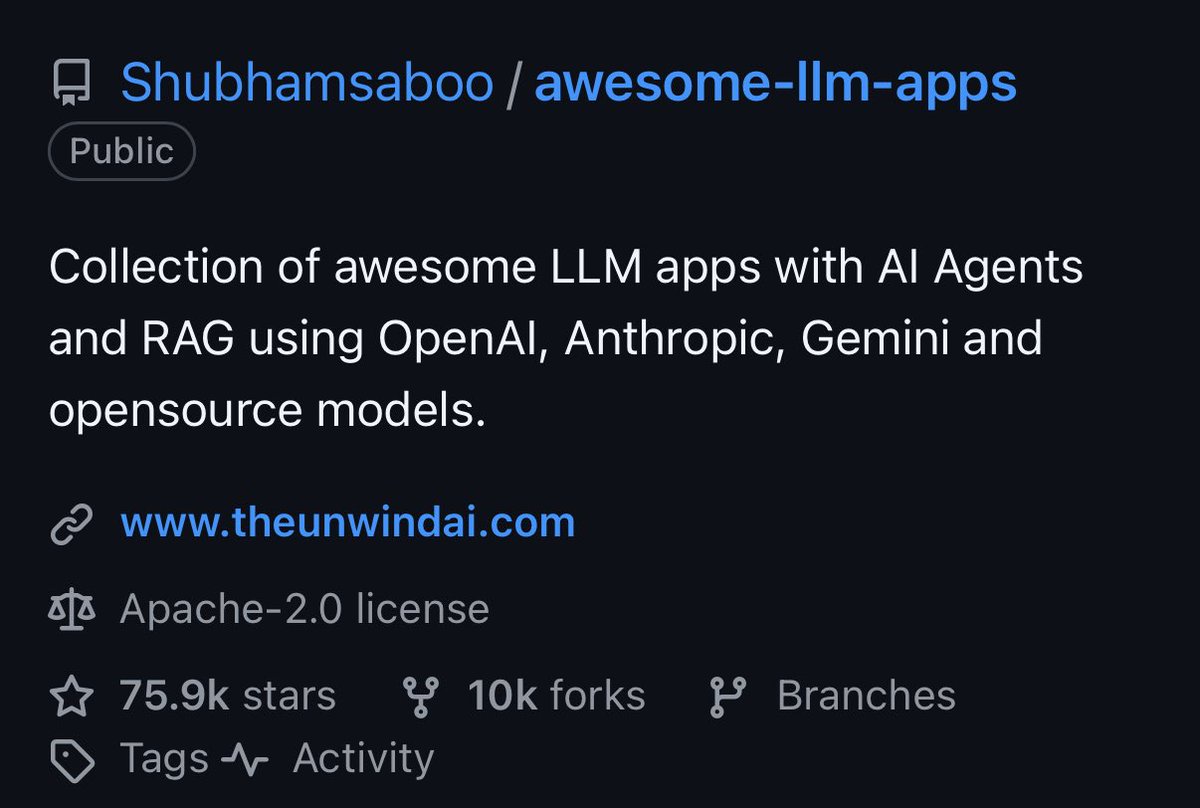
10k+ GitHub forks and 75k+ stars Open Source AI Agents and RAG apps.
Shubham Saboo tweet media
English
9
9
99
9.5K
Shashank retweetledi
Avi Chawla
Avi Chawla@_avichawla·
First Principles Approach to MLOps! MadeWithML is the best place to learn how to combine AI/ML with software engineering to build production-grade solutions. These fundamentals are directly applicable to LLMOps as well. 100% free and open-source.
Avi Chawla tweet media
English
23
137
865
47.2K
Shashank retweetledi
Akshay 🚀
Akshay 🚀@akshay_pachaar·
Microsoft did it again! Building with AI agents almost never works on the first try. You spend days tweaking prompts, adding examples, hoping it gets better. Nothing systematic, just guesswork. This is exactly what Microsoft's Agent Lightning solves. It's an open-source framework that trains ANY AI agent with reinforcement learning. Works with LangChain, AutoGen, CrewAI, OpenAI SDK, or plain Python. Here's how it works: > Your agent runs normally with whatever framework you're using. Just add a lightweight agl.emit() helper or let the tracer auto-collect everything. > Agent Lightning captures every prompt, tool call, and reward. Stores them as structured events. > You pick an algorithm (RL, prompt optimization, fine-tuning). It reads the events, learns patterns, and generates improved prompts or policy weights. > The Trainer pushes updates back to your agent. Your agent gets better without you rewriting anything. The best part: you can also optimize individual agents in a multi-agent system. I have shared the link to the GitHub repo in the replies! Let me know if I should cover this in a video demo!
Akshay 🚀 tweet media
English
59
370
2.5K
200.1K
Shashank retweetledi
Abhishek Nair
Abhishek Nair@abhisheknaironx·
met a guy online who has almost cracked the game of life: - makes 10-12k/mo - both parents alive and together - jacked af - relatives love him - beautiful gf - A LOOOTTT of friends and connections not my goal, but his achievements does push me to do better 😌
English
96
49
2.3K
144.2K
Shashank retweetledi
Makakmayum
Makakmayum@makakmayum_sid·
As a software engineer, learn below to master System Design and build scalable, reliable systems: →Fundamentals a. System components (clients, servers, databases, caches) b. High-level vs. low-level design c. CAP Theorem d. Consistency models (eventual, strong, causal) e. ACID vs. BASE properties f. Trade-offs in design (scalability, availability, cost) →Scalability a. Horizontal vs. vertical scaling b. Load balancing algorithms c. Sharding techniques d. Partitioning strategies e. Auto-scaling and elasticity f. Data replication (master-slave, multi-master) →Reliability & Fault Tolerance a. Redundancy and failover b. Circuit breakers c. Retry and backoff mechanisms d. Chaos engineering e. Graceful degradation f. Backup and disaster recovery →Performance Optimization a. Caching layers (CDN, in-memory like Redis) b. Indexing and query optimization c. Rate limiting and throttling d. Asynchronous processing e. Compression and data serialization f. Profiling tools and bottlenecks analysis →Data Management a. Database selection (SQL vs. NoSQL, key-value, graph) b. Data modeling and schema design c. Transactions and isolation levels d. Data migration strategies e. Big data tools (Hadoop, Spark) f. ETL processes →Networking & Communication a. API gateways and service discovery b. RPC vs. REST vs. GraphQL vs. gRPC c. Message queues (Kafka, RabbitMQ) d. Proxies and reverse proxies e. DNS and CDN integration f. Latency and bandwidth considerations →Security in Design a. Authentication and authorization flows b. Encryption at rest/transit c. Threat modeling d. Access controls and RBAC e. Compliance (GDPR, HIPAA) f. Vulnerability scanning →Architectural Patterns a. Monolithic vs. microservices b. Event-driven architecture c. Serverless and FaaS d. Domain-driven design (DDD) e. CQRS and event sourcing f. Hexagonal architecture →Observability & Maintenance a. Monitoring and metrics (Prometheus, Grafana) b. Logging and distributed tracing (ELK stack, Jaeger) c. Alerting and on-call processes d. SLAs, SLOs, and error budgets e. Versioning and backward compatibility f. A/B testing and feature flags →Case Studies & Best Practices a. Designing URL shorteners b. Social media feeds or notification systems c. E-commerce checkout flows d. Ride-sharing platforms e. Real-time chat applications f. Lessons from outages (e.g., AWS, Google incidents) These will help you architect outstanding systems that scale globally, handle failures gracefully, and deliver high performance under load.
English
4
84
842
41.5K
Shashank retweetledi
Robert Youssef
Robert Youssef@rryssf_·
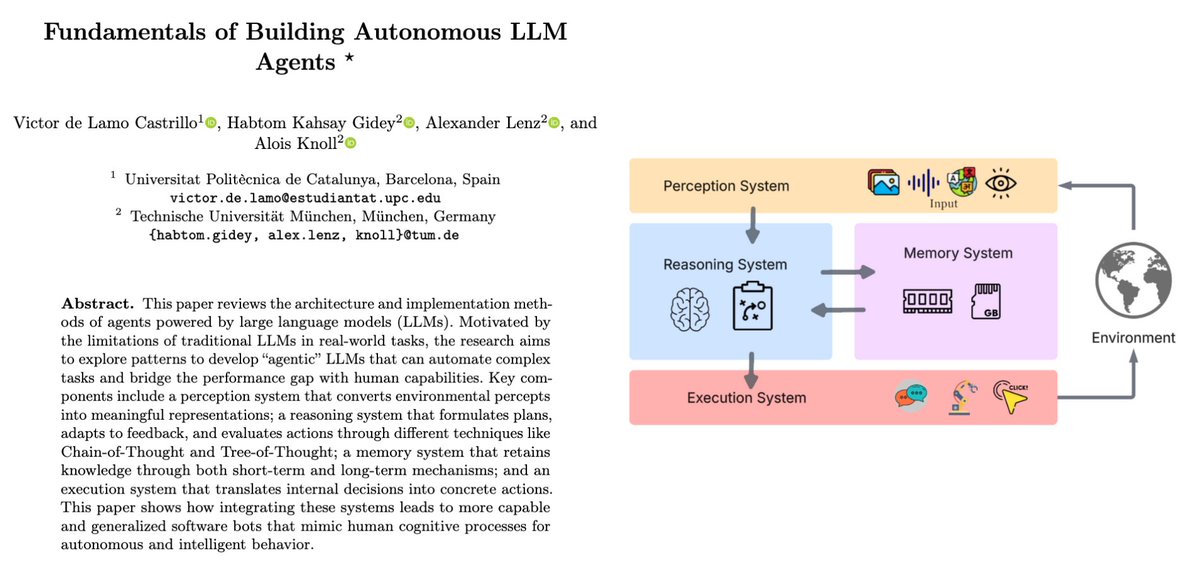
🤖 I finally understand the fundamentals of building real AI agents. This new paper “Fundamentals of Building Autonomous LLM Agents” breaks it down so clearly it feels like a blueprint for digital minds. Turns out, true autonomy isn’t about bigger models. It’s about giving an LLM the 4 pillars of cognition: • Perception: Seeing and understanding its environment. • Reasoning: Planning, reflecting, and adapting. • Memory: Remembering wins, failures, and context over time. • Action: Executing real tasks through APIs, tools, and GUIs. Once you connect these systems, an agent stops being reactive it starts thinking. Full thread 🧵 Paper: arxiv. org/abs/2510.09244
Robert Youssef tweet media
English
41
215
1.2K
109.9K
Shashank retweetledi
Neo Kim
Neo Kim@systemdesignone·
System Design Playbook: Giveaway Alert!! • System design fundamentals. • Condensed notes to read before the system design interview. • Must know concepts from real-world software engineering case studies. (24 hours only!) To get it: 1. Like, Retweet & Follow @systemdesignone 2. Reply "Playbook" Then I'll DM you the details.
Neo Kim tweet media
English
778
600
1.6K
183.8K
Shashank retweetledi
Akshay 🚀
Akshay 🚀@akshay_pachaar·
Finally! A Text-to-SQL tool that actually works! Vanna is an open-source RAG framework for complex Text-to-SQL generation. It manages dynamic data and allows custom RAG model training for greater accuracy. 100% open-source.
English
18
159
1K
83.6K
Shashank retweetledi
Raj Shamani
Raj Shamani@rajshamani·
The brain can hold 4-7 items in working memory at once. That's why obsession over one goal works and chasing ten goals fails.
English
44
68
920
16.2K
Shashank retweetledi
Dhanian 🗯️
Dhanian 🗯️@e_opore·
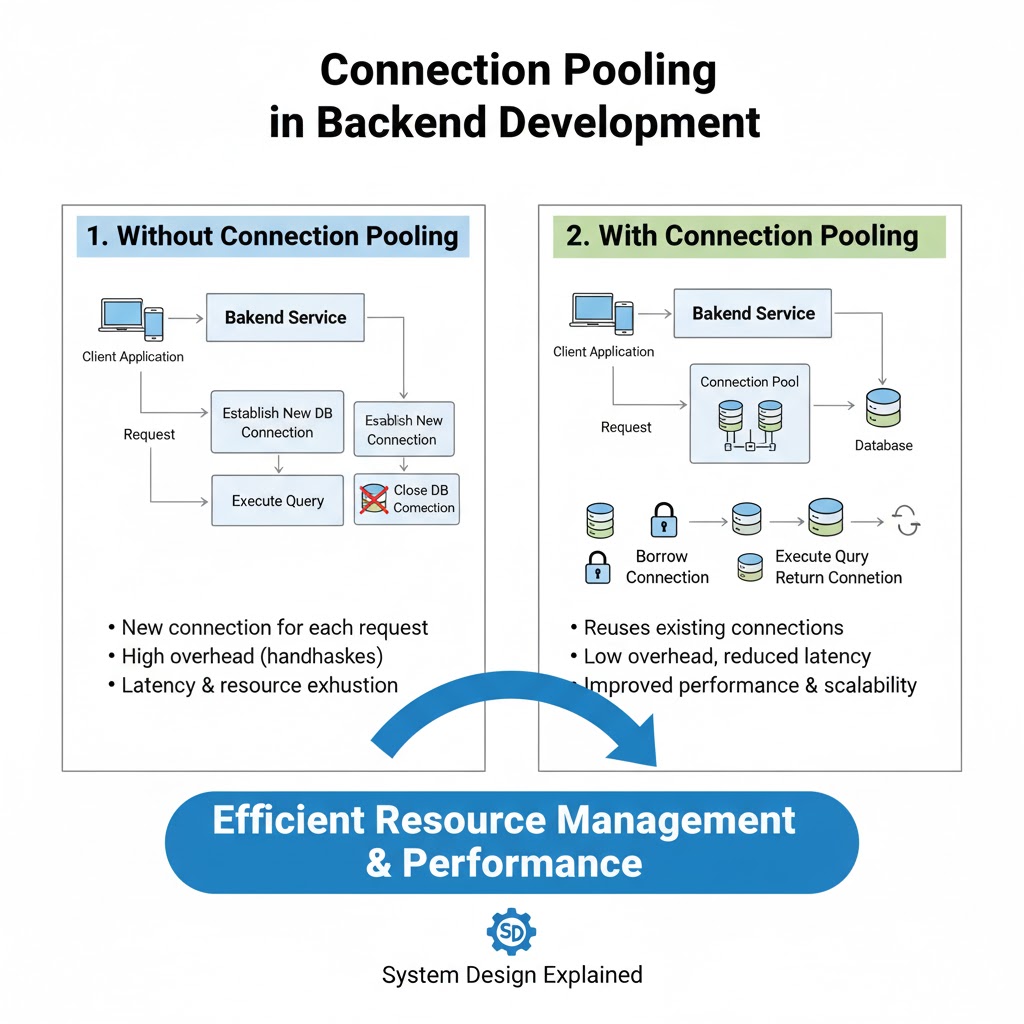
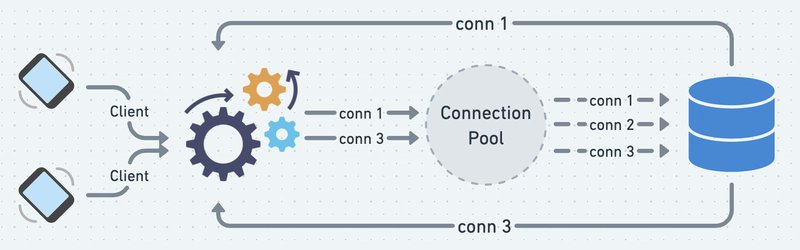
Connection Pooling in Backend Development Introduction → Connection pooling is the technique of reusing database connections instead of creating a new one for every client request. → It improves performance, reduces latency, and optimizes resource utilization in backend systems. → Commonly used in applications that handle multiple concurrent database queries. How Connection Pooling Works → When an application starts, it creates a pool (collection) of database connections. → Each incoming request borrows a connection from the pool, performs the query, and returns it when done. → Idle connections are reused for future requests, avoiding the cost of opening and closing new ones. Why Connection Pooling is Important → Database connections are expensive to create and destroy frequently. → Without pooling, high traffic could overwhelm the database with connection requests. → Connection pooling ensures stability and efficiency during peak loads. Benefits of Connection Pooling → Improved Performance → Reduces time spent establishing new connections. → Resource Optimization → Limits the number of active connections. → Scalability → Handles multiple concurrent requests efficiently. → Reliability → Prevents database overload and connection exhaustion. Key Parameters in Connection Pooling → Max Connections → Defines how many connections the pool can hold at once. → Idle Timeout → Time after which idle connections are closed. → Connection Lifetime → Maximum lifespan of a connection before it’s recreated. → Retry Policy → Determines how failed connections are retried or replaced. Common Tools & Libraries → Node.js → pg-pool for PostgreSQL, mysql2 pool for MySQL. → Java → HikariCP and Apache DBCP for JDBC connection management. → Python → SQLAlchemy connection pooling and psycopg2 pool support. → .NET → Built-in ADO.NET connection pooling. Best Practices → Configure pool size based on expected workload and database capacity. → Monitor connection usage and performance metrics regularly. → Close unused connections gracefully to prevent leaks. → Combine pooling with retry logic for resilience. → Avoid long-running queries that keep connections occupied. Analogy → Think of a restaurant with limited tables (connections). → Customers (requests) are served when a table is available, and when they leave, the table is reused. → Without pooling, each customer would require a new table setup every time ,inefficient and slow. 👉 Grab the Backend Development with Projects Ebook here: codewithdhanian.gumroad.com/l/juuzy
Dhanian 🗯️ tweet mediaDhanian 🗯️ tweet media
English
3
61
462
26.2K
Shashank retweetledi
Akshay 🚀
Akshay 🚀@akshay_pachaar·
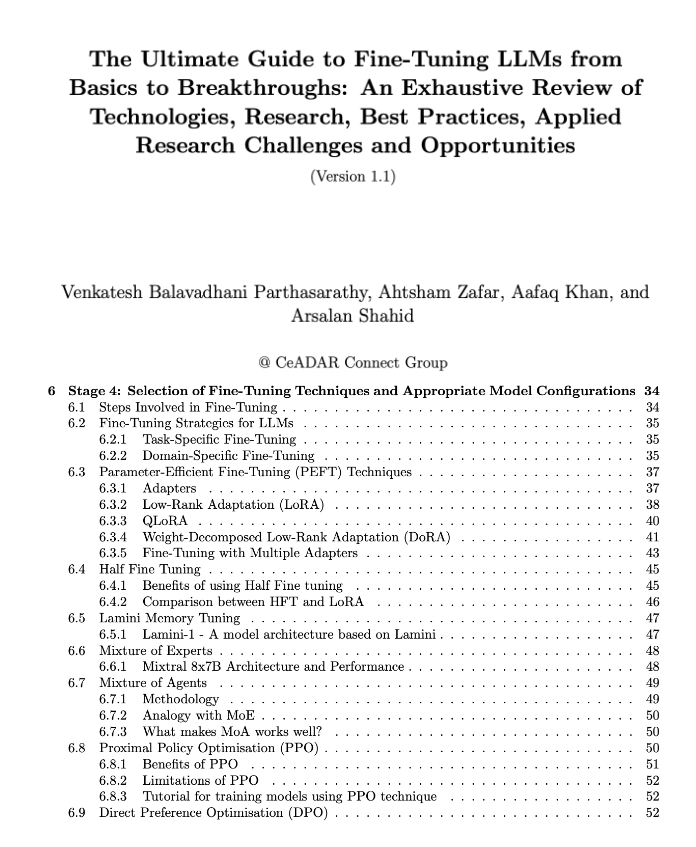
if you're looking for a comprehensive guide to LLM finetuning, check this! a free 115-page book on arxiv, covering: > fundamentals of LLM > peft (lora, qlora, dora, hft) > alignment methods (ppo, dpo, grpo) > mixture of experts (MoE) > 7-stage fine-tuning pipeline > multimodal finetuning & challenges > industrial frameworks (hf, sagemaker, openai) everything you need to know in one place! download link in the replies!
Akshay 🚀 tweet media
English
37
197
928
56K
Shashank retweetledi
Avi Chawla
Avi Chawla@_avichawla·
Finally, someone fixed LLM hallucinations! Parlant lets you build Agents that do not hallucinate and actually follow instructions. One of the things that makes this possible is the new reasoning approach that the open-source Parlant framework uses. Detailed explainer below:
Avi Chawla tweet media
Avi Chawla@_avichawla

Finally, researchers have open-sourced a new reasoning approach that actually prevents hallucinations in LLMs. It beats popular techniques like Chain-of-Thought and has a SOTA success rate of 90.2%. Here's the core problem with current techniques that this new approach solves: We have enough research to conclude that LLMs often struggle to assess what truly matters in a particular stage of a long, multi-turn conversation. For instance, when you give Agents a 2,000-word system prompt filled with policies, tone rules, and behavioral dos and don’ts, you expect them to follow it word by word. But here’s what actually happens: - They start strong initially. - Soon, they drift and start hallucinating. - Shortly after, they forget what was said five turns ago. - And finally, the LLM that was supposed to “never promise a refund” is happily offering one. This means they can easily ignore crucial rules (stated initially) halfway through the process. We expect techniques like Chain-of-Thought will help. But even with methods like CoT, reasoning remains free-form, i.e., the model “thinks aloud” but it has limited domain-specific control. That’s the exact problem the new technique, called Attentive Reasoning Queries (ARQs), solves. Instead of letting LLMs reason freely, ARQs guide them through explicit, domain-specific questions. Essentially, each reasoning step is encoded as a targeted query inside a JSON schema. For example, before making a recommendation or deciding on a tool call, the LLM is prompted to fill structured keys like: ``` { "current_context": "Customer asking about refund eligibility", "active_guideline": "Always verify order before issuing refund", "action_taken_before": false, "requires_tool": true, "next_step": "Run check_order_status()" } ``` This type of query does two things: 1) Reinstate critical instructions by keeping the LLM aligned mid-conversation. 2) Facilitate intermediate reasoning, so that the decisions are auditable and verifiable. By the time the LLM generates the final response, it’s already walked through a sequence of *controlled* reasoning steps, which did not involve any free text exploration (unlike techniques like CoT or ToT). Here's the success rate across 87 test scenarios: - ARQ → 90.2% - CoT reasoning → 86.1% - Direct response generation → 81.5% This approach is actually implemented in Parlant, a recently trending open-source framework (14k stars). ARQs are integrated into three key modules: - Guideline proposer to decide which behavioral rules apply. - Tool caller to determine what external functions to use. - Message generator, when it produces the final customer-facing reply. You can see the full implementation and try it yourself. But the core insight applies regardless of what tools you use: When you make reasoning explicit, measurable, and domain-aware, LLMs stop improvising and start reasoning with intention. Free-form thinking sounds powerful, but in high-stakes or multi-turn scenarios, structure always wins. I’ve shared the repo link in the replies.

English
17
88
501
56.8K
Shashank retweetledi
Akshay 🚀
Akshay 🚀@akshay_pachaar·
uv is the best thing that has happened to Python devs! And you won't find a better cheatsheet than this:
Akshay 🚀 tweet media
English
25
150
1.2K
101.5K
Shashank retweetledi
Akshay 🚀
Akshay 🚀@akshay_pachaar·
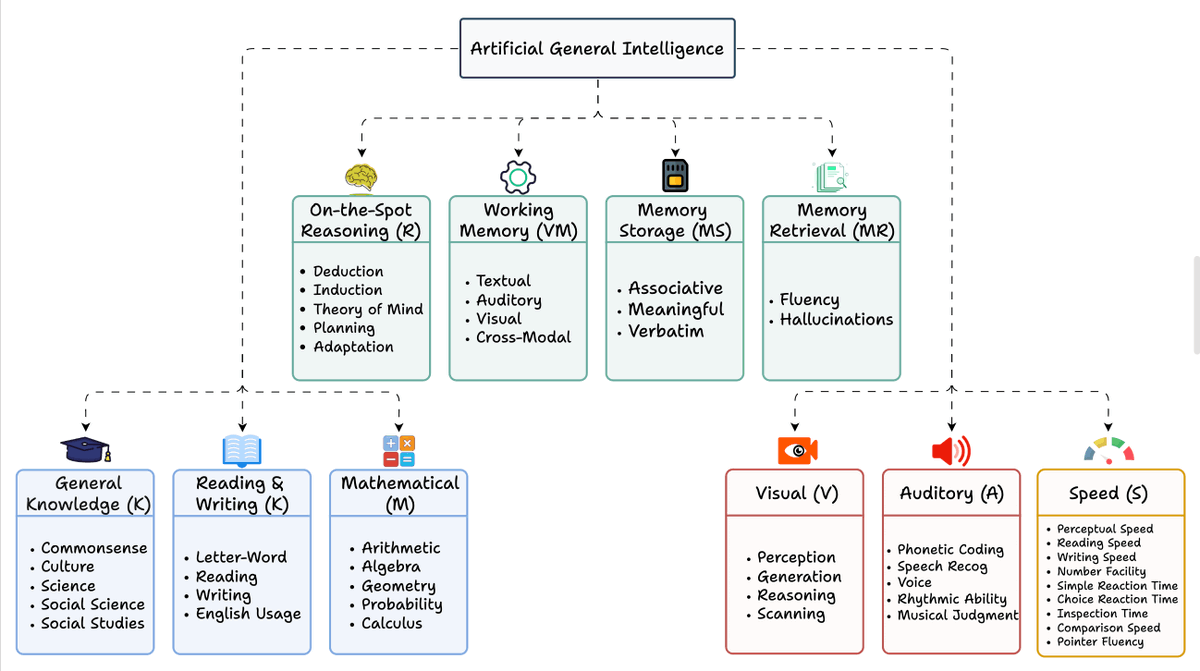
Finally, we have a definition for AGI! A recent paper breaks down what it actually means to reach human-level AI, and the results are surprising. Here's what matters: AGI isn't about passing a single test or excelling at one task. It's about matching the cognitive versatility and skill of a well-educated adult across 10 fundamental areas. The paper breaks down human intelligence into 10 cognitive domains to create an AGI Score (0-100%). Each domain gets equal weight: - General Knowledge - Reading & Writing - Mathematical Ability - On-the-Spot Reasoning - Working Memory - Long-Term Memory Storage - Long-Term Memory Retrieval - Visual Processing - Auditory Processing - Processing Speed So, where do we stand today❓ GPT-4 scored 27%. GPT-5 jumped to 58%. That's massive progress, but here's the catch: Current AI has a jagged cognitive profile. It dominates knowledge-rich domains but crashes on core cognitive machinery. GPT-5 still scores 0% on long-term memory storage. We use large context windows and RAG systems as workarounds, not solutions. The real bottlenecks: Long-term memory remains unsolved, causing amnesia every interaction. Memory retrieval is unreliable. Visual and auditory reasoning are incomplete. Even at 58%, GPT-5 is only halfway there. Reaching AGI isn't about scaling current architectures. We need to solve fundamental bottlenecks in memory, reasoning, and integration. Find the link to the paper in replies!
Akshay 🚀 tweet media
English
24
60
321
30.5K