
Shayan Talabany

870 posts

Shayan Talabany banner
Shayan Talabany

Shayan Talabany

@ShayanTalabany

Senior Analyst @InstituteGC focused on Middle East | Faculty @uk_aspen | Alum @SOAS & @LSEIRDept

Katılım Ekim 2011
3.4K Takip Edilen2.3K Takipçiler
Shayan Talabany retweetledi

MBN English
MBN English@MBNEnglish·
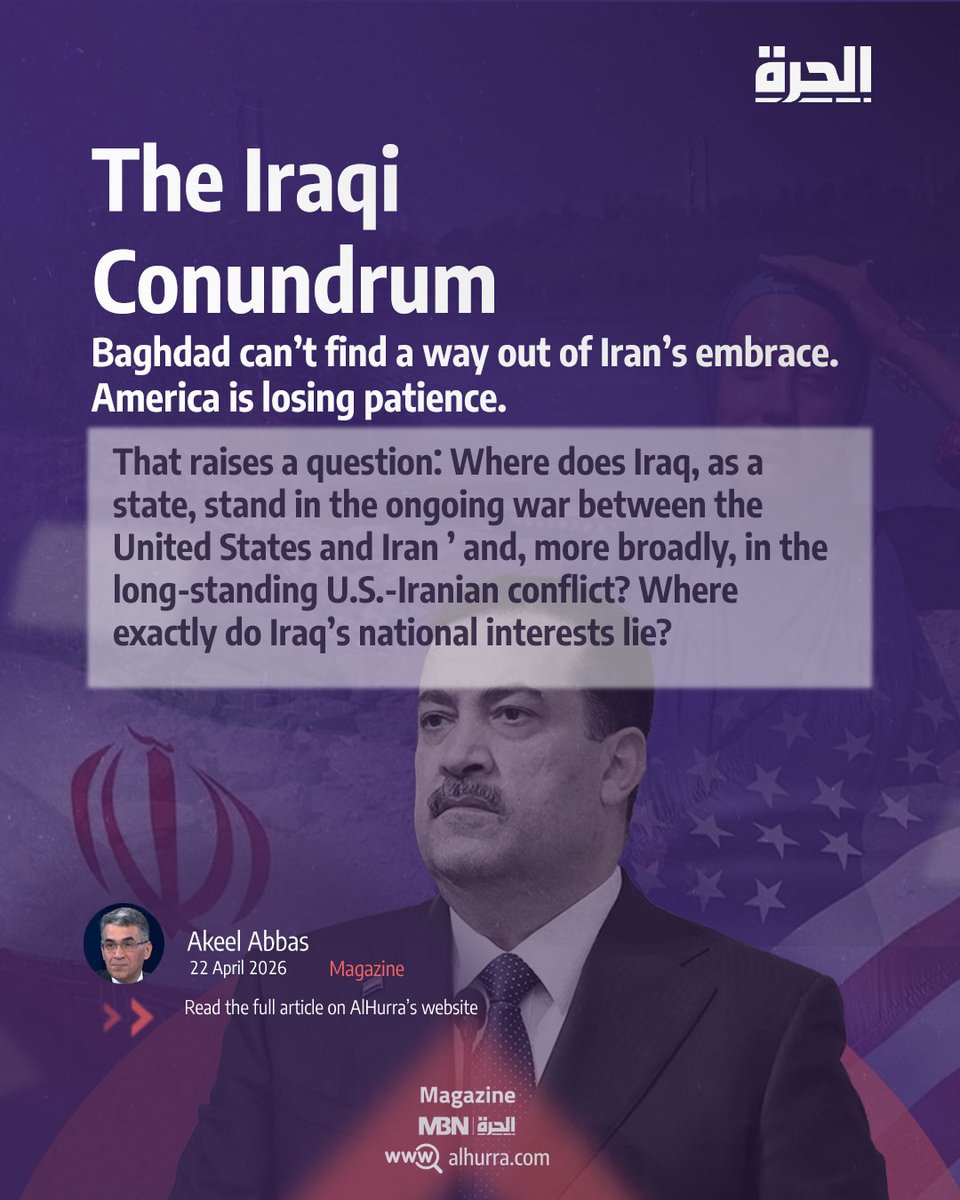
Since the start of the war Iraq has effectively provided Iran with another front for combating the United States. That raises a question: Where does Iraq, as a state, stand in the ongoing war between the United States and Iran – and, more broadly, in the long-standing U.S.-Iranian conflict? Where exactly do Iraq’s national interests lie? Read the full article of @akeel11111⬇️ alhurra.com/en/19023
MBN English tweet media
English
0
1
2
814
Shayan Talabany
Shayan Talabany@ShayanTalabany·
Also worth noting that President Donald Trump reportedly said several months ago that he would accept only two contenders for PM: Sudani or Shatri.
English
6
0
3
1.9K
Shayan Talabany
Shayan Talabany@ShayanTalabany·
As the US ramps up pressure on Iraq to select a PM & form a government, one quiet contender stands out: Hamid Al-Shatri. Close to Sadr, from a prominent Southern tribe, he’s Iraq’s intelligence chief who has been quietly navigating US-Iran tensions, including managing potential security issues with Damascus. Re-upping @danataibmenmy’s piece about Iraq’s potential new PM. newarab.com/news/who-hamid…
English
19
14
97
21.6K
Shayan Talabany retweetledi
Hamidreza Azizi
Hamidreza Azizi@HamidRezaAz·
Will the ceasefire hold? 🔹Iranian state media and government-affiliated institutions continue to frame the ceasefire as a victory, arguing that the United States has effectively accepted Iran’s terms. But developments since this morning have begun to challenge both the ceasefire and the broader narrative of success promoted by Tehran. 🔹Reactions inside Iran have not been uniform. A segment of pro-government experts – many aligned with the regime’s core constituency – have expressed skepticism about whether the ceasefire actually serves Iran’s interests. 🔹Their central concern is trust. These voices argue that the United States has demonstrated it is not a reliable interlocutor, and that the ceasefire may simply give Washington and Israel time to regroup before resuming military operations under more favorable conditions. 🔹This skepticism is reinforced by what they see as inconsistency in official messaging. Iranian leaders had repeatedly emphasized that there would be no ceasefire, only a decisive end to the war. 🔹The acceptance of a temporary ceasefire, without clarity on whether it leads to a definitive resolution, is therefore viewed as a reversal that raises questions about strategic coherence. 🔹Recent comments by Donald Trump have added to these concerns. His shift from referencing Iran’s proposed 10-point plan to promoting a U.S. 15-point framework is interpreted as a sign that Washington may already be reconsidering its position. 🔹Particular attention has focused on the substance of these proposals. The emphasis on removing Iran’s nuclear material in exchange for sanctions “relief” – rather than full “removal” – is seen as evidence that the U.S. is hardening, not softening, its stance. 🔹Beyond elite debates, some commentators warn of domestic repercussions. Public support during the war, they say, was sustained in part by trust in leadership decision-making. 🔹If that trust is perceived to have been undermined, especially through a ceasefire that appears uncertain or disadvantageous, future public mobilization may become more difficult. 🔹At the regional level, developments in Lebanon are placing additional pressure on the ceasefire. Israel’s intensified air campaign there directly challenges Iran’s insistence that any ceasefire must be region-wide. 🔹This creates pressure on Tehran to respond. From the outset, Iran’s position was that the war could not be compartmentalized, and more recently, officials explicitly stated that Lebanon must be included in any ceasefire arrangement. 🔹As a result, pro-government analysts increasingly frame the situation as a strategic challenge: either Iran responds decisively to restore deterrence, or Israel succeeds in imposing a new regional equation. 🔹In that scenario, the so-called “resistance front” would become fragmented, with its different components effectively separated and weakened. 🔹This has direct implications for Iran’s position in Lebanon, they say. Hezbollah entered the war in support of Iran and now expects reciprocal backing. If Hezbollah perceives abandonment, some analysts warn that Iran may struggle to rebuild its influence among Lebanon’s Shiite community. 🔹More broadly, such an outcome would damage Iran’s regional standing. It would reinforce a perception Tehran ultimately prioritizes its own interests over those of its allies. 🔹These concerns are also tied to Iran’s national security calculus. Some analysts argue that Israel accepted the ceasefire with Iran primarily to neutralize the northern front. From this perspective, degrading Hezbollah’s capabilities would remove a key pressure point, allowing Israel to refocus on Iran itself at a later stage. 🔹This leads to a more long-term concern: sequencing. If Iran does not act now to support Hezbollah, it may face a future confrontation with Israel without the same level of regional backing. 🔹In that sense, the ceasefire is not seen as an endpoint but as a transitional phase that could reshape the strategic environment in ways that are ultimately unfavorable to Iran.
English
2
212
630
130.9K
Shayan Talabany retweetledi
Hamidreza Azizi
Hamidreza Azizi@HamidRezaAz·
This could suggest Trump is losing faith in the chances of reaching a negotiated deal with elements of the regime in #Iran. Until recently, he seemed to hope someone within the system might emerge to strike an agreement in a Venezuela-style scenario. This new rhetoric points to the battlefield as the place where the conflict’s outcome will be decided!
Hamidreza Azizi tweet media
English
3
93
357
77.4K
Shayan Talabany
Shayan Talabany@ShayanTalabany·
Beyond just the potential repercussions on Iranian Kurdish groups this carries, the risk of it all backfiring on the KRI and its leadership are extremely high. Comes at a time where the KRI is in a much weaker position than it ever has been economically, socially, politically inside Iraq and regionally.
Gareth Browne@BrowneGareth

Having spoken to a few informed sources, thousands of Iranian-Kurds have been armed and funded by the CIA in recent months. Most of them are already in Iran, waiting for an order to move. A minority are in Iraqi Kurdistan, waiting to cross over into Iran.

English
1
2
16
3K
Shayan Talabany
Shayan Talabany@ShayanTalabany·
As conflict in the Middle East escalates once again, as part of the ebb and flow of an ongoing regional war since October 7, two countries have and will continue to shape the region’s map along their own national security priorities: Israel and Türkiye. Israel and Israeli policymakers have been very clear that they are effectively driven by a national security doctrine after the Hamas attacks that require buffer zones along its Levant borders. Israel’s current incursion into southern Lebanon fits that pattern, so does its continued presence in Syria Mt Hermon, Quneitra, Suwayda etc & its annexations in the W Bank. The ideological angle to this is secondary. Same goes for Türkiye. Türkiye’s long term goals have been to create a buffer zone along its southern borders and eradicate any Kurdish militant presence. Türkiye is the primary external power with influence in Northern Syria, economically, and militarily. From Aleppo to neutralising the SDF. Turkish FM Hakan Fidan has indicated an incursion into Northern Iraq is impending too and its support and engagement with various groups in the North is noteworthy. Israel and Türkiye are dictating the future of the Levant, the region that has been at the heart of instability from wars to transnational jihad. They’re also protecting themselves from future instability. The question is where does that leave the rest of the region?
English
0
0
2
451
Shayan Talabany
Shayan Talabany@ShayanTalabany·
Balochistan Iran and its neighbouring Balochistan region in Pakistan are also home to two of the region's key strategic ports - the Chabahar Port in Iran and the Gwadar Port in Pakistan. Chabahar is Iran's only oceanic port and a key node of connectivity for India, whereas Gwadar serves as the southwestern terminal of the China-Pakistan Economic Corridor (CPEC).
Thomas van Linge@ThomasVLinge

In the scenario ethnic armed organisations cross the borders to launch a rebellion, a rapid potential state collapse will not happen in the west, but more likely in the east, in the Balochistan region close to Afghanistan and Pakistan.

English
1
0
4
473
Shayan Talabany retweetledi
Güney YILDIZ
Güney YILDIZ@guneyyildiz·
Most analysis on Iran is still stuck in a 1980–1990 template: outdated assumptions about nation-states, opposition capacity, minority politics, and Turkey’s role. But the ground reality has changed. Reports that the CIA is arming Iranian Kurdish forces expose a deeper contradiction: parts of Iran’s opposition are attacking the only groups with real operational capacity inside the country. The Kurdish parties never stopped fighting Tehran. If Kurds across the region draw the right lessons from 2015–2017, they could be in a position to shape events. And much will depend on how Turkey approaches this moment — a strategic opening not seen since Yavuz Sultan Selim. My article from last night: forbes.com/sites/guneyyil…
English
13
51
162
53.8K
Shayan Talabany
Shayan Talabany@ShayanTalabany·
A very risky move for Iraqi Kurdish leaders who are effectively the middle men between the US and Iranian-Kurdish groups. For Iranian Kurdish groups, there isn’t much to lose, this is prime time to change dynamics on the ground. But for Iraqi Kurdish leaders, the risk is upending their own regional relations, particularly with Turkiye. Turkiye-KRI relations are often taken-for-granted as solid and stagnant but Turkiye exploits factionalism within the KRG and also maintains relations with other groups outside of the KDP and PUK, including with Sunni, Turkmen and Kurdish Islamist figures and parties.
Amwaj.media@amwajmedia

NEW: Israel is reportedly pressing the Trump admin to mobilize Iraqi-based Kurdish groups for a ground offensive inside Iran. This as Israeli-US airstrikes have hit at least 17 cities in Iran's Kurdish areas as of Mar. 2, with Sanandaj alone targeted 25 times. Details on @amwajmedia 👇

English
2
11
38
9.6K
Shayan Talabany retweetledi
Timour Azhari
Timour Azhari@timourazhari·
WASHINGTON/RIYADH, Jan 31 (Reuters) - Mark Savaya, named by U.S. President Donald Trump as special envoy for Iraq in October, is no longer in that role, sources familiar with the move said. Why? One source pointed to Savaya's "mishandling" of key situations, including his failure to prevent the nomination of former Iraqi prime minister Nouri al-Malikito be the country's next premier, a move Trump openly warned Baghdad against. W/@andrea_shalal & @humeyra_pamuk
English
2
12
44
21.1K
Shayan Talabany retweetledi
Islam Zebari
Islam Zebari@IslamZebari·
اليوم في قامشلو، قدّمنا مساعدات مادية لعشرات العائلات العربية النازحة من الطبقة والرقة. فسألتُ بعضهم: لماذا نزحتم من بيوتكم؟ الرقة والطبقة آمنتان الآن، فلماذا لا تعودون إلى منازلكم؟ فالعودة أفضل من العيش في مدارس ومساجد قامشلو. فقالوا: سينتقمون منا ويقتلوننا لأننا كنا مع الكورد، ولا نستطيع العيش تحت حكمهم. فقلتُ لهم: الجيش السوري أعلن أنه لن يمسّ أحدًا بسوء، والعودة إلى بيوتكم أفضل لكم من البقاء في هذا الوضع المأساوي. فردّوا: الجيش يقول شيئًا، وعناصره تفعل شيئًا آخر، لذلك لا نثق بهم.
العربية
90
37
359
19.5K
Shayan Talabany
Shayan Talabany@ShayanTalabany·
Iraq should expect a scenario where Syrian-backed and based forces could come into confrontation with Iraqi army and PMF units along Iraqi Syrian border regions. This would be catastrophic and could reignite sectarian conflict in the country. Some Iraqi officials have long been warning (prior even to the recent elections) that Iraq’s political map could undergo a significant transformation in the coming months given wider geopolitical shifts since October 7. The current events come at a time of increased US pressure on Iran-aligned armed factions inside Iraq, including warnings of large-scale military strikes inside the country if armed factions don’t concede on weapons control and a fresh bout of threats and warnings of sanctions targeting Iraq - including potentially its oil revenues - should armed groups be included in the next government. The impact of such a conflagration is even more worrisome when you consider the large scale Turkish military presence in Northern Iraq and potential ramped up anti-PKK military action. Things could very well move in this direction should there be an attack by the US and/or Israel on Iran. A further blow to Iran’s ability to manoeuvre around the region is certainly on the cards. And an attack on Iran would provide a useful geopolitical distraction for other regional actors . Could we see simultaneous ramped up Israeli attacks on Hezbollah in Lebanon, Turkish attacks on PKK, Damascus -backed anti-Hashd operations in Iraq, and an Israeli/US-backed attack on Iran all at the same time?
English
3
6
16
25.4K
Shayan Talabany retweetledi
Ziad Daoud
Ziad Daoud@ZiadMDaoud·
This article says Trump thinks his actions in Venezuela could lower oil to $50, his favoured level His dream may be a nightmare for many in the Mideast Iraq, for example, needs oil at $53 just to pay its wage & pension bill — the backbone of stability wsj.com/business/energ…
English
3
15
32
6.8K
Shayan Talabany retweetledi
Ibrahim Hamidi ابراهيم حميدي
Big news: Barham Salih @BarhamSalih , former Iraqi president who once fled Saddam Hussein’s persecution, has been named the next Commissioner for @Refugees breaking the long tradition of choosing leaders mainly from major European donor countries. - A letter from U.N. Secretary-General Antonio Guterres, dated December 11, confirmed Salih’s five-year term starting January 1, pending UNHCR committee approval.
Ibrahim Hamidi ابراهيم حميدي tweet media
English
6
11
68
11.9K
Shayan Talabany retweetledi
The National
The National@TheNationalNews·
Iran-aligned blocs lead Iraq's post-election government formation marathon #Echobox=1763797961" target="_blank" rel="nofollow noopener">thenationalnews.com/news/mena/2025…
English
0
4
4
1.4K
Shayan Talabany retweetledi
Peregraf
Peregraf@PeregrafNews·
1/3 Iraqi PM Mohammed Shia’ al-Sudani says Baghdad and Erbil reached a "historic agreement." ➡️ The Federal #Oil Ministry will take crude produced in the Kurdistan Region and export it via the Iraq–Turkey pipeline. "An achievement 18 years in the making." peregraf.com/en/news/9804
Peregraf tweet media
English
1
3
5
1.1K