Forecasting Maine’s Democratic Delegate Selection and what it means for Jackson, Bellows and Shah using the delegate written statements analyzed through the latest LLM (ChatGPT 5.6 Sol) 🔮
This may be one of the first public attempts to forecast a political nominating convention using thousands of statements submitted directly by prospective delegates through language analysis by LLMs.
How the model works:
To replace Graham Platner as the Democratic Senate nominee, Maine Democrats will hold a special nominating convention with 601 voting delegates.
Of those, 500 delegates are being selected through county-level meetings across Maine’s 16 counties. More than 3,700 applicants submitted written statements explaining why they should be chosen and, in many cases, what they want from the eventual nominee.
The model evaluates each applicant in two separate stages.
First, it estimates the applicant’s likelihood of being selected as a delegate. It considers the strength and specificity of the statement, party and community experience, elected or organizational roles, local credibility, geographic representation and competition against other applicants in the same county.
Second, it estimates the applicant’s probability of supporting Troy Jackson, Shenna Bellows or Nirav Shah. Signals include explicit endorsements, candidate-specific praise, Platner and labor continuity, economic populism, election administration, reproductive rights, electability, public-health leadership, executive competence and appeal to independent or Republican voters.
Statements containing only generic language about unity, Democratic values or defeating Susan Collins are left substantially uncertain rather than being forced toward a candidate.
These two components are combined into an Expected Delegate Contribution:
Probability of being selected × probability of supporting each candidate
The model then simulates the selection of the exact number of delegates allocated to each county.
All 3,732 applicants were scored, with high-impact, explicit-support and ambiguous cases subjected to additional review.
Results among the 500 county delegates
After probabilistically resolving uncertain intent:
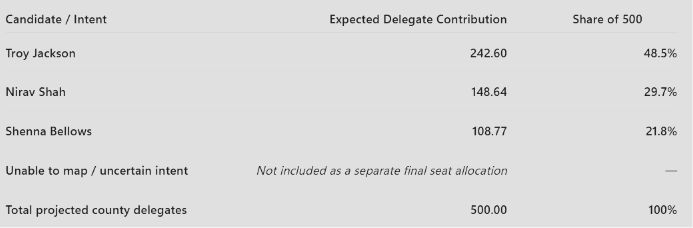
Troy Jackson: 242.6
Nirav Shah: 148.6
Shenna Bellows: 108.8
Before resolving uncertain intent, approximately 82.3 of the 500 expected delegates cannot be confidently mapped to a candidate from their statements alone.
The full convention contains 601 delegates. The other 101 are Democratic State Committee members, who are not included because they did not submit comparable statements.
If all 601 delegates vote, 301 votes would constitute a majority. Jackson therefore enters the broader convention model with a considerable advantage among the 500 county-selected delegates, but the unmodeled State Committee bloc, convention attendance, candidate slates, personal relationships and later-ballot transfers could still materially affect the final outcome.
The follow-up post shows the county-by-county results, including the delegates whose intent could not be confidently mapped.
English