Sherrie Rose ★

23.9K posts

Sherrie Rose ★ banner
Sherrie Rose ★

Sherrie Rose ★

@SherrieRose

Sherrie Rose helps High-Achievers develop MASTERWORK ★ Author ★ Purpose & Mission led by Vision ✨ Masterwork Advisor .com ✨

ChiefLegacyOfficer .com Katılım Temmuz 2008
6.6K Takip Edilen7.2K Takipçiler
Sabitlenmiş Tweet
Sherrie Rose ★
Sherrie Rose ★@SherrieRose·
The name "Sherrie Rose" belongs to more than one remarkable woman. If you're here looking for the author Sherrie Rose then you’re in the right place: @SherrieRose SherrieRose.com
Sherrie Rose ★ tweet media
English
1
0
1
60
Sherrie Rose ★
Sherrie Rose ★@SherrieRose·
How do YOU listen? Do you listen to understand or listen to reply? “The most important thing in communication is hearing what isn’t being said.” — Peter Drucker “The first duty of love is to listen.” — Paul Tillich “Your relationships may hinge on the quality of your communication.” “Good communication means disagreeing without hurting the one you love.”
English
0
0
0
7
Sherrie Rose ★
Sherrie Rose ★@SherrieRose·
@DannyDeraney Jimmy Stewart appeared on season 11 of The Carol Burnett Show in 1978 on the SERIES FINALE. Stewart was age 69.
English
0
1
4
772
Danny Deraney
Danny Deraney@DannyDeraney·
This is so wholesome. 48 years ago today, on the last ever Carol Burnett Show, Tim Conway surprised Carol with her idol, Jimmy Stewart. Her reaction transforms her into a kid again.
English
356
3.1K
22.8K
588.6K
Sherrie Rose ★ retweetledi
The Nobel Prize
The Nobel Prize@NobelPrize·
At least 12 million babies have been born thanks to in vitro fertilisation (IVF), but how did we reach this miraculous milestone? In the 1950s, British scientist Robert Edwards began his research on the biology of fertilisation and soon realised that fertilisation outside the body could be used to treat infertility. He discovered important principles for human fertilisation including how human eggs mature, and first succeeded in accomplishing fertilisation of human egg cells in test tubes – or more precisely, cell culture dishes – in 1969. Despite his breakthrough, there was a problem that a fertilised egg could not develop beyond a single cell division. Edwards suspected that eggs that had matured in the ovaries before removal would function better, and looked for possible ways to obtain such eggs in a safe way. His collaboration with gynaecologist Patrick Steptoe enabled IVF to grow from experimental to practical medicine. Together, they used laparoscopy – a technique pioneered by Steptoe – to remove eggs and put them in a cell culture before adding sperm, which enabled the fertilised eggs to form into early embryos. On 25 July, 1978, Louise Brown, the world’s first “test tube baby” was born. IVF treatment began the previous year when a fertilised egg was developed into an embryo and returned to her mother, Lesley Brown. Louise’s birth marked a major milestone in reproductive medicine and gave hope to millions of people struggling with infertility. Edwards and Steptoe established the Bourn Hall Clinic in Cambridge – the world’s first centre for IVF therapy – and refined their technology. By 1986, 1,000 children had already been born following IVF at the clinic. Today, IVF is a sophisticated and widely accessible fertility treatment option that has allowed millions to experience the joy of parenthood. Learn more about Robert Edwards: nobelprize.org/prizes/medicin… Photo: iLexx via Getty Images.
The Nobel Prize tweet media
English
15
161
578
55.4K
Sherrie Rose ★ retweetledi
Pascal Bornet
Pascal Bornet@pascal_bornet·
I didn’t expect a piano to make music visible but this does. That caught my attention. Someone spent three years trying to turn sound into something you can see. No AI. No screens. Just experimentation. They tried lasers, smoke, different materials. Nothing worked. Until they found something unexpected. Bioluminescent algae. A living system that glows when disturbed, turning each note into light. The first time you see it, it feels unreal. What stands out to me is not just the result, but the process. Innovation didn’t come from better tools. It came from combining ideas across disciplines. Technology. Biology. Art. So here’s something to think about: Where do the most meaningful breakthroughs come from today… deeper expertise, or unexpected combinations? #Innovation #Creativity #Technology #FutureOfTech
English
58
404
1.4K
57.4K
Sherrie Rose ★
Sherrie Rose ★@SherrieRose·
Join Bob, Elizabeth and the rest of the good folks at Longer Tables San Diego - inviting thousands of people from across the region to share a meal together. longertablessandiego.org
English
0
0
0
18
Sherrie Rose ★ retweetledi
NASA
NASA@NASA·
In just a few days, we'll be sending humans on a flight around the Moon. Have you watched our documentary series on the mission? Watch Moonbound before Artemis II lifts off: plus.nasa.gov/series/moonbou…
English
1K
3.8K
17.4K
1.3M
Sherrie Rose ★
Sherrie Rose ★@SherrieRose·
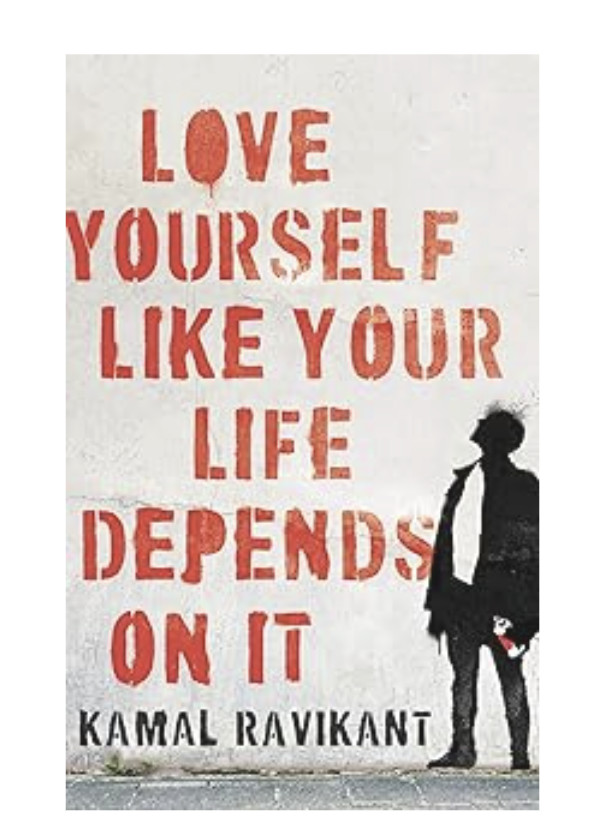
"All of humanity’s problems stem from man’s inability to sit quietly in a room alone." – Naval Ravikant
Joe@JoeBGrech

TLDR… 1.Limit work to 4 hours a day if possible 2.Cut out your most mindless input (podcasts, scrolling, news) 3.Go on daily walks with no headphones or phone 4.Read one chapter of a book slowly, stop when something hits you 5.Sit in silence for 10 minutes, no apps or guides 6.Have one real, present conversation with someone 7.Create something with no plan and no rules, don’t share it for at least 24 hours
English
1
0
1
52
John Nosta
John Nosta@JohnNosta·
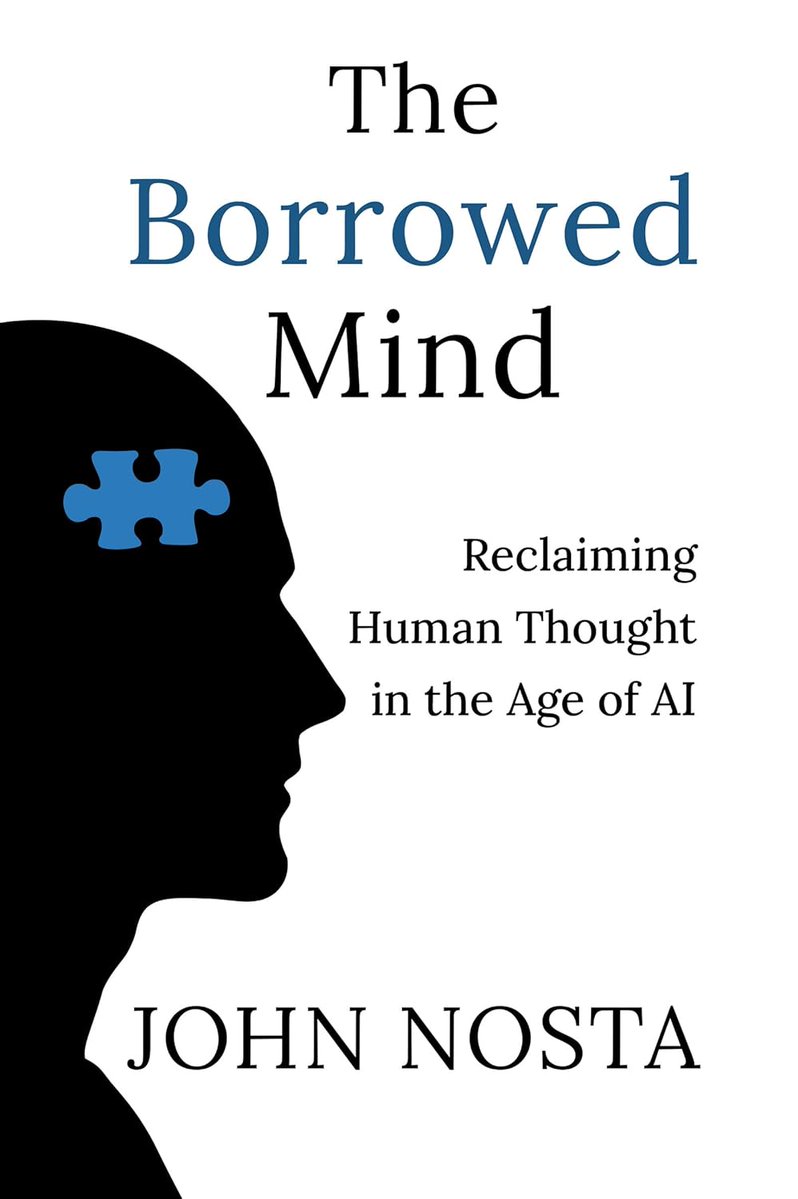
🤔Something very interesting is happening. My book on AI and human cognition is now showing up on Amazon’s top lists in: 🔴Epistemology 🔴Cognitive Psychology 🔴Medical Cognitive Psychology Interestingly, this distribution wasn’t planned. The larger conversation is now shifting, and not about what AI can do, but about what it’s doing to how we think. amazon.com/dp/B0GMJ77QSP #AI #LLMs #cognition
John Nosta tweet media
English
2
9
33
1.8K
Sherrie Rose ★
Sherrie Rose ★@SherrieRose·
strip, show up, move fast
Dustin@r0ck3t23

Jensen Huang just reverse-engineered why Elon Musk operates at a speed no one on the planet can match. Three traits. The first is deletion. Huang: “He has the ability to question everything to the point where everything’s down to its minimal amount.” Most engineers solve problems by adding. Musk solves them by subtracting. Every part. Every process. Every assumption that survived because no one had the nerve to kill it. He picks it up. Asks if it’s load-bearing. If the answer is anything less than absolutely, it is gone. Not simplified. Not optimized. Removed. What survives is the skeleton. The bare physics of the problem. Nothing between intent and execution. Huang said it plainly. As minimalist as you could possibly imagine. And he does it at system scale. Not at a product level. Not at a department level. Across entire companies. Entire industries. Entire supply chains. He strips a rocket the same way he strips a meeting. Down to the load-bearing walls and nothing else. The second is presence. Huang: “He is present at the point of action. If there’s a problem, he’ll just go there and show me the problem.” Not a Slack message. Not a report filtered through four layers of people who weren’t there when it broke. He walks to the failure. Stands over it. Puts his hands on it. Most executives have never seen the actual problem their company is trying to solve. They have seen slides about it. Read summaries of it. Formed opinions about it in rooms that are nowhere near it. Musk stands over the broken hardware and does not leave until it works. That collapses the distance that buries most organizations. The gap between something breaking and the person with authority to fix it actually understanding what broke. In most companies, that gap is weeks. For Musk, it is hours. The third is the one that bends everyone around him. Huang: “When you act personally with so much urgency, it causes everybody else to act with urgency.” Every supplier has a hundred customers. Every vendor has a dozen priorities. Every manufacturer has a backlog stretching months into the future. Musk makes himself the top of every single one of those lists. Not by demanding it. By demonstrating it. When the CEO shows up at your facility at midnight. When he is moving faster than your own internal team. When his timeline makes yours look like a suggestion. You do not put him in the queue. You rearrange the queue around him. Huang watched this up close. Huang: “He does that by demonstrating.” Not by asking. Not by negotiating. Not by leveraging a contract clause. By moving so fast that everyone else’s normal pace feels like standing still. Three traits. Strip everything down. Show up at the failure. Move so fast the world rearranges around you. That is not a management philosophy. That is why one man runs six companies while entire boards cannot keep one moving.

English
0
0
0
4
Sherrie Rose ★
Sherrie Rose ★@SherrieRose·
This one's for you @dorieclark paragraph rhythm: opening claim => inversion => list => revelation => CTA. That formula, repeated, creates the sense of a template being filled in. Good info but the format screams AI wrote this.
English
0
0
0
9
Diccionario VIP
Diccionario VIP@DiccionarioVIP·
🇫🇮 En Finlandia, un anfitrión de Airbnb que vive solo recibió una agradable sorpresa en su cumpleaños. Dos viajeras alojadas en su casa le compraron un pastel y celebraron con él este momento especial. ❤️
Español
30
905
30.5K
501.3K
Sherrie Rose ★
Sherrie Rose ★@SherrieRose·
Sherrie Rose ★ tweet media
Anish Moonka@anishmoonka

September 1997. Steve Jobs stands before Apple employees and tells them he's been up until 3am finishing an ad. He's been back at the company for eight weeks. Apple lost $1 billion that year. Three months earlier, WIRED put Apple's logo on its cover, wrapped in barbed wire, with the word "Pray." He starts by saying what he's found since coming back. He couldn't figure out Apple's own product line. He spent weeks trying to understand which model was which and how they fit together. He talked to customers. They couldn't figure it out either. He cut 70% of the product roadmap. People whose projects were canceled were, in his words, "three feet off the ground with excitement" because, for the first time in years, someone told them where the company was going. Then he says something about marketing that changed how every tech company thinks about advertising. He says Nike sells a commodity. They sell shoes. But when you think of Nike, you feel something different than a shoe company. Nike never talks about their products in ads. Never tells you why their air soles are better than Reebok's. "They honor great athletes. And they honor great athletics. That's who they are." He compares it to the dairy industry spending 20 years trying to convince people milk was good for them, failing, and then running "Got Milk," which doesn't even mention the product. Focuses on its absence. He says Apple spends a fortune on advertising. "You'd never know it." Then he fires the ad agency. Not just fires them. Apple was running a competition with 23 agencies. He scrapped the whole thing and hired Chiat/Day, the agency he'd worked with a decade earlier on the 1984 Macintosh commercial that advertising professionals voted the best ad ever made. The question they asked themselves: "Our customers want to know who is Apple and what is it that we stand for?" His answer: "Apple at its core, its core value, is that we believe that people with passion can change the world for the better. And that those people who are crazy enough to think they can change the world are the ones that actually do." Then he plays the ad. In this room. To Apple employees. For the first time. "Here's to the crazy ones. The misfits. The rebels. The troublemakers." He says almost none of these people had ever appeared in an advertisement before. He personally obtained Yoko Ono's permission to use John Lennon. He says the estates and living subjects agreed because of their feelings toward Apple. "I don't think there is another company on Earth that could have done this campaign." The ad broke that Sunday during the network premiere of Toy Story on ABC. Two 60-second spots. Newspaper ads in the Wall Street Journal, New York Times, and USA Today. Billboards in major cities. Buses in five cities featuring Rosa Parks. Painted walls. The whole thing. Apple's stock was around $0.10 split-adjusted when this meeting happened. The company is worth $3.68 trillion today. Think Different ran for five years. Every product that came after, the iMac, iPod, iPhone, iPad, was built on the identity this campaign established by a guy who'd been back at the company for eight weeks and finished the ad at three in the morning. Video: Steve Jobs internal staff meeting at Apple, September 1997. This is the first time the Think Different campaign has been shown to employees. Jobs had been back at Apple for eight weeks. Footage leaked from an internal recording.

ZXX
0
0
0
2
Sherrie Rose ★
Sherrie Rose ★@SherrieRose·
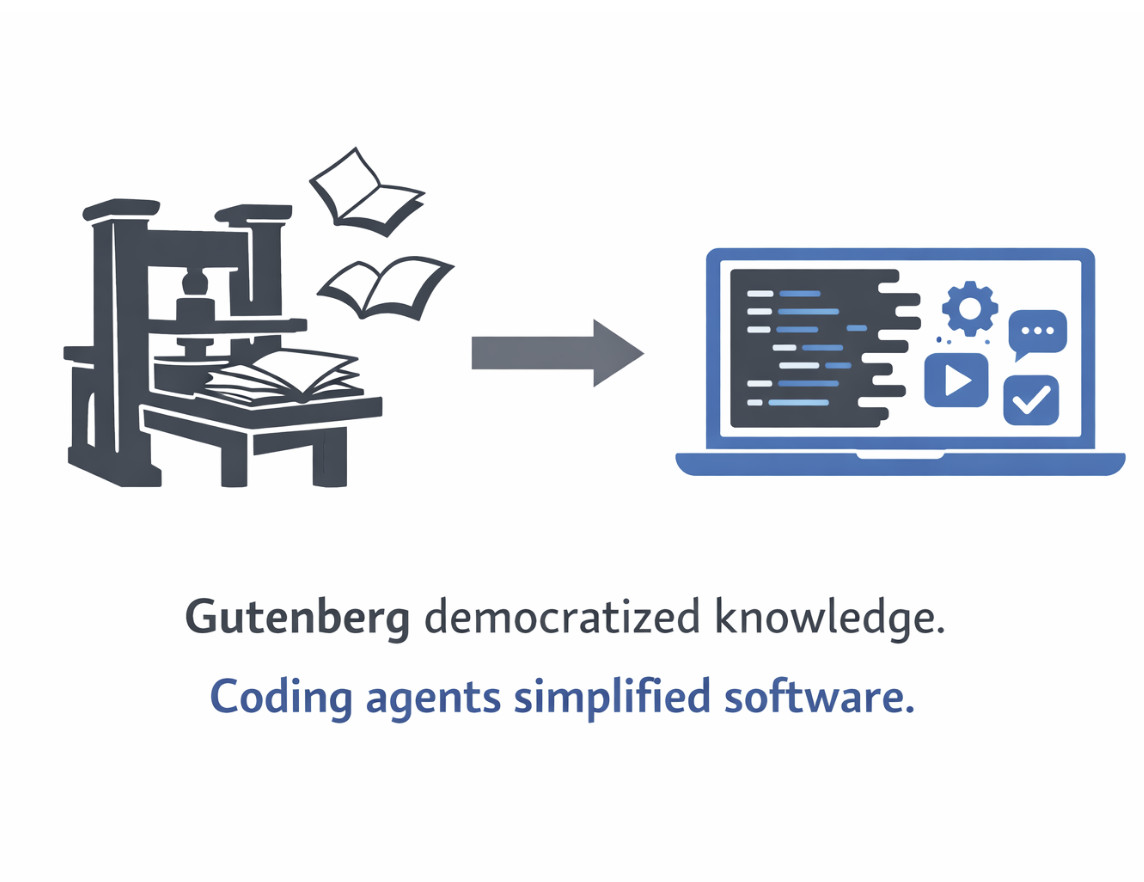
Gutenberg democratized knowledge. Coding agents simplified software. Around December 2025, AI crossed a threshold that marks an infrastructure shift on the scale of the printing press, electricity, or the early internet, because it changes who can build apps and software and how quickly ideas develop across any industry. Now coding agents are reliably capable of building complete software systems, collapsing the cost and speed of creation to near zero. As software becomes universally accessible through natural language (vibe coding), the advantage concentrates in people who move early and learn to direct AI systems with intent, judgment, and iteration, rather than treating them as simple tools. Oversight is still required, and those with a background in systems thinking, software engineering, and domain expertise will be best positioned to guide outputs, validate results, and translate raw capability into durable, real-world value.
Sherrie Rose ★ tweet media
English
0
0
0
3