SiliconSweetie
87 posts

SiliconSweetie
@SiliconSwe71940
A nerdy girl, who loves computers, retro computers, games, retro games, Linux and technology
Katılım Mayıs 2026
50 Takip Edilen11 Takipçiler
SiliconSweetie retweetledi

In 2009, a $3,000 desktop beat a multi-million dollar supercomputer.
The man behind it never took a dime. And you use his code every single day. 🤯
Meet Fabrice Bellard 🇫🇷
> French programmer. Born 1972.
> No Google. No Meta. No hype. Just a quiet job.
> 2000 ~ built FFmpeg, largely solo.
> The engine behind YouTube, Netflix, TikTok, VLC, Instagram.
> NASA runs it on the Perseverance rover on Mars. 🚀
> 2003 ~ built QEMU.
> The foundation of every Android emulator and most cloud servers on Earth.
> 2009 ~ broke the Pi world record. 2.7 trillion digits. One desktop.
> Used a formula he invented himself.
> Supercomputers had done less. He did more.
> Won the Obfuscated C Code Contest 3 times. For fun.
> Released it all free. Open source. No patents.
One man. The invisible engine behind much of the internet.
Absolute Legend 🐐


English
SiliconSweetie retweetledi

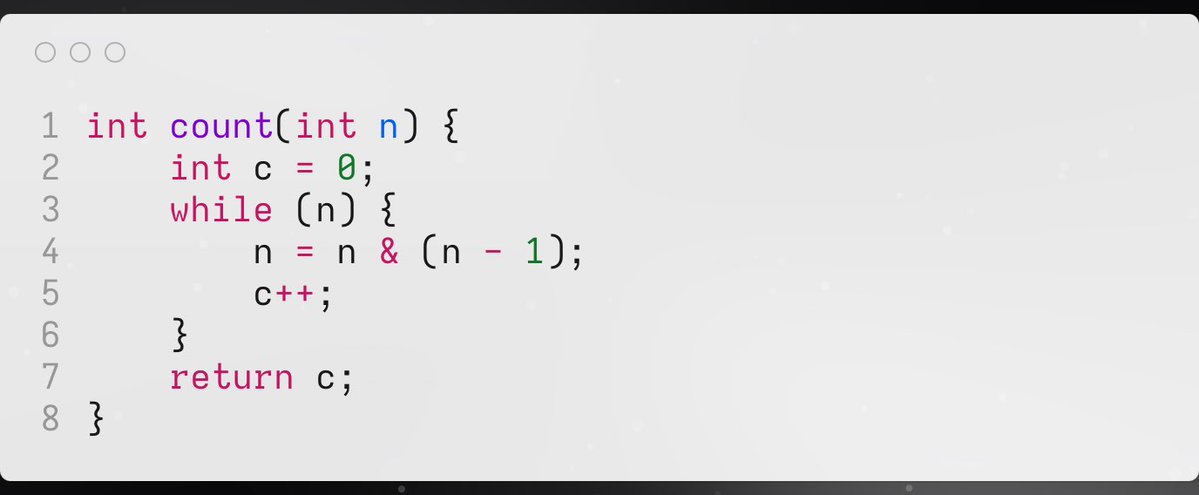
3 times
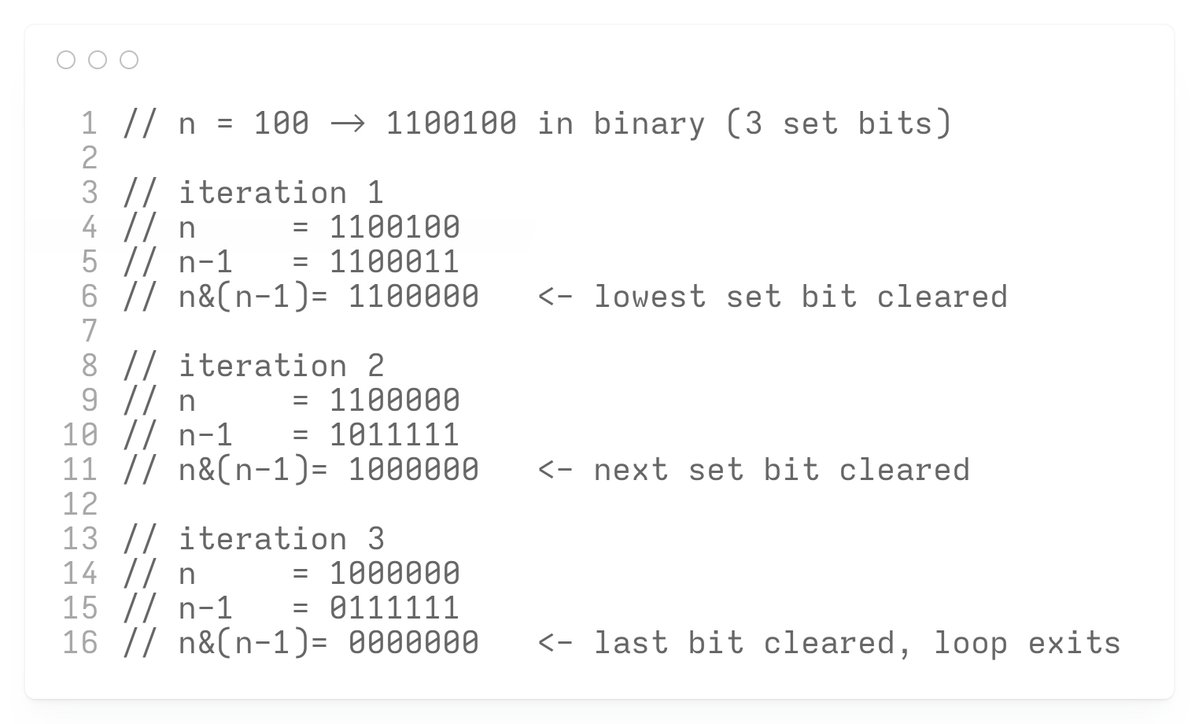
100 in binary is 1100100
it has 3 set bits
the loop runs exactly once per set bit, not per total bit
n & (n-1) removes the lowest set bit from n on every iteration
subtracting 1 flips all bits after the rightmost set bit including that bit itself
AND-ing with n clears those flipped bits and leaves everything above untouched
so for a 32-bit integer with only 1 bit set the loop runs once
for 0xFFFFFFFF it runs 32 times
the iteration count has nothing to do with the size of the integer
only the number of set bits matters
this is Brian Kernighan's algorithm

trish@TrisH0x2A
how many times does this loop run for n = 100? the answer will surprise you the loop does not behave the way it looks take a guess this exact pattern is in K&R "The C Programming Language" exercise section and the Linux kernel uses it under a different name in dozens of places
English


@MathGuyTFL 180 m
two possible ways to calculate this.
1)
h= vt + (at^2)/2; v=0 => h = (t^2)/(2g) = 180 m
or you can say that all initial potential energy transforms in to final kinetic energy when it hits the ground.
2)
Ep = Ek
mgh = (mv^2)/2 => h = (v^2)/(2g) = 180 m
English

Radical Pink Tiger T-shirt | Retro Neon Tiger Graphic Tee
New T-Shirt available in my etsy.com store.
You can buy it now. Follow link bellow.
etsy.com/listing/451012…
#80sFashion #NeonVibes #TigerTee #RetroStyle #VintageFashion #80sAesthetic #GraphicTee #BoldColors #Streetwear #NostalgiaFashion

English

@Surendar__05 Computers architecture and system software.
So assembly and C obviously.
English