Silo Chad retweetledi

last 50 mins to vote FOR Seed Gauge and Hypernative app.bean.money/#/governance
English
Silo Chad
230 posts


@SiloChad
contributing engineer at @BeanstalkFarms building the $BEAN economy 🌱



@PeapodsFinance should launch a liquidity pair on @basinexchange with $BEAN, aggregators would route through Basin to avoid the 1% Uniswap fee, which would then increase value to $PEAS holders. If they could then get the PEA/BEAN LP whitelisted, LP's could also gain BEAN seigniorage when demand for BEAN picks up. Seems like it would work well for both protocols
It´s been a few months since my first article about @BeanstalkFarms where I ate the pill and fell down the 🌱🕳️. I´m back to try to unfold the protocol in "Feynman’s explain it to a 5-year-old principle". Let´s first introduce some important terminology and concepts. 🧵👇
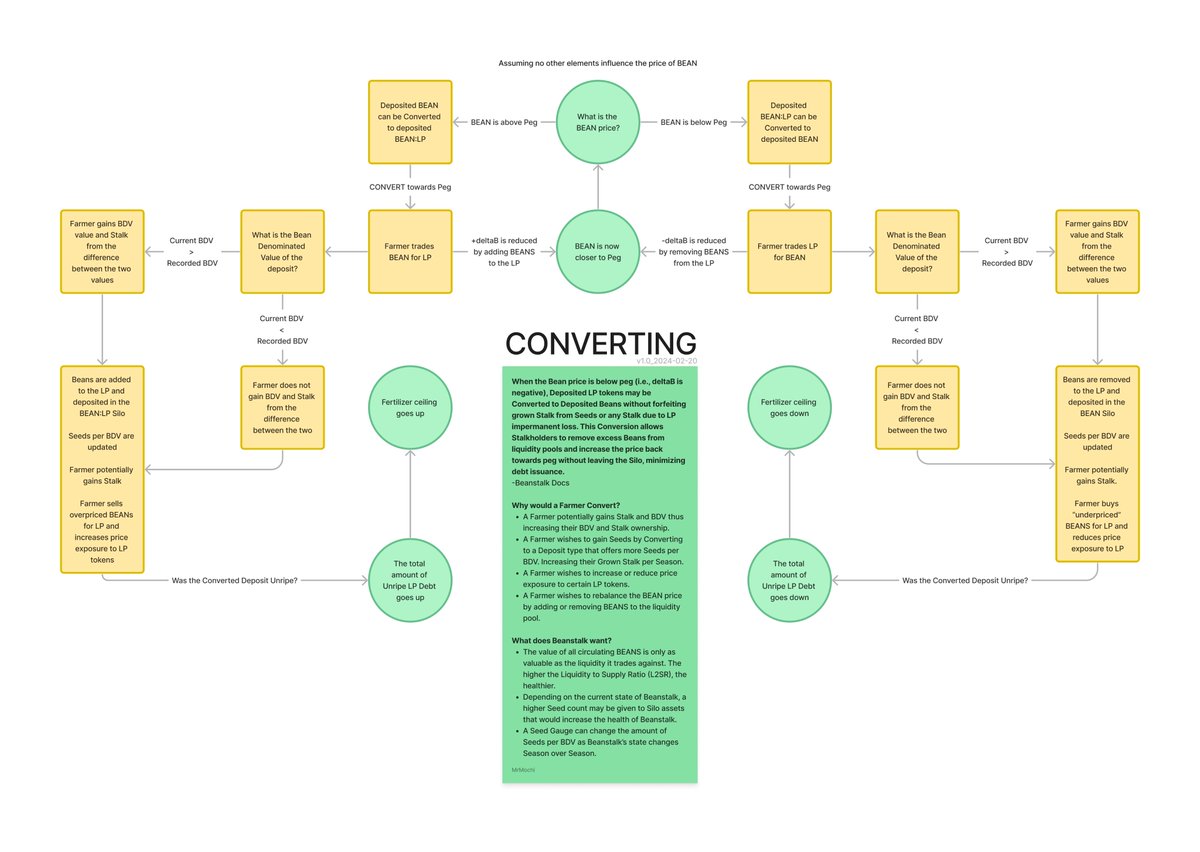
A quick guide on earning $BEAN, Ethereum's only credit-based algorithmic stablecoin. Let’s start with what Beanstalk aims to do for the DeFi ecosystem. One of the biggest use cases for Crypto in general is the transfer of value natively over the internet without using an intermediary. Bitcoin solves the value transfer problem but unfortunately the volatility of the Bitcoin price makes it difficult to use as money. If Beanstalk could be built on Bitcoin it would be, and maybe one day it will. What does DeFi need? More US Dollars created within the system, since if they are brought over from Tradfi then unfortunately the corruption and current power structure will also follow, so Beanstalk aims to create US Dollars in the form of Beans natively on the EVM. How do I make money with this protocol? There are a few different ways to interact with Beanstalk. The easiest and most simple way to earn Beans is by buying some and depositing them into the Silo - the Beanstalk DAO. Doing this will give you an allocation of Seeds which are tied to your Bean deposit and which grow Stalk. Stalk entitles you to a share of any newly minted Beans the protocol mints whenever there is excess demand for Beans. All you have to do is sit back while Beanstalk grows and count your Beans as they’re automagically deposited into your farm balance. 👇 The next way to stack Beans is to buy some and pair them with some 3CRV or ETH and add liquidity to the Bean:3CRV or BEAN:ETH liquidity pools. Doing this will give you a greater amount of Seeds that will generate more Stalk and give you a larger share of newly minted Beans when there is excess demand. Keep in mind, you only earn Beans when the price of 1 Bean is greater than $1, so you won’t always earn Beans, however you will continually earn Stalk while your deposit is in the Silo and if you remove your deposit and cash out your Beans all the Seeds and Stalk associated with your deposit are burned, increasing the percentage owned by others that keep their deposits Silo’d. 👇 The third way to earn Beans is to buy some and lend them back to Beanstalk whenever Beanstalk is willing to borrow Beans. This normally happens whenever the price of 1 Bean is less than $1. Beanstalk will offer you a fixed interest rate on any Beans you lend it at the time, and will pay you back your Beans plus any interest once demand for Beans has sufficiently increased and the price of 1 Bean is above $1. Keep in mind, Beanstalk pays back its debt to whoever is first in the debt line (called a Pod line, since when you lend Beans to Beanstalk it will issue you a number of Pods depending on your interest rate which can be redeemed for Beans as newly minted Beans enter circulation).👇 The fourth way to earn Beans is to buy them when their price is low and sell them when the price recovers (arbitrage), and the last way to earn Beans is to simply offer a service and ask to receive payment for said service in Beans. When and how does Beanstalk mint new Beans? Beanstalk will only mint new Beans if there is a time-weighted shortage of Beans in the whitelisted liquidity pools. This only happens when the price of 1 Bean is above $1, and it does this to incentivise Bean holders to sell their Beans, since the ideal price of 1 Bean is $1. During periods of excess demand however, the price of 1 Bean can remain above $1 for extended periods of time which can quickly lead to more Beans being minted, and if holders don’t sell them and instead deposit them into the Silo, this can cause a positive feedback loop which is designed to help Beanstalk increase the Bean supply. This is good for the protocol and all holders. What happens when the price of Bean is less than $1? When the price of 1 Bean is less than $1, Beanstalk offers debt for sale to creditors. It provides an interest rate which is set by an algorithm and which varies depending on demand for the debt. If there’s no demand for the debt, the interest rate will increase over time and vice versa if there is demand for the debt then the interest rate will decrease. When lenders purchase debt and lend Beans to Beanstalk, Beanstalk burns the Beans which reduces the supply which in turn makes it easier for traders to move the price of Bean back up towards $1 with less demand. What’s the deal with deposits? Are they locked in the Silo for any length of time? Deposits are not locked and can be withdrawn from the Silo at any time. Debt(Pods) that is purchased however, can only be redeemed with newly minted Beans by Beanstalk, although there is a peer to peer market for Pods (the Market) where they can be traded in a decentralised manner without the need for an intermediary using the bean.money dApp. What happens if no-one buys Beans, I smell a death spiral scenario… The whole premise of Beanstalk relies on demand for Beans, one reason why @basinexchange was built. Basin is a DEX architecture built on top of Beanstalk that uses Beanstalk’s positive carry to incentivise liquidity providers and so is the only DEX that can offer 0 fees (except native gas fees), this should increase demand for Beans as future projects pair their assets with Beans to take advantage of fee-less swaps. The longer Beanstalk survives, the more likely it will survive. Considering what Beanstalk has been through so far, it has proved very resilient. A death spiral for Bean is impossible since Bean is backed by credit, not collateral, and it is not hard-pegged to $1, instead it is designed to oscillate above and below $1. The only way Beanstalk fails is if it cannot attract credit from creditors. I heard Beanstalk was exploited and lost a lot of money, why would I risk losing my deposits? Correct, Beanstalks governance mechanism was exploited by a nefarious actor and all the non-Bean liquidity was stolen from the Silo. Beanstalk has always aimed to be as decentralised as possible and so was using an on-chain governance mechanism which subsequently failed. Before Beanstalk was re-planted, an updated off-chain version of governance was installed so that it would be impossible for the same exploit to happen again. Besides that, the economic model of Beanstalk at the time of the exploit seemed to have found product market fit, which is why it was able to raise a considerable amount to re-capitalise the liquidity pools and restart the protocol. It was also heavily audited by multiple best-in-class auditors before restarting. What are the returns like for depositing my Beans in the Silo? %APY? Beanstalk does not guarantee any sort of return if you Silo your deposits. Instead the %APY is variable depending on demand for Beans. If there is demand for Beans and the supply is increasing, %APY will increase, and if demand for Beans is low and the supply is decreasing, %APY will decrease. You can see on the Beanstalk dApp an average %APY for all deposits. The only known %APY is your Stalk return, since it is set by the algorithm, currently Bean deposits receive approximately 176% APY and LP deposits receive 352% APY for Stalk, which is not capped and is designed to be inflationary so that as more holders enter the Silo, current holders supply is diluted, this helps increase the Stalk distribution and reduce Stalk concentration over time, helping with decentralisation. I’m struggling to get my head around all the new terms Beanstalk uses, what’s with that? There are numerous instruments that are new within Beanstalk and that don’t have traditional names, so, in keeping with the farming theme, Beanstalk had to create them. Admittedly they can be confusing but there is some excellent documentation in the Farmers Almanac if you want to gain a more in-depth understanding. Beanstalk is a very complex protocol just like the global monetary system, and it requires time and study if you want to know the ins and outs of the system. The 5 ways of taking part in the Beanstalk ecosystem however are quite simple and easy to do, you just need to have a go. What’s this ‘convert’ option? Convert is another way Beanstalk incentivises depositors to bring Bean closer to peg. When Bean is above peg, Bean holders can convert their Bean deposits into LP deposits to take advantage of the arbitrage opportunity, in effect selling their Beans at a higher price and receiving more LP deposits. This can only be done when the price of Bean is above peg. Same goes for converting LP deposits into Beans, if Bean is below peg then LP depositors can swap their LP deposits for Bean deposits, effectively buying Beans below $1 and pushing price back up to peg. Once again, this can only be done while Bean price is below $1. The Beanstalk experiment is an ongoing attempt to create a frictionless stablecoin ecosystem that can scale with demand and act as the money of the internet using the Ethereum blockchain as its settlement layer. If you're interested in finding out more about Beanstalk follow @BeanstalkFarms @beanstalkmoney or access the full documentation at bean.money Welcome to the farm




1/ Today, Beanstalk contributors are excited to announce the launch of @basinexchange and the proposal of BIP-37, which integrates Basin into Beanstalk. The Mayflower has been spotted on the horizon!