Sitric O'Toole
2.6K posts


Red Pill Harem Experiment Results:
The quality of the girlfriend and the effort she puts into the relationship is dependent on her body count. In the beginning of the relationship the high body count and low body count girls appear the same. But later in the relationship it becomes clear that the more men the girl has slept with the less able she is to fall deeply in love.
Of course that is one of the tenants of Red Pill, but I actually thoroughly tested the theory.

English

What does 1,000 kcal of low-intensity exercise look like for the average person?
Assuming...
- 75kg (165lb) bodyweight
- Max HR 170 bpm
- Rest HR 50 bpm
- VO2max of 50ml/kg/min
2hrs total of...
- Easy Cycling - 140W @ 110bpm (~65% MHR) 🚴♀️
- Jog/Walk - 8:30/k (13:30/mi) @ 110bpm (~65% MHR) 🏃♂️🚶
Alan Couzens@Alan_Couzens
1,000 kcal of low-intensity exercise every day keeps the Doctor away. 2,000 kcal of low-intensity exercise every day keeps the competition at bay.

English

@annakhachiyan @HellenicVibes @liron it would be fun to hear @annakhachiyan thoughts on AI Doom, on @DoomDebates podcast.
English

@HellenicVibes I wish we could get an explainer for the foids without and breathless headlines or horny dooming
English

This is narrow Artificial Superintelligence (ASI) btw
This is going to happen in every field of human activity at some point in the next decade

Anthropic@AnthropicAI
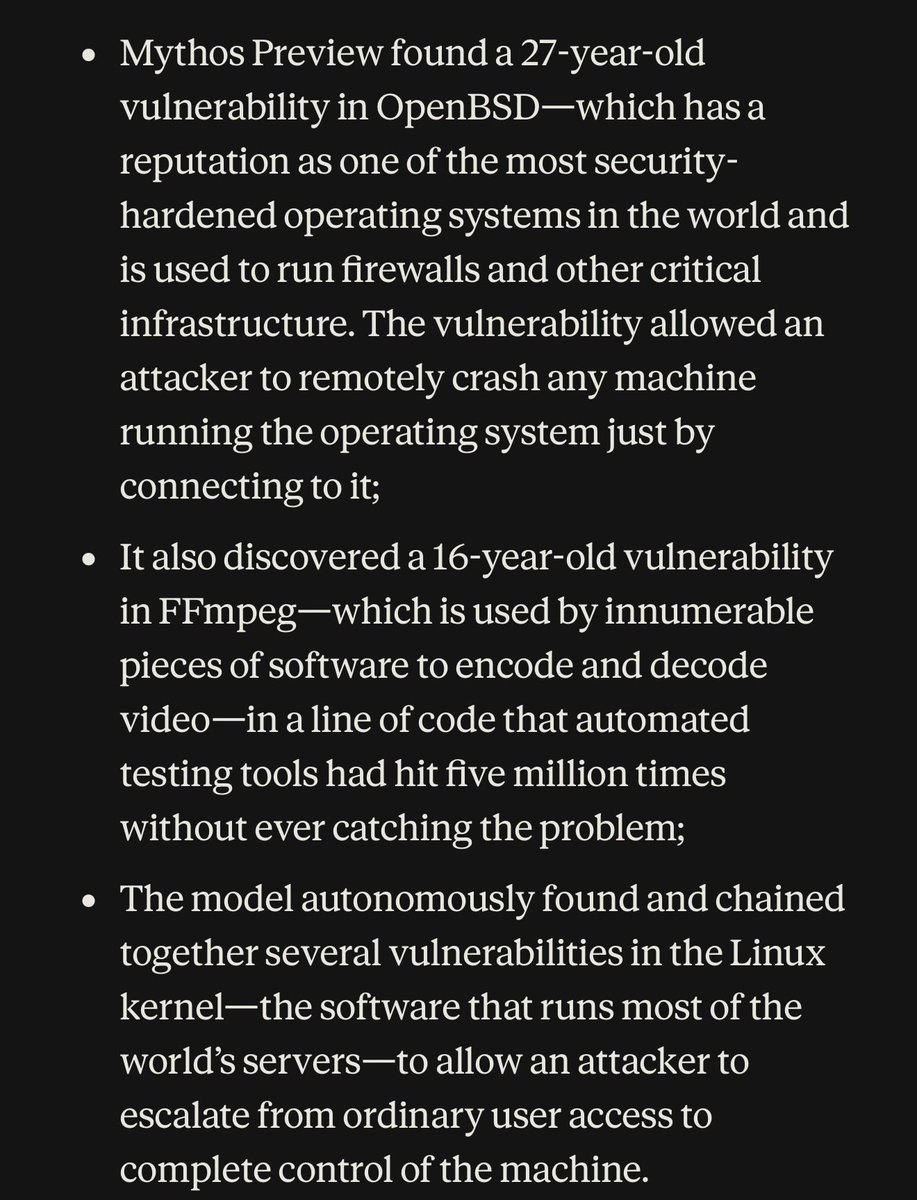
Introducing Project Glasswing: an urgent initiative to help secure the world’s most critical software. It’s powered by our newest frontier model, Claude Mythos Preview, which can find software vulnerabilities better than all but the most skilled humans. anthropic.com/glasswing
English

🚨Nuclear Tests, Missing Objects, and a New Paper That Corroborates Vasco's Findings
There's a new replication paper out looking at those Palomar sky survey plates from the 1950s. Using the same dataset Villarroel and Bruehl worked with, but this time Brian Doherty ran the analysis independently to see if the claims hold up, and they did.
We're talking about thousands of one off light events captured on photographic plates between 1949 and 1957. They show up once, then they're gone. No matching object either before or after.
That is already a bit odd, but the issue is what happens when you line those dates up with nuclear tests because when you look at days within one day of a detonation, the number of these transients goes up. Not by a tiny amount either, there is roughly a 45% increase in likelihood compared to normal days. That holds even when you factor in weather, cloud cover, moonlight, all the usual things that could mess with observations.
They shuffled the nuclear test dates thousands of times to see if random timing could recreate the same pattern but it couldn't. The real dates keep producing a stronger signal than the randomized ones and at that point you've got a correlation you can't just brush off.
They also checked where these transients show up in the sky relative to Earth's shadow. Anything inside that shadow can’t reflect sunlight. So if these were random flashes, or plate defects, or something atmospheric, you'd expect them to be spread out more evenly.
They show up far less often inside the shadow than they should. About a third of what you'd expect based on the geometry. This tells you that whatever these things are, they tend to be visible when sunlight can hit them.
This is all pre-Sputnik. During that period there were no satellites up there. No debris fields, or orbital junk reflecting sunlight back toward Earth.
If you try to explain it as atmospheric effects, you run into the shadow problem. The upper atmosphere doesn't care about a geosynchronous shadow cone. If you try to say it's just bad plates or scanning artifacts, that also doesn't explain why the events avoid specific regions of the sky in a way that lines up with orbital lighting conditions.
So you end up in a tight spot, you either have some unknown interaction between nuclear detonations and observational conditions that produces both a timing signal and a spatial pattern tied to sunlight, or you're looking at something that behaves like reflective objects in orbit before we officially had anything in orbit.
This is further confirmation of the Vasco teams findings. Replicated, tested and confirmed.
Source:
arxiv.org/pdf/2604.00056
#ufotwitter #uapX #Science #Astronomy @DrBeaVillarroel

English

I've never seen a pro-human accelerationist engage with the standard X-risks arguments, in good faith, and remain an accelerationist.
There are many accelerationists who are anti-human (who are OK with humanity being replaced by AI 'successor species'), and who take X risk as basically a net positive rather than a net negative.
But almost all accelerationists who want humanity to survive seem to know almost nothing about ASI alignment or ASI X-risk.
English

I was also confused by this - can any accelerationists steelman these arguments as countering the typical x-risk concerns?
Rosie Campbell@RosieCampbell
Yeah I had a similar reaction, all they said was: a) AI has massive potential upside (I don't disagree!) b) Technological advancement has been good in the past so why not assume it will be in future (an ok heuristic but not a fundamental law of reality; does not actually address the arguments)
English

“Not there yet”, we are not even “a little bit” there now, nothing of the kind is “at stake”.
(Imo-) It’s valuable philosophical work and I am glad folks are exploring it though, but at the end of the day it’s less plausible than aliens invading the earth, it misunderstands the nature of intelligence and agency and it’s not relevant for policy discussions or mainstream discourse.
I’m keen to understand how you developed such strong views though, is it because you see AI benchmark results going up every year? People/orgs you respect are saying it? Or are you interested in the notion of existential risk in of itself?
What would need to happen over the coming years for you to update and think this wasn’t actually that important after all?
English

If someone could convince me that there exists an intelligence ceiling below world takeover level, as @fchollet seems to believe, that would take away perhaps my biggest existential risk threat model.
English

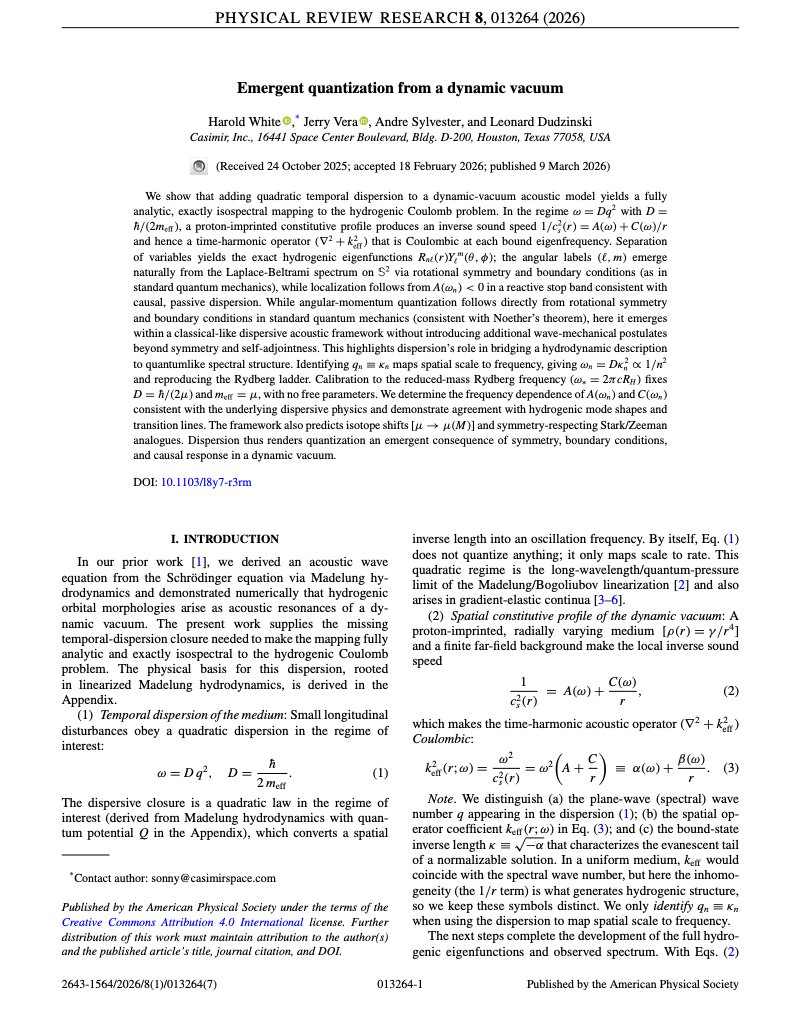
BREAKING: While a new War for Oil erupts in the Middle East
A Physics Paper just quietly dropped TODAY that will eventually make Oil, and the entire current Energy Industry, irrelevant.
Ushering in the era of Zero-Point Energy
@EagleworksSonny
Here is the breakthrough🧵

English

@JobstLandgrebe It would be fun to hear you on @liron podcast Doom Debates about your forthcoming book.
English

Apple has shown that LRMs do not reason (machinelearning.apple.com/research/illus…). In our forthcoming book the Myth of Machine Intelligence, we explain why this will not change.
English
Sitric O'Toole retweetledi

Dé Céadaoin beag seo/Wednesday 25 Márta. Tapaidh an deis chun do chuid Gaeilge a chleachtadh le craic, caint, ceol (agus ól) sa Cobweb/Gréasán an Damháin Alla i gCaisleán an Bharraigh
Ciorcal Cainte 8-9pm
#caisleánanbharraigh #gaeilge #irishlanguage
#ciorcalcomhrá

CY
Sitric O'Toole retweetledi

Ciorcal Cainte - Baile an Róba / Ballinrobe
📅Gach Máirt / Every Tuesday
🕐11am
📍 The Bowers Bar - Baile an Róba / Ballinrobe
Fáilte roimh chách. All are welcome
@ForasnaGaeilge

Suomi
Sitric O'Toole retweetledi