
Slant 3D

1.9K posts

Slant 3D banner
Slant 3D

Slant 3D

@Slant3D

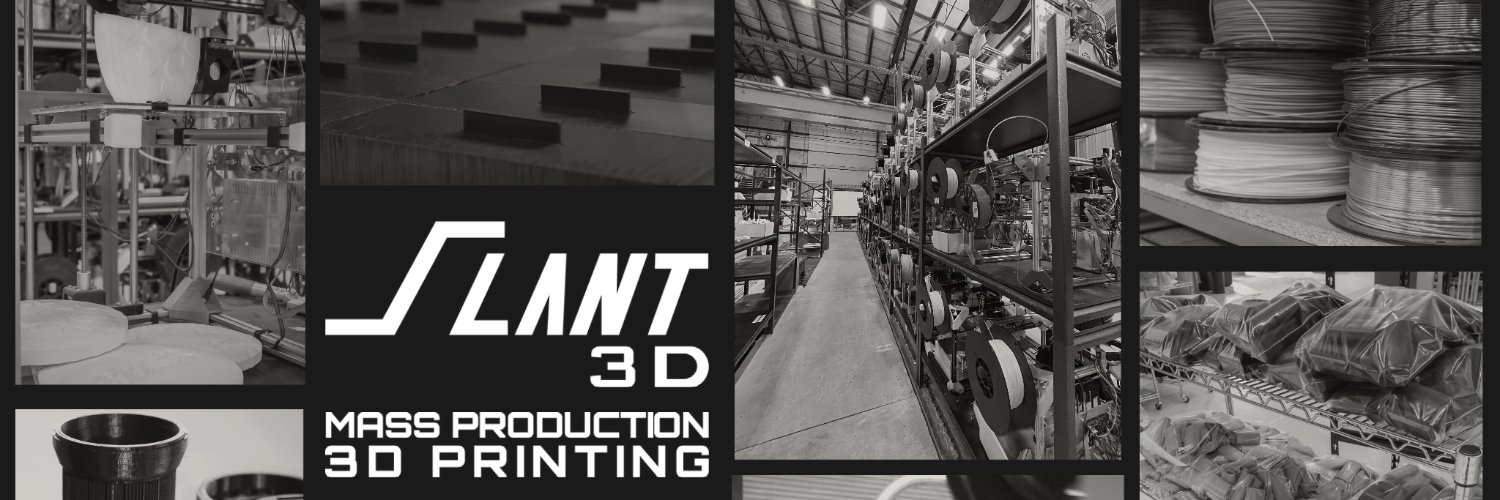
1000 3D printers on tap through our API and Teleport e-commerce 3D print service. Making Giant 3D print farms. #3dprinting #manufacturing

Boise, ID Katılım May 2018
277 Takip Edilen2K Takipçiler

2026 Yıllık Özeti

@Slant3D hesabının Twitter yılını gör

Slant 3D
Slant 3D@Slant3D·
We are a vertically integrated digital manufacturing company.
Slant 3D tweet media
English
1
0
10
304
Slant 3D
Slant 3D@Slant3D·
The devil of good manufacturing hurting an engineers need to add complexity for optimization.
Caleb (OSH Cut)@CalebChamberla6

@Saint_n0mad Super cool! But you just designed a part that'll cost about 10x what it could if you made it out of sheet metal.

English
0
0
9
827
Slant 3D
Slant 3D@Slant3D·
We have a pretty good line of sight for selling 3d prints for less than the cost of buying the material from Amazon.
English
2
1
23
1.2K
Slant 3D
Slant 3D@Slant3D·
When life gives you lemons...you suck it up, call the supplier and go get the oranges that you ordered
Slant 3D tweet media
English
1
0
7
328
Evan Reilly
Evan Reilly@verymidengineer·
@Slant3D Also can you please say whether or not the cost to print in your teleport service includes the fulfillment/shipping? Or at least create a page that breaks down what extra fees/costs are associated with this?
Evan Reilly tweet media
English
1
0
0
14
Evan Reilly
Evan Reilly@verymidengineer·
@Slant3D Why don't you offer a catalog of all the filaments you can print with? List maximum dimension? Before I invest in a product that targets your manufacturing I want to know what materials are at my disposal for things like finishing texture etc. Feels basic
English
3
0
0
38
Slant 3D
Slant 3D@Slant3D·
@girdley Don't be an entrepreneur. It sucks and is horrible and you will probably fail.
English
0
0
2
179
Michael Girdley
Michael Girdley@girdley·
Speaking to a college entrepreneurship class next week. What can I say so that I never get invited back?
English
314
2
158
50.8K
Slant 3D
Slant 3D@Slant3D·
Many of these types of items are boring. The talent to make mass producible beautiful things have focused on higher return activities (software, rockets) few spacex or apple engineers will go build phone booths. But since these items still have a deep need to exist they subsist on the talent and goals they have available. But they loose grace and intentionally in favor of low effort functionality
English
0
0
2
350
Patrick Collison
Patrick Collison@patrickc·
Someone asked me recently why I’ve become interested in aesthetics after having spent most of my life more interested in STEM-adjacent topics. I hadn’t really considered the question consciously before, but I’m certainly thinking about aesthetics more than I used to. I think it’s a confluence of things: • Many things today are ugly and far uglier than they used to be or need to be. Once you see this, it’s kinda hard to stop perceiving it. (Early twentieth century phone boxes versus modern phone boxes; old water fountains versus new water fountains; etc.) As someone with a naively meliorist assumption that most things should be getting better rather than worse, it’s all a bit perplexing: why did we stop doing things nicely? Is it a choice? Was there a malevolent spell cast upon us? This vein led me to think more about modernism and why much of art became more intentionally "challenging", grotesque, opposed to prettiness, rebarbative, dissonant, etc. Can or should anything be done about this? Is this just how things ought to be? • Relatedly, much of modernism involved a kind of explicit repudiation of cultural continuity and represented a schism with prior practices. This is maybe most evident in American architecture, where the International Style exhibition in 1932 initiated the displacement of a rich tapestry of prior styles. This cultural break seems important and interesting to me, and I suspect that the rejection had important consequences outside of the aesthetic domain. Samuel Hughes has been exploring this question in his recent writing at @WorksInProgMag; @RuxandraTeslo is also pulling on this thread. Elaine Scarry wrote about how beauty inspires creation. If so, the inverse may also be true: ugliness inhibits it. • It’s clearly the case that changes in the aesthetic domain can at least inspire progress in other places. Petrarch helped set some of the preconditions for the Renaissance which in turn fostered the scientific revolution and Enlightenment. Things like World Fairs (the 1851 Fair at the Crystal Palace recorded 6 million admissions when the population was 21 million) reflect the popular interdependency that used to exist between aesthetics and material development. • @tedgioia and others have written about stuck culture and how so many domains seem to have ceased to straightforwardly advance in the way that they did up until the nineties or thereabouts. This is obviously peculiar and interesting. What changed, and what does it mean? Is it about the internet and fragmentation? Is it about a loss of supply? Is it just about having reached the zenith of various mediums? • I’m generally interested in markets and the dynamics of creation. In aesthetics broadly, I find the reflexivity between supply- and demand-side factors to be very thought-provoking. There’s a natural desire to view satisfaction of individual preferences as the yardstick to measure market success, but things get interesting and even a bit unsettling when we start to think about how the supply might start to shape the demand. I often think about this in the context of food. Why is food so much worse in Germany than many of its neighbors? Germany certainly doesn’t have less material ability to produce good food; indeed, Germany is richer than the countries around it. There’s probably something about German food supply chains that is impoverished relative to France and Italy, but the Germans themselves don’t seem too upset about it. It just seems that the Germans are stuck in an objectively worse market equilibrium than their neighbors: the food is bad and they’ve gotten used to it. The obvious question then is where else these kinds of reflexive patterns apply, and where else we’re stuck in some objectively inferior equilibrium, even if preferences are in some superficial sense being sated. • While this is an extremely banal and obvious point, I hadn’t until recently thought much about or internalized how much one can study reasonably objective things ("the status of women in society", say) through artwork. (Thanks to @_alice_evans for opening my eyes here.) In this vein, I’m pretty excited about the possibilities over the coming years in computational art analysis. I want something that’s conceptually similar to Google Ngram timelines but for the visual arts. • We've always tried to do things well at Stripe. I've come to see that attempting to do them beautifully is often a helpful way to break out of standard practices and to do something with greater novelty and in a way that might have other benefits besides. (Also, excellent people want to do great work because it is intrinsically satisfying. Explicitly allowing aesthetic considerations to carry weight avoids having to justify every assessment with some kind of torturous empiricism.) • In his Nobel Lecture, Solzhenitsyn said that, among the Platonic virtues of goodness, truth, and beauty, that beauty is special, for it possesses a unique kind of irrefutability. He notes that arguments, writing, and philosophical systems can all be predicated on misapprehensions, but that “a true work of art carries its verification within itself.” He proceeds to observe that when goodness and truth are threatened, the “ever surprising shoots of beauty will still force their way through.” There is a lot of specious and motivated reasoning in the world today and plenty of questionable value systems. I don’t think that beauty directly reflects any definitive trait, but I’m intrigued by the idea that it can be a marker of deeper metaphysical coherence.
Patrick Collison tweet mediaPatrick Collison tweet media
English
412
472
5.2K
943.4K
p::rti
p::rti@parti_party·
@Slant3D A 32 cavity mold with a 10 sec cycle would make 192 parts a minute. For 1M parts, it would take 100 3D printers 70 days. It would 4 days for an injection mold. It's like trying to start a newspaper press with a bunch of small printers instead of using a large offset press
English
1
0
30
1.7K
Slant 3D
Slant 3D@Slant3D·
So we recreated Destin's knob for the SmarterScrubber to show how mass production 3d printing can make one part every 6 seconds. If a part takes ten minutes to print. And you have 100 machines 100 parts every ten minutes 10 parts every minute 1 part every 6 seconds. 3D printing scales fine. There are just to many historical fallacies floating around. youtu.be/F3ViXSLH_ZM
YouTube video
YouTube
Slant 3D tweet media
English
77
9
240
376.3K
Slant 3D
Slant 3D@Slant3D·
@bnemehh Every other process requires post processing and always will Fdm can go from the machine to the box instantly.
English
2
0
1
114
Slant 3D retweetledi
Tengiz
Tengiz@tengizlab·
Inspecting a 3D-Printed Turbine Blade This isn't an X-ray scan. It's a neutron computed tomography (CT) scan of an additively manufactured Inconel 718 turbine blade. Unlike conventional inspection methods, neutron CT allows engineers to visualize both the external geometry and complex internal features without cutting the part open. This is especially valuable for components with internal cooling channels that cannot be inspected directly. The scan is then compared with the original CAD model, allowing engineers to verify printing tolerances, detect internal defects, evaluate surface roughness, and confirm that the manufactured part matches the intended design before it enters service. Source: Oak Ridge National Laboratory
English
5
25
376
11.1K
Slant 3D
Slant 3D@Slant3D·
@paulsl_3 Right. You will take a file. Cut a mold. Usurp all your other work. Verify it. And have 100,000 out in a day. You have the secret to bringing manufacturing back to the US.
English
1
0
3
329
Mike Baier
Mike Baier@Mike__Baier·
Boring factory runs on a homegrown manufacturing execution system we call Wormhole. The system keeps track of the state of all 176,000 parts in each TBM on the line and issues tasks to everyone in the factory 24h a day, 7 days a week. It also manages our production assets (think lathes, mills, water jets, etc.) by keeping track of what job is assigned to each and the state of its preventative maintanence (PM) schedule. Each asset gets 2 dashboards - a PM dashboard and a task dashboard. If the machine is running a job and has all its PMs done both dashboards are bright green. If not, one or both are red. If you want to design a factory where issues bubble up to the right people as fast as possible - design it in a way that allows someone to “see” all the problems simply by taking a quick floor walk. This is one small example of a principle that we have employed throughout our entire factory.
Mike Baier tweet media
English
140
233
3.9K
160.8K
Slant 3D
Slant 3D@Slant3D·
Slant 3D has created 5 new jobs in the last two weeks.
English
2
1
15
473
Slant 3D
Slant 3D@Slant3D·
@YukonK9 Our megafarm is actually speced for 3000. Probably put 5000 in before done. And working on a couple more.
English
1
0
5
190
Slant 3D
Slant 3D@Slant3D·
Using the slicer to make a part perform the way you need is the 3d printing equivalent of "I'll fix it in post"
English
1
2
10
902