Slone Sterling (pen name)

603 posts

Slone Sterling (pen name) banner
Slone Sterling (pen name)

Slone Sterling (pen name)

@SloneSterling

Code is abundant. Energy, copper & compute are scarce. For families who want to understand why — before they feel it. Free field guide in the link.

Katılım Mart 2026
62 Takip Edilen48 Takipçiler
Sabitlenmiş Tweet
Slone Sterling (pen name)
Slone Sterling (pen name)@SloneSterling·
Ten years ago, I didn't have a framework for what was happening to the economy. I had anxiety. I had news. I had noise. What I needed was someone to show me the pattern underneath. Here's what I know now: The world isn't chaotic. It's causal. Every financial shock, every energy crisis, every AI headline — there's a First Domino. One thing that moved first and set everything else in motion. When you can see the domino, the chaos becomes a sequence. The fear becomes a framework. That's what I write. Every week. For families who are intelligent, time-constrained, and sense that something big is shifting — but can't quite name it yet. AI. Energy. Macro. Geopolitics. Crypto. The human cost of all of it. Not financial advice. Not hype. The pattern behind the noise, translated into something you can actually use. I put the methodology into a free field guide. It's called The First Domino — and it walks through three real examples of how the causal chain works. It's free. It's in the link in my profile. If it changes how you read the news, that's enough.
English
0
0
0
12
Slone Sterling (pen name)
Slone Sterling (pen name)@SloneSterling·
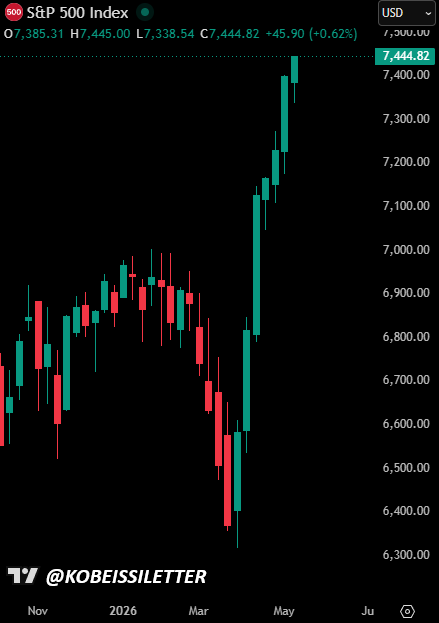
@KobeissiLetter $10.2T in market cap in 6 weeks. Know what didn’t move? The 10-year yield. The bond market didn’t get the memo. Equity markets reprice on hope. Bond markets reprice on math. When those two disagree this loudly, one of them is wrong. Which one do you trust?
English
1
0
9
932
The Kobeissi Letter
The Kobeissi Letter@KobeissiLetter·
BREAKING: The S&P 500 extends its historic rally into record high territory, now up +18% since its March 30th bottom. That's +$10.2 TRILLION in market cap added in just 6 weeks.
The Kobeissi Letter tweet media
English
274
436
3.4K
204.6K
Slone Sterling (pen name)
Slone Sterling (pen name)@SloneSterling·
$25–35B just for enrichment. That’s the chokepoint Russia controlled for 30 years — by design. Now the AI buildout needs 24/7 baseload power and there’s only one answer. The scarcity isn’t in the model. It’s in the yellowcake. What happens to this number when hyperscalers start bidding too?
English
0
0
0
37
Slone Sterling (pen name)
Slone Sterling (pen name)@SloneSterling·
Smart money doesn’t exit. It relocates. The largest tech selloff in a decade isn’t panic — it’s a portfolio making room. The Mag 7 era was the software chapter. What’s being written next is physical. Every dollar leaving semiconductors is a dollar searching for the infrastructure that makes semiconductors matter. The code was never the destination. It was always the road. The question is — where does the road lead when the smart money finally reads the map?
English
0
0
0
86
The Kobeissi Letter
The Kobeissi Letter@KobeissiLetter·
Hedge funds are rushing to reduce tech exposure: Hedge funds just posted their largest 2-week reduction in US information technology exposure over the last decade, excluding the meme stock frenzy in early 2021. This was driven by long sales outpacing short covers at a ratio of 1.5 to 1. Nearly every subsector saw exposure cuts, led by Semiconductors and Semi Equipment via long sales. Furthermore, hedge funds sold Magnificent 7 stocks in 4 of the last 5 trading sessions. Hedge funds are cashing-in massive profits in tech.
The Kobeissi Letter tweet media
English
189
264
1.9K
314K
Slone Sterling (pen name)
Slone Sterling (pen name)@SloneSterling·
The switchboard operator didn't disappear because she became less valuable. She disappeared because the infrastructure underneath her changed. We keep making this about the job. It was never about the job. Every great transition in history changed not just what people did — but what people were for. The real question isn't what AI takes from us. It's who we decide to become on the other side of it.
English
0
0
0
43
Slone Sterling (pen name)
Slone Sterling (pen name)@SloneSterling·
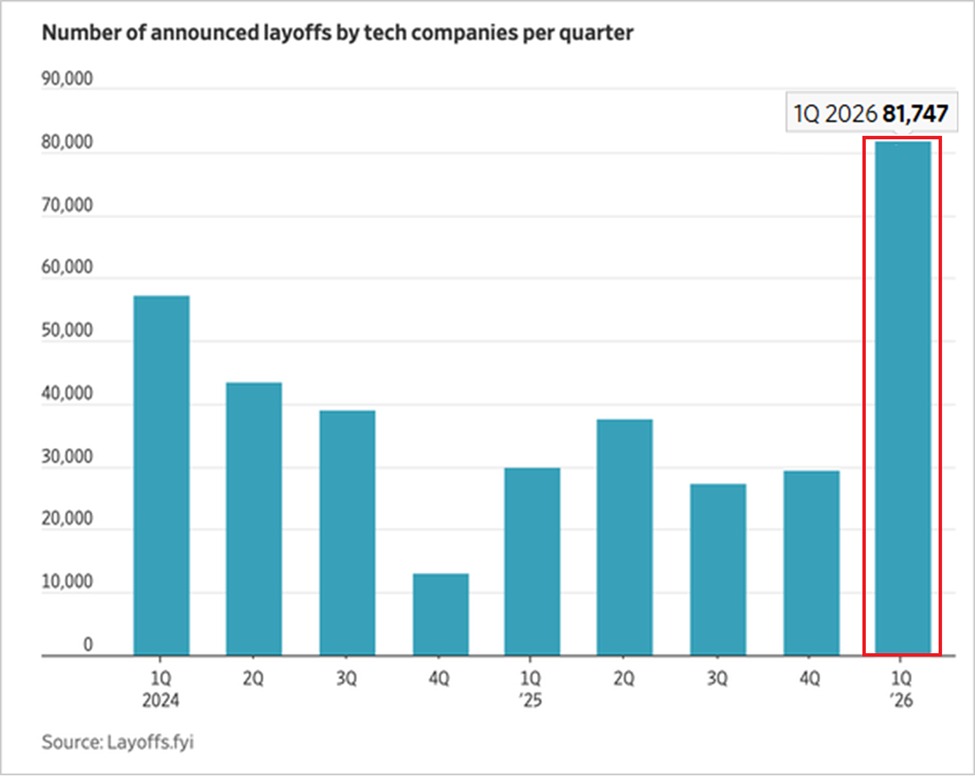
81,747 tech layoffs isn’t a contraction story. It’s a capital reallocation story. Every person cut is a dollar redirected from salaries into megawatts, copper, and compute. The tech industry isn’t shrinking — it’s molting. Shedding the software-era workforce to fund the physical infrastructure era. The jobs disappearing are white collar. The jobs being created are in the ground and on the grid. Are we building the education system fast enough to close that gap?
English
0
0
2
1.6K
The Kobeissi Letter
The Kobeissi Letter@KobeissiLetter·
Tech layoffs are skyrocketing: Tech companies announced 81,747 layoffs in Q1 2026, the highest quarterly total since at least Q1 2024. Layoffs have more than DOUBLED from the previous quarter and have risen +580% since Q4 2025. March alone saw 45,800 announced job cuts, the worst single month for tech layoffs in at least 2 years. Tech layoffs are set to remain elevated with Meta's, $META, recent plans to cut ~8,000 employees. Furthermore, Microsoft, $MSFT, is offering voluntary retirement to ~7% of its US workforce, which could transition into layoffs if participation is low. This comes as tech giants shift spending toward AI chips and data centers, trimming staff to free up capital for infrastructure. US tech employment is rapidly contracting.
The Kobeissi Letter tweet media
English
236
770
3.1K
597.2K
Slone Sterling (pen name)
Slone Sterling (pen name)@SloneSterling·
The DOJ protected competition so hard they killed the competitor. 17,000 jobs gone. Fewer choices. Higher fares. This is what happens when regulators fight the last war instead of reading the structural shift happening in front of them. The same playbook is now being run on AI and energy infrastructure. Slow the permits, block the mergers, debate the policy — while the rest of the world pours concrete. How many Spirit Airlines moments are we building into the energy transition right now?
English
0
0
4
1.2K
The Kobeissi Letter
The Kobeissi Letter@KobeissiLetter·
This is truly unfortunate: In 2022, JetBlue had agreed to merge with Spirit Airlines in a $3.8 billion transaction. This was intended to end Spirit's imminent bankruptcy and employ the majority of Spirit's 17,000 employees. One year later, in 2023, the US Department of Justice sued to block the merger, saying it would reduce competition and drive up fares. Fast forward another 2 years to today, and Spirit has officially gone bankrupt, ceased operations, and 17,000 people are now unemployed. And, tens of thousands of Spirit passengers are now "stranded." The worst part? The "reduced competition" that the DOJ thought they were avoiding by blocking the transaction has only gotten worse. There quite literally is no competition in the space anymore. This will go down as one of the biggest transactional failures in US history.
The Kobeissi Letter tweet media
English
418
645
5.1K
506.4K
Slone Sterling (pen name)
Slone Sterling (pen name)@SloneSterling·
This map isn’t about weather preparedness. It’s a blueprint for where the AI economy actually gets built. Data centers don’t follow talent pipelines or tax incentives anymore — they follow the grid. Florida and Alabama just became the most valuable real estate in the AI buildout and most people are still looking at Silicon Valley. The compute follows the power. Always has. Which states on this map are quietly becoming the next data center corridors?
English
0
0
0
59
Visual Capitalist
Visual Capitalist@VisualCap·
As AI and data centers raise electricity use, these states are best prepared for power demand surges ⚡ This graphic, in partnership with the @_NPUC, shows the states most prepared for power demand surges using peak potential demand savings data from the EIA. visualcapitalist.com/sp/mapped-the-… #npuc26
Visual Capitalist tweet media
English
2
22
46
6.6K
Slone Sterling (pen name)
Slone Sterling (pen name)@SloneSterling·
BNP sees speculation. Here’s what they’re not modeling. Every AI data center being built right now requires 4-5x more copper than a conventional building. $600B in Mag 7 AI spend this year alone — all of it needs wire, cooling, and grid connection. The “oversupply” BNP sees today meets an AI buildout demand curve that hasn’t fully arrived yet. What happens to that surplus when 50 gigawatts of new data center capacity comes online simultaneously?
English
0
0
0
184
*Walter Bloomberg
*Walter Bloomberg@DeItaone·
COPPER MAY SPIKE TO $14,000 ON SPECULATION BEFORE FUNDAMENTALS WEIGH IN BNP Paribas says copper could rise to around $14,000/ton in Q2, driven more by investor speculation than supply-demand strength. The bank sees momentum tied partly to geopolitical sentiment, including potential progress on Middle East peace. However, it warns the underlying market is oversupplied, and that surplus is likely to persist. Forecasts: Q2 average: $13,800/ton Q4 drop: $12,650/ton BNP expects the rally to fade in the second half of 2026 as fundamentals reassert themselves. Meanwhile, LME copper is slightly lower at $13,012/ton (-0.2%).
English
50
32
285
63.9K
Slone Sterling (pen name)
Slone Sterling (pen name)@SloneSterling·
Exactly, Mining is where the leverage lives. A 10% move in a metal can mean a 40-60% move in the right miner. But most retail investors are buying the software story while the real asymmetry is sitting in the ground. The picks and shovels of the AI revolution aren’t GPUs — they’re drills, open pits, and processing plants. The question is whether you have the stomach for the volatility that comes with it.
English
2
0
1
41
Raging Buffalo
Raging Buffalo@RagingBuffaloX·
Indeed, all connected. Shanghai Metals Market recently put out an article stating that one of the biggest drivers for silver will be in solid-state lithium batteries as well. Electrification does not move backwards, only forwards, and resources to build the future are the major play. Certain mining companies currently appear juicy with exponential growth potential.
English
1
0
2
64
The Kobeissi Letter
The Kobeissi Letter@KobeissiLetter·
Our most frequently asked question right now: "If oil prices are above $100/barrel and the Iran War isn't over, why are stocks at record highs?" The answer to this question is simple. The AI Revolution has simply become so large, that investors are viewing everything else as "noise." Over the last few months, as large cap technology stocks traded flat then sharply lower amid the Iran War, the AI narrative only grew. The Magnificent 7 companies are set to invest over $600 BILLION in AI this year alone. And, as broader markets swept tech giants like Nvidia and Alphabet lower, these stocks reached their cheapest Forward P/E levels since 2019. At the March 30th bottom, the S&P 500 Information Technology index was trading at just a 4% Forward P/E premium to the S&P 500, the lowest since January 2019. Tech stocks became cheaper than the average S&P 500 stock for the first time since 2017. Nvidia, for example, is now trading at just a ~26x Forward P/E multiple, even as it is back at record highs. Walmart? 43x. Costco? 46x. The reality is that many large cap technology stocks are merely getting cheaper as they go up. And when they go down, they become remarkably cheap. We are in the biggest technological revolution in modern history, and even $100 oil, a 4.40% 10Y Yield, and rate cuts priced out until 2027 are unable to derail the train. Asset owners will continue to win.
English
341
505
4.7K
528.9K
Slone Sterling (pen name)
Slone Sterling (pen name)@SloneSterling·
Lithium and silver are the right instinct. But here’s the layer most miss — copper is the nervous system connecting all of them. Every lithium battery needs copper. Every uranium reactor needs copper. Every AI data center needs copper. You can own the king and the prince, but without the nervous system, none of it moves. What happens to copper when the AI buildout, the energy transition, and the grid hardening race all peak demand at the same time?
English
1
0
1
84
Slone Sterling (pen name)
Slone Sterling (pen name)@SloneSterling·
Dimon naming stagflation isn’t a warning. It’s a confirmation. Rising energy costs plus slowing growth plus a Hormuz chokepoint that 79% of oil executives don’t expect to normalize until August. That’s not a cycle — that’s a structural reset. The assets that survive stagflation aren’t in software. They’re in the physical stack. What’s in your portfolio that actually works when both inflation and growth move against you?
English
0
0
0
751
*Walter Bloomberg
*Walter Bloomberg@DeItaone·
DIMON SAYS WORST CASE I WORRY ABOUT IS STAGFLATION
English
46
46
492
92.6K
Slone Sterling (pen name)
Slone Sterling (pen name)@SloneSterling·
Russia just exported energy sovereignty to Bangladesh. That’s not an infrastructure deal — it’s a geopolitical anchor. Rosatom doesn’t just build reactors. It builds dependency, influence, and allegiance for 60 years. While the West debated permits, Moscow was pouring concrete. The global energy order is being rewritten one reactor at a time. Who builds the next one?
English
0
0
0
365
Mario Nawfal
Mario Nawfal@MarioNawfal·
🇧🇩🇷🇺 Bangladesh just became a nuclear-powered nation. Russia built it, Rosatom flipped the switch. Another country that didn’t ask for permission to turn the lights on.
English
501
2.4K
15.1K
981.8K
Slone Sterling (pen name)
Slone Sterling (pen name)@SloneSterling·
Ending the war without a nuclear deal doesn’t end the energy equation. Iran still sits on the Hormuz chokepoint. No deal means no normalization of oil flows, no LNG rerouting relief, no reduction in the energy sovereignty arms race already accelerating across Europe and Asia. Peace without a deal isn’t stability. It’s a frozen chokepoint. And frozen chokepoints are still chokepoints. Who fills that energy vacuum?
English
0
0
1
189
Slone Sterling (pen name)
Slone Sterling (pen name)@SloneSterling·
@MarioNawfal Bessent's "security we've never seen" = 1991 Gulf War convoy model. THEN: • Operation Earnest Will (1987): US reflagged Kuwaiti tankers • Provided naval escorts through Hormuz • Ended when Iran-Iraq War concluded (1988) NOW: • Same convoy model but Iran controls both sides of strait • "Security" requires 2 carrier groups + 45K troops permanently • Costs $2.5B/month (vs. $2M one-time toll) We're in the "unsustainable protection" phase. US can provide security, but can't afford it long-term. The math favors Iran: They collect tolls profitably while US bleeds budget. Next: Watch for "burden-sharing" announcement (Gulf states pay for US protection). That's when this becomes transactional, not alliance-based. NATO fractures, Gulf becomes mercenary operation.
English
0
0
0
26
Mario Nawfal
Mario Nawfal@MarioNawfal·
🇺🇸🇮🇷 Sec. Bessent: "We have taken actions to ensure oil supply stranded at sea are made available to the global market. Soon [we will] provide shippers through the Gulf region with a level of security we have never seen before."
Mario Nawfal@MarioNawfal

🇺🇸🇩🇪🇮🇷 Trump: "When I heard the head of Germany say this is not our war about Iran... I said well, Ukraine is not our war, we helped. I thought it was a very inappropriate statement to make. But he made it. He can't erase it."

English
30
15
99
54.9K
Slone Sterling (pen name)
Slone Sterling (pen name)@SloneSterling·
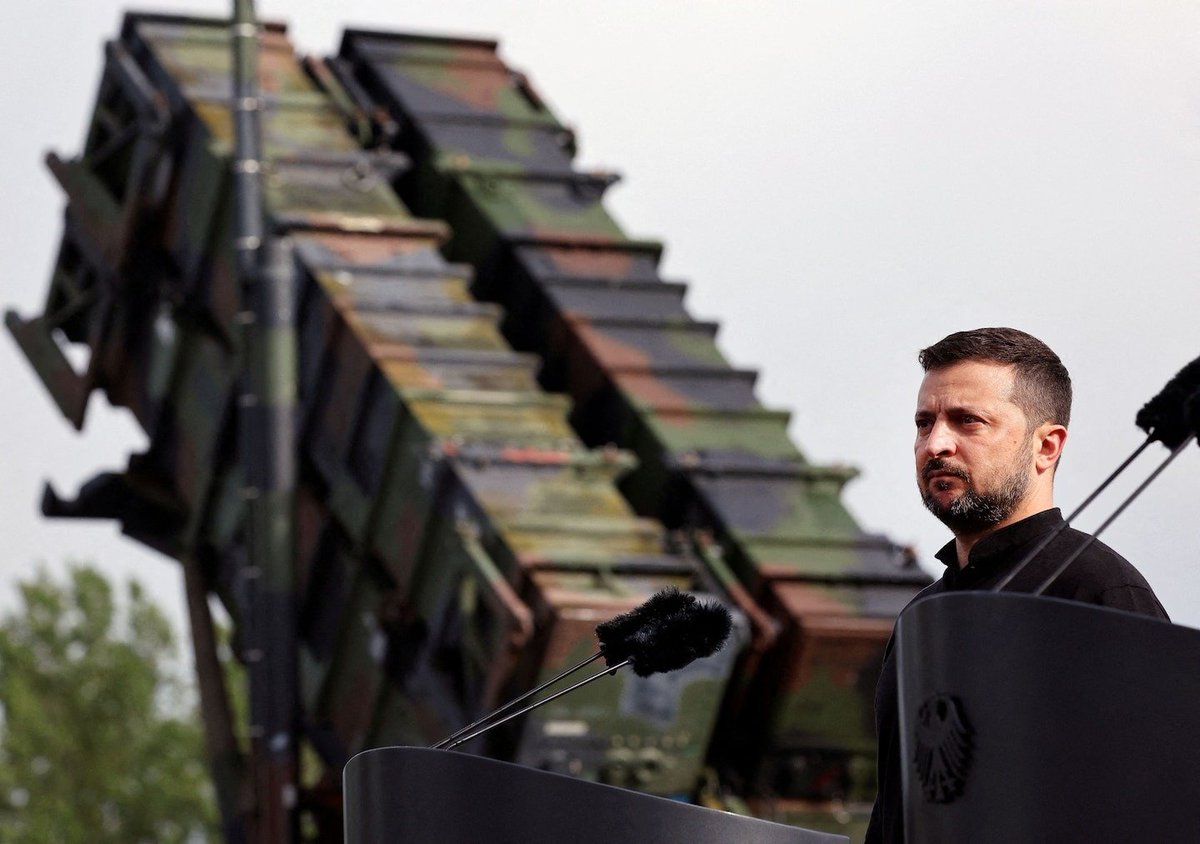
@MarioNawfal The Ukraine-to-Iran weapons redirect reveals fiscal triage: 9,000 targets hit → Critical stockpiles depleted → Ukraine aid frozen → Zelensky forced to negotiate Donbas → War ends to free munitions for Iran • US burned through 4 weeks of stockpiles in 3 weeks • Ukraine depends on exact same missiles (Patriots, JASSMs) • $61B allocated but only $34B disbursed (rest redirected) Translation: Hormuz didn't just close a waterway—it closed Ukraine's war. Trump's forcing Donbas deal because he can't afford two theaters simultaneously. Next: If Ukraine deal closes by Monday, expect immediate munitions shipments to Gulf. That's the tell this was always about resource constraints, not diplomacy.
English
0
0
0
16
Mario Nawfal
Mario Nawfal@MarioNawfal·
🇺🇸🇮🇷🇺🇦 The Pentagon is considering redirecting weapons meant for Ukraine to the Middle East as the war with Iran drains U.S. munitions. This isn’t a final decision yet. In less than 4 weeks, the U.S. has already hit over 9,000 targets, burning through critical stockpiles. The weapons at risk include key air defense missiles Ukraine depends on. Now the trade-off is on the table. The more the U.S. commits to Iran, the less it can sustain elsewhere. And Ukraine could be the one that feels it next. Source: WaPo
Mario Nawfal tweet media
Mario Nawfal@MarioNawfal

🇺🇸🇮🇷 Sec. Bessent: "We have taken actions to ensure oil supply stranded at sea are made available to the global market. Soon [we will] provide shippers through the Gulf region with a level of security we have never seen before."

English
36
31
105
59.7K
Slone Sterling (pen name)
Slone Sterling (pen name)@SloneSterling·
@AndreasSteno The binary choice reveals fiscal constraints: Deal with toll revenue-split → Iran keeps chokepoint control → Permanent yuan-denominated fees → Dollar loses 20% of oil settlement share OR Boots on ground → $2.5B/month operation cost → Deficit explodes → Bond market crisis (10Y already at 4.4%) Translation: Both options weaken the dollar. Deal legitimizes yuan. Invasion bankrupts the Treasury. Markets haven't priced this yet—they're treating it as "temporary crisis." Watch: If deal announced, expect immediate yuan strengthening and oil price collapse ($80-90 Brent). If boots on ground, expect 10Y spike to 5%+ and equity selloff. Position: Yuan exposure (CNH bonds), defense contractors (invasion), or cash (if neither option resolves cleanly).
English
0
0
0
17
Andreas Steno Larsen
Andreas Steno Larsen@AndreasSteno·
Seems like the choice is 1) Deal that includes a toll/revenue split on a Hormuz toll 2) Boots on the ground And we will know more by monday
English
52
10
271
36.5K
Slone Sterling (pen name)
Slone Sterling (pen name)@SloneSterling·
@zerohedge Stocks unpriced for escalation because of the earnings lag constraint: • Q1 earnings reports start April 15 (3 weeks away) • Companies report Q1 results (Jan-Mar, mostly pre-crisis) • Q2 guidance will show full Hormuz impact (shipping costs, energy, inflation) Translation: Markets are trading on stale data. The repricing happens when Q2 guidance drops and analysts realize: • Margins compressed 300-500bps (energy + shipping costs) • Revenue growth negative (consumer tapped out) • Inventory stuck in 60-day transit (working capital crisis) Real crash comes April 15-30 during earnings season. Current consolidation is the calm before Q2 guidance devastation.
English
0
0
0
11
Slone Sterling (pen name)
Slone Sterling (pen name)@SloneSterling·
@zerohedge META's -6.5% reveals the ad spending contraction from Hormuz: Oil at $120 → Consumer spending craters → Digital ad budgets cut first → META/Google revenue guidance slashed → Tech selloff accelerates But here's what's missed: - META's data center energy costs also spiking. - AI training requires massive power—and energy prices up 85% since January. • META operates 21 data centers (18 in US) • Average data center uses 30MW (equivalent to 25,000 homes) • Electricity costs up 40-60% depending on region Translation: META getting margin compression from both sides—revenue down (ad cuts) + costs up (energy). This isn't a dip to buy. It's repricing for lower-margin reality.
English
0
0
0
11
zerohedge
zerohedge@zerohedge·
META -6.5%
Español
32
31
438
73K