Spencer

952 posts

Spencer

Spencer

@Spencer_Nit

fun but not cool. writer.

United States Katılım Nisan 2017
631 Takip Edilen195 Takipçiler
Spencer retweetledi
Asimov Press
Asimov Press@AsimovPress·
New fiction alert: "How to See the Dead." 🚨 A retinal implant designer is asked by a grieving widow to help her see her dead husband again. By @spencer_nit
Asimov Press tweet media
English
1
5
20
5.5K
worm_in_heaven
worm_in_heaven@oneshoeistoobig·
I get confused when B. Irving is playing because i think it’s me
English
1
0
3
68
Spencer retweetledi
The Adroit Journal
The Adroit Journal@adroitjournal·
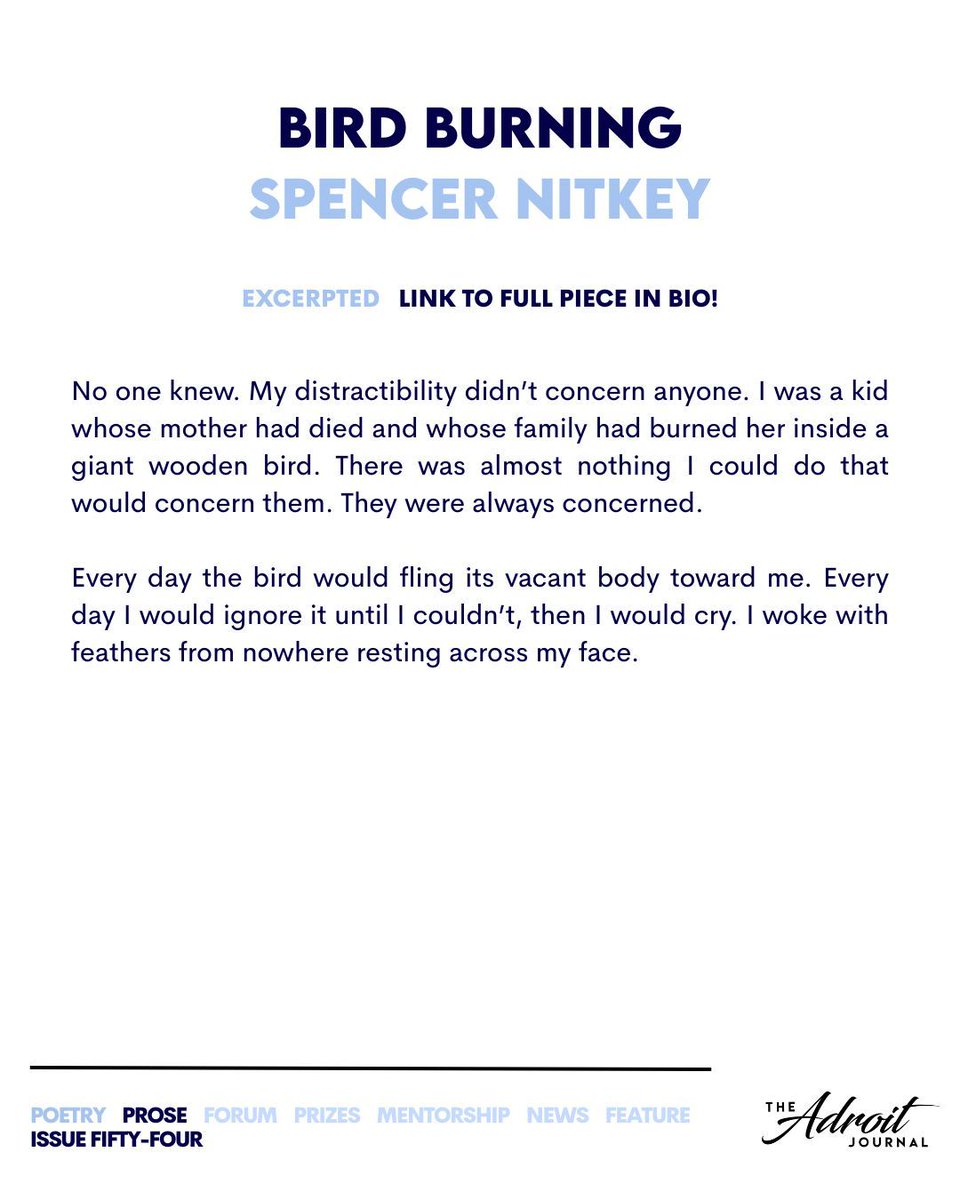
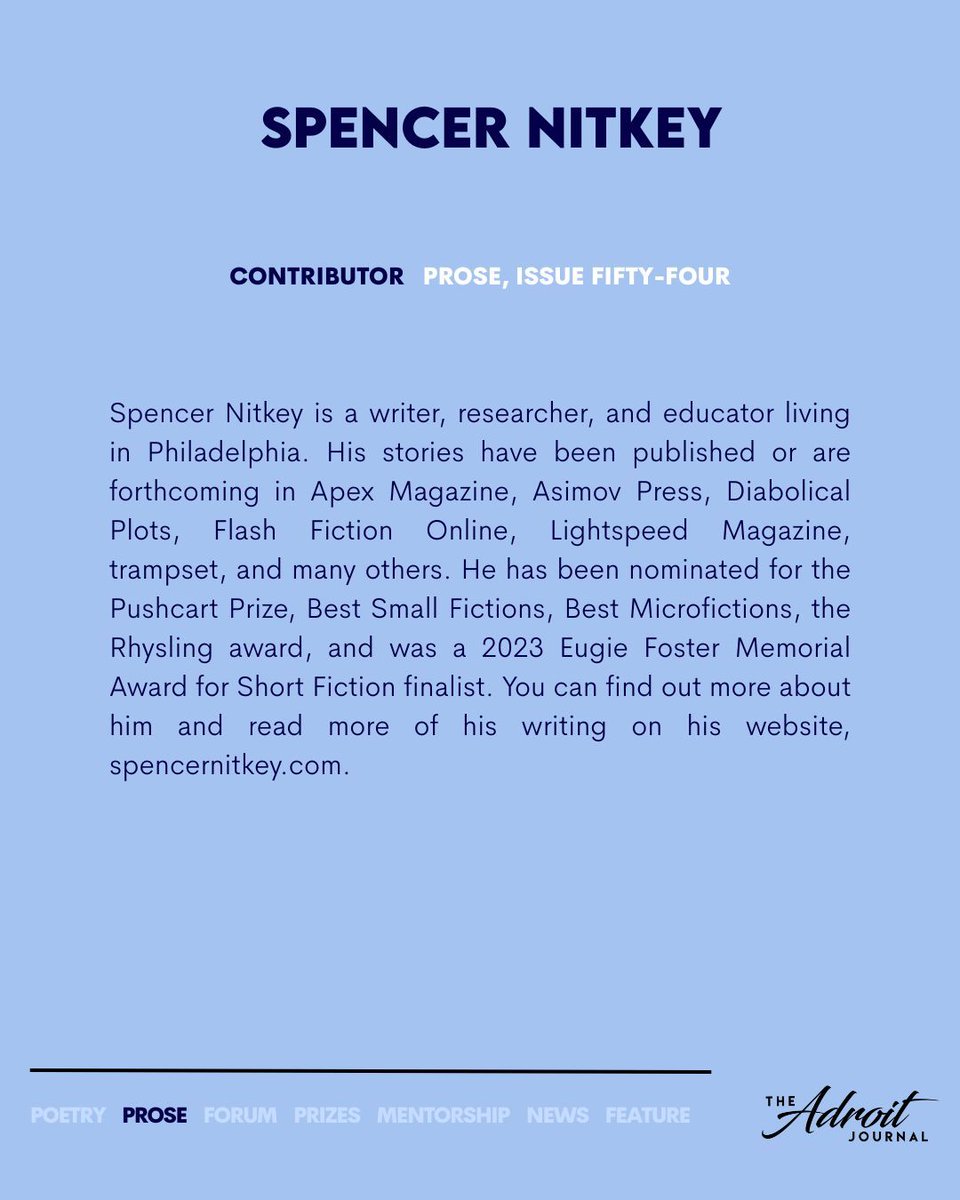
“Bird Burning” by Spencer Nitkey appears in Issue Fifty-Four. Read the full piece via the link in our bio. 🕊️🔥
The Adroit Journal tweet mediaThe Adroit Journal tweet mediaThe Adroit Journal tweet media
English
0
2
5
654
Spencer
Spencer@Spencer_Nit·
@Greg_Gerke Are you open all September or on specific tba dates?
English
1
0
1
33
Spencer retweetledi
Niko McCarty.
Niko McCarty.@NikoMcCarty·
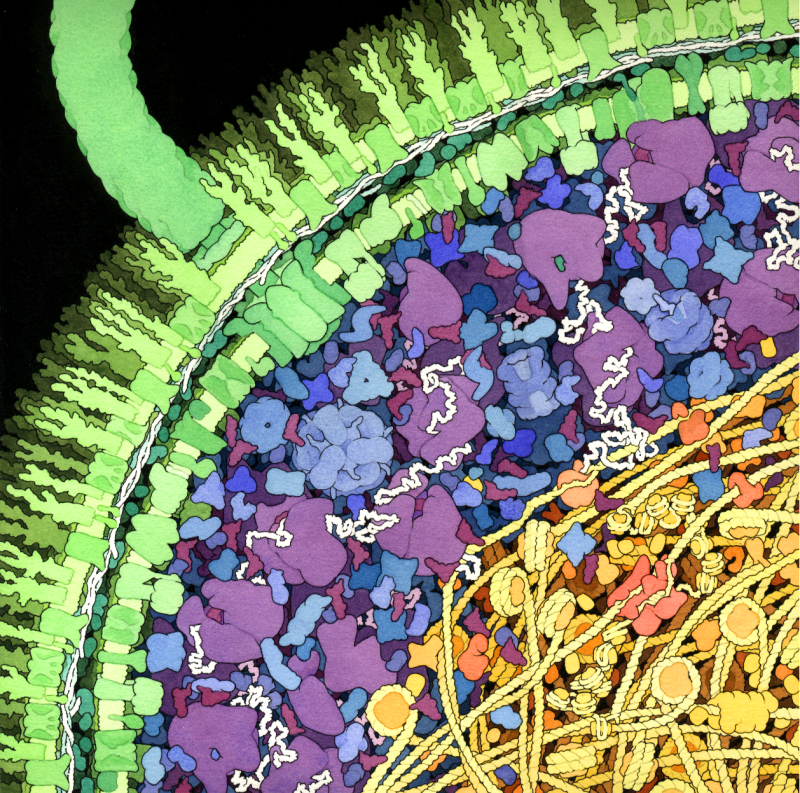
I'm (slowly) writing the book I've been thinking about for the last 3+ years. Nothing official yet, but I'm hoping to write a deeply mechanistic and interactive, Bartosz Ciechanowski-style book about how a single E. coli cell works. It will cover DNA, transcription, signaling, diffusion, metabolism, and so on. It will present everything through a quantitative lens, such that readers get a real "sense" of these things; how they look, how big they are, how fast they move. There will be boxes in each chapter that actually explain where those numbers came from, and the experiments through which they were collected. It's sort of an intellectual continuation of my prior @AsimovPress essays on this subject: Biology is a Burrito, Fast Biology, Recipe for a Cell, What Limits a Cell's Size? and The Weight of a Cell. I'd like to publish every chapter for free, online, and then do a print book later. Heavily inspired by Stewart Brand's "Book in Progress" for @WorksInProgMag and Michael Nielsen's Quantum Country textbook. If you are a biophysicist, or just someone who might enjoy reading this book, or an illustrator/animator, I'd really love to talk with you and get ideas. (I'm also looking for a publisher!) My dream would be for this book to supplant some of the textbooks currently used in high school biology classes. Let me know what you think. What should I cover? (Painting by David Goodsell.)
Niko McCarty. tweet media
English
108
144
1.8K
80.4K
Spencer retweetledi
Niko McCarty.
Niko McCarty.@NikoMcCarty·
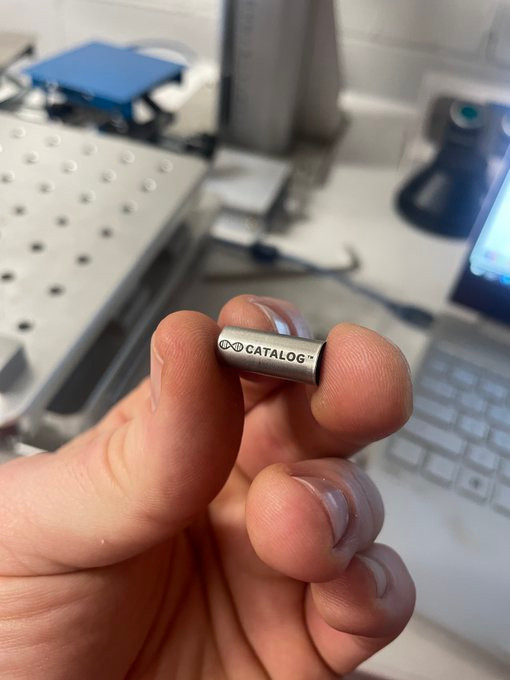
While making the second @AsimovPress book, we asked CATALOG (a DNA computing company in Boston) if they could write it in DNA. And they said yes! But the encoding steps, or how the book was converted to nucleotides, wasn't obvious. Now a new paper explains it all in detail. The open-access paper explains how CATALOG wrote "The Complete Works of William Shakespeare—about 1 million words of text—into DNA with raw error rates rivaling conventional media." Now, a direct encoding scheme would be to simply convert each letter of text into its binary form. So you could say that A = 00, T = 01, C = 10, and G = 11, and then you could go through all the words, convert them into binary, and synthesize the DNA accordingly. But that would not be super efficient and would be super expensive to synthesize! So instead, CATALOG started with a plain text file of Shakespeare, where all the punctuation had been removed and all the words were made lowercase. Then, they split this text into individual words, resulting in 982,890 total words or 29,869 unique words. The final file was only 5 MB. Each unique word was next turned into DNA. The trick here is that CATALOG didn't use a direct encoding scheme, but rather started with 81 short pieces of DNA that they had already made ahead of time. You can think of these 81 sequences a bit like Lego bricks. Then, these "bricks" were partitioned into 14 sets; some sets had 4 bricks, others had 5, and and so on. CATALOG took just the first six sets of DNA bricks (containing 6, 5, 5, 5, 5, 5 bricks, respectively) and used that to write the words in Shakespeare. The other sets were used for retrieval, identifying where in the text the words show up, and so on. They picked exactly one brick from each of these six sets and stuck them together in order, thus making a longer DNA molecule called an identifier. There are 18,750 possible identifiers one can make by connecting a single brick from each of the first six sets. I'm simplfying a bit, but each word was basically assigned a set of 3 different identifiers. (So for the word love, maybe identifiers #984, #12,442, and #17,301 would be selected, and they would synthesize and combine those 3 DNA molecules.) Every unique word in Shakespeare got its own unique pattern of three identifiers, and that pattern is the code for the word. So finally, they went through the Shakespeare text word-by-word, looked up the three identifiers for each word, and told their custom-built DNA printer — a machine called “Shannon” — to make them. Shannon works fast because it just mixes the bricks together into a spot and lets chemistry glue them together automatically. The DNA printing took minutes, and processing the DNA afterwards took a few hours. They checked their work by sequencing the DNA and comparing it to the original text. Only about 2% of the identifiers were wrong before error correction. Read the paper: dl.acm.org/doi/pdf/10.114… Get the book ($30): press.asimov.com/books
Niko McCarty. tweet mediaNiko McCarty. tweet media
English
6
38
212
21.5K
Spencer retweetledi
Niko McCarty.
Niko McCarty.@NikoMcCarty·
This paper is really elegant and beautiful. Researchers took a vesicle, filled it with a single type of enzyme and some protein pores, and showed that this "minimal cell," made from just three components (!!), could "actively propel itself toward an enzyme substrate gradient." Here are some more details on what they did and why this is so cool. First, they encapsuled one enzyme (either urease or glucose oxidase) into the vesicle. They also included some pore proteins (α-hemolysin) to allow molecules to freely diffuse into, and out of, the vesicles. Next, these loaded vesicles were put in a microfluidic chamber with a substrate gradient (either glucose or urea) and watched under a microscope. Vesicles without any pores drifted around aimlessly. But, oddly enough, the vesicles carrying a single enzyme and some pores were able to actively move up the substrate gradient. The vesicles loaded with urease, for example, moved 0.3 µm/s up the gradient. (They did not move whatsoever in the y-direction.) This is really surprising to me because these vesicles have no flagellum or energy source. Indeed, they don't have any obvious mechanism to move whatsoever! All they have is this one enzyme and some pores poked in the vesicle's membrane. The researchers, appropriately, tried to explain how these vesicles move in the paper. Here's what they think is going on. When you drop a vesicle into a chemical gradient, there is a different concentration of molecules on each side. One side of the vesicle is "exposed" to a higher concentration of, say, urea than the other side. These molecules bump into the vesicle and tug on it, but generally the effects are random and small. But now, if you add an enzyme and a pore to that vesicle, it isn't passive anymore. Substrates are diffusing into the vesicle, and then the enzyme inside is transforming them and spitting out new products. These new "products" build up inside the vesicle and need to escape through the pores. This gradually sets up a tiny imbalance in chemical concentrations around the vesicle, which is enough for the vesicle to basically recoil from its own "exhaust pipe." Note that this effect is REALLY different for different enzymes. Urease triggered the fastest movements, whereas other enzymes led to much smaller effects. It all depends on how quickly the enzyme makes products, what those products are, how many pores are in the vesicle, and so on. There are a lot of variables. But still, the researchers ran LOTS of control experiments for this paper just to be sure this wasn't a fluke. They watched and recorded "empty vesicles, empty vesicles with pores..." and other controls, too. None of them had any "appreciable difference in drift." The movements were "only observed when vesicles incorporate both an encapsulated enzyme and functional pores." I really like this paper (and all its math equations), because it shows just how complicated it can be to understand even a super simple biochemical system; in this case, a system made of little more than a vesicle, an enzyme, and a pore.
Niko McCarty. tweet mediaNiko McCarty. tweet mediaNiko McCarty. tweet media
English
13
108
606
40.2K
Spencer retweetledi
Impressions
Impressions@impression_ists·
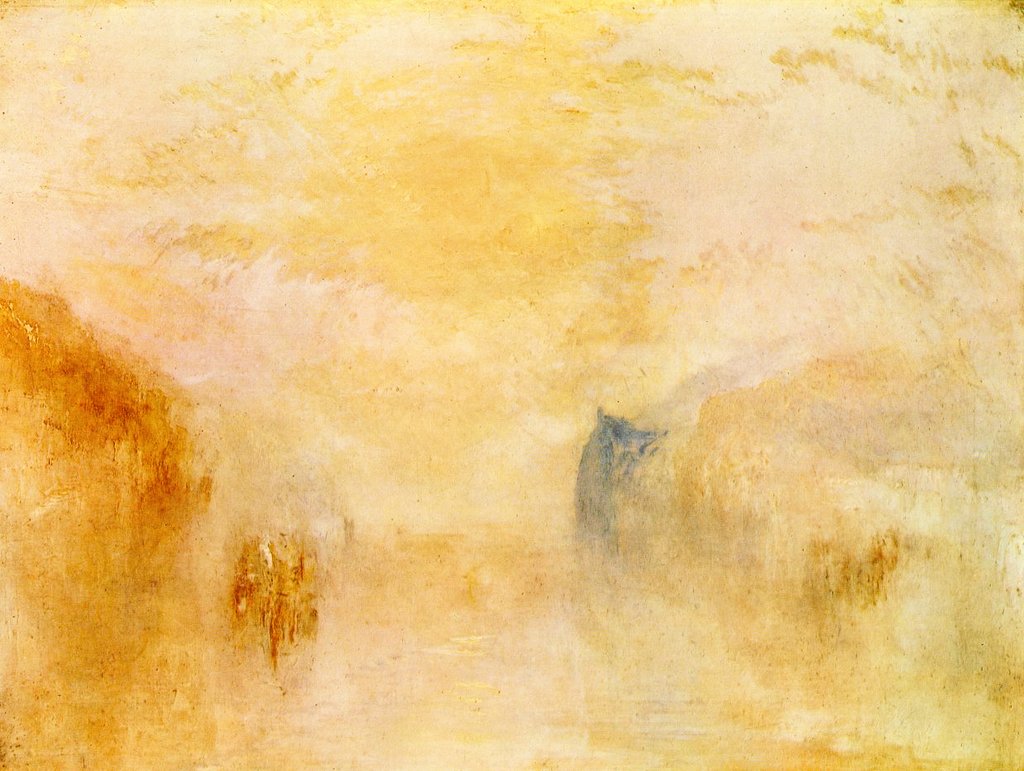
J. M. W. Turner, Sunrise
Impressions tweet media
English
8
114
885
25.6K
Spencer
Spencer@Spencer_Nit·
@_McKatie_ I love Jeanne Lee’s album The Newest Sound Around. Some of my favorite jazz vocals ever on that album.
English
1
0
1
28
Katie McIvor
Katie McIvor@_McKatie_·
Hello friends, who are your favourite jazz singers / musicians? I've been playing the baby some Billie Holliday and Etta James during her naps bc I got worried she was listening to too much hip hop, and I'd really appreciate some more recs! 🎵 💜
English
2
1
2
182
Spencer retweetledi
Angela Liu
Angela Liu@liu_angela·
Ahhh, just saw my time traveler romance “Time Is An Ocean” was podcast on @strangehorizons! The narration is so good! I love that feeling of stepping into an old story and meeting characters you really cared about again, like seeing old friends. strangehorizons.com/wordpress/podc…
English
0
8
40
954
Spencer
Spencer@Spencer_Nit·
My story about a dead magic artist haunting the gallery which hosts his posthumous works is out free to read (or listen to) in @lightspeedmagazine.com, today! (Link in thread) The entire issue is available for $4.99, and you can subscribe for just $41.92/year.
Spencer tweet media
English
1
0
1
38
Spencer
Spencer@Spencer_Nit·
@drumm_colin Is there a baseline knowledge set/engagement with foundational texts/etc. one should have before attending this and other courses? Like I’m sure you’ll take my money regardless (sincerely no shade!!), but to get the most out of it?
English
1
0
1
627
Spencer retweetledi
Angela Liu
Angela Liu@liu_angela·
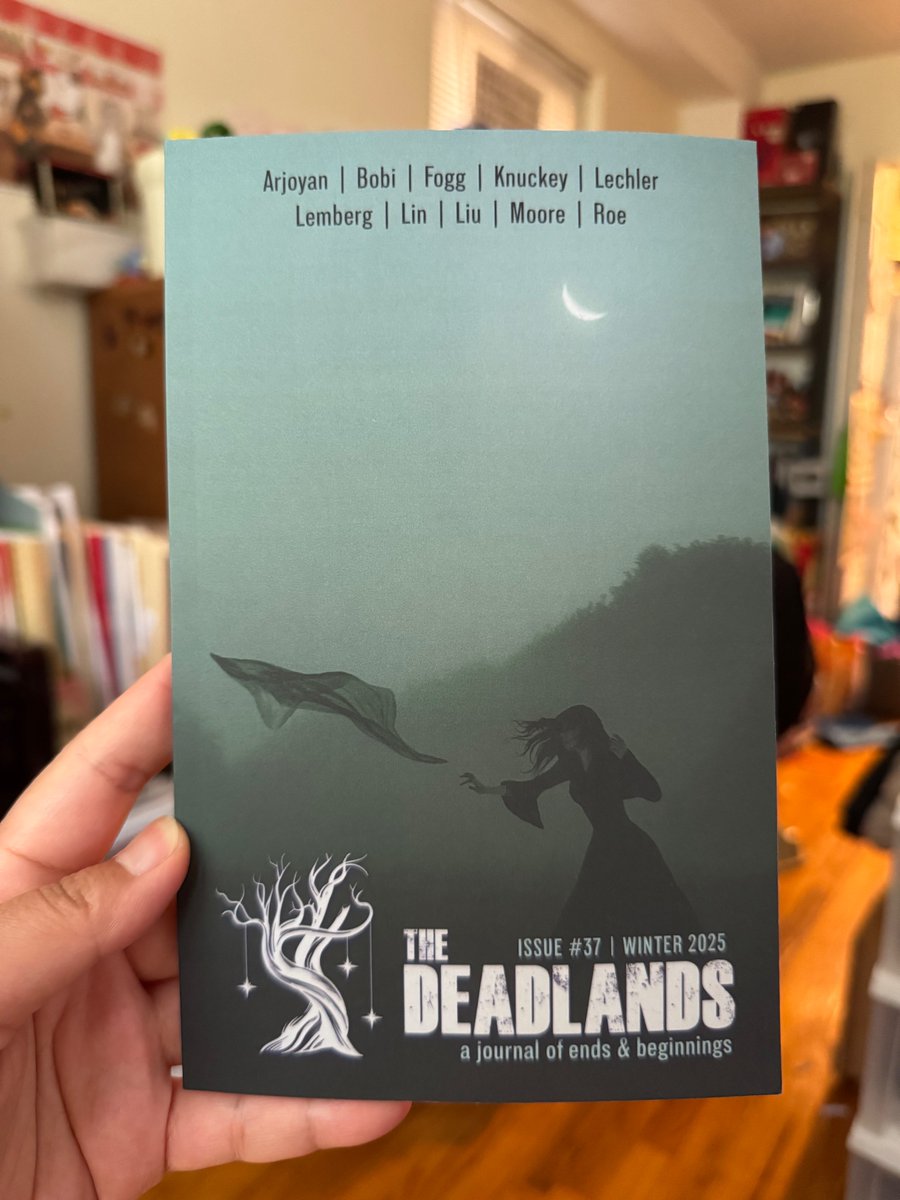
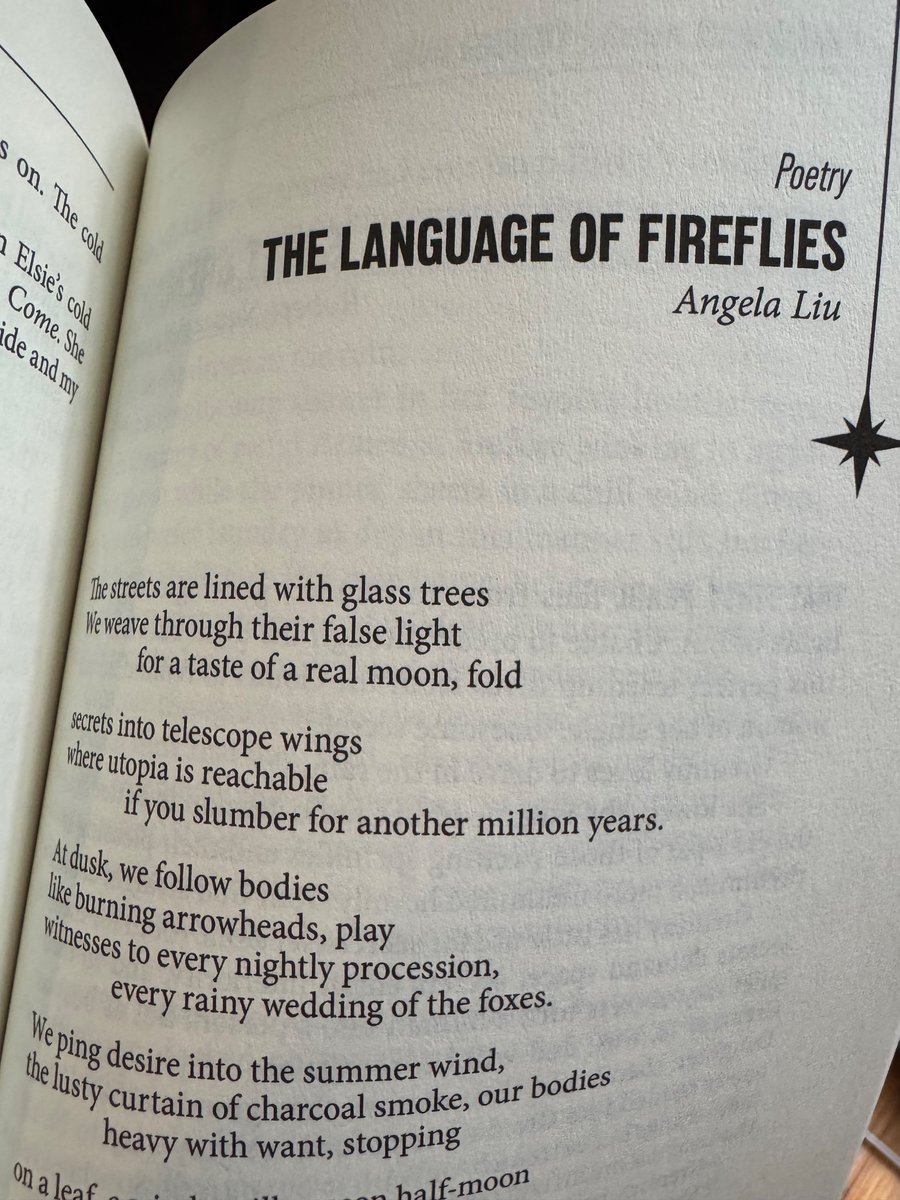
Someday I’d like to have a whole shelf of contributor copies. Huge thanks to @thedeadlands for letting me add this gorgeous book to my collection and for giving my poem “The Language of Fireflies” a home. psychopomp.com/deadlands/issu…
Angela Liu tweet mediaAngela Liu tweet media
English
0
1
30
359
Spencer retweetledi
Y2K Quarterly
Y2K Quarterly@Y2Kquarterly·
Subs open next week!
English
0
2
11
394