Yiannis Zourmpanos@yianisz
Alright. I’m going to push back on this not emotionally, just analytically. $HIMS
A lot of what you’ve laid out sounds compelling because it’s detailed and directional.
But several of these conclusions jump from interesting signal to structural collapse without proving causation.
That gap matters.
Let’s go piece by piece.
First, the 51.6% website traffic decline. That’s a serious number no argument there. But for a DTC healthcare company, web traffic isn’t the whole funnel anymore.
A meaningful portion of acquisition has shifted to mobile-first, paid social, influencer-driven, and in-app flows. Organic desktop traffic can fall sharply while paid and app-driven conversions remain stable.
The key question isn’t traffic volume it’s subscriber net adds and CAC efficiency. Without conversion rate data or disclosed marketing spend trends, we can’t confidently conclude a CAC death spiral.
The historical comps (Groupon, Zillow, HomeAdvisor) also aren’t apples-to-apples. Those were marketplace or housing-exposed models with macro shocks and structural model flaws.
$HIMS is subscription-based telehealth with recurring revenue. That’s a different elasticity profile.
Reminder: traffic ≠ revenue ≠ subscriber retention.
Now the Stocktwits and Reddit argument. Retail chatter collapsing isn’t automatically bearish. In fact, speculative social engagement peaking and then fading often marks the end of momentum froth not necessarily the start of structural decay.
Some of the strongest bottoms form when retail loses interest and volume dries up. Low noise can precede accumulation.
Also, sentiment staying at 77 while price falls doesn’t automatically equal “distribution.” It can also mean core holders are sticky. Value traps exist, yes but so do temporary multiple compressions during growth slowdowns.
The CEO posting less on X is probably the weakest signal in the entire thesis. Executive social media frequency is NOT a reliable earnings predictor. Correlation there is extremely thin.
The more legitimate concerns in your framework are:
1. Traffic decline magnitude
2. Hiring slowdown
3. Potential growth deceleration
4. Margin sensitivity if paid marketing replaces organic
Those are real. Those deserve modeling.
But projecting an automatic additional 25–35% downside based purely on alt-data sentiment compression assumes:
1. Traffic decline converts directly to revenue collapse
2. Subscriber churn exceeds guidance
3. Market fully reprices to a lower terminal growth rate
4. Shorts press and aren’t forced to cover
That’s a stacked assumption chain.
Could it happen? Yes. Is it statistically inevitable based on these signals alone? No.
Right now, what IHMS looks like is this:
1. Heavy short positioning (~32% float)
2. Price at major demand
3. Growth deceleration fears
4. Mixed alternative data
5. Sentiment not yet capitulated
That’s not a clean short. It’s also not a clean long.
It’s a volatility setup.
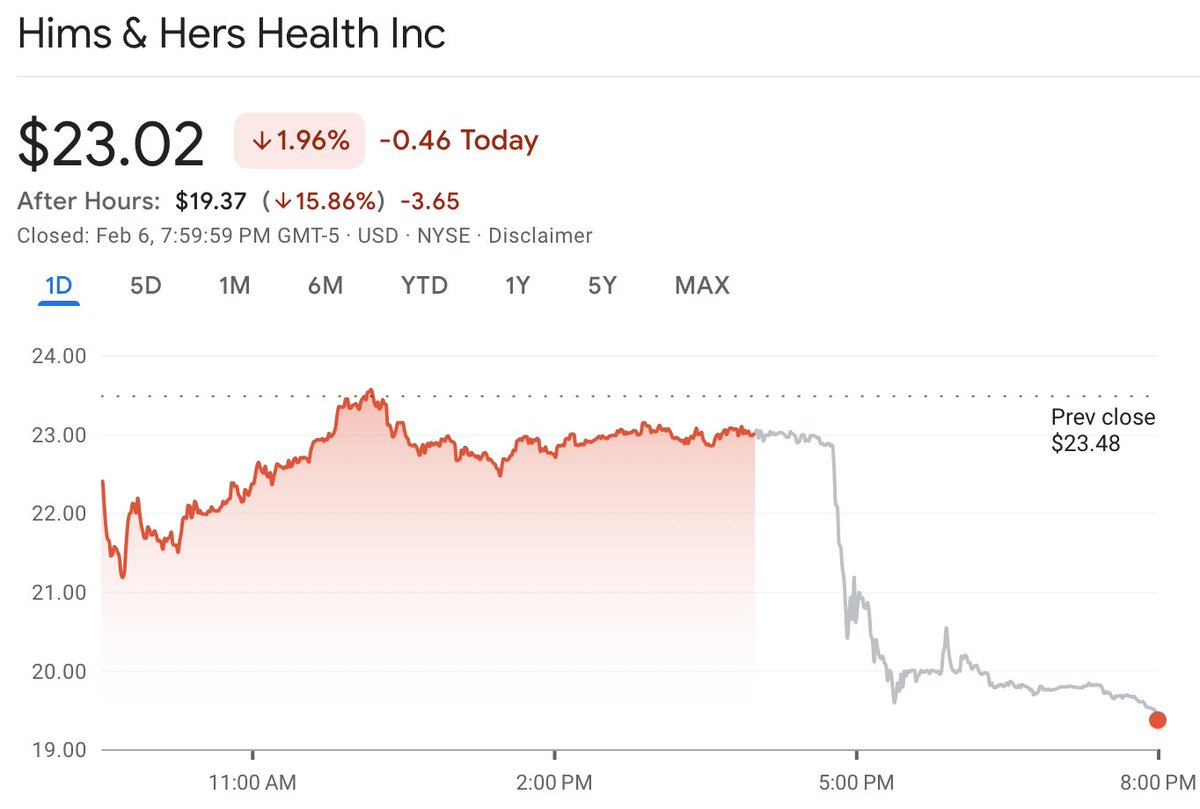
If Q4 shows subscriber growth holding and CAC stable, this entire “death spiral” narrative unwinds fast. If growth materially misses, then your structural deterioration thesis gains teeth.
Still, zooming out, the $HIMS long-term thesis remains compelling the debate is timing and execution, not whether the opportunity exists.