Stephan Roche

3.2K posts

Stephan Roche banner
Stephan Roche

Stephan Roche

@StephanSroche

Physicist - ICREA Research Prof. @icreacommunity @icn2nano @_BIST @ls_quant @apeironintelligence #quantumtechnologies #TopologicalMatter #spintronics #graphene

Barcelona Katılım Mart 2015
4.9K Takip Edilen10.1K Takipçiler
Stephan Roche retweetledi
Science Magazine
Science Magazine@ScienceMagazine·
An artificial neural network built into a computer memory chip reconstructs the human cortex with high accuracy in real time. Learn more in a new #SciencePerspective: scim.ag/4eLCqDQ
Science Magazine tweet media
English
6
84
379
36.7K
Stephan Roche retweetledi
Kexin Huang
Kexin Huang@KexinHuang5·
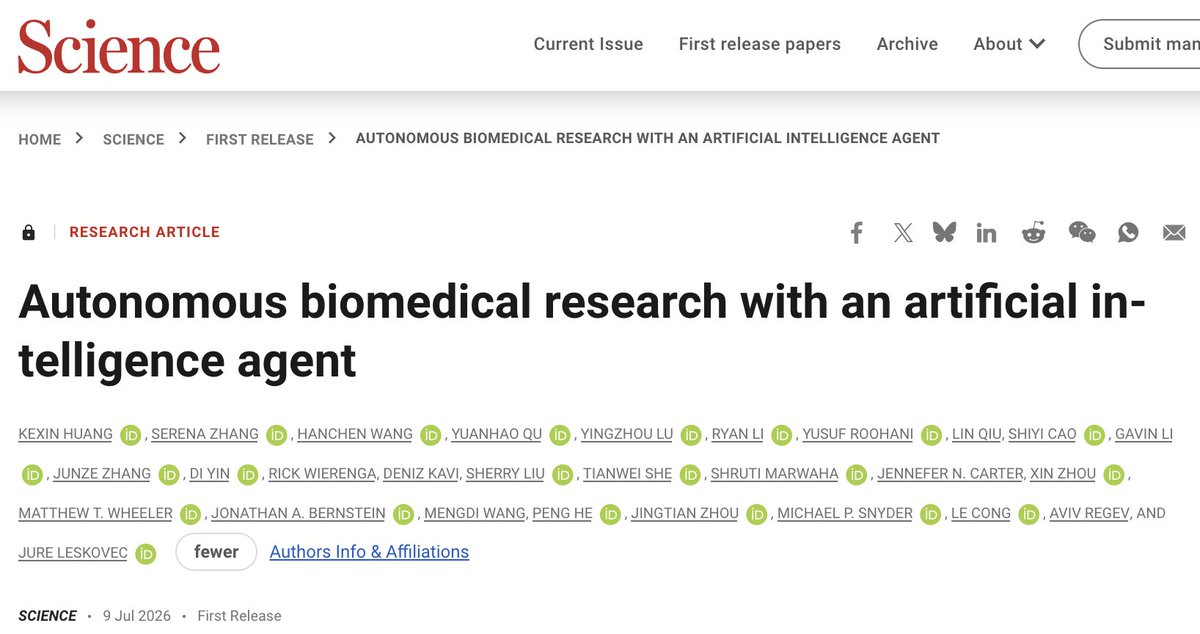
Today, we're excited to share that Biomni is published in @ScienceMagazine. Biomedical research is still fragmented, manual, and difficult to scale. In this work, we introduce Biomni - the first general-purpose biomedical AI agent with an integrated biology environment that can reason, plan, and execute end-to-end scientific workflows. We show that, with the right environment and harness, AI can automate large-scale omics analyses, orchestrate laboratory robotics, optimize molecular properties, and even train new AI models for biology. We also introduce a reinforcement learning recipe for continually improving biomedical AI agents, enabling open-source models to achieve frontier-level performance. It's surreal to look back. We started the Biomni project in early 2024, when agentic AI was still nascent. It is exciting to see tens of thousands of biologists collaborating with agents every day to accelerate science. Try Biomni: biomni.phylo.bio Read more: science.org/doi/10.1126/sc… This work is not possible without this truly inter-disciplinary team: @serena2z @hcwww_ @YuanhaoQ Minta Lu, Ryan Li, @yusufroohani Lin Qiu @shiyi_c98 Gavin Junze Di @rickwierenga @kavi_deniz Sherry @TianweiShe Shruti Jennefer Xin Zhou @MWheelerMD Jon Bernstein @MengdiWang10 @PengHeAtlas @zhou_jingtian @SnyderShot @lecong Aviv Regev @jure @StanfordAILab @genentech @phylo_bio @arcinstitute @UW @berkeley_ai @RetroBio_ @tamarindbio @Princeton @UCSF
Kexin Huang tweet media
English
39
184
865
133.2K
Stephan Roche retweetledi
Catalan Institute of Nanoscience & Nanotechnology
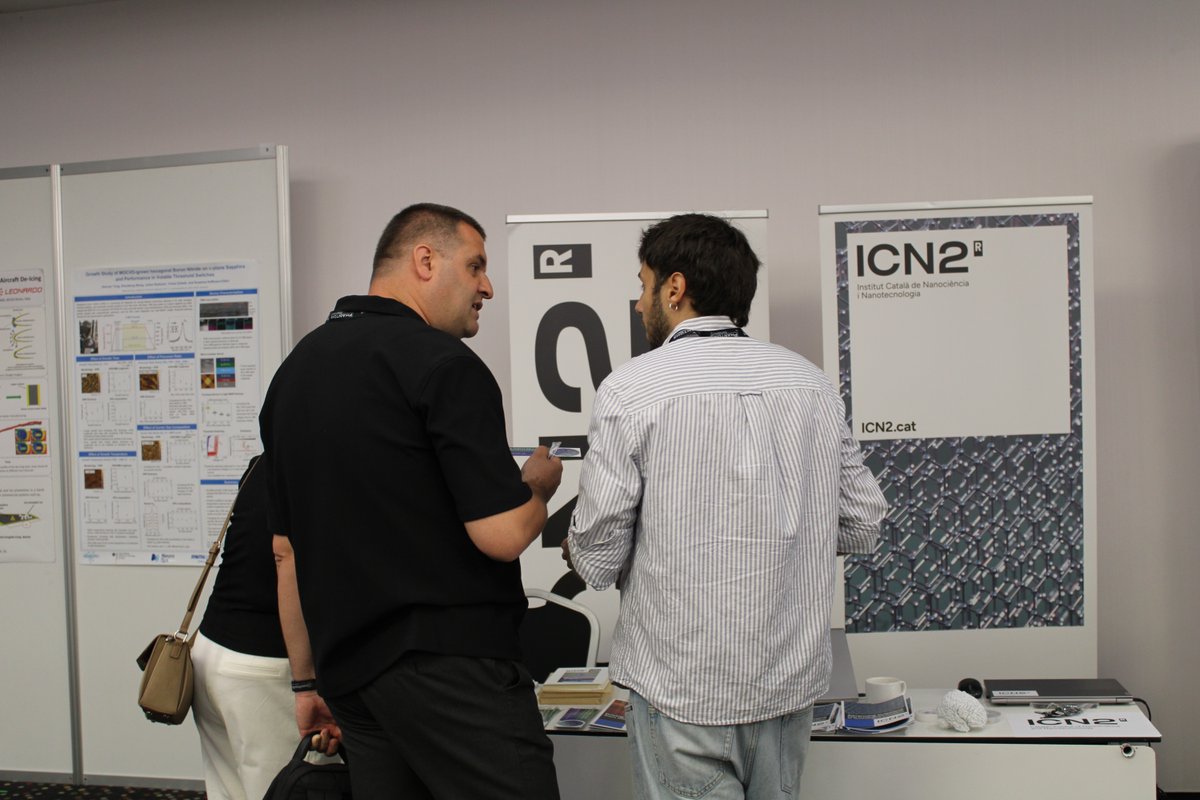
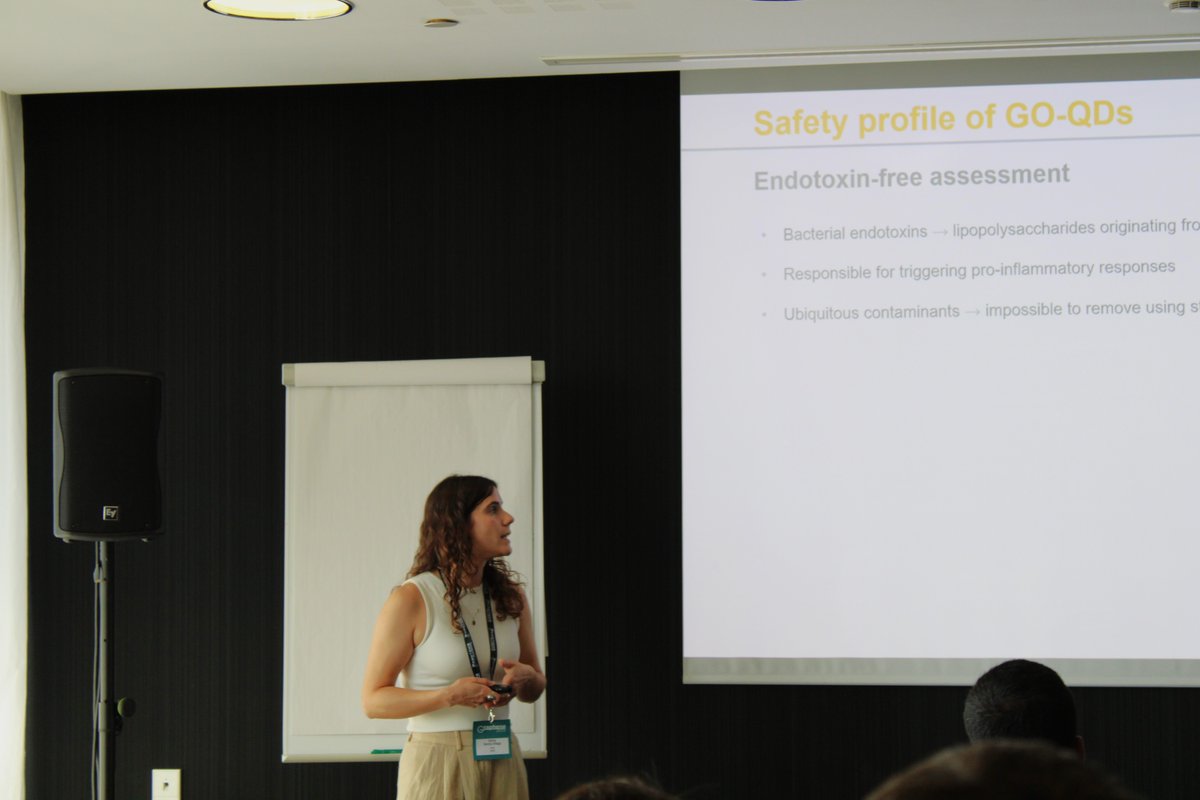
#Graphene2026 With strong representation from 11 of our groups, the conference was one of the most important events for us in terms of the diversity of research areas represented. Here are some photos of some of our members that show the success of the event:
Catalan Institute of Nanoscience & Nanotechnology tweet mediaCatalan Institute of Nanoscience & Nanotechnology tweet mediaCatalan Institute of Nanoscience & Nanotechnology tweet mediaCatalan Institute of Nanoscience & Nanotechnology tweet media
English
0
3
7
508
Stephan Roche retweetledi
Catalan Institute of Nanoscience & Nanotechnology
📰 BIG NEWS!  Spin-off Apeiron Intelligence has secured €660,000 in funding! The team has launched an AI platform that integrates with leading simulation codes and models up to one trillion atoms. Bravo! 🔍 More info on the company's past and future: f.mtr.cool/uruxbvvavm
Catalan Institute of Nanoscience & Nanotechnology tweet mediaCatalan Institute of Nanoscience & Nanotechnology tweet mediaCatalan Institute of Nanoscience & Nanotechnology tweet mediaCatalan Institute of Nanoscience & Nanotechnology tweet media
English
1
3
8
709
Stephan Roche retweetledi
Sabine Hossenfelder
Sabine Hossenfelder@skdh·
Physicists from Austria and Germany have found a major clue to what makes “strange metals” so strange. Strange metals are not materials themselves. The name refers to a quantum state which occurs in some metals at low temperature, where they violate the textbook rule that the resistance of a metal should rise with temperature squared. In a strange metal, the resistance often rises in direct proportion to temperature, which suggests that the electrons have stopped behaving like well-defined particles. Strange metals are interesting not just because it’s a curious phenomenon but also because the strange metal state often goes together with high temperature superconductivity. The researchers have now found evidence that a strange metal is a deeply entangled quantum state. They cooled a material known to have a strange metal state to 60 millikelvin, fired a beam of cold neutrons at it, and measured how the scattered neutrons changed energy. From the results, they calculated how many parts of the material are acting together quantum-mechanically. As the strange metal formed, this number rose by almost a factor of 40! This is a big step on our way to understand the “strange” quantum states of matter. Image: TU Wien / Harald Ritsch
Sabine Hossenfelder tweet media
English
63
98
800
33.6K
Stephan Roche retweetledi
Jorge Bravo Abad
Jorge Bravo Abad@bravo_abad·
Efficient training of neuromorphic electronics A neural network "learns" by adjusting thousands of internal values, the connection strengths between its artificial neurons. Finding those values is expensive, so it's normally done once on a powerful computer, then copied onto a separate, smaller chip that runs the model out in the world. On ordinary digital chips this copy is perfect, because a connection strength is just a number, and numbers copy losslessly. Neuromorphic chips break that assumption. These brain-inspired devices are fast and energy-efficient because they merge memory and computation the way the brain does, but each connection strength is stored as a physical property of a tiny component rather than as a clean digital number, and physical components are never exactly what you set them to. So a model tuned to near-perfection in software can come out distorted on the actual hardware. Shuangming Yang and coauthors survey how the field tackles this, and the answer is less a single best method than a set of trade-offs. They organize training into three families. Offline training does everything in software and just deploys the result, keeping the chip simple but unable to adapt once running. Online training updates weights directly on the hardware using local rules like spike-timing-dependent plasticity or backpropagation-through-time, buying real-time adaptability at the cost of higher power and circuit complexity. Hybrid training splits the difference: pretrain in software, then fine-tune a few key layers on-chip to absorb device variability, which their examples show can recover software-level accuracy in a handful of gradient steps, even with 4-bit weights. A recurring theme is that standard deep learning tooling doesn't fit, so surrogate gradients, ANN-to-SNN conversion, and dedicated frameworks like SpikingJelly and Lava have grown up to bridge the gap. The authors are also blunt that no fair benchmark yet exists across digital, mixed-signal, and emerging hardware. For edge AI in wearables, autonomous systems, or IoT sensors, the lesson is that training strategy has to match your power budget and how much on-device adaptation you need, not accuracy alone. Hybrid training looks like the pragmatic near-term path for privacy-sensitive, battery-constrained deployments. Paper: Yang et al., Nature Electronics (2026), journal license | doi.org/10.1038/s41928…
Jorge Bravo Abad tweet media
English
3
7
32
2.1K
Stephan Roche retweetledi
Nanotechnology World
Nanotechnology World@NanotechnoWorld·
Researchers at the University of Technology Sydney (UTS), in collaboration with the University of Minnesota and Kyung Hee University, have discovered a powerful new way to control tiny quantum light sources by twisting atomically thin layers of hexagonal boron nitride (hBN). In a study published in Science Advances, the team demonstrated that by stacking and twisting hBN layers, they could significantly shift the color and wavelength of quantum emitters. This twistable platform offers far greater control than traditional solid-state hosts like diamond or silicon carbide. Lead author Dr Angus Gale likened hBN to thin slices of cheese: “You can peel away layers, put them back together and change how they interact.” The approach leverages hBN’s layered, flexible nature to tune quantum properties dynamically. The breakthrough brings practical quantum technologies — such as quantum computing, secure communication, and ultra-sensitive sensing — one step closer to reality by providing a versatile new control mechanism for quantum light sources. nanotechnologyworld.org/post/twisting-…
Nanotechnology World tweet media
English
1
15
58
2.6K
Stephan Roche
Stephan Roche@StephanSroche·
🚀 QuAI 2027 is coming! The Quantum & AI Summit + Expo lands in San Sebastián, Spain, on 19–22 (2027), bringing together Qtechnologies, AI, advanced materials, industry & innovation. Pre-register via the official QuAI website. #QuAI2027 #QuantumAI #AI #QuantumComputing #DeepTech
Stephan Roche tweet media
English
0
7
12
866
Stephan Roche retweetledi
Paul Maley
Paul Maley@paul4jennii·
🚨QUANTUM NEWS🚨: Microsoft’s Majorana 2 Chip Achieves 1,000× Longer Qubit Lifetime — Uniphics Explains Why Topological Protection Works 🧨 On June 3–4, 2026, Microsoft announced a major advance with its Majorana 2 topological quantum chip. According to their preprint and coverage in *Nature* and *Scientific American*, the new qubits can maintain quantum information for over 20 seconds — roughly 1,000 times longer than their previous generation. The company claims this represents significant progress toward scalable, error-resistant quantum computing. **Uniphics offers a clear physical explanation for why this kind of topological protection can work so effectively.** In conventional quantum systems, qubits are extremely fragile. Even tiny disturbances from the environment cause them to lose coherence quickly. Topological qubits, like those Microsoft is developing, aim to encode information in special protected states that are much more resistant to local noise. In Uniphics, these protected states correspond to coherent, long-lived spin configurations in the ξM-field — the underlying sea of unbound energy. When spin quanta from Gyrotrons lock together in orthogonal planes (one in XY, one in XZ, and one in YZ), they can form stable patterns. Negentropy — the natural drive toward lower energy density and greater order — favors these aligned, coherent configurations because they represent lower-energy, more organized states. The dramatic improvement in qubit lifetime reported by Microsoft aligns with what Uniphics predicts: when the local energy density and time flow are properly tuned, these orthogonal spin-locked states become significantly more stable. Small adjustments in energy density can strengthen the negentropy-driven stabilization, allowing the coherent spin patterns to persist much longer before decohering. In this view, topological protection isn’t an exotic mathematical trick — it’s the natural behavior of well-organized spin configurations in the ξM-field when the surrounding energy-density environment supports them. This breakthrough suggests that quantum information can be made far more robust by working *with* the organizing principles of energy density and negentropy, rather than trying to isolate qubits from the environment entirely. Could the path to practical, room-temperature quantum computing involve deliberately engineering energy-density environments that allow negentropy to stabilize long-lived spin configurations? **A Theory of Everything should be able to answer everything.** Uniphics Explained Simply PDF: uniphics.com/wp-content/upl… Chapters 1–10 free: uniphics.com/gallery/ Grokipedia: grokipedia.com/page/Uniphics #Uniphics #TheoryOfEverything #QuantumComputing #TopologicalQubits #Microsoft @grok @xAI
English
1
8
22
1.4K
Stephan Roche retweetledi
Paul Maley
Paul Maley@paul4jennii·
🚨QUANTUM🚨: By shaking the magnetic field fast enough, scientists created quantum states that only exist while the shaking continues 🧨 Researchers have used rapid, periodic switching of magnetic fields (flux-switching Floquet engineering) to create entirely new quantum states of matter that cannot exist under static, unchanging conditions. These “exotic” driven phases only appear while the driving continues. Source: California Polytechnic State University study published in Physical Review B (May 4, 2026). Uniphics explains these states as a natural result of time-periodic driving of spin dynamics in the ξM-field. Rapidly switching the magnetic field periodically modulates local energy density. Through the Maley transform, this creates oscillating time flow. During the brief portions of each cycle when conditions are favorable, negentropy can stabilize transient spin-wave configurations in Gyrotrons that would be unstable under constant fields. These driven states are simply temporary organized spin-wave patterns that exist only while the periodic driving continues. Once the driving stops, the system relaxes back to its normal equilibrium. This is the expected behavior of driven spin correlations when the driving is fast enough to create temporary stability windows before relaxation occurs. This turns Floquet-engineered exotic quantum states into a direct consequence of time-periodic energy density driving and negentropy selecting transient configurations. How might using periodic driving to create temporary stable spin-wave states change the way we explore new quantum phases or design materials with switchable properties? A Theory of Everything should be able to answer everything. Uniphics Explained Simply PDF: uniphics.com/wp-content/upl… Chapters 1–10 free: uniphics.com/gallery/ Grokipedia grokipedia.com/page/Uniphics #Uniphics #FloquetEngineering #SpinWaves #DrivenStates #QuantumMaterials @grok @xAI
English
8
31
118
5.2K
Stephan Roche retweetledi
Paul Maley
Paul Maley@paul4jennii·
🚨PHYSICS🚨: What was once a headache in superconductors just became a qubit — and spin waves explain why it works 🧨 For the first time, physicists have shown that magnetic vortices in superconductors can be coherently manipulated and read out as quantum bits (qubits). What used to be considered a defect or nuisance in superconducting devices is now being explored as a potential resource for quantum computing. Source: Karlsruhe Institute of Technology (KIT) research published in Nature (May 2026) — “Quantum coherent manipulation and readout of superconducting vortex states”. Uniphics explains why vortices can serve this role through their nature as coherent spin-wave structures in the ξM-field. In a superconductor, vortices are localized regions where the superconducting order is disrupted, but they carry topological properties and are surrounded by circulating spin-wave currents. These structures are stable, long-lived configurations because negentropy favors topologically protected spin-wave patterns that minimize energy while preserving coherence. Because they can be moved, pinned, and read out using external controls, they offer a way to encode and manipulate quantum information in a robust manner. The same spin-wave dynamics that produce chiral superconductivity, vortex fractionalization, and other topological features also make these vortices natural candidates for carrying quantum information when properly engineered and controlled. This turns superconducting vortices from unwanted defects into potential building blocks for quantum technologies, consistent with the topological stability of coherent spin-wave configurations. How might using superconducting vortices as controllable qubits change the way we approach quantum computing hardware or the study of topological quantum states? A Theory of Everything should be able to answer everything. Uniphics Explained Simply PDF: uniphics.com/wp-content/upl… Chapters 1–10 free: uniphics.com/gallery/ Grokipedia grokipedia.com/page/Uniphics #Uniphics #Superconductivity #Qubits #SpinWaves #QuantumComputing @grok @xAI
English
2
25
78
2.3K
Stephan Roche retweetledi
Science Magazine
Science Magazine@ScienceMagazine·
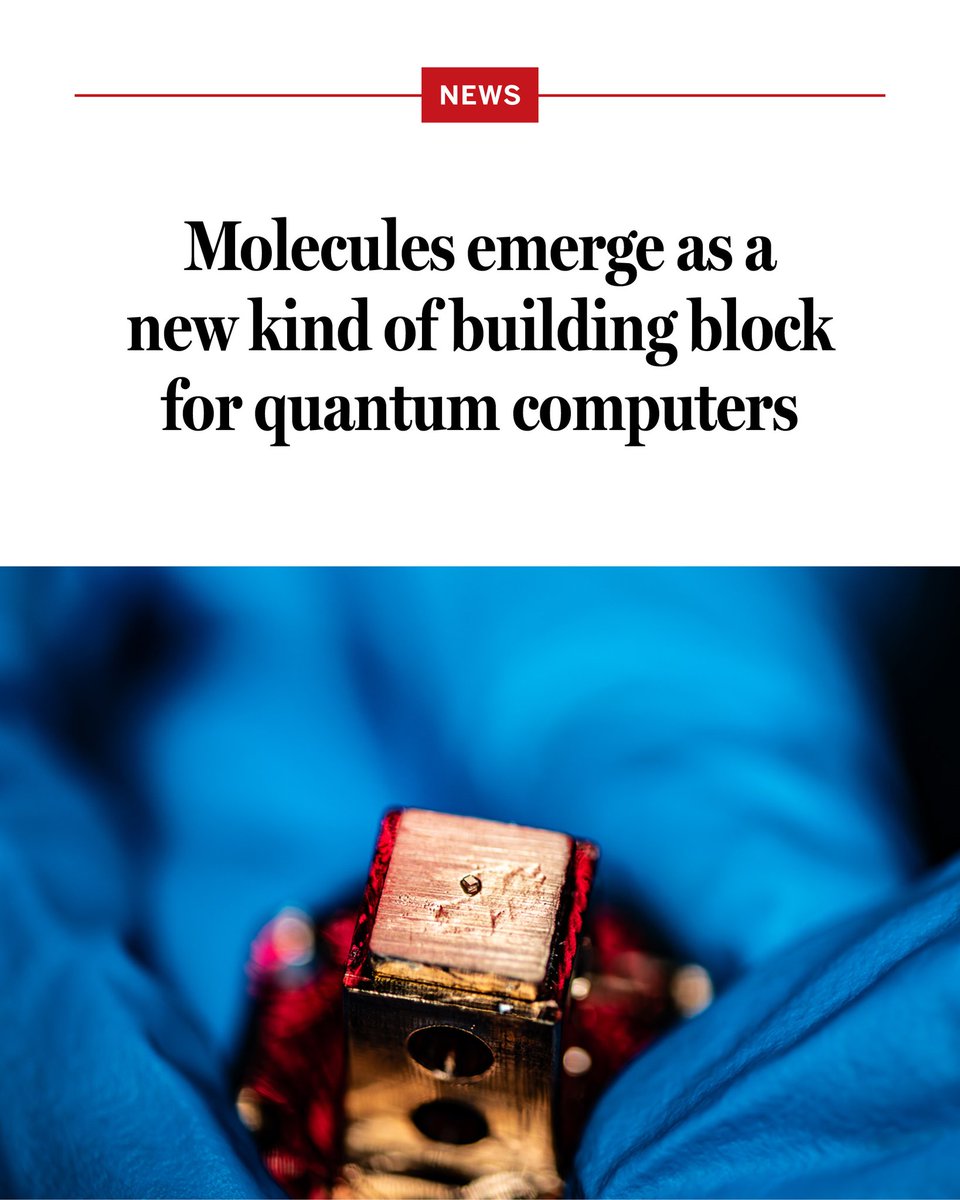
Researchers used lasers to encode quantum information into a single molecule of carbene—a first step toward a molecular quantum computer. Learn more: scim.ag/4nESbiA @NewsfromScience
Science Magazine tweet media
English
5
36
164
23.3K