To be clear, our sale of $GOOG was not a bet against the company. We are very bullish long term on Alphabet. But at current valuations and in light of our finite capital base, we used $GOOG as a source of funds for $MSFT.
Jay Wong
2.3K posts

@Stepmark_Jay
M&A banker focused on the AI industry. Not financial advice, DYOR.

To be clear, our sale of $GOOG was not a bet against the company. We are very bullish long term on Alphabet. But at current valuations and in light of our finite capital base, we used $GOOG as a source of funds for $MSFT.

Very rarely will you need to buy your husband a new wallet, but when that day comes, it is somehow a major household decision and you cannot screw it up. Men will carry the same wallet for 20 years with the corners falling apart and still say it’s fine. So this is not the moment for creativity. Slim, durable, leather if he’s a leather guy, metal if he already likes that kind of thing. Do not surprise a man with a weird wallet.

@mil000 its already here. only a few ppl have access. manufacturing at scale takes time. especially if you want to do it quietly


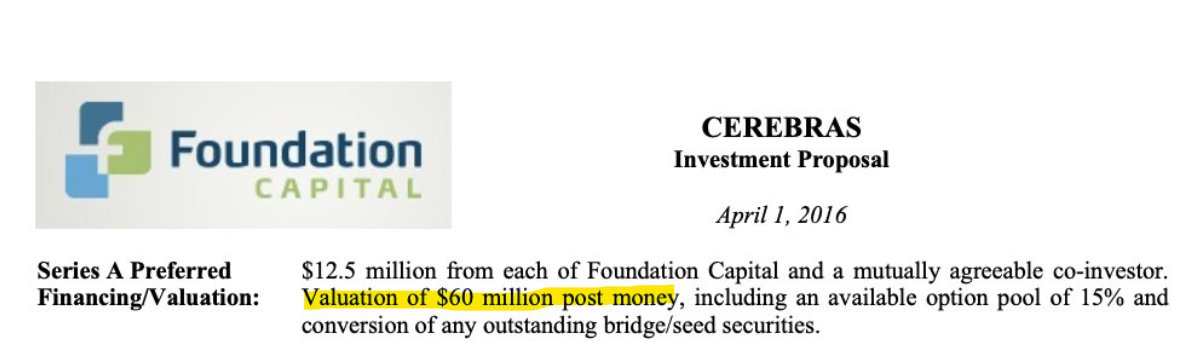
In April 2016, I threatened to climb over @andrewdfeldman's fence to give him his first term sheet for @cerebras. It was April Fool’s day, but I wasn’t fooling around. The story started in October 2007, when Andrew and his co-founder Gary Lauterbach had just started SeaMicro. Even then, Andrew was a force of nature. He was extremely intense and miswired in all the right ways. You could feel the sparks flying off him. We didn't invest in SeaMicro, but we stayed in touch. Andrew and the team built SeaMicro then sold it to AMD in 2012. When AMD acquired SeaMicro, I had a hunch Andrew wouldn't last long inside a big company. He has, as I've said many times, immense ambition and a heart full of disobedience. By early 2014, he was looking for an escape hatch. Over the next year and a half, Andrew and I met 6 or 7 times. Sometimes in our office. Sometimes at a coffee shop in Portola Valley. Sometimes at our local tennis and swim club. We kept coming back to one thing: deep learning workloads were growing exponentially, and traditional compute architectures couldn't keep up. GPUs had become the default for neural network training, mainly because researchers had accidentally discovered they were less terrible than CPUs. Andrew, Gary and Sean saw the GPU for what it was: a battlefield promotion of a chip optimized for graphics. Better than a CPU, but not what anyone would design starting from a blank sheet of paper. Their key insight was that memory bandwidth, not raw compute, was the real constraint on what neural networks could achieve. So Andrew, Sean Lie, Gary Lauterbach, Jean-Philippe Fricker and Michael James set out to do something nobody had pulled off in the 75-year history of semiconductors: Build a wafer-scale chip the size of a dinner plate. In April 2016, I asked Andrew if we could be his first term sheet. @ericvishria at Benchmark and I co-led the round along with Pierre Lamond from Eclipse. Then the hard work began. In the 75-year history of computing, no one had made wafer scale work. Which meant no one had ever had to solve the problems that came from trying. How do you power a chip that large? How do you cool one? How do you maintain electrical continuity across tens of thousands of connection points on a single piece of silicon? To get there, Cerebras had to invent in nearly every modern computing discipline at once: semiconductors, systems, data fabric, software, algorithms. Each was a startup in its own right. Their first wafer self-destructed on initial power-up and Andrew and the team were back in the lab the next morning, identifying what didn’t work and coming up with approaches to solving it. Yesterday, Cerebras went public. 19 years after our first meeting, 10 years after that April Fool's term sheet, they’ve built a generational AI company. From a coffee shop in Portola Valley to ringing the bell at the NASDAQ. What a journey. Proud to have been Andrew's first partner in Cerebras. Even prouder to call him my friend.


Tomorrow… Krishna Rao, the CFO of Anthropic, in his first podcast appearance


ICYMI: $EBAY tipped hand in unsolicited email to me - they're being advised on $GME by strategic comms firm Joele Frank.👀 FYI: Head of Financial & Crisis Comms Maddy Martinez came by way of TCGPlayer w/ prev stint at Joele Frank. @ryancohen might find that interesting.


It’s cliche but life comes at you fast. I go back and forth between pushing for a sense of urgency in life versus enjoying the journey. I’m in my 40s and feel young but also am stressed that I don’t have enough time. Recently I connected with two early 30 hedge fund guys asking for advice. First guy’s path was equity research and then pod hedge funds where he’s experienced some bad luck as both of his portfolio managers at different firms had been let go after poor performance. Recruiters were chasing him and his resume is clean so he would have been able to find a job quickly, but he was reticent to stay on his current path as the idea of finding a new job every 2-3 years seemed unsustainable. He came to the factory earlier this year to learn about business buying. Second guy’s path was banking, private equity and now single manager that has over a $1bn but performance has been blah and he is losing confidence it is a path of growth long term and is considering long only or pod hedge funds. He is smart enough he will both options no doubt. First guy lives a spartan life with his fiance (W2) and they live in a cheap apt outside of Manhattan to save money. They have enough liquidity to buy a sizable business and are now pursuing this path. They want to play the long game of finding a business knowing it could take time. Second guy is more debating if pods worth it given the stress and high turnover with exit options less clear to him if he’s 40 and gets canned (happens a lot) versus the lower beta long only path with less upside. I’m in year 4 of business ownership and it’s hard as heck and there have been periods where I didn’t pay myself for 6 months to prioritize not having to let employees go and pay down debt (I’ve paid off close to 7 figures of debt since the deal closed). I am still trying to figure shvt out myself and still have days I think I’m dead while other days I think my business is worth 8 figures. I’ve been fortunate that things have been working out, but what’s funny is that I would love to be 32 again. As I’ve gotten older I’ve realized time is just as important if not more important than money. I had similar concerns as both of them at 32. I was at a pod and like most of the industry had severe career insecurity as I basically saw a team fired weekly. I was too scared/risk adverse to leave until I had a daughter and realized I wanted to be around her more. I asked my friends if they would rather have $500k and be 30 or have $5mm and be 40. 100 pct said be 30. I agree with this. Both of these guys will be fine. I get the stress. But 40 will be here sooner than they think and it’s smart they are both thinking out 5 years. They both don’t realize it because they are too focused myopically on their current decision trees, but they both still have something us older guys wish we had more of=> time.⏳ x.com/adamstatonsmit…

@DavidSacks And it turns out that the business case is just “if you spend the money to build it out but can’t make use of it, you can rent it out to the AI company that can” and you’ll make near-market token rates. The demand exists and is fungible.


Come down the Peninsula folks!!! Easy drive to SF plus you’re closer to the VCs!!