Steven Feldstein

4K posts

Steven Feldstein banner
Steven Feldstein

Steven Feldstein

@SteveJFeldstein

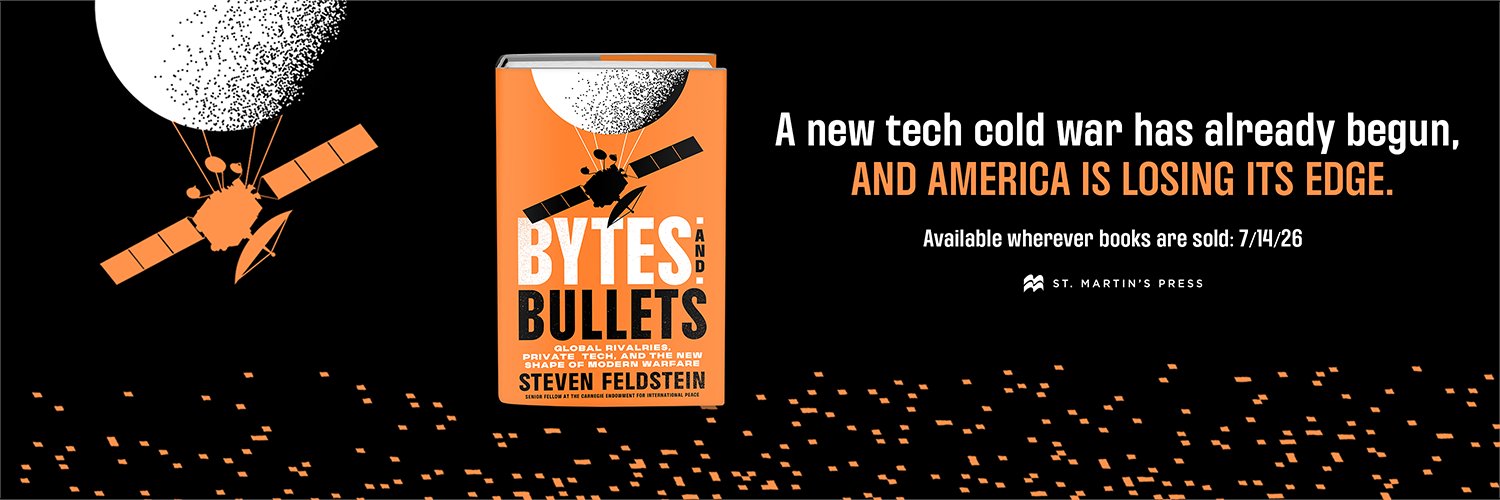
Senior Fellow @CarnegieEndow / Pre-order my book “Bytes and Bullets: Global Rivalries, Private Tech, and the New Shape of Modern Warfare" at the link below.

Washington, DC Katılım Haziran 2014
2.7K Takip Edilen3.1K Takipçiler
Steven Feldstein retweetledi
Matthew Ford
Matthew Ford@warmatters·
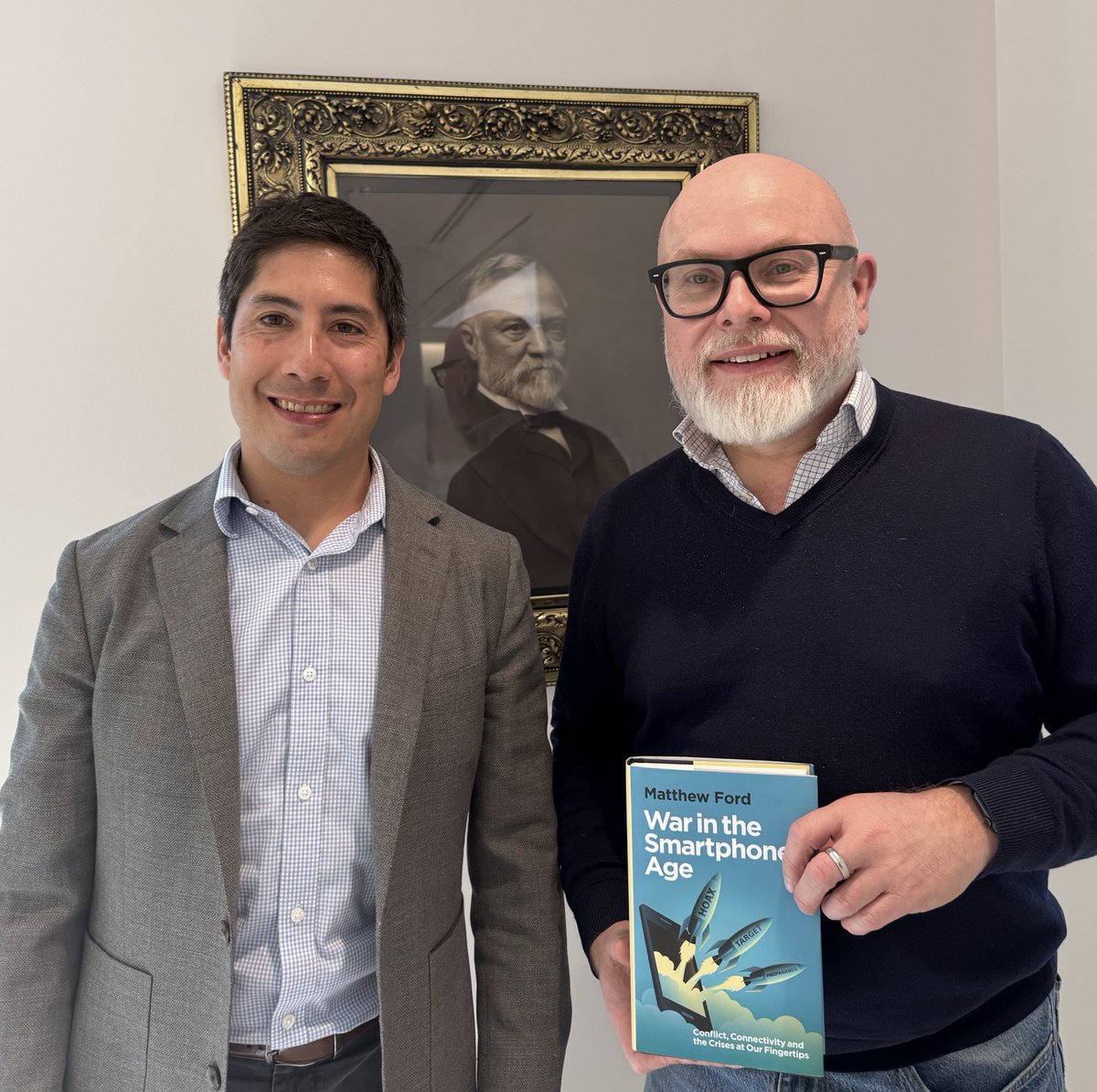
Was very pleased to give a book talk at the @CarnegieEndow in Washington DC this afternoon. Many thanks to @SteveJFeldstein for hosting me. Great crowd. Seriously good questions.
Matthew Ford tweet media
English
0
2
9
1.5K
Steven Feldstein retweetledi
Usama Khilji
Usama Khilji@UsamaKhilji·
In the latest DigiPod episode, @SteveJFeldstein helps us unpack what’s happening with AI companies contracts with the Pentagon, & the larger context of tech companies contracts with militaries in the age of war. Watch here:
Dawn News English@dawnnewsenglish

The DigiPod host @UsamaKhilji speaks with Steven Feldstein (Senior Fellow, @CarnegieEndow) about how military partnerships with private tech companies are reshaping modern warfare, and what it means for data, civil liberties, and global accountability. youtu.be/78rokeV6rNI


English
0
3
7
1.5K
Steven Feldstein retweetledi
Kelly Grieco
Kelly Grieco@ka_grieco·
UAE is shooting down ~92% of everything Iran throws at it. That's extraordinary. Yet the financial toll of sustaining that defense is enormous, raising the prospect that tactical ‘victory’ masks a costly strategic drain. A 🧵👇
English
149
622
3.2K
1.4M
Steven Feldstein retweetledi
Daron Acemoglu
Daron Acemoglu@DAcemogluMIT·
On Iran and Anthropic: Robert Mugabe, Zimbabwe’s dictatorial president since 1987, won the big prize in the country’s lottery in 2000. Why did he go out of his way to concoct such a charade? A surface-level answer: Because he could. Once you destroy institutions constraining your power and behavior, you can act in largely unrestricted fashion, whether it is for personal enrichment, personal aggrandizement, or simply projecting even greater power. But there is a deeper, more problematic answer as well: What better way to further decimate institutional checks on your power than showing how much of a farce the existing system of rules is. It is not just a coincidence that such behavior can do damage to norms, institutions and security and stability of the country. It is part of the design. Mugabe’s lottery win echoes in two fateful decisions by the Trump administration, which will have long-lasting and troubling implications, are just. Trump and his allies are pursuing these actions because they can and because these actions are consistent with their agenda of upending all rules and constraints on their future behavior. The first problematic action is the US-Israeli attack on Iran and the killing of the country’s supreme leader Ayatollah Khamenei. Leave aside the loss of life and the immediate chaos, it should be obvious that such a move will trigger a long period of instability in the Middle East. There should be no doubt that the Iranian regime was repressive, murderous and bad news for its own people’s economic and social well-being. The supreme leader, leading Iranian elites and the country’s feared Revolutionary Guard had blood in their hands and the repression had intensified lately. But none of this justifies the United States and Israel initiating a war in the Middle East, without support from international allies or from the public in the United States (still considered a democracy where people’s views should in principle matter). But even worse, this act violates the sovereignty of another nation and risks plunging the entire region into carnage. And however awful Ayatollah Khamenei’s track record may be, he’s no Nicolas Maduro (who had only a few diehard supporters even in the Venezuelan military). By virtue of his religious role, Khamenei enjoyed respect and authority among the Shiites and even the broader Muslim mission community, and his killing risks turning him into a martyr, which is the last thing that Iran or the region needs. The second is the Department of Defense (it is still painful to call it the Department of War even if recent actions confirm that this change of name wasn’t just for optics) designating the AI company Anthropic a supply-chain risk. The official designation is typically used for companies from foreign adversaries, such as China’s Huawei. It bars federal contractors using the Anthropic’s models and heralds major restrictions on what the company can do in the future. The Secretary of Defense Pete Hegseth announced “Effective immediately, no contractor, supplier, or partner that does business with the United States military may conduct any commercial activity with Anthropic.” The reason? Because Anthropic wanted safeguards against its models being used for mass surveillance of Americans and autonomous weapon systems. Neither of these two provisions would have put meaningful restrictions on the DoD in practice. Mass surveillance is illegal under US law and autonomous weapon systems are a not near-term possibility. Yet, it is the showdown that matters, just like Mugabe’s lottery winning. This action will also have major consequences, perhaps more far-reaching than the attack on Iran. Regardless of what one might think of current AI capabilities, there is little doubt that who controls AI will have momentous implications for democracy, business, communication and privacy. This designation can be interpreted by many in the industry that it will be the US government, not the private sector, that controls AI. Even more far-reaching are the broader implications of this action: this administration, and perhaps future administrations, can now bring hugely disproportionate penalties on any contractor they disagree with. Security of private property rights, which has been a mainstay of American state-business relations for centuries, is now looking much shakier. It also sends exactly the wrong signal to the world that Pentagon is intent on mass surveillance and the development of autonomous weapon systems (why else bother about these two ineffective provisions in the contract?). The absurdity of both actions is what harkens back to Mugabe’s lottery win. Trump came to power promising no foreign adventures, and now has spearheaded a potentially riskier one than the Iraq war, with even flimsier justification. There would have been no bite to the provisions that Anthropic wanted in the contract, since current AI systems are nowhere near reliable to be used in autonomous weapon systems and the US government has plenty of other tools that can be (and sometimes are) used for mass surveillance. The shock value and the norm breaking are part of the intent. Mugabe’s lessons continue.
English
85
433
1.8K
468K
Steven Feldstein retweetledi
Jim Sciutto
Jim Sciutto@jimsciutto·
New: The US has planned an escalating series of strikes with off-ramps along the way, according to a senior US official. Each round will be over a one to two-day period with pauses to reset and assess battle damage. #Iran
English
53
352
1.1K
466.9K
Steven Feldstein retweetledi
Dean W. Ball
Dean W. Ball@deanwball·
Think about the power Hegseth is asserting here. He is claiming that the DoD can force all contractors to stop doing business of any kind with arbitrary other companies. In other words, every operating system vendor, every manufacturer of hardware, every hyperscaler, every type of firm the DoD contracts with—all their services and products can be denied to any economic actor at will by the Secretary of War. This is obviously a psychotic power grab. It is almost surely illegal, but the message it sends is that the United States Government is a completely unreliable partner for any kind of business. The damage done to our business environment is profound. No amount of deregulatory vibes sent by this administration matters compared to this arson.
Secretary of War Pete Hegseth@SecWar

This week, Anthropic delivered a master class in arrogance and betrayal as well as a textbook case of how not to do business with the United States Government or the Pentagon. Our position has never wavered and will never waver: the Department of War must have full, unrestricted access to Anthropic’s models for every LAWFUL purpose in defense of the Republic. Instead, @AnthropicAI and its CEO @DarioAmodei, have chosen duplicity. Cloaked in the sanctimonious rhetoric of “effective altruism,” they have attempted to strong-arm the United States military into submission - a cowardly act of corporate virtue-signaling that places Silicon Valley ideology above American lives. The Terms of Service of Anthropic’s defective altruism will never outweigh the safety, the readiness, or the lives of American troops on the battlefield. Their true objective is unmistakable: to seize veto power over the operational decisions of the United States military. That is unacceptable. As President Trump stated on Truth Social, the Commander-in-Chief and the American people alone will determine the destiny of our armed forces, not unelected tech executives. Anthropic’s stance is fundamentally incompatible with American principles. Their relationship with the United States Armed Forces and the Federal Government has therefore been permanently altered. In conjunction with the President's directive for the Federal Government to cease all use of Anthropic's technology, I am directing the Department of War to designate Anthropic a Supply-Chain Risk to National Security. Effective immediately, no contractor, supplier, or partner that does business with the United States military may conduct any commercial activity with Anthropic. Anthropic will continue to provide the Department of War its services for a period of no more than six months to allow for a seamless transition to a better and more patriotic service. America’s warfighters will never be held hostage by the ideological whims of Big Tech. This decision is final.
English
546
2.8K
13.6K
1.2M
Steven Feldstein retweetledi
Congressman Greg Casar
Congressman Greg Casar@RepCasar·
This is a flashing red siren for anyone who cares about keeping America safe and free. The Trump administration wants to use A.I. to spy on Americans without a warrant and to give A.I. power to make life and death decisions without humans involved. That would put our Constitutional rights and our lives in the hands of unaccountable AI systems. nytimes.com/2026/02/27/tec…
English
182
1.7K
3.5K
62.3K
Steven Feldstein
Steven Feldstein@SteveJFeldstein·
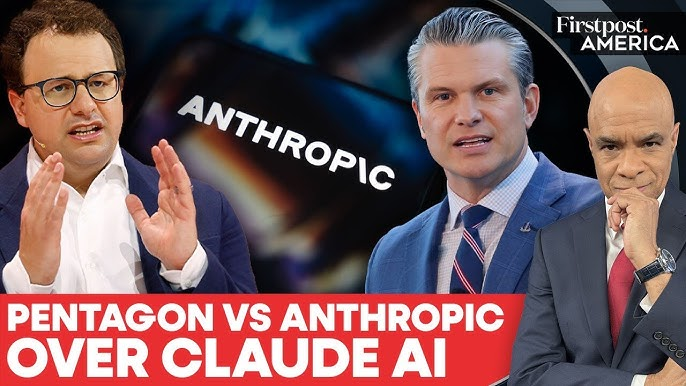
My thoughts about escalating feud btwn Anthropic & the Pentagon: 👉Hegseth claims this fight is about who gets final say--private firms or government 👉But that's a distraction. 👉Bigger Q: can Trump be trusted to responsibly oversee military AI tech? 👉My view: no.
Steven Feldstein tweet media
English
1
1
1
155
Steven Feldstein retweetledi
Tom Malinowski
Tom Malinowski@Malinowski·
If this is being correctly reported, it should be the lead story in the country. The Pentagon is legally prohibited from engaging in mass surveillance of Americans. It has a policy requiring human oversight of autonomous weapons. Is Hegseth threatening to disregard any of that?
Jennifer Griffin@JenGriffinFNC

At high stakes Pentagon meeting today Sec Hegseth gave Anthropic head Dario Amodei ultimatum to allow the Pentagon to use Anthropic’s AI model for mass domestic surveillance and kinetic autonomous operations without human oversight or face censure and be labeled “supply chain threat.” According to a source familiar: The meeting was cordial, not a dressing down, not a screaming match, all business. Hegseth praised the Anthropic product but then said if by Friday Anthropic does not agree to the Pentagon’s use of the model without restrictions, then Hegseth would terminate the contract and use the Defense Production Act to force Anthropic to comply AND/OR designate Anthropic a supply chain threat and national security risk. (EDIT: Both are mutually exclusive. You can’t be a supply chain risk but also invoke the DPA to say that the country needs this product so much for national security that it will override any restrictions put in place by the company that limits govt access to the product. Both cannot be true.) At issue is Anthropic’s two stipulations that its advanced AI model currently used in the Pentagon’s classified systems is NOT used for autonomous kinetic operations (Anthropic currently requires human oversight of autonomous operations when used to kill things for safety reasons because they don’t know how the autonomous system will react and could even endanger soldiers using the model; soldiers and others could lose control of the model and automatically start killing large groups without humans in the “kill chain.”) Second Anthropic bars its models from being used for mass domestic surveillance. Hegseth wants these restrictions lifted. According to a source familiar with the talks, Anthropic has never objected to the use of its models for “legitimate military operations.” It also told the Hegseth it never complained to the Pentagon or Palantir about the use of its models in the Maduro raid.

English
127
3.3K
10.7K
443.2K
Ishaan Tharoor
Ishaan Tharoor@ishaantharoor·
I have been laid off today from the @washingtonpost, along with most of the International staff and so many other wonderful colleagues. I’m heartbroken for our newsroom and especially for the peerless journalists who served the Post internationally — editors and correspondents who have been my friends and collaborators for almost 12 years. It’s been an honor to work with them. I launched the WorldView column in January 2017 to help readers better understand the world and America’s place in it and I’m grateful for the half a million loyal subscribers who tuned into the column several times a week over the years.
English
1.5K
1.5K
9.7K
2.2M
Christian Shepherd
Christian Shepherd@cdcshepherd·
My job was also eliminated. It’s been a thrilling challenge to cover seismic changes in China for WaPo. As access shrinks, I believe it has become ever more vital for the world to understand what is happening there. To my amazing colleagues, especially our researchers, 千恩万谢
English
96
162
1.1K
146.6K
Steven Feldstein retweetledi
Anastacia Galouchka
Anastacia Galouchka@NastyaGalouchka·
It’s been the greatest honor to work under @siobhan_ogrady at the WaPo Kyiv bureau. Three and a half years ago, you held my hand while we were hiding under a tank to avoid the cluster ammunition bombarding us. We lived through hell. There’s no point doing this work without you.
Siobhán O'Grady@siobhan_ogrady

It’s been the honor of my life to serve as Washington Post bureau chief in Ukraine. ❤️‍🩹

English
16
217
1K
68.9K
Steven Feldstein retweetledi
Peter Baker
Peter Baker@peterbakernyt·
Jeff Bezos wealth in 2024: $194 billion Jeff Bezos wealth in 2025: $215 billion Jeff Bezos wealth today: $249.4 billion Net increase in Bezos wealth since 2024: $55.4 billion Cost of Bezos’s 417-foot superyacht: $500 million Amazon investment in "Melania": $75 million Original Bezos purchase price of the Washington Post in 2013: $250 million Bezos net worth in 2013: $25.2 billion Net increase in Bezos wealth since buying the Post: $224.2 billion Last reported annual losses of Post: $100 million Number of years Bezos could absorb those losses with what he makes in a single week: 5 @JeffBezos
English
3.3K
3.9K
13K
3M
Steven Feldstein retweetledi
Slate
Slate@Slate·
On the latest What Next TBD: Iran’s government shut off the country’s internet for three weeks. How do we still know what’s going on? slate.trib.al/qHzXNBB
English
0
1
1
1.6K