Steven.N

357 posts

Steven.N banner
Steven.N

Steven.N

@StevenMacroView

Real economy macro Energy, cost & supply constraints Mapping flows → pressure → system impact. BTC through macro lens

Asia Katılım Eylül 2020
109 Takip Edilen73 Takipçiler
Sabitlenmiş Tweet
Steven.N
Steven.N@StevenMacroView·
Most people consider food inflation an issue of pricing. It is not. It begins as an issue of input constraint. As fertilizer prices increase ➡️ farmer profit margins are compressed Farmers do not stop producing right away. The next crop cycle will show a weakening of production This is when actual supply tightening occurs. In headlines - not in delayed responses. Market participants typically miss this. I monitor cost, energy & supply chain indicators in order to determine where pressures build prior to their appearance in inflation. Follow if you want to see…
English

1
0
1
485
Steven.N
Steven.N@StevenMacroView·
Why does Fiat have to be so "Necessary" when the USD has lost ~96% of it's purchasing power since 1913 while the amount of BTC created will never exceed 21 million? Governments claim that inflation is a short-term issue; however, when we are losing 50% of the value of our money every 35 yrs (due to an annual inflation rate of 2%), that is theft through gradual erosion.
English
1
0
0
155
Santiago Capital
Santiago Capital@SantiagoAuFund·
If Govs prefer fiat currency bc it is designed to help them steal purchasing power from citizens…then why on earth do you believe they would they be looking to change to a currency that doesn’t allow them to steal purchasing power from citizens…?
English
28
16
188
10.1K
Steven.N
Steven.N@StevenMacroView·
Neutral money makes sense in concept; however, people do not pay for their grocery shopping based upon concepts. The price of BTC dropped ~70% in 2022. If your rent is due in 30 days, then which aspect (volatility or ideology) matters to you more? To serve all 8 billion of us, a successful currency has to be able to provide 3 elements. These are stability, inexpensive fees & simple accessibility. BTC will certainly beat out other currencies when it comes to being neutral. However, does it still lose in the realm of everyday living? What percentage of your average monthly spending budget would you actually invest into holding in BTC today
English
0
0
0
34
Cory 🦢 Real Bitcoin @ Swan.com
I don't want to accept yuan. My buddy doesn't want to accept dollars. We're both fine with bitcoin. This ⬆️ for 8 billion people.
English
37
48
707
19.4K
Steven.N
Steven.N@StevenMacroView·
Although the dollar is the dominant currency, it has become less absolute as compared to previous yrs. One of the key points that we may overlook: A currency can earn market share without having to be perfect. A currency simply has to be useful. Although global investors do not consider the RMB to be as reliable as the dollar, for countries wishing to limit their reliance on Washington; for countries seeking increased trade with China; for countries wishing to create a geopolitical buffer against possible U.S. actions; and for countries wishing to use the RMB as a tool for economic and/or political purposes, there is no question that the RMB has become increasingly useful. As it relates to markets, some important implications were identified: - Increased demand for neutral Reserves will benefit Gold; - The dollar will remain relatively strong but will likely experience erosion of what economists refer to as its "monopoly premium," and - Investors could potentially begin to pay more attention to non-U.S. assets as capital becomes more diverse. In my opinion: The next decade will not be focused on which currency replaces the dollar. The next decade will focus on learning how the world operates without becoming dependent solely on the dollar. And, I believe this represents a larger paradigmatic shift than most realize.
Steven.N tweet media
English
0
0
0
14
Steven.N
Steven.N@StevenMacroView·
The EU's recent sanctions will target more than simply restricting trade with Russia; they also intend to restrict the maritime & digital infrastructure that fuels the "shadow"/ "black" market economy. By identifying 46 shadow tankers as being blacklisted & removing Russian entities' ability to utilize cryptocurrency exchange providers, the EU is increasing the transaction cost for "gray-market" transactions. Increasingly shrinking the compliant tanker pool & making it increasingly difficult for parties involved in international commerce to settle collateral obligations at no additional expense, the increased costs associated with moving energy are creating an ongoing and systemic form of inflation in all global supply chains.
English
0
0
0
11
Steven.N
Steven.N@StevenMacroView·
The difference between 66.33 Yen per dollar versus ~75 Yen per dollar in 1970 speaks volumes about "progress" over the past 56 years. In that time the real U.S. Dollar / Japanese Yen exchange rate has declined to an all-time low. This isn't just FX noise; this impacts everything we purchase for our families on a daily basis (food, energy, travel & wage). Exporters may benefit from weak currency but how are households benefiting from their continued loss of purchasing power? Is it the consumers or business owners that are receiving assistance from this policy?
English
0
1
2
1.8K
World of Statistics
World of Statistics@stats_feed·
🇯🇵 Japanese Yen’s Real Value Falls Below Levels from 56 Years Ago… Purchasing Power Continues to Collapse 😓 According to data from the Bank for International Settlements (BIS), the yen’s real effective exchange rate (base year 2020 = 100) dropped to 66.33 in March. This is now below the level seen around the start of the data series in 1970 (near 75).
English
37
158
487
69.5K
Steven.N
Steven.N@StevenMacroView·
@Blockstradamus_ @steve_hanke Yep. Gold moves on real rates + liquidity. But if both are already partially priced, does $6k need fresh easing or fresh panic?
English
0
0
0
22
Daniel Tschinkel
Daniel Tschinkel@Blockstradamus_·
@steve_hanke If real rates stay contained and liquidity keeps expanding, gold can overshoot any forecast, the path matters more than the number.
English
1
0
5
934
Steve Hanke
Steve Hanke@steve_hanke·
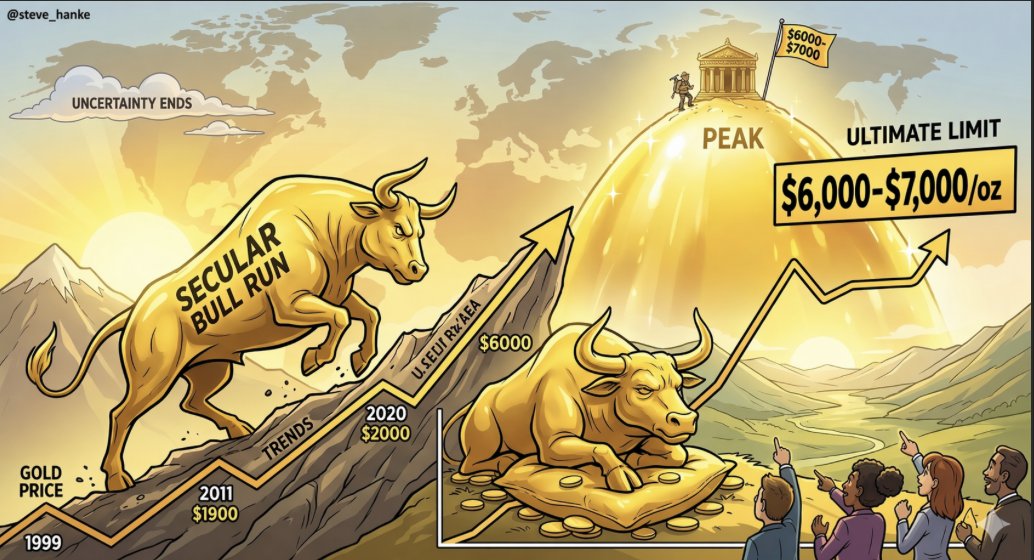
Morgan Stanley just cut its gold price forecast for the rest of 2026 from $5,700/oz to $5,200/oz. I DISAGREE. I stand with my prediction that gold's secular bull run will peak out at $6,000-$7,000/oz. BUY GOLD, WEAR DIAMONDS.
Steve Hanke tweet media
English
52
100
735
91.2K
Opium Witness
Opium Witness@MarketOpium·
@steve_hanke buy gold sure, but april 2026 gold is already up more than the entire move from 2018 to the 2020 breakout. when a 2-year sprint starts matching a multi-year base, the next leg usually needs a macro accident, not just conviction.
English
1
0
3
494
Steven.N
Steven.N@StevenMacroView·
@angelszanotty @PeterMallouk That’s fair. I think we’re discussing 2 layers: America’s durability vs investors’ entry price. Both can be true at once.
English
0
0
1
10
Peter Mallouk
Peter Mallouk@PeterMallouk·
"No one has ever been a success betting against America since 1776 — and they're not going to be a success in the future doing it, either." – Warren Buffett
Peter Mallouk tweet media
English
126
293
1.6K
132.4K
Steven.N
Steven.N@StevenMacroView·
@jhains2 @PeterMallouk Correct. But a company competes on margins. A country competes on institutions, talent & capital allocation.
English
0
0
0
8
Steven.N
Steven.N@StevenMacroView·
Good upside to gold if it peaks at $6k-$7k; that's only ~15-35% higher than $5.2k. That is still relatively decent for a "secular bull run". The real issue is whether we get to see the FED cut interest rates again, an economic downturn (recession), or do central banks continue with their current trend of buying gold? Until we have a clear catalyst of how the price will reach this level, then price targets become nothing more than headlines. I believe gold will be strong long term, but timing is far more important than buzz words. What is the most significant factor from here?
English
0
0
8
1.9K
Steven.N
Steven.N@StevenMacroView·
@angelszanotty @PeterMallouk Right. America’s edge is institutional compounding. The only caveat: wonderful assets can still produce poor returns when bought too expensively.
English
1
0
0
13
Steven.N
Steven.N@StevenMacroView·
Yep. Cost of living affects most people (housing, childcare etc.), but demographic changes take long time to come into effect. This will affect labor force many yrs from now; for business, however, it may be important that productivity grows over the first 5-10 yrs after today's decisions rather than how many children are being born."
English
0
0
0
5
Kadayak
Kadayak@theyak21·
@jhains2 @StevenMacroView @PeterMallouk Slow demographic growth is not due to “unfettered inmigration” rather bad living standard for local populations. If people don’t feel there is good future for their children then they won’t thave any independently of immigrants :)
English
2
0
0
30
Steven.N
Steven.N@StevenMacroView·
@jhains2 @PeterMallouk For investors, demographics matter - but so do productivity & innovation. A slower population can still produce strong returns if output per worker rises.
English
1
0
0
6
Steven.N
Steven.N@StevenMacroView·
@RPudhucode @PeterMallouk Yep. Debt ratios across countries are useful. A country can be stronger than peers & still deliver weak returns if bought at expensive valuations. Relative strength & entry price are 2 different debates.
English
0
0
0
7
RamP
RamP@RPudhucode·
@StevenMacroView @PeterMallouk China has 130% debt to gdp. Japan has 230%, UK 110%, Canada 112%, France 120%. Basic knowledge is needed before one comes on American platform before displaying jealousy and ignorance.
English
1
0
2
18
Steven.N
Steven.N@StevenMacroView·
The real question for me is...if about 3-5 % of the worlds population own's BTC, what will happen when 10 % do? My view is: the next large increases in value will likely occur at a slower pace however larger in dollar amount. Am I early to the party....or am I late getting into something that was already in its "early stages"?
English
0
0
1
311
Richard Teng
Richard Teng@_RichardTeng·
Bitcoin's journey from whitepaper to sovereign reserves in under 16 years is one of the most remarkable financial stories of our generation. And we're still early.
English
60
24
234
22.3K
Steven.N
Steven.N@StevenMacroView·
@zombieputin @RBReich Right. People aren’t imagining this. Older generations compare one paycheck buying a home & raising kids. Younger gen compare one paycheck to rent & groceries.
English
0
1
1
41
Zombie Putin
Zombie Putin@zombieputin·
It’s crazy something went wrong somewhere , my grandfather and his dad especially worked one job and were able to take care of a whole family. Stuff was cheaper back then.. houses and cars included. Nowadays, one job is just not enough especially if you don’t have the ability to save, you may be able to pay enough bills for yourself but not a family
English
1
0
0
12
Robert Reich
Robert Reich@RBReich·
The richest Americans saw their net worth soar 120% from 2017 to 2025. The top 1% now control $55.8 trillion in assets — more than the G.D.P. of the United States and China combined. Meanwhile, millions of Americans live paycheck to paycheck. Still wondering if inequality is out of control?
English
105
440
1K
22.9K
Steven.N
Steven.N@StevenMacroView·
@zombieputin @RBReich Yep. So, the bigger question is why full-time work alone no longer feels enough for us
English
1
0
1
21
Zombie Putin
Zombie Putin@zombieputin·
My focus now, is not on government intervention, I have thought that way before but I’m unpleased with the results, it seems like when .gov gets involved in anything it gets more complicated or worse off, but now instead of relying on just hourly wage alone, I am slowly stacking away money in a nice ETF in an IRA and a self direct account hopefully when I have enough stacked away the dividends will keep stacking in the IRA and the self direct will supplement the hourly wage, where I won’t have to rely solely on the hourly to get by… I think just one income is hard for anyone looking at ways to supplement haha
English
1
0
1
25
Steven.N
Steven.N@StevenMacroView·
@izakaminska Yep. Sometimes the facility matters more than the usage. A standing swap line says “you’re inside the perimeter” even if drawdowns stay near zero. Liquidity tool on paper, geopolitical signal in practice.
English
1
0
2
73
Izabella Kaminska
Izabella Kaminska@izakaminska·
Yep. That's basically my point. Liquidity poor does not mean insolvent. You can be asset rich and liquidity poor. Repoing securities might disturb SOFR. Though Fima is still an option, but if you're about to become a strategic ally you might just want to avoid that trouble. The extension of a permanent cbank swap line usually injects confidence without the need to really tap all that much.
English
1
0
7
271
Izabella Kaminska
Izabella Kaminska@izakaminska·
A note on the increasingly frustrating dollar swap line confusion. While the ESF definitely has a shady history in which it doubles up as black ops financing arm of the US Treasury, when it comes to the UAE situation, it's simple dollar liquidity mechanics that are the issue in this case. To understand this you need to go back to your Zoltan Pozsar 101, about how shadow dollar liquidity actually flows through the system. This explains entirely what's going on at the moment. Adam Tooze would have you think otherwise and brings up the ESF's shadowy history as a source of slush funds to add intrigue to the situation. (While it's not untrue, it's besides the point). And now Brad Setser is speculating there may be "something radically new about the US providing dollar credit to a country that itself has pledged to invest in the US" and that this "looks like the US government is financing a off balance investment fund outside Congressional scrutiny, with the Emirates getting the upside ..." But I'm pretty sure that this is not the case. It's an entirely obvious and transparent situation. First of all, the original WSJ story that flagged the UAE situation talked about swap lines not ESF-funded Argentina-style swaps. These are entirely different arrangements. For one, the ESF is a Treasury-powered vehicle and usually operates via finite credit facilities. It is also usually arranged between respective sovereign Treasuries. A swap line, however, is Fed-initiated and potentially limitless. It is an arrangement between fellow central banks. Now, if you speak to central bankers in the know, they will tell you that despite the central banking framing, it's not entirely the case that the Treasury has no influence on the initiation or not of a swap line. But this doesn't change the mechanical structure, which sits outside of the Treasury system — and imposes on it only in so much as central bank profits or losses ever do. The WSJ may have got the nomenclature wrong, but I doubt it. As to why the UAE, despite having pledged to invest in the US, needs dollars? I'd argue it's because the original investment is mostly an expression of allegiance, and a signal that the UAE trusts the US to defend its property rights more so than any other superpower and is prepared to fund its military-industrial reconstitution... since the protection of its property rights also hangs in the balance. If the UAE decides to fund these investments with USTs, this mostly constitutes a transfer of that economic value from the Treasury to the private sector. There needn't be a liquidity event associated with the transfer if it's mediated, as it has been, at the US Government level and extended via a co-investment with the US into newly forged equity investments. The UAE leg, in that sense, becomes a promise to expire its outstanding claim over the US Treasury in exchange for x shareholding (49% one would presume) in the newly forged company. Think of it more like an asset swap, wherein its debt-based assets are swapped into equity assets underpinned by USG co-investments. The actual liquidity to start the venture up would likely come exclusively from the US side, with the funding essentially already raised by way of the defense industrial allocations in the BBB. In that scenario, the investments act more like a quid pro quo with an ally, to ensure the US can raise the money it needs via formal channels, without fear that its bond markets do a Liz Truss. But it's very unlikely that the UAE plans to fund these American investments entirely with UST reserve assets. Much more likely, it plans to deploy its trillion-dollar sovereign wealth fund chest, as well its future oil revenue, to meet most of the $1.4 trillion investment it has promised over 10 years. In that case, what the UAE would really be doing is merely bouncing back dollar liquidity that's already coming its way from existing USD-denominated assets straight back into American investments. The only difference is that on this occasion, it has agreed to transfer some level of influence over how those investments will be steered. This makes sense if the true purpose of the arrangement is to help reindustrialise the US, as the USG sees fit, so that it can better provide regional security and defy industrial decoupling with China. Why does it make sense for the UAE? Since some 50% of its SWF is already invested in the US, if America loses in a war with China or Iran, so does the UAE. It needs a strong and autonomous America with trusted supply chains to defend it. In some respects, this is an echo of how China funded its own industrialization. In 1979 under Deng Xiaoping’s broader “Reform and Opening-Up,” China brought in its Equity Joint Venture Law, creating the main channel through which foreign capital first entered China’s industrial economy. The main difference here is that in China's case, the co-investments were with Western private sector companies or multinationals. In America's case it is wooing capital from fellow sovereigns, with whom it can establish related defense agreements. Statecraft 101. Why dollar swap lines then? Well, if a good chunk of UAE dollar liquidity is drawn from oil sales, this is self-evidently currently under pressure. And while the UAE probably has many other sources of dollar income, it's what happens at the margin that matters. Under a peg system even a small marginal fluctuation in flows can put pressure on the system. All the more so, if foreign residents are moving money out of the UAE because of regional volatility. A country like the UAE, in such circumstances, faces the same problem as a distressed bank. It finds itself technically dollar-asset rich, but simultaneously dollar-liquidity poor. The options it has on the table in that case are either to abandon its peg temporarilly, liquidate its assets at potentially firesale prices compounding the problem (definitely suboptimal), borrow from the market, or seek the one thing it doesn't have under a pegged system: Access to a dollar lender of last resort. With the UAE likely to become a formal ally, extending lender of last resort facilities to help it manage local dollar liquidity issues, seems the obvious way to go for the US. In a sense it becomes the first official member of what Robert McCauley sees as the emergence of a new dollar swap-line diplomacy club. [Which could, in my mind, be the makings of a new type of IMF system.] For a country that already operates under a soft form of dollarization, it's not too great a leap. References below:
English
14
34
121
20.7K