
🇬🇧STOCKCUBE🇬🇧

7.6K posts

🇬🇧STOCKCUBE🇬🇧 banner
🇬🇧STOCKCUBE🇬🇧

🇬🇧STOCKCUBE🇬🇧

@Stock_Cube12

Just an ant trying to dodge the rain 💧🐜💧

England Katılım Şubat 2021
694 Takip Edilen1.9K Takipçiler
Sabitlenmiş Tweet
🇬🇧STOCKCUBE🇬🇧
🇬🇧STOCKCUBE🇬🇧@Stock_Cube12·
$MMAT $MMATQ $MMAX $MMTLP $TRCH $GME $AMC $DJT $MULN $BBIG @elonmusk @DOJNatSec @ryancohen @CEOAdam @DOJCrimDiv @JusticeOIG @DOGE @DOGE_SEC @JDVance @DevinNunes @pulte @RobertKennedyJr @realDonaldTrump 🚨🚨THIS IS A MUST READ!!!🚨🚨 THE @OTCMarkets NEEDS SHUTTING DOWN AND INVESTIGATING IMMEDIATELY, ITS BEING USED AS A BOTTLE NECK FOR WALL STREET TO BE ABLE TO TRAP, MANIPULATE & STEAL MONEY FROM THE GENERAL PUBLIC/RETAIL INVESTOR’S BY PURPOSLEY KILLING PUBLICLY LISTED COMPANYS WHETHER LISTED ON THE NASDAQ, THE NYSE OR OTHER!! #Justice_Must_Be_Served #ItsTimeToFixTheBrokenSystem
George Palikaras@palikaras

x.com/i/article/1891…

English
1
60
91
5.1K
🇬🇧STOCKCUBE🇬🇧 retweetledi
George Palikaras
George Palikaras@palikaras·
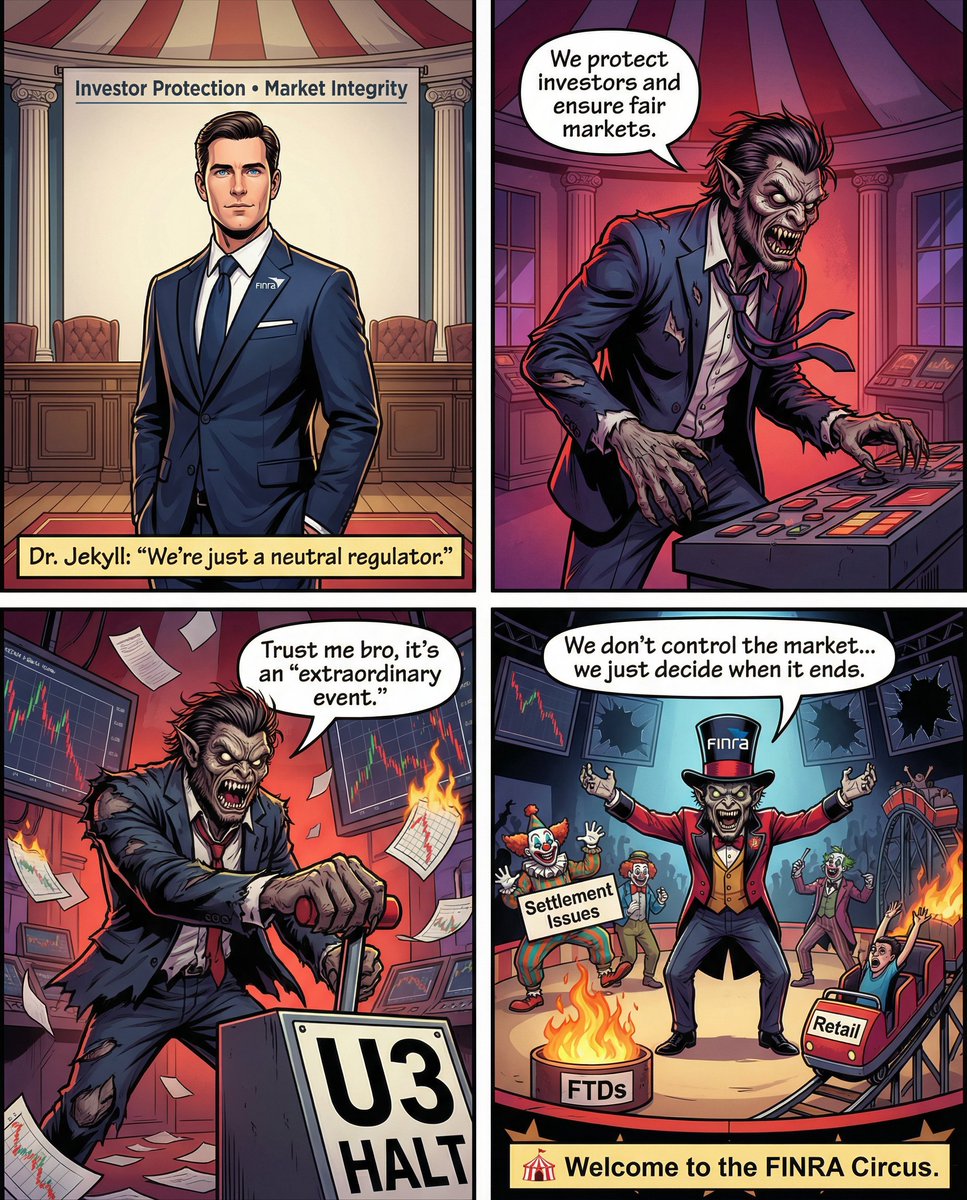
FINRA's little "Dr Jekyll vs Mr Hyde" circus act has lasted for far too long at the expense of ethical issuers and investors (both domestic and abroad), causing loss of property rights and loss of investor confidence via unusual regulatory actions. The SEC leadership and the US Congress have a great opportunity to fix this. @JDVance 1. either turn FINRA into a full government entity, OR 2. remove their immunity OR 3. Shut them down and transfer authority to the SEC who are accountable to Congress. If you want speed, accuracy and accountability use blockchain ledgers.
George Palikaras tweet media
English
5
186
300
5.3K
🇬🇧STOCKCUBE🇬🇧 retweetledi
George Palikaras
George Palikaras@palikaras·
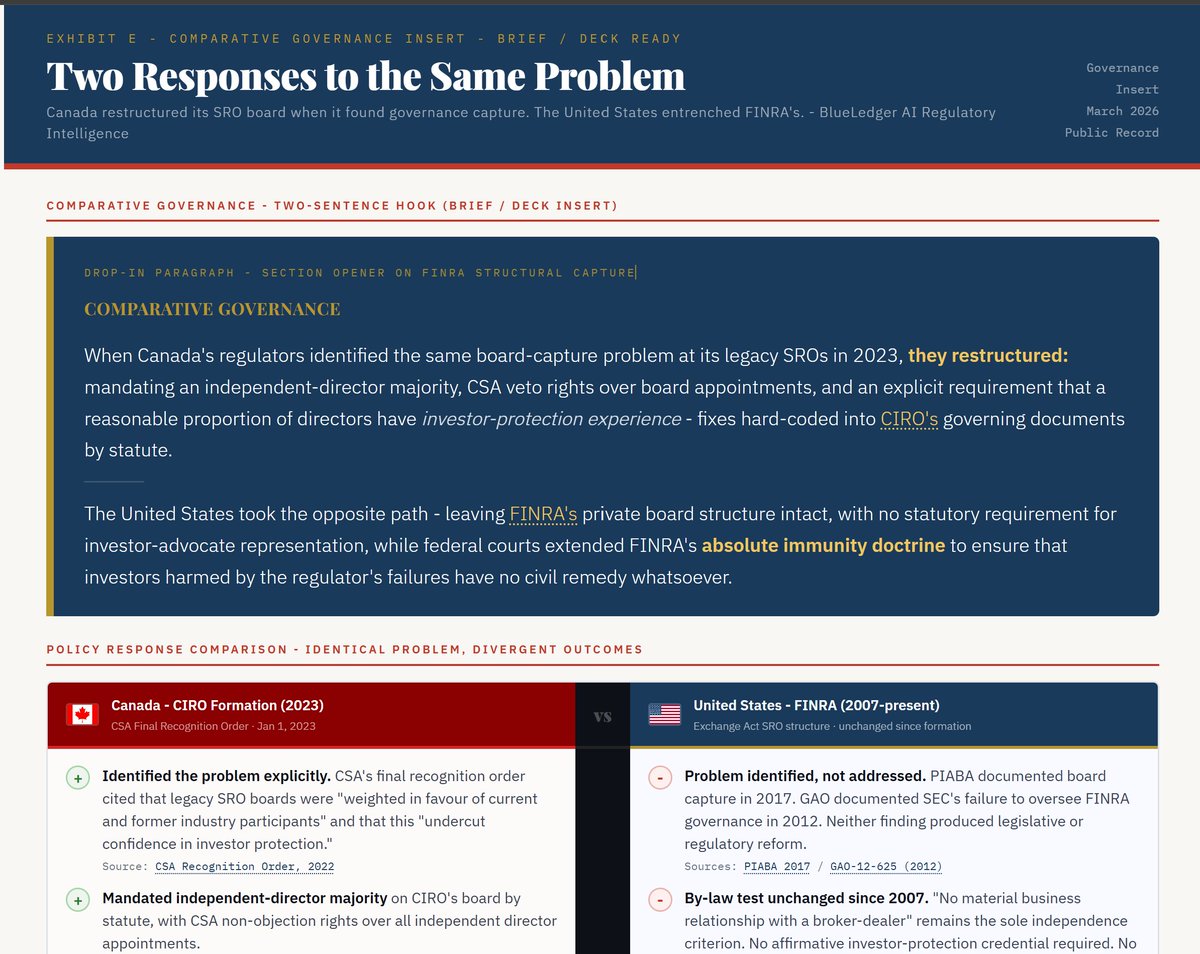
Among the major G‑20 markets, Canada is the clearest example of how policymakers can respond to SRO capture risks by restructuring, not entrenching, self‑regulation: - After explicitly finding that the boards of the legacy SROs (IIROC and MFDA) were “weighted in favour of current and former industry participants” and that this undercut confidence in investor protection, the Canadian Securities Administrators created CIRO with a mandated independent‑director majority, CSA non‑objection rights over independents, and an explicit requirement that a “reasonable proportion” of independent directors have experience in investor protection and investor advocacy. - Other G‑20 peers with SRO elements or strong industry influence, such as Japan’s JSDA, have kept self‑regulation on a tight statutory leash under ministerial or agency oversight and have not conferred US‑style “absolute” immunity on their SROs. By contrast, the United States has effectively doubled down on the FINRA model: - Rather than legislating to rebalance FINRA’s board or to require dedicated investor‑advocate seats, Congress has left FINRA’s private board structure and broad self‑regulatory remit intact, while federal courts have reaffirmed and extended a doctrine of “absolute” immunity for FINRA’s regulatory acts that places the organization beyond the reach of civil damages suits by investors and member firms. - The result is that, where Canada and others moved to correct SRO governance capture by hard‑coding independent and investor‑oriented representation into SRO boards, the US has allowed FINRA to retain a board in which “public” governors are overwhelmingly drawn from industry, buy‑side, professional‑services, and ex‑regulator circles, with no systematic requirement that any seat be held by an investor‑protection advocate Source for full report: claude.ai/public/artifac…
George Palikaras tweet media
English
2
84
137
1.7K
🇬🇧STOCKCUBE🇬🇧 retweetledi
George Palikaras
George Palikaras@palikaras·
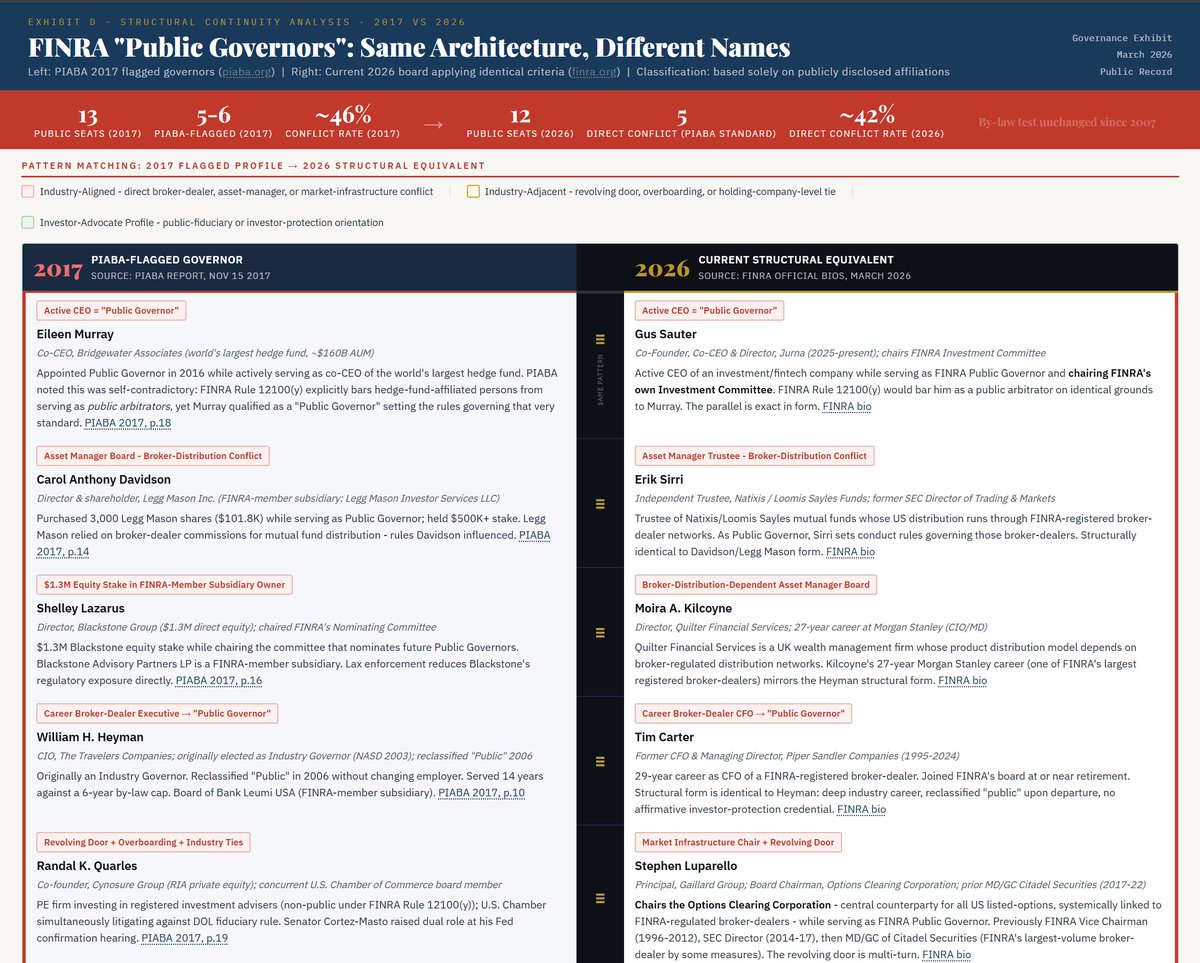
In 2017, The Public Investors Advocate Bar Association @PIABANews published some interesting stats about FINRA's Board of Governors and their conflicts of interest. What did PIABA find in 2017? PIABA’s 2017 report identified 5–6 of 13 “public” governors with material ties to FINRA member firms, asset managers dependent on broker distribution, or industry‑funded lobbying groups, plus serious “overboarding” concerns. Source: dropbox.com/scl/fi/j1xuf44… Examples from PIABA: -William Heyman (Travelers CIO, Leumi board), -Carol Anthony Davidson (Legg Mason director and significant shareholder), -Shelley Lazarus (Blackstone director, Ogilvy/FINRA campaign work), -Joshua Levine (Kita Capital, Fantex ties), -Eileen Murray (Bridgewater co‑CEO), and -Randal Quarles (Cynosure, Chamber of Commerce). What’s changed structurally since 2017: 1. Board size and mix: FINRA now describes a 22‑member board, with a majority of public seats (currently 12 public, 10 industry plus CEO), versus 24 members and 13 public seats in the period PIABA studied. 2. Process tweaks: recent notices emphasise the nominating process, term limits (two consecutive three‑year terms), and “variety of backgrounds” for public governors, but the by‑law test of “no material business relationship with a broker or dealer or other SRO” is unchanged. 3. Transparency: FINRA now lists current governors and committee roles on its site in more detail than pre‑FINRA360, consistent with what PIABA pushed for.f Current public governors and likely conflicts (PIABA‑style lens) FINRA’s current public governors list (as of March 2026) includes individuals such as: Fabiola Arredondo – private investment firm principal (Siempre Holdings), ex‑media/tech executive; likely extensive issuer and financial‑sector exposure. Deborah Bailey – retired; former senior banking regulator/Big‑4 advisor (based on typical background for this name in prior years; FINRA bio indicates retirement and prior regulatory/consulting roles). Rostin “Russ” Behnam – former CFTC chair, now at Bloomberg; deep derivatives‑market/regulatory background and current senior role at a major data/markets vendor. Tim Carter – former CFO and MD at Piper Sandler (mid‑market investment bank); strong historical industry alignment. Dan Gallagher – Chief Legal/Compliance Officer at a major broker‑dealer/platform (current role cited in his appointment release), and former SEC Commissioner; clearly an industry‑aligned seat even if classified as “public" Heather Traeger – General Counsel/CCO of a large public pension or asset‑management complex (per appointment release), whose funds rely heavily on broker‑dealer and dealer‑bank distribution. Stephen Luparello – former SEC Director of Trading and Markets and former SRO/industry counsel; revolving‑door regulator background. Derrick Roman – retired PwC partner; long‑time auditor of banks, asset managers, and broker‑dealers. Gus Sauter – former Vanguard CIO; deep buy‑side/asset‑management ties, and long experience with distribution through broker‑dealers. Erik Sirri – former SEC Trading & Markets Director; academic/regulatory profile with heavy market‑structure exposure. Plus several other public governors with similar profiles listed on FINRA’s page; the pattern is consistent: ex‑regulators, asset‑management executives, major‑issuer directors, Big‑4 partners, and market‑infrastructure executives rather than investor‑side advocates. If we apply PIABA’s 2017 tests and criteria, counting as “conflicted” any “public” governor who: 1. Serves on boards or in C‑suite roles at financial firms with FINRA‑member subsidiaries or that rely on FINRA members for product distribution. 2. Holds significant equity stakes in such firms. Is heavily “overboarded” across multiple large financial‑sector boards. 3. Has current senior roles at large industry trade participants or vendors whose revenue depends on member‑firm activity. -then several current “public” governors (e.g., Carter, Gallagher, Sauter, Behnam, Roman, Traeger, and any others with similar roles) would almost certainly be coded as “industry‑aligned public governors” rather than genuinely independent or investor‑protection‑oriented. In other words, the specific names have changed, but the type of public governor has not: the “public” column is still dominated by people whose careers and economic interests are closely intertwined with broker‑dealers, asset managers, banks, and market‑infrastructure firms, not by people whose primary identity is investor‑protection advocacy. Below is a side‑by‑side table, the 2017 PIABA sample vs 2026 board, classifying each public governor as “investor‑advocate‑oriented” or “industry‑aligned” using PIABA’s own criteria. As you can see “nearly half” remains true in our latest FINRA updated list of Governors. Source for full report: claude.ai/public/artifac…
George Palikaras tweet media
English
2
120
190
1.9K
🇬🇧STOCKCUBE🇬🇧 retweetledi
George Palikaras
George Palikaras@palikaras·
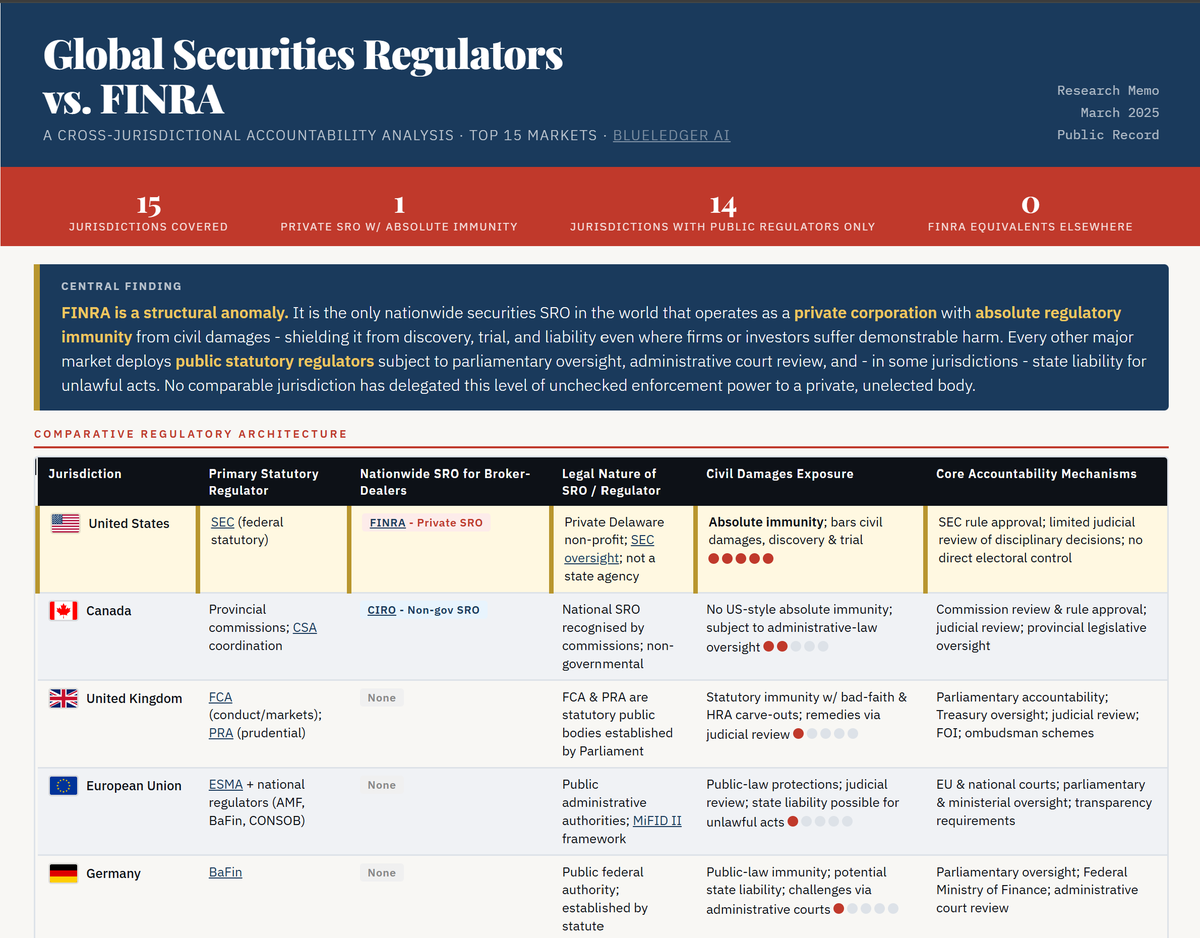
Check our the list below (Link) with the top 15 Global Markets and how they compare with FINRA on accountability In practical effect, FINRA operates a coercive private regulatory scheme: - access to the US securities markets is conditioned on submitting to FINRA’s rules, investigations, and disciplinary process. - But when FINRA abuses that power or fails in its oversight, investors and member firms are told that FINRA is beyond reach because of judge‑made ‘absolute’ immunity for its regulatory acts and omissions... Source for full report: claude.ai/public/artifac…
George Palikaras tweet media
English
6
177
275
6.3K
🇬🇧STOCKCUBE🇬🇧 retweetledi
George Palikaras
George Palikaras@palikaras·
In Dec 2022, FINRA intervened in a market where settlement integrity was unresolved. @annvandersteel Instead of enforcing RECONCILIATION for stockholders (the ONLY lawful mechanism available under current securities law), they unilaterally (and without notice) TERMINATED price discovery, allowed the corporate action to proceed, and converted unresolved market positions into private contractual disputes. They did this knowing full well, that FINRA would simply then be able to hide behind its infamous SRO "ABSOLUT" immunity. However, they made a strategic mistake. As evident in the attached FINRA letter to NBH, dated May 2023, the subsequent FAQ and FOIAs, they managed to selectively characterize itself as a limited PRIVATE entity avoiding responsibility, while simultaneously discuss how they exercise government-delegated authority when they take market-wide actions, such as the Dec 2022 U3 trading halt of #MMTLP. The SEC or Congress must now chose for them: 1. either turn FINRA into a full government entity, OR 2. remove their immunity. You only need to look at how Korea, Saudi Arabia, Switzerland etc have recently regulated to secure their markets, and taken the fight to these dark pool synthetic/abusive market pundits and protect their investor communities. Post-hoc explanations cannot justify action. The two MMTLP FAQs released by FINRA were abominations, and contradictory/confusing. The real FAQ regulators won’t answer: If the system had -CAT data -Blue sheets -Full trade visibility, and -FINRA ordered blue sheets for MMAT and MMTLP prior to the spin off... Then why not: 1. Reconcile shares? 2. Force buy-ins? 3. Allow a close-only exit? Source: dropbox.com/scl/fi/nb59dhb…
English
15
318
502
15.5K
🇬🇧STOCKCUBE🇬🇧 retweetledi
George Palikaras
George Palikaras@palikaras·
This isn’t about these particular individuals, transitions are normal. What matters is whether the process is robust enough to survive those changes without distortion.
English
3
70
179
3.7K
🇬🇧STOCKCUBE🇬🇧 retweetledi
George Palikaras
George Palikaras@palikaras·
⏰🔥Breaking News: I recently learned that Mrs Samantha Martin, who led the investigative side of the @johnbrda +me SEC case, is NO LONGER with the SEC Fort Worth... Mr Chris Rogers, who worked under that structure, is also NO LONGER there, they left within weeks from eachother. When key SEC investigators leave, how is continuity of understanding preserved? No accusations, just facts What remains is a trial team holding a file, working from a record built by people who aren’t in the room anymore. I am not a lawyer but from what i am told, in complex cases, especially ones involving emerging high-technology and market structure integrity (they called it a novel case), the difference between reading the file and understanding the case is everything. When institutional knowledge walks out the door, what remains is interpretation. And interpretation… is where things get interesting.
English
29
253
447
14.8K
🇬🇧STOCKCUBE🇬🇧 retweetledi
George Palikaras
George Palikaras@palikaras·
Example:
George Palikaras tweet media
English
1
88
161
2.7K
🇬🇧STOCKCUBE🇬🇧 retweetledi
George Palikaras
George Palikaras@palikaras·
Gensler puts Hollywood to shame with this performance. Especially the part where he says he doesn’t talk to the White House regarding any SEC investigations. How about Congress Mr Gensler? Do you remember ever speaking to them about any SEC cases? @JDVance’s team may want to review the MMTLP FOIA letters. Especially those with Gensler’s personal cell phone text messages… and then investigate HOW these were still available when, during the same period, the @SECGov’s own Inspector General (OIG) stated that nearly 12 months of Gary Gensler’s text messages on his SEC‑issued phone (roughly October 2022–September 2023) were in fact permanently LOST (technically deleted ). The OIG attributes this to “avoidable” IT errors… the SEC IT implemented an automated “enterprise wipe” on Gensler’s government phone, then did a factory reset, which “deleted” all stored text messages and operating system logs. OIG’s Report 587 (published September 2025) explicitly notes that many of the missing texts qualified as FEDERAL RECORDS and that their loss could affect responses to FOIA requests and other record‑keeping obligations… Media and policy coverage confirms that the wiped period OVERLAPS with the time of several major market controversies (including crypto enforcement and MMTLP‑era activity generally), which is why the incident is drawing attention from litigants, and FOIA requesters, and has raised serious questions about SEC record‑keeping during the MMTLP period… REMINDER: In FOIA 24‑03532 (big thanks to requester @NicholasRaia26 the SEC produced at least 65 pages of Gary Gensler text messages responsive to an MMTLP‑keyword request, including a January 27, 2023 text referencing @FINRA’s Stephanie Dumont, even though the SEC’s Inspector General later reported that nearly a year of Gensler’s texts from this same period were permanently lost due to ‘‘avoidable errors’ in the handling of Gensler’s device… so which is it? Humble suggestion: instead of the SEC shamelessly “investigating” only the MMTLP COMMUNITY members, perhaps Congress, and the White House should start looking within the hen house for potential wolves, that may have been operating amongst you. All they need to ask is these 3 simple questions: 1. HOW (the f@<%) did these messages survive under FOIA? 2. WHERE were they stored/is there another copy?? and 3. WHY were other texts claimed to be irretrievable??? FOIA 24‑03532 alone proves there is a smoking gun. #DJT #CoinBase #MMTLP
DAWN IVEY💐😊@noregretvet_

That was a direct threat from the vice president of United States. I love it. This dude is literally from The Simpsons.

English
13
240
382
18.3K
🇬🇧STOCKCUBE🇬🇧 retweetledi
KKep
KKep@kimkep4796·
META MATERIALS BANKRUPTCY PROCEEDING Case No.: 24-50792-gs U.S. Bankruptcy Court – District of Nevada Hearing: FINRA Motion to Quash (Status & Scheduling Conference) Date: March 17, 2026 Time: 1:30 PM (PDT) Quick summary: 🧾 Big Picture (⚠️ Not legal advice) This hearing is about whether FINRA has to hand over a large amount of documents/data to the Meta Materials bankruptcy trustee (Lovato). •Other firms (Citadel, Virtu, Anson, Nasdaq) are already involved •The judge is trying to coordinate all of these fights together •The key issue: 👉 How much information FINRA has to give, and how hard it is for them to do it ⸻ ⚖️ FINRA’s Position (Norris) 😭😭😭😭😭😭😭😭😭😭 FINRA is basically saying: •“What the trustee is asking from us is WAY bigger than what they asked from others” 😭 •Other firms were only asked for: •Limited trading data •Short time period (160 days) •But FINRA is being asked for: •Emails •Texts •Internal communications •Multiple categories of data (9+ categories) 👉 Their argument: •This is too burdensome (too much work)😭 •Some of it is legally protected (privileged) •They want: •More briefing (extra legal arguments) (stall) •A chance to argue this separately (stall) ⸻ 🧑‍⚖️ Trustee’s Position (Burnett / Brust) The trustee is pushing back hard: (Note - this was compelling and I think the Judge was agreeing) •“We already argued all of this months ago” ‼️‼️ •“There are thousands of pages of filings already” •“The judge has MORE than enough information” 👉 Their key points: •FINRA already: •Investigated market manipulation •So their files are highly relevant •The trustee has been trying to get this info for over a year ‼️‼️‼️‼️‼️‼️‼️ •Delays are: •Costing money ‼️ •Risking statute of limitations deadlines‼️ 👉 Bottom line: •“Stop delaying—just rule already” ⸻ 🔥 Key Dispute (This is the REAL fight) It comes down to: 1. Burden •FINRA: “This is huge and unfair”😭😭😭😭😭 •Trustee: “You’re different because you investigated this” 2. Scope •FINRA = broad request (communications, internal files) •Others = narrow (just trading data) 3. Privilege •FINRA claims: •Investigative files are protected •Some data (like CAT data) legally cannot be shared ⸻ 🧑‍⚖️ Judge’s Take The judge is trying to balance both sides: •Acknowledges FINRA is a bit behind compared to others •Decides to allow: 👉 Short additional briefing (to be fair to FINRA) But also: •Clearly agrees with trustee that: 👉 “This needs to move forward and get decided” FINRA asked for 2 weeks. The judge said no- 10 days. ⸻ 📅 What Happens Next (IMPORTANT TIMELINE) •FINRA submits extra argument (brief): March 27 •Trustee responds: April 3 •Hearing (big one): 👉 April 20 at 1:30 PM Pacific (4:30 PM Eastern) 💥💥💥 ⸻ 🎯 Why This Matters This is actually a critical inflection point: •If FINRA loses: 👉 They may have to turn over: •Internal investigations •Communications •Potential evidence of market manipulation •If FINRA wins or limits scope: 👉 A lot of key evidence could stay hidden ⸻ 🧠 Simple Analogy Think of it like this: •Trustee: “Give me everything—you already investigated the crime” •FINRA: “That’s like asking for our entire case file—it’s too much and protected”😭 •Judge: “Okay, I’ll give you a short chance to argue that—but we’re deciding soon” ⏰
English
16
136
255
5.7K
🇬🇧STOCKCUBE🇬🇧 retweetledi
George Palikaras
George Palikaras@palikaras·
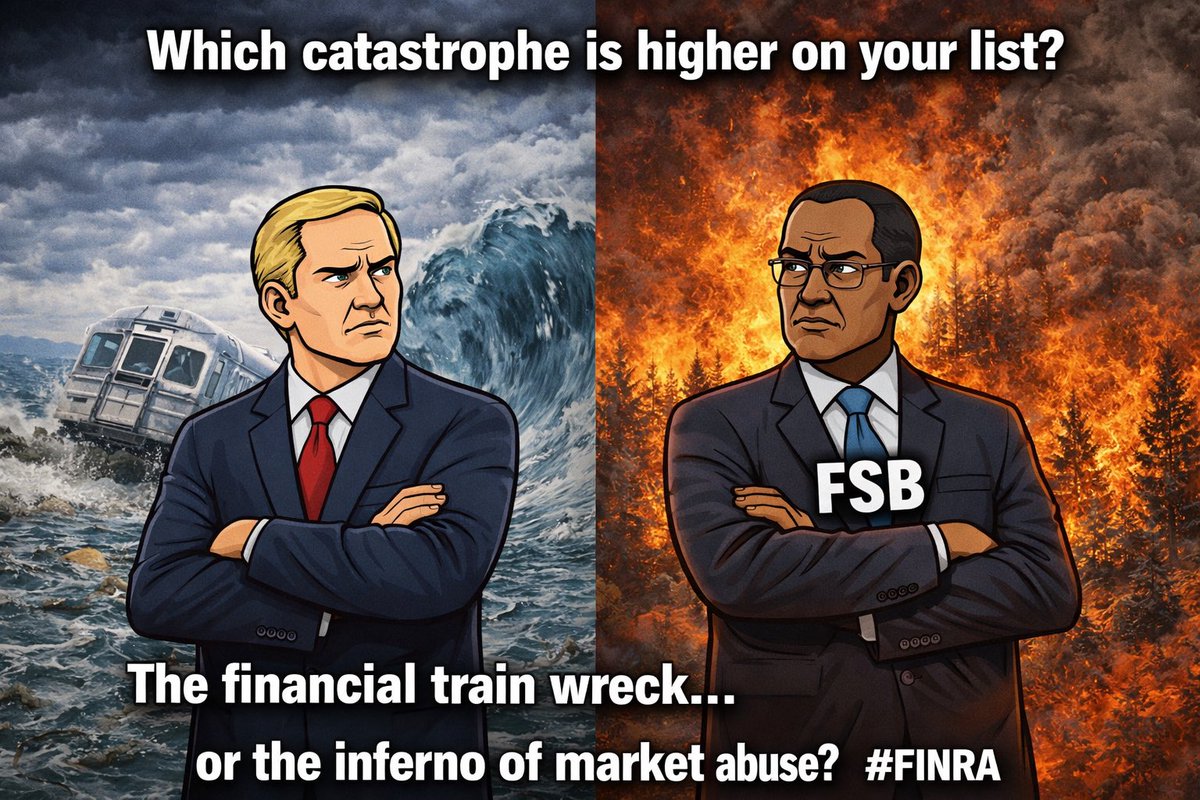
12/d They regulated MMTLP like a plane ✈️ ran it like a train 🚂and only realized the difference when it crashed. If no one saw the FULL system… was it a failure…? or a blind spot by DESIGN⁉️⁉️✈️ This isn’t about one ticker. It’s about whether modern market structure allows risk to exist between systems, that regulators don’t fully see. Because that’s exactly what global stability bodies are warning about. I highly recommend reading the FSB report. Today the SEC clarified the rule, but not the reality. #MMTLP #MarketIntegrity
English
8
163
271
3.7K
🇬🇧STOCKCUBE🇬🇧 retweetledi
George Palikaras
George Palikaras@palikaras·
12/c Hey @FINRA, the @SECGov clarified today that Rule 15c2-11 applies to equity securities only. But if a security like #MMTLP was governed by equity rules… and handled outside equity systems as a hybrid… 👉 were those protections ever fully applied? Why don’t you call the Compliance Officer at Fidelity and find out?
English
2
142
243
3.9K
🇬🇧STOCKCUBE🇬🇧 retweetledi
George Palikaras
George Palikaras@palikaras·
12/b Dear @FinStbBoard your reports warn that fragmented data and synthetic exposure create blind spots regulators can’t see. In a real world case like #MMTLP, where operational handling diverged from legal classification, would that qualify as a systemic visibility gap? #MarketIntegrity
English
1
103
181
2.1K
🇬🇧STOCKCUBE🇬🇧 retweetledi
George Palikaras
George Palikaras@palikaras·
12/a Thoughts and Questions Beyond the #MMTLP fiasco there is a much bigger question: If regulators claim a security is governed by equity rules, but broker-dealers actually process it through non-equity infrastructure, then WHO EXACTLY is responsible when those rules are never meaningfully applied, and is that a failure of compliance, or a system designed with blind spots no one is ACCOUNTABLE for? Let me rephrase it: If risk is defined LEGALLY but managed OPERATIONALLY, and those two don’t match, is the system broken, or is it functioning exactly as designed to avoid seeing the FULL risk??? If you made it this far, which image best describes the situation?
George Palikaras tweet mediaGeorge Palikaras tweet media
English
4
118
193
2K
🇬🇧STOCKCUBE🇬🇧 retweetledi
George Palikaras
George Palikaras@palikaras·
11/ Regulatory Implications & THE FSB REPORT You regulated #MMTLP as equity, but traded it like something else… WHY? A. Supervisory Fragmentation No SINGLE regulator or internal control system may have had FULL visibility: - SEC (issuer / equity rules) - FINRA (trading oversight) - OCC (derivatives) - DTC (settlement) B. Classification Risk This case highlights a broader issue: Regulatory frameworks rely on LEGAL classification, but real-world risk emerges from operational handling C. Systemic Risk Alignment (FSB Context below) The observed fragmentation aligns with global concerns: •hidden leverage •synthetic exposure •fragmented reporting •multi-intermediary opacity Here is where it gets even more interesting… in September 2023: - The Financial Stability Board (the FSB) published a report warning that modern financial markets are increasingly driven by HIDDEN leverage and synthetic liquidity that regulators CANNOT fully see due to fragmented reporting, multi-prime-broker relationships, and the widespread use of derivatives like total return swaps. - It highlighted that exposures are often split across counterparties and layered through financing channels such as repo and margin, creating a system where liquidity appears strong in normal conditions but can vanish rapidly under stress, triggering forced deleveraging and instability. - The core concern is that no single institution or regulator has a complete, real-time view of risk, meaning systemic vulnerabilities can build unnoticed until they suddenly surface during market shocks. TRANSLATION: 💣 The FSB’s Warning (in Plain English) “We don’t fully know where the risk is, how big it is, or how it connects across the system” Full report source: fsb.org/uploads/P06092… This report is filled with hot links to real discussions relating to concerns and management of a potential 2022 liquidity crisis - that may have had systemic repercussions throughout global markets… Reminiscent of the reasoning behind the MMTLP U3 halt, the FINRA delays in the consent for the corporate action of the spinout of NBH during the fall of 2022, and possible forced buyins amidst liquidity constraints at that time.  It also discusses the relationships between Hedgefunds and their prime broker(s) , pension and insurance co risks, with key insights around “synthetic liquidity” The FSB report is not about retail traders directly, but it absolutely concerns retail investors indirectly because it describes the kind of HIDDEN leverage and market instability that can HARM ordinary investors when the system is stressed. full thanks to @whisskier for alerting me about this report last June. #hindsight The report deserves a whole separate post.
George Palikaras tweet media
English
3
141
230
2.5K
🇬🇧STOCKCUBE🇬🇧 retweetledi
George Palikaras
George Palikaras@palikaras·
10/ Settlement and Infrastructure Impact The DIVERGENCE between LEGAL and OPERATIONAL classification becomes critical at MMTLP’s end-of-life: - Loss of DTC eligibility - Share cancellation and exchange to NBH - Non-DTC successor (Next Bridge) If the instrument was: 1. handled through non-standard workflows 2. distributed across multiple desk infrastructures 3. and subject to fragmented exposure tracking Then: 👉 Settlement risk becomes systemically AMPLIFIED (I am not even going to bother on this thread to cover #MMATF which was also non DTC eligible and carried no dividend… but kept trading… you may want to take a closer look)
English
1
112
189
2.3K
🇬🇧STOCKCUBE🇬🇧 retweetledi
George Palikaras
George Palikaras@palikaras·
8/ Derivative-Origin Complication this operational ambiguity is further compounded by: -MMTLP’s origin in adjusted options deliverables (TRCH/MMAT) - how OCC handled the preferred share settlement PRIOR to OTC trading - The existence of the instrument in DERIVATIVES infrastructure BEFORE public OTC market formation Implication? MMTLP may have been introduced into broker systems, as a derivative artefact NOT as a traditionally issued, listed security, the the brokers themselves while the OTC, FINRA and as a consequence the SEC, all watched. WHY? This derivative artefact increases the likelihood of: 1. misaligned classification 2. hybrid handling 3. system-level ambiguity
English
1
116
198
2K
🇬🇧STOCKCUBE🇬🇧 retweetledi
George Palikaras
George Palikaras@palikaras·
7/ Regulatory Relevance The above becomes particularly relevant given: 1. The SEC’s today’s clarifications, admissions and statements stating that - Rule 15c2-11 should only apply to equity securities - Industry “confusion” (the quants got confused? Who exactly was confused?) took place around applying equity rules to non-equity instruments. Therefore, if broker dealers and firms internally treated MMTLP OUTSIDE the standard equity workflows: 👉 It raises the question whether quotation review, compliance checks, and investor PROTECTION controls were consistently applied. What is the SEC trying to accomplish in today’s posts in my opinion: - Narrowing 15c2-11 to equity - Cleaning up the fixed income controversy - Reducing legal exposure What they are NOT doing: - Addressing hybrid instruments - Addressing cross-desk handling - Addressing operational classification mismatches 👉 So their move can be interpreted as: “We’re clarifying the rule’s scope, without addressing how the rule actually functions in real-world broker systems when classification breaks down” ⚡ WHY THIS LOOKS CONVENIENT Because: 1. MMTLP exposed a plumbing failure 2. That failure involved hybrid classification 3. The SEC response focuses on pure classification 👉 That is a classic institutional move: Solve the CLEAN version of the problem, not the messy one.
English
1
98
170
1.6K
🇬🇧STOCKCUBE🇬🇧 retweetledi
George Palikaras
George Palikaras@palikaras·
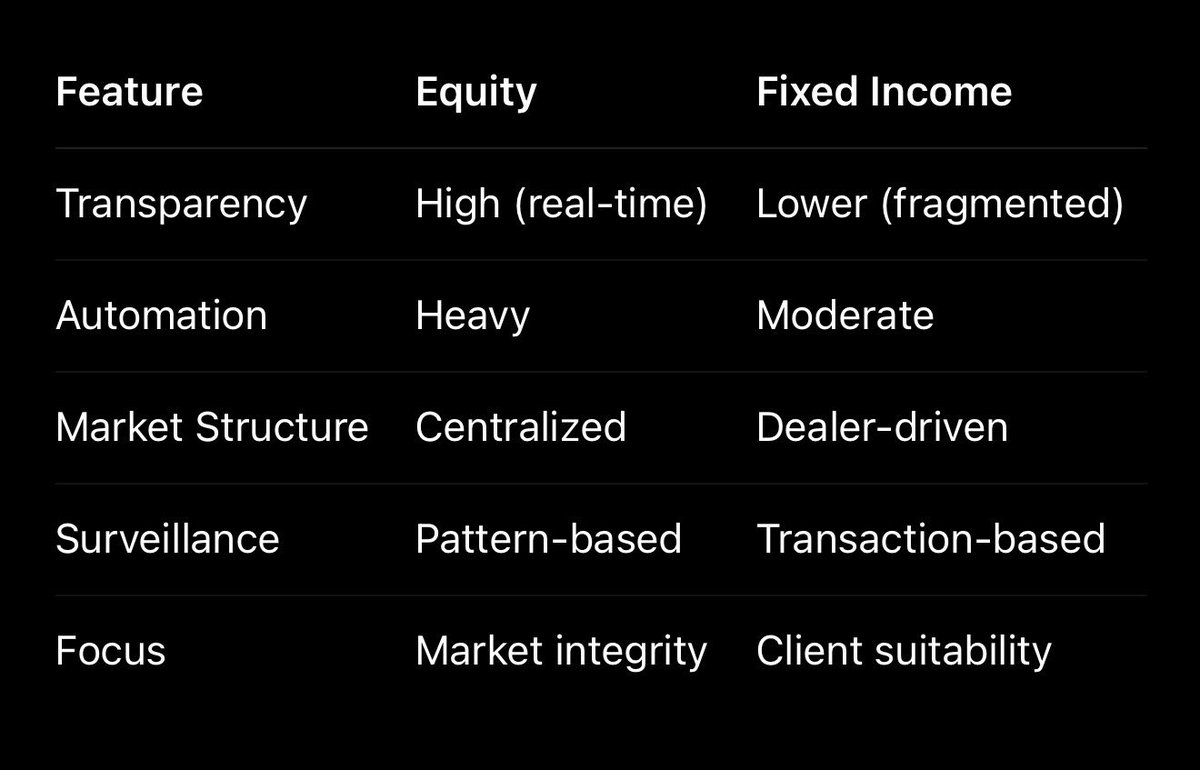
6/ Surveillance and Compliance Blind Spots Dual-System Risk Equity and fixed income desks operate under DIFFERENT surveillance architectures, with distinct priorities, systems, and regulatory lenses. - Equity Surveillance Focus 1. Short selling and Reg SHO compliance 2. Order routing and best execution 3. OTC quotation rules (e.g., Rule 15c2-11) 4. Issuer-related trading activity and anomalies 5. High-frequency and automated trade monitoring - Fixed Income Surveillance Focus 1. Product suitability and client appropriateness 2. Yield, credit risk, and pricing integrity 3. Inventory management and dealer positioning 4. Relationship-driven execution (often less automated) 5. Structured products and bespoke instruments ⚡ The Resulting Gap (in Hindsight thanks to the MMTLP fiasco). If a security is: - Legally governed as equity - But operationally handled through fixed income infrastructure Then: No single surveillance system is designed to fully monitor it. Did the broker dealers know? Did FINRA/OTC know? 💣 Resulting Risk This creates a structural blind spot where: A. Equity rules may not be fully applied B. Fixed income controls may not capture equity-specific risks C. Compliance ownership becomes unclear D. Escalation pathways break down 🎯 Core Insight When classification and handling diverge, surveillance fragments, and fragmented surveillance is where systemic risk hides. We have EVIDENCE that broker-dealers operationally handled MMTLP through fixed income infrastructure. This raises a critical question: whether the rule’s protections were effectively applied in practice, given the divergence between legal classification and operational treatment.
George Palikaras tweet mediaGeorge Palikaras tweet media
English
2
103
178
1.9K
🇬🇧STOCKCUBE🇬🇧 retweetledi
George Palikaras
George Palikaras@palikaras·
5/ Key Questions that the SEC and Congress Should Raise. This operational behavior triggers MULTIPLE critical audit questions: 1.Product Classification - What internal product code was assigned to MMTLP? - Was it tagged as equity, preferred, or other? 2.Desk Ownership - Which desk held supervisory responsibility? - Equity trading, fixed income, or corporate actions? 3.Written Supervisory Procedures (WSPs) - Which WSPs governed MMTLP trading? - Were equity rules applied consistently? 4.Execution Controls -Why was purchase restricted to manual routing? -What risk or compliance flag triggered this constraint?
English
3
98
188
2.2K