Arjo Basu

25 posts

Arjo Basu banner
Arjo Basu

Arjo Basu

@StrategyMoksho

Deep Systems Thinker | Data & Capital Strategist| Seeking partnership with govts. and international orgs. to drive systemic equitable growth for billions.

USA Katılım Mayıs 2025
7 Takip Edilen5 Takipçiler
Arjo Basu
Arjo Basu@StrategyMoksho·
#Leadership and #strategy are extremely misunderstood. This conversation is another example of that : youtube.com/watch?v=dHVMuj… . #SteveJobs was not successful because he was deciphering noise from signal on a '18 hour' cycle. Yes, he must have used that principle to make his #tactical to-do list or to shut-down a 'noisy' investor who had no idea what strategy is. #SteveJobs was successful because he developed a vision for a new #system of human interaction with technology and built effective #strategy for achieving that system change. He had enough time, way more than '18 hour' cycles, to achieve that vision once he created that #blueocean of new possibilities with his systemic vision and separated apple from the others. Don't be misled by wrong interpretation of people's success. You can be successful by being a purely tactical person - success is relative and can be caused by many things. But you won't be a #leader with lasting impact without strategic and #systemthinking. Period.
YouTube video
YouTube
English
0
0
1
51
Arjo Basu
Arjo Basu@StrategyMoksho·
it would be interesting to know how old these folks are in this conversation. I would guess they are all in 50+ age group. This is the systemic effect of nurturing fear against a particular thought/group/nation/idea for decades and making it the mainstay of piolitical decisions - they don't just disappear even after the sources have disappeared. And I would suspect, this same trend would continue in America 50 years from today... the fear against the immigrants and communism and what not that this generation is growing up with would drive the society even then... perhaps, they won't have to worry a lot more about immigrants in 20 years from today... not many good ones would be coming this way.
English
0
0
0
140
Brooklyn Flowers
Brooklyn Flowers@BrooklynFlowe15·
Interesting read because first President Obama and then President Biden tried to give Kerr County funds to update their Flood Warning Systems, but they REJECTED it from Obama but then Senator John Cornyn told them to KEEP the cash from Biden and still not update the system -
Brooklyn Flowers tweet mediaBrooklyn Flowers tweet mediaBrooklyn Flowers tweet media
English
456
8.4K
40.7K
2.6M
Arjo Basu
Arjo Basu@StrategyMoksho·
Why the Strategic view of data is so important? Today, most health insurance companies are at the bottom of data literacy. With the increase of data volume, they would struggle even further. The companies also exist in a 'rule-based decision making paradigm'. But at phase 3 onwards, this paradigm would shift at the blink of an eyes. All healthcare service and insurance related decision would be a pureplay AI driven decision. Rules would not be enough to handle this huge data volume and its nuances personalized variations in hundreds of dimensions. So the existing big players, with access to their existing customer's data would have leverage. But only if the data is well governed and trust worthy, the decision made based on it would be valuable. Even large companies with under-governed and flawed data would start making insurance decisions leading to major losses or customer dissatisfaction. On the contrary, if you are a startup with knowledge of healthcare and of data, get ready for an exponential growth. Is the impact worldwide? This would be the case primarily for US based companies. Europe has been on a different trajectory when it comes to regulation on personal and health data and would continue to diverge from US path even further going forward. #datastrategy #strategymistakes #data #leadership #healthcare #dataprivacy #regualtion #healthinsurance #systemsthinking #systemshock #BigBeautifulBill #DataAnalytics 3/3
English
0
0
0
14
Arjo Basu
Arjo Basu@StrategyMoksho·
Phase 1: #Systemshock in the #healthcare industry The Medicare and Medicaid coverage would reduce by 10+ percentage over the next decade. This would put extreme pressure on the healthcare providers and health insurers. There is a large segment of mid-small size health insurance companies whose majority revenue comes from Medicare and Medicaid. They would suffer the most as they loose the advantage of scale, which is extremely important for success in healthcare industry as the profit per patent is very low while infra including technology infra cost is high. Phase 2: Extinction of smaller players This would lead to consolidation of corporations - wiping out the smaller payers in the first wave - maybe by 2028/9. But the 'system shock' would not stop there. Phase 3: Government losing control over health data protection Once there are only bigger players, and government's stake and so its 'control' over the industry reduces, the demand for deregulation would increase to support better profit structure for the dominant private players. This is when the 'strictly regulated' access to patient data would start becoming easily available. Phase 4: age of data driven personalized insurance A new group of data first health insurance companies would emerge - who would provide 'personalized' health insurance instead of today's 'fixed' set of health care plans. Think of it more like car insurance industry today, where everyone's insurance is unique based on their driving history and valuation of the cars they own. Same would happen in health insurance sector - an individual's past health history, age, genetic assessment, lifestyle details, and other relevant data points would be sued to decide one's health insurance cost. A world where your insurance cost would be driven by your wildly multi-dimensional (thousands of dimensions) health DATA. I believe, it would be there well within the next decade. #datastrategy #strategymistakes #data #leadership #healthcare #dataprivacy #regualtion #healthinsurance #systemsthinking #systemshock #BigBeautifulBill #DataAnalytics 2/3
English
1
0
0
29
Arjo Basu
Arjo Basu@StrategyMoksho·
#DataStrategy Forecast for American HealthCare Industry: #datastrategy #strategymistakes #data #leadership #healthcare #dataprivacy #regualtion #healthinsurance #systemsthinking #systemshock #BigBeautifulBill #DataAnalytics In my previous post (x.com/StrategyMoksho…) I talked about how the current mid-size manufacturing and financial companies would be extinct within the next decade if they don't make the three common strategic mistakes they are making today. I did not include healthcare companies in that list - because they have a different strategic challenge and path forward. Let's discuss that here. What's happening in healthcare, especially in health Insurance industry? If you think of one industry that has been least adversely affected by the data bandwagon over the last decade, it's the healthcare service providers, especially the health insurance industry. Health care has been a heavily regulated industry and so protected from the disruptions brought in by the data innovations especially in the area of insight generation by AI/ML (in other words, insight generation which is not based on predefined rules). But that's been changed by one 'big beautiful bill'. The heavily government sponsored and so 'protected' system, that's now being shaken by the new bill passed in July 2025 ( and going into effect from Jan 2027), would go through a 4 phase transitions over the next decade. 1/3
Arjo Basu@StrategyMoksho

#DataStrategy Mistakes - #extinction looming large for Mid-size Companies #datastrategy #midsizecompanies #ELT #startegicmistakes #data #leadership #manufacturing #finance #datamaturity #aiml #datanalaytics Every organization wants to capitalize on data. Yet, most of them are failing miserably to leverage their data. Many of them only waste money, especially the mid-size companies in manufacturing and financial sector, who have the right type and volume of data that can help them propel ahead of the competition or create new blue-ocean niches purely based on their data strength. They are failing in three strategic fronts. 1. Embracing out of the box ELT (Extract Load transform) data warehouse solutions like Snowflake/Databricks etc. for all their data needs While the ELT solution are great for what they offer, many mid-size companies are just buying into them without realizing what they are getting into and how these choices constraint their data ambitions. all their data get locked into a vendor platform which are not the best when it comes to AI/ML data governance go for a toss and data duplication become the norm - resulting in pure chaotic data Without robust governance and AI/ML capacities, data just consumes money and does not return anything. 2. Choosing wrong leader for their data initiatives. most companies are bringing in cloud and software engineering specialist as data leaders in director+ roles, or even worse just bringing in business leaders to lead their data organizations most MVP's have no idea what data strategy means and are clueless about the organizations data maturity 3. FOMO forces the leaders at the top, who barely know what data means and what it needs but feel compelled to spend money in data. Result- companies are wasting money in data, which is by far the highest cost center within the entire IT portfolio, with almost zero ROI. Time is running out for mid-size companies! With AI everywhere, there is no middle ground to hide. My prediction is, these mid-size companies, especially in data heavy sectors like manufacturing and finance, would simply go out of business within the next decade, if they can't solve this problem within the next couple of years. They would be replaced/taken over with new generation companies with data first strategy. Embrace right data strategy, get proper assessment of data maturity, hire right leaders and propel forward. Or face extinction. There is no middle ground.


English
1
1
1
96
Arjo Basu
Arjo Basu@StrategyMoksho·
#DataStrategy Mistakes - #extinction looming large for Mid-size Companies #datastrategy #midsizecompanies #ELT #startegicmistakes #data #leadership #manufacturing #finance #datamaturity #aiml #datanalaytics Every organization wants to capitalize on data. Yet, most of them are failing miserably to leverage their data. Many of them only waste money, especially the mid-size companies in manufacturing and financial sector, who have the right type and volume of data that can help them propel ahead of the competition or create new blue-ocean niches purely based on their data strength. They are failing in three strategic fronts. 1. Embracing out of the box ELT (Extract Load transform) data warehouse solutions like Snowflake/Databricks etc. for all their data needs While the ELT solution are great for what they offer, many mid-size companies are just buying into them without realizing what they are getting into and how these choices constraint their data ambitions. all their data get locked into a vendor platform which are not the best when it comes to AI/ML data governance go for a toss and data duplication become the norm - resulting in pure chaotic data Without robust governance and AI/ML capacities, data just consumes money and does not return anything. 2. Choosing wrong leader for their data initiatives. most companies are bringing in cloud and software engineering specialist as data leaders in director+ roles, or even worse just bringing in business leaders to lead their data organizations most MVP's have no idea what data strategy means and are clueless about the organizations data maturity 3. FOMO forces the leaders at the top, who barely know what data means and what it needs but feel compelled to spend money in data. Result- companies are wasting money in data, which is by far the highest cost center within the entire IT portfolio, with almost zero ROI. Time is running out for mid-size companies! With AI everywhere, there is no middle ground to hide. My prediction is, these mid-size companies, especially in data heavy sectors like manufacturing and finance, would simply go out of business within the next decade, if they can't solve this problem within the next couple of years. They would be replaced/taken over with new generation companies with data first strategy. Embrace right data strategy, get proper assessment of data maturity, hire right leaders and propel forward. Or face extinction. There is no middle ground.
English
0
0
1
115
Arjo Basu
Arjo Basu@StrategyMoksho·
#ChinaVsIndia #meritocracy #castesystem #futureofIndia #strategy #systemsthinking #China and #India are two of the longest lasting civilizations on this planet. And they both are based on fundamental principles of #hierarchical societies - where everyone in the society has a well-designated place in the social hierarchy and follows their roles as per that designation. One must admit that hierarchical social structure has served both the civilizations reasonably well - they both have survived thousands of years. In China, #Confucius (551 -479 BCE) introduced the idea of hierarchy - bring harmony in the society by letting everyone know of their role in the hierarchy and how to play it well. In India, the idea of #caste based hierarchy and work allocation took concrete shape around 3000 years ago (there is now well established genetic proof of that). However, there are one major differences between these two hierarchies: #meritocracy Although Chinese society was still hierarchical, more than 2000 years ago, Chinese society introduced the concept of a merit based hierarchical system. In 165BCE, the early Han dynasty introduced the concept of #ImperialExamination to find the right candidates for the officials roles. From that point, anyone could rise in the hierarchical ladder based on his/her hard work and merit. Each of the subsequent dynasties experimented with it and further refined it. Introduction of #ImperialExaminations to fill up positions across government hierarchies made sure that the power centers within the society were continuously shifting. Although Chinese society was still hierarchical, anyone could rise in the hierarchical ladder based on his/her hard work and merit. This made putting in hard work in studies while young a phenomenon in the society with all its benefits - not only for a segment of the population, but for everyone in the society. @RayDalio has described this very well in his book "Principles for Dealing with the Changing World Order - Why nations succeed and fail". On the other hand, India's caste based hierarchical system was a system of hierarchy based on one's birth. A person's family lineage decided what kind of skills the person would be taught and what would be his/her profession. Kids from higher castes like #brahmins (and some other upper castes like #kshatriya - the warriors) were entitled to study the ancient texts and learn the wisdom and philosophies embedded in them. They would grow up to adorn the official positions in their respective states and advising the kings. Anything that required deeper/purely mental abilities (including specialized warfare skills and tactics) were kept for the upper caste whereas the manual labor (including farming, pottery, blacksmith, cook, maid etc.) were kept for the lower castes. But there were lower than the lowest castes - called #dalits (#untouchables), who were trusted with the most disrespectful but still essential duties of the society - including cleaning sewers and handling human waste - for generation after generation. Surprisingly, the two upper castes of #Brahmins and #Kshatriyas were less than 10 percent of the entire population!!! So, all the sacred and significant skills, knowledge, wisdom... anything of value, anything that gives one power and influence, stayed locked within less than 10 percent of the population. So, while their counter parts in China took a more progressive approach towars society building, empowering people from all walks of life to be part of power, for thousands of years, India's #castesystem not only assigned a role to every one in the hierarchy, it also was extremely vigilant of anyone trying to move up the ladder and served the cruelest possible punishments to set an example so that no one would dare to rise up. Two important questions arise from this background: 1. Given the deeply compassionate and humane philosophical thoughts embedded inside the ancient Indian texts (#Veda s and #Upanishad s and the #puran s) , its surprising that the wise thinkers of India chose to establish a discriminatory social hierarchy (it's easy to understand that this is a detrimental system, even for the upper castes, in the long run) based on one's family lineage and went to great lengths to retain this discrimination for 3000 year. Why?? What prompted this? 2. How much repair does India need to capitalize on any opportunity to become a world leader in the modern world? Is its huge 1.4+B population a true opportunity or just a number? part 1/
English
0
0
0
25
Arjo Basu
Arjo Basu@StrategyMoksho·
#post4 of my #datamaturity #masterclass #series as a foundational pillar of #analytical #datastrategy Step 4: Primitive to #Platform – First Steps to Recovery If your organization is in primitive mode, pivot from tactical projects to #strategic #platforms Recovery Step 1: rationalize efforts into building platforms Identify the most robust existing pipelines for each layer (ingestion, transformation, etc.) and halt new standalone builds. Channel future investment into those “best” apps to evolve them into enterprise platforms. This breaks down arbitrary silos quickly. Recovery Step 2: Build trust with central metadata catalog Launch a centralized metadata catalog to define all data assets and transformations. Populate it with names, definitions, owners, quality rules and lineage for each dataset. A vocabulary/ontology helps – e.g. map “cust_id” to “customer_id” so teams align. #important: make it #searchable for all. Improved discoverability alone will reduce duplicate work. These are tough changes - lines of business will resist vehemently as they fear of losing control and privileges of the data that they think 'only belongs' to them - but these two steps are essential. Firms that recognize and pull this off can skip much of the painful Low maturity stage. But those who can't do this in a timely manner, may never mature into anything significant - however hard they try after a few years. #biggest #enemy of #datamaturity: proliferation of redundant data pipelines creating duplicate copies of data
English
0
0
0
81
Arjo Basu
Arjo Basu@StrategyMoksho·
#post3 of my #datamaturity #masterclass #series as a foundational pillar of #analytical #datastrategy Step3: Spotting the #Primitive / #NoMaturity Phase Most organizations unknowingly plunge into a Primitive (#NoMaturity) stage trying to generate data insights beyond the traditional reports and dashboards. #how #Primitive #datamaturity unfolds: - Typically, a single data-savvy team (often in the highest-revenue LOB) decides they need insights beyond the lagging indicators ( reports and dashboards) provided by the legacy data warehouses. - They pick a cloud provider and spin up a standalone data lake for their domain - They build a primitive data pipeline to bring data from one of the operational plane applications - This team gets organizational accolades, but the sister teams lack trust on their process, data, and insight - they know far too well about the inherent lack of maturity in engineering and architecture - So, every other LOB (or even teams within the same LOB) starts to build their own data lake and data pipelines to pull data from the same sources, leading to duplication. From outside, this #LooksLikeSuccess, but watch for the telltale signs of #Primitive #maturity : #datasilos: Are separate teams each maintaining their own data pipelines and copies of the same tables? This leads to increased data processing cost while diverging “truths”. #Metadata gaps: If #datadictionary is in one developer’s head (or code), not a shared catalog, that’s a primitive-level risk. #multiple #sourceoftruth: without a shared catalog, teams each curate their own “clean” data - all #inconsistent #Teamburnout: A few engineers burn-out maintaining patchy pipelines, while business analysts struggle to trust any dataset. #LowROI: Despite spending on tools and hires, organizational data consumption remains tiny. Analytical projects contribute negligible revenue. #WhatToDo as a #leader: Pivot from #TacticalToStrategy
Arjo Basu tweet media
English
0
0
0
78
Arjo Basu
Arjo Basu@StrategyMoksho·
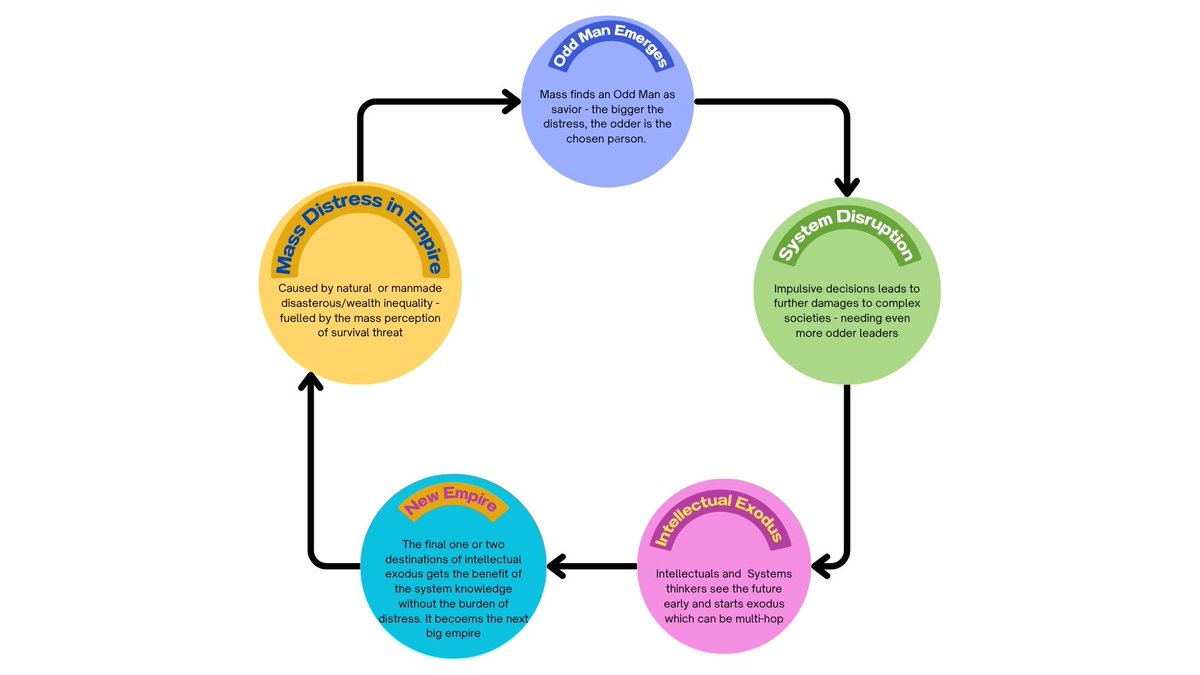
#USAToday #EmpireCycle #HistoryMatters #SystemsThinking #MassHysteria #OddMan & #Exodus #History is a continuous process, yet there are major mile markers that often decide the course of history. What causes those major historical markers? If we read history, we see one man/woman who made a major decision which changed the course of history, for worse or for good, but none of these leaders ever came to the power or made those decisions, made without a #MassHysteria behind it. What causes #MassHysteria? When the majority population feels distressed. The most important word here is ‘feel’ - often people looking from outside may not see the situation as distressful.. Like the #USAToday… but if the population feels distress, a #MassHysteria forms. What causes distress in society? I believe the cause of distress is always connected to #survival. Over the last few centuries, the survival distress is primarily caused by #WealthInequality #KarlPolanyi explained this in his book #TheGreatTransformation - how abuse of #FictitiousCommodities (land, labor, money/debt etc.) causes dis-embeddedness of economic activities and separates it from the society (creating concentration of wealth and distress for mass) and how #DoubleMovement, a form of societal reaction - as #WealthInequality increases, the society makes a counter move to ‘re-embed’ the economy within it by finding alternative leadership voices. (will make another post on those details). #ImportantQuestion - Who does society turn to when in distress? @davidgraeber and @davidwengrow has answered this masterfully in their special book #TheDawnOfEverything - from the beginning of time of human societies, perhaps for other Homo genus other than homo sapiens, when in distress, mass turns to those who are ‘slightly odd’. Odd people have always been perceived as leaders who possess a reserve of political talent and insight that could be called on in the time of distress. The odder you are, the bigger the faith of mass on you in the time of a crisis or unprecedented turn of events (think of spiritual leaders at the extreme end of it). It’s no different today. When in distress, mass turns to leaders who are ‘odd’, those who defy logic and stand against the current systems. But why is it a problem? Here comes the #SystemsThinking & intellectual pursuits of #strategy . Any major system (like a society) is a collection of interdependent #elements intertwined via more threads than understood from any one angle. In early societies, the #Oddman were perhaps more insightful than the rest - why perhaps, they were more insightful for sure, our success as a race is the proof of that… but societies were less complex and with less dimensions and their circle of influence was also very small - one person or a tiny group of people could fathom all the #intellectual insights of a small community. But now the society has become much more complex and multi-dimensional - it’s still possible for a small group of people to accumulate a lot of wealth, but it’s not possible for a small group of people to understand everything about the system. It takes many more apparently disconnected groups of #intellectuals to understand the interconnections among the system components and the higher degree impact (multi-layered indirect effect of one action on one component of the system) of one decision. Only then the system runs smoothly and produces benefits for a large section of the population. However, #masspsychology has not evolved much. The masses still search for that one savior, they believe in that one ‘#oddman to save them in the time of distress - thus embracing a sure recipe for disaster for themselves. Why is it important today? Take #USAToday . Anyone with some knowledge of the rest of the world would agree that the situation of the masses in the USA is better than most other populations. But the masses of USA feels otherwise - the ‘market’ driven society has caused extreme abuse of labor and money over the decades and we are now seeing a #MassHysteria. The leaders who thought they were helping the masses by printing and doling out free money, have forgotten the #CycleOfMoney - in any society, money disbursed by the Government always accumulates in the hands of a few wealthy private entities. The more disproportionately you print money, the faster the rate of #wealthinequality. What should we do? Once the mass turns away from the current system, what follows is an #ExodusOfIntellectuals. The most recent of such exoduses was from Nazi Germany in 1930/40s which helped make the USA of today. And it will be the same in the next cycle. Wherever the intellectuals gather, the next empire would flourish there. Today, my guess is, the exodus may not be a single hop though. The initial exodus may be scattered, eventually leading to one or two final destinations. So, follow the #exodusroutes and final destinations closely. That’s the next #SafeHaven.
Arjo Basu tweet media
English
0
0
0
103
Arjo Basu
Arjo Basu@StrategyMoksho·
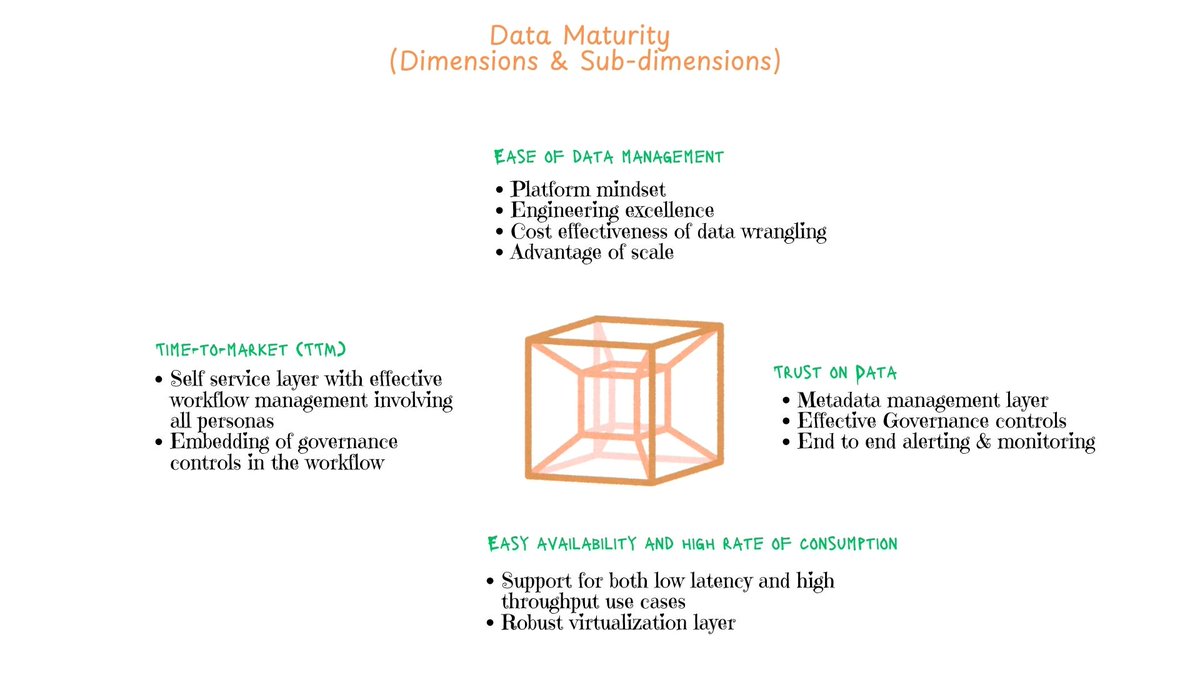
#post2 of my #datamaturity #masterclass #series as a foundational pillar of #analytical #datastrategy Step 2: Map the Maturity Dimensions and Understand the Phases In today’s big data world, processing #analyticaldata is a costly affair. So, it’s important that the #leadership has a clear vision of #maturity #phases of data and how to measure the #dataROI on analytics investments. To effectively leverage analytical data, an enterprise must mature along these four #data #dimensions: #dimension 1 : Ease of #datamanagement Scalable storage, compute, discovery, and serving layers for both analytical data and metadata so that the ‘advantage of scale’ is realized for both cost and performance while standardization and governance become easier. Key sub-dimensions: - Platform mindset - Engineering excellence - Cost effectiveness of data wrangling - Advantage of scale #dimension 2 :Trust on data: It also demands combining data wrangling with decentralized domain specific tribal knowledge to help reduce data duplication and arbitrary uniqueness of data processing solutions and focus on the quality and subsequent trustworthiness of data. Key sub-dimensions: - Metadata management layer - Effective Governance controls - End to end alerting & monitoring #dimension 3: Easy availability and high rate of consumption Primary purpose of data wrangling is to create unique and meaningful insights that help grow the business. It can only happen when high quality data is easily available and consumers, both humans and machines, are consuming data at a high rate. The greater the rate of consumption of analytical data, the higher the chance of revenue growth. Key sub-dimensions: - Support for both low latency and high throughput use cases Robust virtualization layer #dimension 4 : Time-to-market (#TTM): While the above three dimensions make sure that the data provided for #decisioning is accurate, trust-able, and easily available, the time from #conception to #production of consumption-ready analytical data for insight generation should be minimal for the data to be effective. Achieving low TTM requires maturity in several non functional aspects like multi-persona workflow driven self service and embedding of governance dimensions inside this workflow. #Key sub-dimensions: - Self service layer with effective workflow management involving all personas - Embedding of governance controls in the workflow Combining this with four data wrangling layers in #analyticaldata plane - #storage - #Ingestion - #transformation - #virtualization & #serving we can break down the maturity journey of analytical data for any organization into 4 prominent #maturity phases: #Phase 1 : No maturity or primitive maturity - tactical only approach to data #Phase 2. Low maturity - strategic vision for data has been established by leadership but teams are not on-boarded #Phase 3. Medium maturity - strategic vision is now well accepted and teams are working towards achieving it #Phase 4. High Maturity - strategic vision for analytical data achieved Link to #post 1 : x.com/StrategyMoksho…
Arjo Basu tweet mediaArjo Basu tweet media
English
0
0
0
22
Arjo Basu
Arjo Basu@StrategyMoksho·
I am starting a #datamaturity #masterclass #series as a foundational pillar of #datastrategy #AnalyticalData is today’s strategic currency, yet most enterprises never fully unlock its value. A common trap is to jump into tools and projects without a strategic roadmap - which eventually traps into very low/no #datamaturity stage for years - causing you a lot of money without significant ROI . Here is a series of steps to help avoid those costly data traps for any organization. Step 1: Begin by mapping your data into three distinct planes : Whether you are an C level executive of an enterprise, a policy maker of an international organization, or a senior administrator of a country, understand the three planes where your #data exists. Operational plane: where transactional systems (CRM, ERP, etc.) reside. These systems do their own magic, are owned by different vendors, and almost never talks to each other. Analytical plane: data lakes/warehouses where data is ingested from multiple disconnected transactional systems and from different LOBs/departments, stored in a central/federated #datalakehouse, and are joined and transformed into business value added features in the form of #dataproducts Insight plane: the dashboards, reports and AI models that generate business value based on the data features in the analytical plane. These can be offensive insights (which helps grow the top line) or defensive insights (which reduces costs) For example, a bank’s account/transaction DBs (operational plane) feed a cloud data lake (analytical plane) which powers executive dashboards and fraud-detection models (insights plane). Use this mapping to spot bottlenecks – if marketers can’t join marketing data with sales data, flag a gap in the analytical plane and in your #dataarchitecture . Next, differentiate your insight goals: are you building observatory reports for governance which runs on a lag or offensive AI models to lead your growth? To, align your #datastrategy to those outcome, first understand the planes and their interaction. #DataStrategy #DataArchitecture #Analytics #CloudData
English
0
0
0
28
Arjo Basu
Arjo Basu@StrategyMoksho·
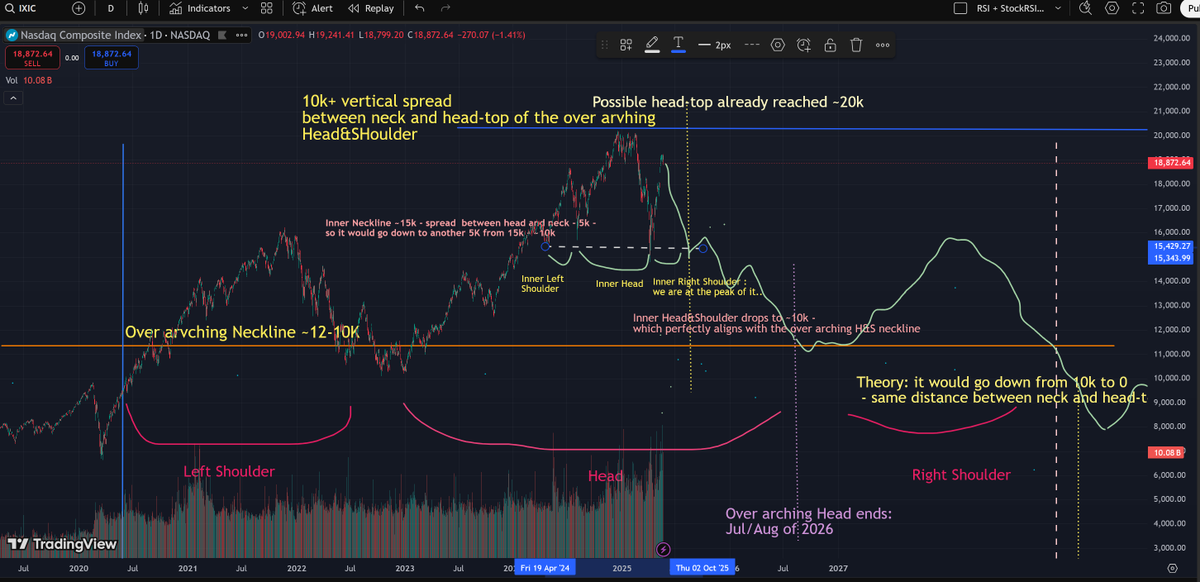
#strategymoksho #investing #StockMarket #Nasdaq #Bearish In my May17 post, I talked about #NASDAQ forming a multi-year #headandshoulder ( #HnS) #bear pattern: x.com/StrategyMoksho…. Here is further refinement and supporting patterns to that. Within the overarching (outer) head, another #headandshoulder is forming with neckline at ~15k and top aligning with the top of the over arching #hns pattern at ~20k.. vertical spread ~5k.. which means, this inner #hns #bearish pattern would take #Nasdaq down to 10k, where it meets the neckline of the over-arching #hns pattern... amazing #synchronicity.. isn't it... (off course it's not .. it's all #technicalanalysis .. just over a longer time frame). so around Jul/aug 2026, the overarching head would come down to the neck ~10k.. then it would start forming the right shoulder .. rising back to ~15-16k over the next year and then falling again back to ~10k by Aug 2028... which then completes the over arching multi-year #HnS pattern for #nasdaq... and begins the long bear phase which in theory, would take #NASDAQ100 back to near zero levels (same distance down from the neckline as is the distance between neckline and head top ,which is ~10k) during the period between 2028 -2030. what should be the #Strategy, especially for #RetailInvestor ? - play the level carefully to toggle between #investing in stocks vs gold based on your #market #riskappetite. #GoldPrice would rise every time the #StockMarket falls... and would fall when the right shoulder of the ovuter #hnS is formed. But except aug'26 to aug'27, rest of the next 5 years would be downward #StockMarket trend... so gold should be the primary choice... Refer to the chart for more calrity on the pattern and the levels. Question remains: does this pattern predction align with the #trends in #macroecomony and #Geopolitics ? My #Systems #thinking mind says yes... Further to this: #NVIDIA is forming a similar #HnS bearish pattern but it's ahead of #Nasdaq .. in fact, it has reached the top of the right shoulder already... so it's only downward from here ... baed on the neckline vs top analysis, I won't be surprised to see it touching 40s Q1 2026 before turning back... if and when the overall market supports the uptrend.. Disclaimer: All opinions in this and other posts are my personal opinion.. not a recommendation. Make careful investment decisions with proper analysis and risk considerations.
Arjo Basu tweet media
Arjo Basu@StrategyMoksho

NASDAQ is forming a multi-year H&S bearish pattern that can wipe out everything in tech. Left shoulder started 2020 with neckline ~10k; right now a double-top head is forming; 2nd head top ~20-22k b reached ~jul/aug'25. back to neckline mar/apr'26; r-shoulder top ~apr/may'27 back to~10k NASDAQ level by dec'27/jan'28... this brings and end 2 the long bullish trend that started around 2009/10. This would b followed by the long fall to very very low levels over 2028-2031. What's in it for 4 u(especially if u r a retail investor): Pundits have all understood it (via different formulas and calcs. of their own) and have started shifting away to other markets and asset classes with the idea that it's a lost decade. But everybody, especially retails investors, can't do that so easily; at the same time, u can't park your money 4% deposit/bond yield when inflation has gone up by 100+% over the last decade. But being aware and seeing big picture prepares and protects u. Book profits at the head top and right shoulder tops and don;t buy every deep; wait for deeps closer to neckline (~10-12k); use sector rotation strategy (refer: beyondmainstream.news/visualizing-ho…); at peaks, the gold would go down - so dump other stocks and buy gold ( in different forms - ETFs, streaming, royalty or miner company stocks etc.); when the troughs arrive, gold will go up - dump gold and buy the right stock sectors.. and keep looking for outside USA markets.. will share more on that soon.. remember, like everything else, market is also cyclical and it is symmetrical in shape. What can break this pattern and save the market: People see patterns after they have formed, but real value is in being able to foresee them forming. Market reacts to the same news bullishly vs bearishly and with varying degree of both depending on many other factors which are beyond it. But since 2020, it has violated most traditional rules and have evolved into something completely different; the doubling of daily NASDAQ volume since 2020 pandemic is a clear indication of that (more on it later). It does not react to individual company fundamentals as much as it reacts to macroeconomic, geopolitical or legal risks triggers. The newest tariffs have been such a trigger and perhaps accelerated this long term bearish pattern; it matches perfectly with the graphs symmetrical cyclical trends. In short, today, a lot depends on China's internal politics and how their leadership looks at this proposal of a new world order in juxtaposition to China's ambitions of becoming the world leader by 2039. Ironically, US has put itself in a corner and have given China the upper hand in deciding its own and world's economic future. Sad but true. We would only escape the stranglehold if China makes strategic mistakes at this very crucial junction in world politics and to its own future. Let's hope they do.

English
0
0
0
31