Aliaksei Papou | Superfluid Mechanical Universe

609 posts

Aliaksei Papou | Superfluid Mechanical Universe banner
Aliaksei Papou | Superfluid Mechanical Universe

Aliaksei Papou | Superfluid Mechanical Universe

@SuperfluidVoid

Rethinking modern physics. Superfluid Universe & Vortex Atom models. Dark matter as a shock wave. Fluid dynamics meet subatomic world. Preprints inside.👇

Earth. Discover more ➜ Katılım Temmuz 2023
1.3K Takip Edilen220 Takipçiler
Sabitlenmiş Tweet
Aliaksei Papou | Superfluid Mechanical Universe
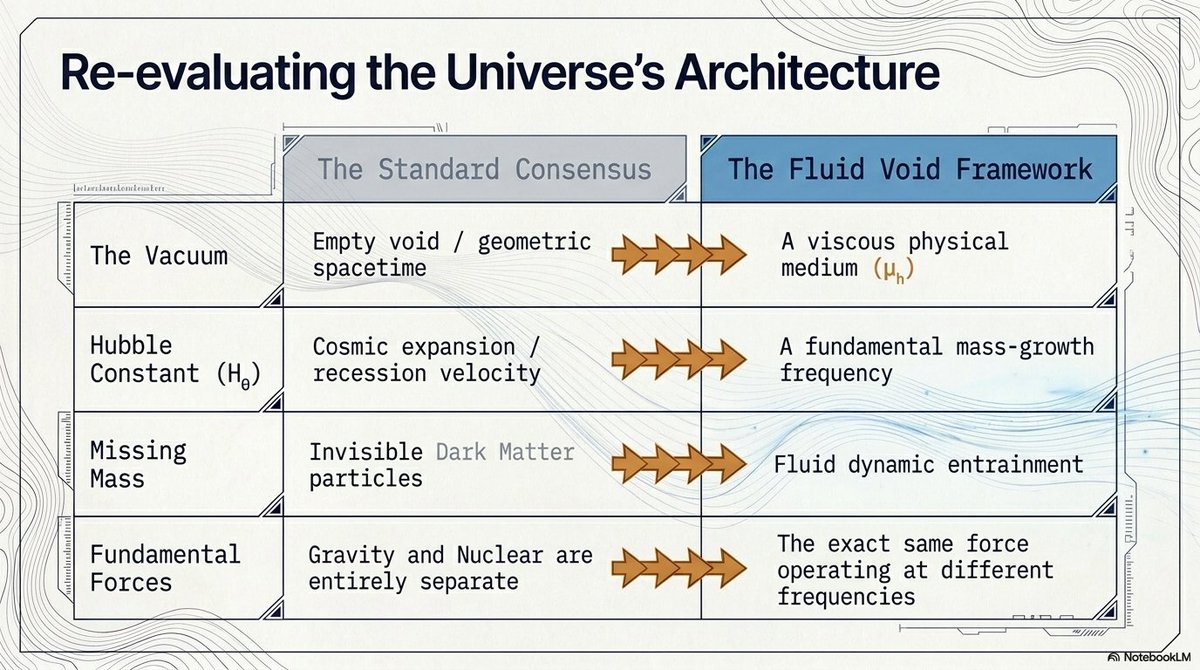
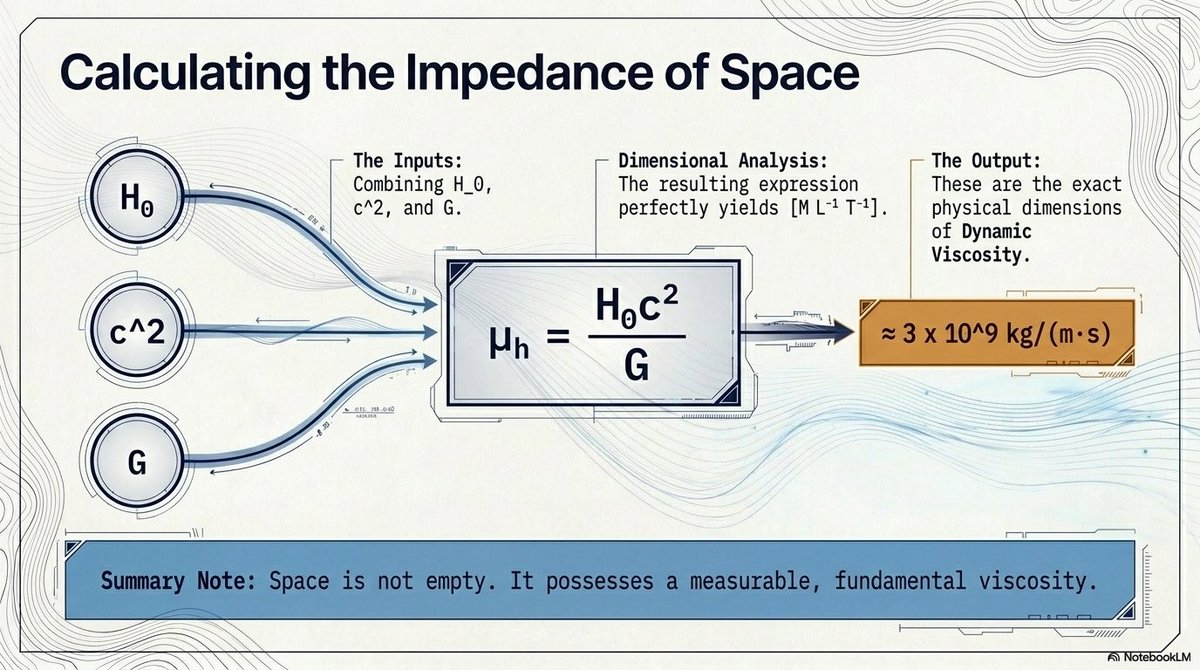
1/4 Imagine redefining physics by bridging the ultra-small with the ultra-large. What if we evolve classical Planck units by introducing the cosmic Hubble constant H_0? This creates a hybrid "Planck-Hubble" unit system that links quantum vacuum to the cosmos. 🚀 #Physics
English
1
0
0
86
Ethan Siegel
Ethan Siegel@StartsWithABang·
Did Hubble’s new “dark galaxy” kill modified gravity? Hundreds of millions of light-years away, a collection of four globular clusters was found orbiting... nothing. Is there a "dark galaxy" there, and if so, is modified gravity now dead? bigthink.com/starts-with-a-…
English
10
14
60
8.4K
Curt Jaimungal
Curt Jaimungal@TOEwithCurt·
Why do you think it is that the laws of nature seem to apply everywhere? That they don't exactly vary? This is a tricky statement of course because you could write down time(and space)-varying laws, but you would still be left with some mega sort of meta-law which itself applies everywhere. Also, my usage of the word "where" in everywhere implies something spatial, but I don't intend that. English doesn't seem adequate to capture what I intend, but I'm trusting you understand the spirit behind the text.
English
119
6
77
9K
The Scientific Lens
The Scientific Lens@LensScientific·
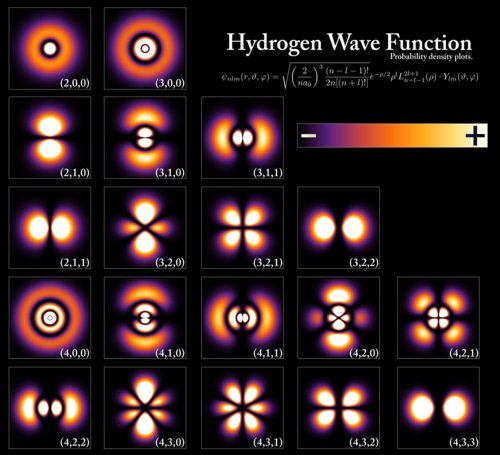
Wave functions of an electron in a hydrogen atom across different energy levels. Quantum mechanics cannot predict the exact location of an electron, only the probability of where it may appear. The brighter regions show where the electron is most likely to be found.
The Scientific Lens tweet media
English
4
29
93
3K
Aliaksei Papou | Superfluid Mechanical Universe
4/4 This framework opens up an amazing avenue: unifying long-range gravity with short-range nuclear forces via frequency-dependent Yukawa potentials. Gravity isn't isolated—it's dynamically modulated by cosmic expansion. Check out the full preprint! 📄👇
English
1
0
0
47
Aliaksei Papou | Superfluid Mechanical Universe
1/4 Imagine redefining physics by bridging the ultra-small with the ultra-large. What if we evolve classical Planck units by introducing the cosmic Hubble constant H_0? This creates a hybrid "Planck-Hubble" unit system that links quantum vacuum to the cosmos. 🚀 #Physics
English
1
0
0
86
Erika 
Erika @ExploreCosmos_·
Dark matter remains one of the central unresolved problems in cosmology. We see its gravitational influence in galaxy rotation curves, gravitational lensing, galaxy clusters, and the large-scale structure of the Universe, but we still do not know what it is made of. In the standard cosmological model, dark matter is usually treated as cold and collisionless: its particles move relatively slowly compared with light and pass through one another without interacting, except through gravity. That framework, Lambda Cold Dark Matter, works very well on large cosmic scales, but it can run into tension when we look at smaller, denser structures. A new idea focuses on self-interacting dark matter, or SIDM. In this model, dark matter particles do not simply ignore one another. They can collide, exchange energy, and gradually reshape the internal structure of dark matter halos. Under the right conditions, these interactions can trigger what is called gravothermal collapse, causing dark matter to contract into very dense, compact clumps. The study suggests that these clumps could have masses of roughly a million Suns and might explain several puzzling observations that standard cold dark matter has difficulty accounting for. What makes the proposal interesting is that the same mechanism could help explain three apparently separate astrophysical mysteries. The first involves the gravitational lens system JVAS B1938+666, where a distant galaxy is distorted into an Einstein-ring-like structure by the gravity of a foreground galaxy. Observations suggest there is an additional very dense object perturbing the lensing pattern, but its nature is not obvious. A compact clump of self-interacting dark matter could provide the required gravitational influence without needing to be a normal luminous object. The second case concerns the GD-1 stellar stream, a long stream of old, metal-poor stars in the Milky Way halo. GD-1 shows gaps and a spur, as if something massive and compact passed through it and disturbed the stream. This kind of feature can act like a fossil record of an invisible gravitational encounter. A dense SIDM clump could be the unseen perturber that carved those irregularities into the stream. The third case is Fornax 6, a globular cluster in the Fornax dwarf galaxy, one of the Milky Way’s satellite galaxies. Fornax has an unusually rich population of globular clusters for a dwarf galaxy, and Fornax 6 is especially interesting because it is more metal-rich and likely younger than the others. The study proposes that a dense dark matter clump could act as a gravitational trap, sweeping up passing stars and helping form or preserve such a compact stellar system. The broader implication is not that dark matter has been “solved,” but that self-interacting dark matter may offer a common explanation for small-scale structures that otherwise look unrelated: an anomaly in a distant gravitational lens, a scar in a Milky Way stellar stream, and an unusual star cluster in a nearby satellite galaxy. That is scientifically attractive because a good model should not only explain one isolated object after the fact; it should connect different phenomena through the same physical mechanism. Here, the proposed mechanism is the formation of dense, core-collapsed SIDM halos. Still, this remains a theoretical interpretation, not a direct detection of dark matter particles. The value of the work is that it makes self-interacting dark matter more testable: if such dense clumps exist, they should leave gravitational fingerprints in lensing systems, stellar streams, and satellite galaxies. Future observations could therefore strengthen or weaken the case. For now, the study adds to a growing argument that dark matter may not be completely passive and collisionless. It may have its own internal physics, and that hidden physics could be written into the structure of galaxies. 👉 share.google/gC0f1lgDyKdRA9…
Erika  tweet media
English
43
52
295
6.2K
Aliaksei Papou | Superfluid Mechanical Universe
@tayfunatlas Thermal equilibrium is what makes blackbody radiation possible! When an object is in equilibrium, it absorbs and emits energy at identical rates. This removes any dependency on the material's composition, locking the emission spectrum strictly to its temperature (via Planck's Law
English
1
0
1
34
Tayfun Atlas
Tayfun Atlas@tayfunatlas·
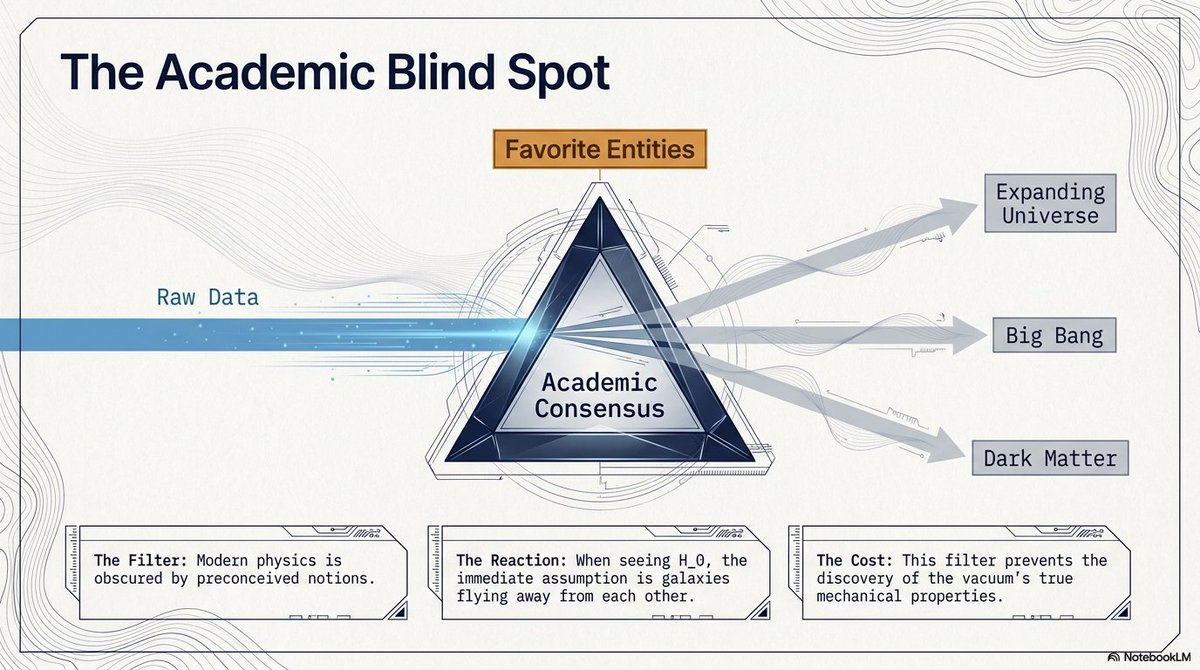
Although the idea that photons age/get tired seems very sympathetic in theory, it does not match the observations Aliaksei 😊 If there was a balance of CMB aged photons, we would not be able to see that perfect thermal spectrum (black body radiation); light would scatter and become blur. Also, this situation cannot explain the time expansion (i.e. the appearance of time flowing slowly) in distant supernovae. Physics continues to show us that space itself stretches 😌
English
1
0
0
20
Tayfun Atlas
Tayfun Atlas@tayfunatlas·
Unsolved Mysteries of the Universe That Keep Scientists Awake at Night 🌌❓ We’ve mapped galaxies and split atoms, but the cosmos still hides massive secrets. Here are 6 profound mysteries science hasn’t solved yet 🧵👇
Tayfun Atlas tweet media
English
1
0
4
93
steve hsu
steve hsu@hsu_steve·
This model has been specially trained for math/physics capability - achieves gold-medal performance on IMO and IPhO. It is based on Qwen3-30B-A3B, an MoE model with only 3B active parameters! 🦾
steve hsu tweet media
Ning Ding@stingning

We’re releasing a 30B-A3B reasoning model that reaches gold-medal level across both physics and math Olympiad evaluations: IPhO directly, and IMO/USAMO with test-time self-verification and refinement. A simple, unified scaling recipe for proof search. huggingface.co/papers/2605.13…

English
1
13
54
5.8K
Tayfun Atlas
Tayfun Atlas@tayfunatlas·
You made a great point Aliaksei, your gravitational redshift approach is theoretically very creative! 👏 However, things are changing a bit on a cosmic scale. If the universe were not just this effect, we wouldn’t be able to explain that ‘time expansion’ (i.e. explosions that look like slow motion) and that perfect structure of the CMB that we see in distant supernovae. Still, a very eye-opening perspective, thank you for your contribution! 🚀
English
1
0
0
19
Tayfun Atlas
Tayfun Atlas@tayfunatlas·
This idea was really discussed in the past under the name “tired light” 🙂 But today’s observations (especially supernovae and cosmic background radiation) more strongly support that the universe is indeed expanding. In the dark energy section, scientists still do not know the exact answer. This is the mysterious side of the incident anyway 🙂
English
1
0
0
29
Alex Boge
Alex Boge@alexboge·
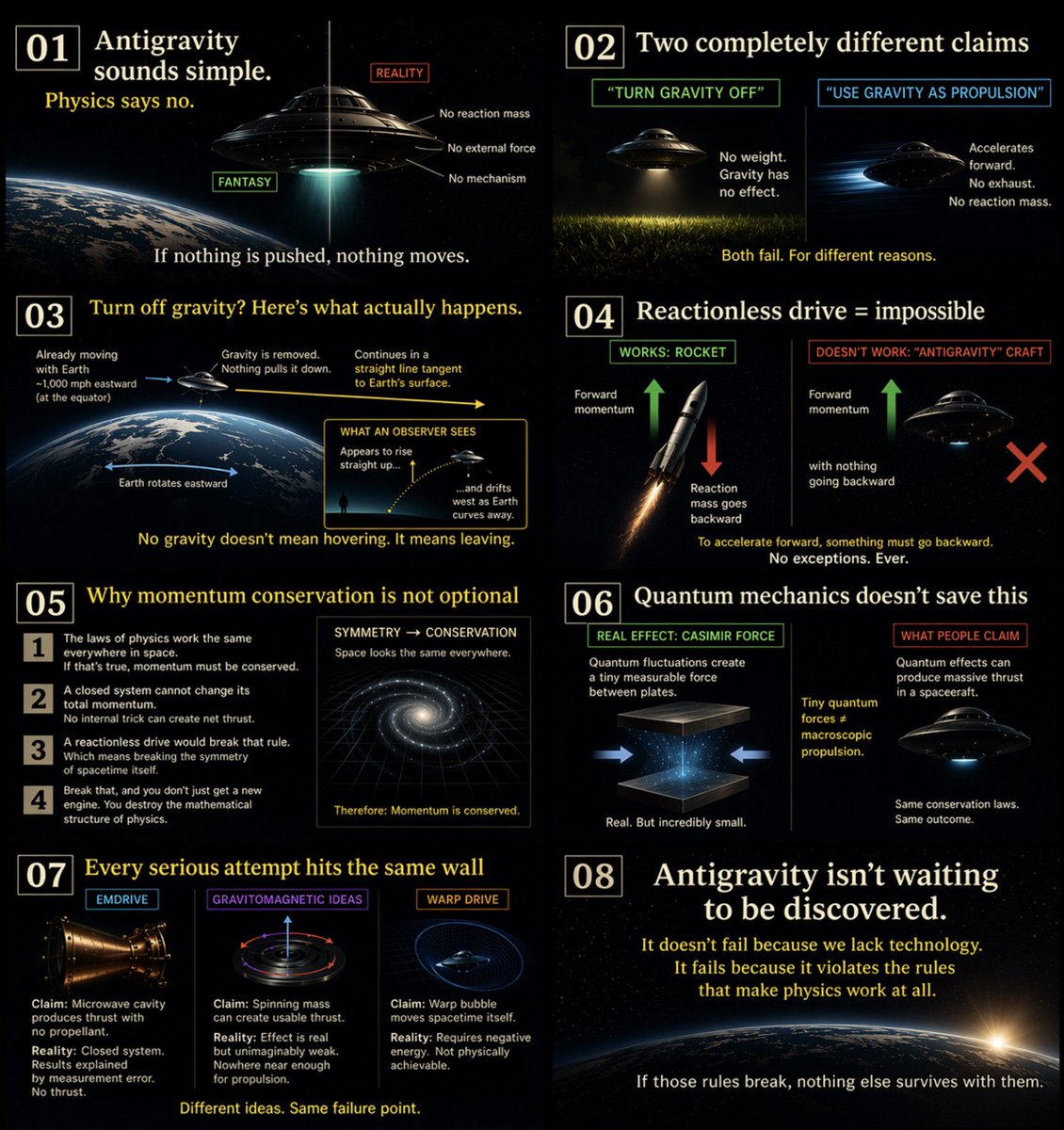
Anti-Gravity is a science fiction dream that can’t be fulfilled. TL;DR: This isn’t an engineering or math problem. It’s a “breaks the laws that make the universe work” problem. I already know the pushback this will get. Those flying orbs, “tic tacs”, and other various so-called UAP need lots of rule breaking to do what’s claimed - and A-G is the most common. For some people, ideas like “antigravity” propulsion and faster-than-light travel aren’t just interesting possibilities. They’re load-bearing assumptions. If those don’t work, a lot of other conclusions built on top of them don’t work either. That kind of dependency tends to produce very strong reactions, and not always for technical reasons. Don’t worry I won’t talk physics. And, before going further, a quick clarification: “antigravity” is an imprecise term. What most people mean by it isn’t literally canceling gravity. What they’re describing is a propulsion system that can lift, hover, and accelerate without expelling any reaction mass. In other words, a reactionless drive. That distinction matters, because the physics problems are different. And the one people actually care about most, the propulsion version, runs straight into the hardest limits we know. “Sure, that’s what physics says today. But what about the future?” Fair question. Science evolves. We don’t know everything. But this isn’t about missing a trick or needing better engineering. This is about breaking rules that everything else depends on. Reactionless propulsion doesn’t just require a clever breakthrough. It requires violating conservation of momentum. That’s not a niche assumption. That’s a consequence of spacetime symmetry, baked into every successful physical theory we have. If that breaks, you don’t just get advanced propulsion. You get a universe where the framework that predicts planetary motion, particle interactions, and energy transfer stops working. Could future physics revise our understanding? Of course. But “revision” in physics has always meant refining and extending existing laws, not casually discarding the ones that already explain reality with extreme accuracy. So yes, anything is possible in a philosophical sense. But some things would require so much of physics to be wrong that treating them as plausible today isn’t skepticism. It’s wishful thinking.
Alex Boge tweet media
English
36
8
64
2.5K
Tayfun Atlas
Tayfun Atlas@tayfunatlas·
Dark Energy The mysterious force causing the universe to expand faster and faster (~68% of the universe). We don’t know what it is or why it’s accelerating. It might be the biggest unsolved puzzle in modern cosmology.
Tayfun Atlas tweet media
English
2
0
2
31
Alex Boge
Alex Boge@alexboge·
That’s a fair point on quantum gravity - we don’t have a complete theory yet uniting QM and GR. But conservation of momentum isn’t derived from a specific quantum gravity mechanism; it’s a direct consequence of Noether’s theorem from the symmetry of spacetime under translations (the laws of physics are the same everywhere). This holds across classical mechanics, special relativity, quantum field theory, and even in GR with appropriate definitions (like using pseudotensors for energy-momentum). Every experiment we’ve ever run confirms it to insane precision. Lack of quantum gravity might let us tweak gravity or inertia in extreme regimes (e.g., near black holes or Planck scales), but it doesn’t open the door to a closed-system device casually violating momentum conservation here on Earth. That would break the predictive power of all our other theories in testable ways, not just ‘fill a gap.’ Reactionless drives would need something truly revolutionary - like interacting with a background field in a way that’s not closed-system or effectively expelling something (virtual particles, spacetime itself, etc.). Until there’s evidence or a working model, it’s still in the ‘extraordinary claims’ category.
English
2
0
1
18